
订单转化

Search documents
逾千家A股公司业绩预喜沪市首份年报出炉
Zhong Guo Zheng Quan Bao· 2026-02-02 20:45
Group 1 - The A-share annual report disclosure for 2025 has commenced, with Chip导科技 being the first to release its report, showing a revenue of 394 million yuan, an 11.52% year-on-year increase, and a net profit of 106 million yuan, a 4.91% decrease [1] -沃华医药 reported a revenue of approximately 817 million yuan, a 6.96% year-on-year increase, and a net profit of about 95.71 million yuan, a 162.93% year-on-year increase, focusing on proprietary Chinese medicine products [2] - 指南针 achieved a revenue of approximately 2.146 billion yuan, a 40.39% year-on-year increase, and a net profit of about 228 million yuan, an 118.74% year-on-year increase [2] Group 2 - A total of 3,056 A-share companies have disclosed their 2025 performance forecasts, with 1,095 companies expected to report positive results, indicating significant performance differentiation [3] - Among the companies, 678 are expected to achieve a net profit growth of over 10%, and 231 companies are projected to exceed 100% growth, with some companies like 宁波富邦 and 广东明珠 expecting over 1,000% growth [3] - 619 companies are expected to have a net profit exceeding 100 million yuan, with 136 companies projected to exceed 1 billion yuan, including major players like 紫金矿业 and 中国神华 [3] Group 3 - The non-ferrous metals, automotive, chemical, and semiconductor industries are showing signs of recovery, with leading companies performing exceptionally well [4] - In the non-ferrous metals sector, gold mining companies are particularly strong, with 西部黄金 expecting a net profit of 425 to 490 million yuan, a year-on-year increase of 46.78% to 69.23% [4] - The semiconductor industry is benefiting from high order volumes and capacity utilization rates, indicating a positive outlook for the sector [4] Group 4 - 芯原股份 reported a significant increase in new orders, with a total of 5.96 billion yuan in new orders for 2025, a 103.41% year-on-year increase, and a substantial backlog of orders expected to enhance future profitability [5] - The company noted that over 73% of its new orders are related to AI computing, with over 50% in data processing, indicating a strong focus on these growth areas [5] - Following the performance forecasts, many companies have attracted institutional research interest, focusing on order volumes, production progress, and industry trends [5] Group 5 - 东芯股份 indicated that niche memory product prices are rising due to supply constraints caused by industry cycles, leading to a positive operational outlook [6] - 中集集团 expects a significant decline in container manufacturing performance for 2025 due to high base effects from 2024, but maintains a long-term positive outlook on container demand linked to global trade growth [7]
华尔街点评甲骨文财报:看似超预期,实则利润“虚胖”,投资逻辑已从“看订单”转向“看兑现”
美股IPO· 2025-12-11 13:00
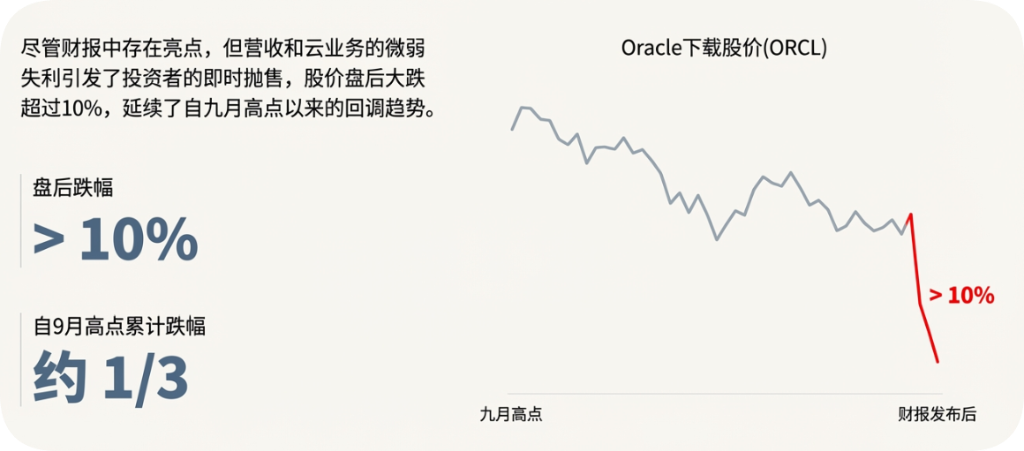
Core Viewpoint - Oracle's recent financial report has sparked significant discussion on Wall Street, highlighting a substantial reliance on non-recurring income to inflate profits, despite a record backlog of $523 billion in orders and a notable increase in non-GAAP EPS [1][3][8] Financial Performance - Oracle reported a non-GAAP EPS of $2.26, significantly exceeding market expectations of $1.65, primarily due to $2.7 billion in non-recurring income from the sale of its stake in Ampere [8] - The company's total revenue grew by 13% year-over-year, slightly below market expectations, with cloud infrastructure revenue at $4.079 billion, a 66% increase, but still below UBS's forecast of 68% growth [7][8] Order Backlog and Conversion Concerns - The order backlog reached a record high of $523 billion, with a $67.7 billion increase in the quarter, reflecting a year-over-year surge of 583% in implied order value, driven by AI-related purchases from major clients like Meta and Nvidia [6][8] - Despite the impressive order growth, concerns are rising regarding the conversion of these orders into sustainable revenue, with analysts noting a lack of confidence in the company's ability to translate order volume into profits [7][10] Capital Expenditure and Cash Flow - Oracle's capital expenditures soared to $12 billion, more than doubling year-over-year, leading to a negative free cash flow of -$10 billion [8][9] - The management has raised the capital expenditure target for FY2026 to $50 billion, which is 75% of the expected annual revenue, indicating a significant investment in AI infrastructure [8][9] Market Reactions and Analyst Ratings - Following the earnings report, Oracle's stock price fell over 10%, prompting several investment banks, including UBS and Morgan Stanley, to lower their target prices or reassess their ratings [5][10] - UBS maintained a "Buy" rating but reduced the target price from $380 to $325, while Bank of America also retained a "Buy" rating, lowering its target from $368 to $300 [10][11] Valuation and Future Outlook - The valuation logic for Oracle has shifted from a premium based on order potential to a discount reflecting conversion risks, with analysts emphasizing the need for clearer signals of revenue growth and improved profit margins [10][12] - Discrepancies in valuation perspectives stem from differing views on Oracle's potential for AI transformation, with some analysts optimistic about the long-term potential of the $523 billion backlog, while others call for more concrete evidence of profitability improvements [12][14]



华尔街点评甲骨文财报:看似超预期,实则利润“虚胖”,投资逻辑已从“看订单”转向“看兑现”
Hua Er Jie Jian Wen· 2025-12-11 08:58
Core Insights - Oracle's stock plummeted over 10% after the earnings report, prompting several investment banks to lower target prices or reassess their ratings [1] - Concerns have shifted from order growth to conversion efficiency, with a significant increase in RPO but doubts about sustainable profit generation [2][6] - The discrepancy between strong EPS and weak core profitability raises questions about the underlying business health [3][4] Financial Performance - Oracle reported a record RPO of $523 billion, with new orders increasing by $67.7 billion, driven by AI-related purchases from major companies like Meta and Nvidia [2] - Total revenue grew by 13% year-over-year, but cloud infrastructure revenue of $4.079 billion fell short of market expectations [2][3] - Non-GAAP EPS reached $2.26, significantly exceeding the expected $1.65, primarily due to $2.7 billion in non-recurring gains from the sale of Ampere shares [3] Capital Expenditure and Cash Flow - Capital expenditures surged to $12 billion, a 200% increase year-over-year, leading to negative free cash flow of -$10 billion [3][4] - Management raised the capital expenditure target for FY2026 to $50 billion, which is 75% of the expected annual revenue, indicating a mismatch between high investment and slow revenue conversion [3][4] Market Reactions and Valuation Adjustments - Investment banks have collectively downgraded target prices, reflecting a shift in valuation logic from premium based on order potential to discount due to realization risks [6][7] - UBS maintained a "Buy" rating but lowered the target price from $380 to $325, while Bank of America also retained its "Buy" rating with a target price cut from $368 to $300 [6][7] - Morgan Stanley has placed its rating and target price under review, expressing concerns over order conversion and margin trends [6][7] Future Outlook - UBS and Bank of America remain optimistic about the long-term potential of Oracle's $523 billion RPO, anticipating recovery as OCI growth accelerates [6][7] - Morgan Stanley emphasizes the need for clearer signals of revenue growth, stable margins, and positive cash flow to rebuild confidence in Oracle's AI business profitability [7]
Applied Industrial Technologies(AIT) - 2026 Q1 - Earnings Call Transcript
2025-10-28 15:02
Financial Data and Key Metrics Changes - The company reported a 9.2% increase in consolidated sales year-over-year, with acquisitions contributing 6.3 percentage points to growth, while organic sales growth was 3% [17] - EBITDA increased by 13.4% year-over-year, with EBITDA margins expanding to 12.2%, up 46 basis points from the previous year [21] - Earnings per share (EPS) rose 11.4% to $2.63, benefiting from a reduced share count due to buyback activity [21] Business Line Data and Key Metrics Changes - The service center segment saw organic sales growth of 4.4%, driven by internal initiatives and firming technical MRO demand [22] - The engineered solutions segment experienced a 19.4% increase in sales, primarily due to acquisitions, but organic sales decreased by 0.4% year-over-year [23] - Hydradyne's EBITDA contribution improved by over 20% sequentially, indicating strong progress in integration and synergy initiatives [14] Market Data and Key Metrics Changes - Year-over-year organic sales growth was reported at 3%, the strongest in two years, with 16 out of the top 30 markets showing positive sales growth [6] - Strongest growth was observed in machinery, food and beverage, refining, pulp and paper, metals, oil and gas, and aggregates, while declines were noted in lumber and wood, transportation, chemicals, mining, and utilities [6][7] - The company noted a stable to slightly positive underlying demand backdrop, with positive order momentum across various segments [10][30] Company Strategy and Development Direction - The company aims to leverage ongoing operational initiatives and structural mix tailwinds to achieve mid to high teen incremental annual margin targets [13] - M&A remains a top capital allocation priority, with an active pipeline of mid-sized targets across both segments [15] - The company is focused on enhancing its technical differentiation and value-added service capabilities through strategic acquisitions [15] Management's Comments on Operating Environment and Future Outlook - Management expressed optimism about the first quarter performance, highlighting stronger top-line trends and sustained positive order momentum [30] - The company anticipates that industrial activity will remain mixed in the near term, with expectations for order conversion to be more weighted toward the second half of fiscal 2026 [27][28] - Management noted that customer sentiment is gradually improving, with favorable demand signals across traditional and emerging markets [31] Other Important Information - The company ended the quarter with approximately $419 million in cash and a net leverage ratio of 0.3 times EBITDA, indicating a solid balance sheet position [25] - Free cash flow totaled $112 million, representing a conversion rate of 111% relative to net income [25] Q&A Session Summary Question: Insights on holiday shutdowns from customers - Management indicated it is still early to assess customer plans for holiday shutdowns, but some customers are expected to remain active [36] Question: Supplier pricing behavior - Management noted no significant changes in supplier behavior, with price increases being orderly and manageable [39][40] Question: Engineered solutions performance expectations - Management expects engineered solutions to potentially outperform service centers in the second half of fiscal 2026 due to order backlog conversions [44] Question: Order growth dynamics - Management explained that order growth is encouraging, but project conversion times vary based on complexity and scheduling [52] Question: Pricing expectations for the year - Management maintained a cautious outlook on pricing, indicating it may not ramp beyond the current 200 basis points without clearer market activity [55] Question: Capital allocation priorities - Management confirmed that organic growth opportunities and M&A remain top priorities, with a disciplined approach to acquisitions [63]
