云基础设施(OCI)

Search documents
华尔街点评甲骨文财报:看似超预期,实则利润“虚胖”,投资逻辑已从“看订单”转向“看兑现”
美股IPO· 2025-12-11 13:00
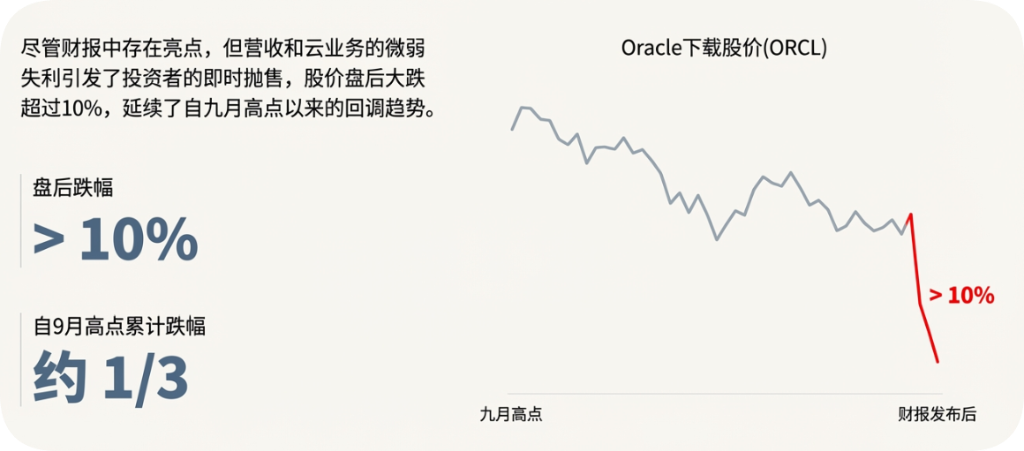
Core Viewpoint - Oracle's recent financial report has sparked significant discussion on Wall Street, highlighting a substantial reliance on non-recurring income to inflate profits, despite a record backlog of $523 billion in orders and a notable increase in non-GAAP EPS [1][3][8] Financial Performance - Oracle reported a non-GAAP EPS of $2.26, significantly exceeding market expectations of $1.65, primarily due to $2.7 billion in non-recurring income from the sale of its stake in Ampere [8] - The company's total revenue grew by 13% year-over-year, slightly below market expectations, with cloud infrastructure revenue at $4.079 billion, a 66% increase, but still below UBS's forecast of 68% growth [7][8] Order Backlog and Conversion Concerns - The order backlog reached a record high of $523 billion, with a $67.7 billion increase in the quarter, reflecting a year-over-year surge of 583% in implied order value, driven by AI-related purchases from major clients like Meta and Nvidia [6][8] - Despite the impressive order growth, concerns are rising regarding the conversion of these orders into sustainable revenue, with analysts noting a lack of confidence in the company's ability to translate order volume into profits [7][10] Capital Expenditure and Cash Flow - Oracle's capital expenditures soared to $12 billion, more than doubling year-over-year, leading to a negative free cash flow of -$10 billion [8][9] - The management has raised the capital expenditure target for FY2026 to $50 billion, which is 75% of the expected annual revenue, indicating a significant investment in AI infrastructure [8][9] Market Reactions and Analyst Ratings - Following the earnings report, Oracle's stock price fell over 10%, prompting several investment banks, including UBS and Morgan Stanley, to lower their target prices or reassess their ratings [5][10] - UBS maintained a "Buy" rating but reduced the target price from $380 to $325, while Bank of America also retained a "Buy" rating, lowering its target from $368 to $300 [10][11] Valuation and Future Outlook - The valuation logic for Oracle has shifted from a premium based on order potential to a discount reflecting conversion risks, with analysts emphasizing the need for clearer signals of revenue growth and improved profit margins [10][12] - Discrepancies in valuation perspectives stem from differing views on Oracle's potential for AI transformation, with some analysts optimistic about the long-term potential of the $523 billion backlog, while others call for more concrete evidence of profitability improvements [12][14]



华尔街点评甲骨文财报:看似超预期,实则利润“虚胖”,投资逻辑已从“看订单”转向“看兑现”
Hua Er Jie Jian Wen· 2025-12-11 08:58
Core Insights - Oracle's stock plummeted over 10% after the earnings report, prompting several investment banks to lower target prices or reassess their ratings [1] - Concerns have shifted from order growth to conversion efficiency, with a significant increase in RPO but doubts about sustainable profit generation [2][6] - The discrepancy between strong EPS and weak core profitability raises questions about the underlying business health [3][4] Financial Performance - Oracle reported a record RPO of $523 billion, with new orders increasing by $67.7 billion, driven by AI-related purchases from major companies like Meta and Nvidia [2] - Total revenue grew by 13% year-over-year, but cloud infrastructure revenue of $4.079 billion fell short of market expectations [2][3] - Non-GAAP EPS reached $2.26, significantly exceeding the expected $1.65, primarily due to $2.7 billion in non-recurring gains from the sale of Ampere shares [3] Capital Expenditure and Cash Flow - Capital expenditures surged to $12 billion, a 200% increase year-over-year, leading to negative free cash flow of -$10 billion [3][4] - Management raised the capital expenditure target for FY2026 to $50 billion, which is 75% of the expected annual revenue, indicating a mismatch between high investment and slow revenue conversion [3][4] Market Reactions and Valuation Adjustments - Investment banks have collectively downgraded target prices, reflecting a shift in valuation logic from premium based on order potential to discount due to realization risks [6][7] - UBS maintained a "Buy" rating but lowered the target price from $380 to $325, while Bank of America also retained its "Buy" rating with a target price cut from $368 to $300 [6][7] - Morgan Stanley has placed its rating and target price under review, expressing concerns over order conversion and margin trends [6][7] Future Outlook - UBS and Bank of America remain optimistic about the long-term potential of Oracle's $523 billion RPO, anticipating recovery as OCI growth accelerates [6][7] - Morgan Stanley emphasizes the need for clearer signals of revenue growth, stable margins, and positive cash flow to rebuild confidence in Oracle's AI business profitability [7]
甲骨文2026财年第二季度电话会全文
美股IPO· 2025-12-11 00:34
Core Insights - Oracle Corporation reported a strong performance in Q2 of FY2026, with Remaining Performance Obligations (RPO) reaching $52.33 billion, a 433% year-over-year increase, driven by large contracts with companies like Meta and Nvidia [2][5][6] - Total cloud revenue reached $8 billion, growing by 33%, with Cloud Infrastructure (OCI) being the main growth driver, increasing by 66% to $4.1 billion, and GPU-related revenue surging by 177% [2][5][6] - The company is confident in executing its business backlog and maintaining an investment-grade debt rating, with capital expenditures expected to increase by approximately $15 billion to support accelerated business growth [2][5][9] Financial Performance Review and Outlook - The company reported a total revenue of $16.1 billion, a 13% increase year-over-year, with operating profit rising by 8% to $6.7 billion [6][8] - Non-GAAP earnings per share were $2.26, up 51%, while GAAP earnings per share were $2.10, reflecting an 86% increase [6][8] - The company anticipates that IPOs will account for 40% of revenue in the next 12 months, up from 25% in the previous year [5][6] Cloud Infrastructure (OCI) Growth - OCI's revenue growth accelerated by 66%, with significant demand for AI infrastructure, including the deployment of Nvidia GPUs [10][12] - The company operates 147 customer-facing real-time regions and plans to add 64 more, with a focus on delivering high-capacity data centers [10][12] - OCI's market consumption grew by 80%, supported by partnerships with companies like Broadcom and Palo Alto [13][15] AI Data Platform and Application Strategy - Oracle has developed the Oracle AI database and AI data platform to enable multi-step reasoning on private enterprise data while ensuring data privacy and security [16][17] - The AI data platform integrates various AI models, allowing for comprehensive data access and analysis across different databases and applications [17][18] - The company is focused on leveraging AI to enhance its applications, with significant growth in sectors like healthcare, where AI-driven solutions are being implemented [20][21] Application Business Performance and Sales Synergy - Total application revenue grew by 11%, with strong performance in core applications like Fusion ERP, SCM, and HCM, which saw growth rates of 17%, 18%, and 14% respectively [19][21] - The integration of industry application sales with core application sales teams has led to increased strategic conversations and larger transactions [21][22] - The company has successfully migrated 330 customers to the cloud, demonstrating robust demand for its application solutions [25][26]

甲骨文,股价暴跌
财联社· 2025-12-11 00:24
Core Viewpoint - Oracle's stock price experienced a significant drop of over 10% following the release of mixed Q2 earnings, raising concerns among investors about the company's heavy investments in AI projects and the associated risks and returns [1][2]. Financial Performance - For the second fiscal quarter ending in November, Oracle reported an adjusted earnings per share of $2.26, a 54% increase year-over-year, surpassing analyst expectations of $1.64 [3]. - Revenue grew by 14% year-over-year to $16.1 billion, slightly below the anticipated $16.2 billion [3]. Cloud Infrastructure Growth - Oracle's cloud infrastructure revenue surged by 68% to $4.1 billion, accelerating from previous growth rates of 55% and 52% in the prior two quarters [4]. - This growth positions Oracle as a strong competitor against major players like Amazon, Microsoft, and Alphabet in the AI sector [4]. Contract Backlog - The company's remaining performance obligations (RPO) increased by 438% year-over-year to $523 billion, exceeding analyst expectations of $502 billion and growing 15% from the previous quarter [5][6]. - This substantial RPO growth is attributed to new commitments from clients such as Meta and NVIDIA [6]. Investor Concerns - Despite strong demand indicated by the earnings report, investors remain worried about the high costs associated with fulfilling these contracts and Oracle's reliance on OpenAI as a major client [6]. - The company's five-year credit default swap (CDS) rates have risen to their highest levels since 2009, reflecting declining investor confidence in Oracle's credit quality [7].

甲骨文的AI大饼不香了? 市场疑虑资金缺口
Huan Qiu Wang· 2025-10-20 05:11
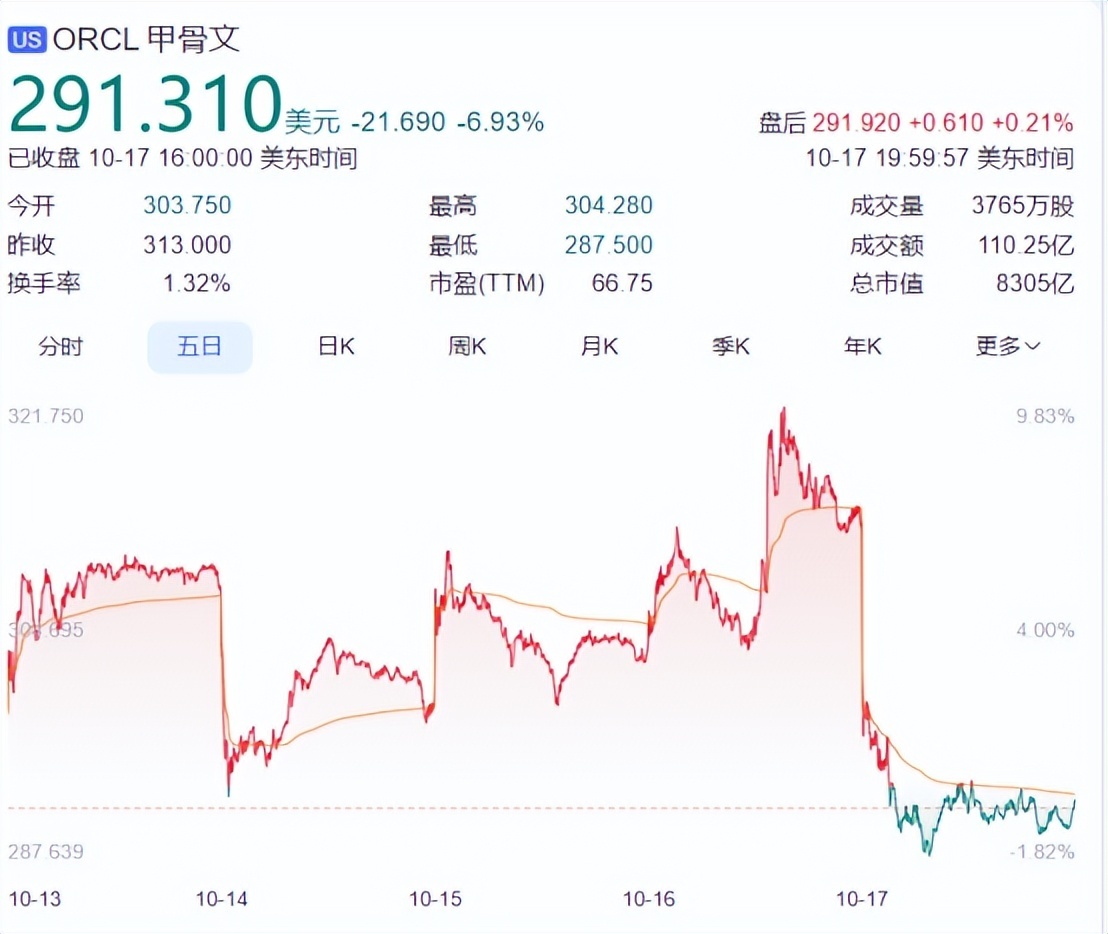
Core Viewpoint - Oracle raised its long-term performance guidance significantly at the AI World Conference in Las Vegas, projecting revenues of $225 billion and adjusted earnings per share of $21 by fiscal year 2030, but the market reacted negatively, with the stock price dropping nearly 7% the following day, marking its worst single-day performance since January [1] Group 1: Financial Projections - Oracle's AI infrastructure business is expected to achieve a gross margin of 30% to 40% by 2030, addressing previous concerns about the profitability of its GPU leasing business, which had a gross margin of around 16% [3] - The company increased its fiscal year 2030 cloud infrastructure (OCI) revenue forecast from $144 billion to $166 billion, indicating a compound annual growth rate (CAGR) of 75% for its OCI business [3] - Oracle's backlog reached $455 billion at the end of the first fiscal quarter, with an additional $65 billion in new OCI contracts signed in the past 30 days, bringing its remaining performance obligations (RPO) to over $500 billion [3] Group 2: Market Concerns - Analysts from Deutsche Bank and Jefferies raised concerns about the substantial capital required to achieve such aggressive growth targets, noting that Oracle did not disclose its capital expenditure forecasts, leading to doubts about meeting AI demand costs [3] - Consensus forecasts from Visible Alpha suggest that Oracle will experience negative free cash flow over the next three fiscal years, with cumulative cash consumption nearing $29 billion by the end of fiscal year 2028 [3] - Morgan Stanley's debt analysts pointed out that Oracle's recent issuance of $18 billion in bonds would only cover about a quarter of its cash needs until 2028 [3] Group 3: Historical Performance - Oracle's long-term goal requires a compound annual growth rate of slightly over 30% in revenue over the next five years, a target the company has not achieved since the 1990s [4] - Analysts from JPMorgan highlighted that software companies historically struggle to meet 4-5 year guidance frameworks, raising further skepticism about Oracle's ambitious AI narrative [4] - Despite Oracle's long history and experience through various industry cycles, uncertainties regarding capacity ramp-up, profitability realization, and significant capital expenditures pose challenges to the company's ambitious growth plans [4]
9.16犀牛财经早报:上半年非货币基金保有规模首破10万亿 部分民营银行大额存单利率超2%
Xi Niu Cai Jing· 2025-09-16 01:51
Group 1: Fund Distribution and Sales Fee Reform - The China Securities Regulatory Commission has solicited opinions on the draft regulations for managing sales fees of publicly offered securities investment funds, which may impact commercial banks' role in fund distribution [1] - Banks are expected to prefer large fund managers and equity funds that demonstrate stable performance and sound management due to the focus on personal customer service and encouragement of long-term investment in the draft [1] - The reform aims to enhance banks' professional service capabilities and promote the healthy development of the public fund industry [1] Group 2: Fund Sales Performance - In the first half of 2025, the total scale of non-monetary funds held by the top 100 fund distribution institutions exceeded 10 trillion yuan, reaching 10.2 trillion yuan, a 6.95% increase from the previous half [1] - The combined scale of equity funds held by these institutions was 5.14 trillion yuan, reflecting a 5.89% quarter-on-quarter growth [1] - Ant Group continues to lead in equity fund holdings, with significant growth in non-monetary funds and stock index funds, while major brokerages dominate the index product sector [1] Group 3: Interest Rates on Large Deposits - Several private banks have launched large-denomination certificates of deposit with interest rates exceeding 2%, contrasting with state-owned and joint-stock banks where rates are generally in the "1" range [2] - These high-rate products are often limited in availability and sell out quickly, indicating a strategy for customer acquisition by private banks [2] - Industry insiders suggest that this approach is a temporary measure and may not be sustainable in the long term [2] Group 4: New Energy Vehicle Insurance - The high growth and high claims phenomenon in new energy vehicle insurance is changing, with leading insurers moving towards profitability while improving the claims ratio [2] - The new energy vehicle insurance market is expected to remain a key growth area for the auto insurance sector, although achieving overall profitability will take time [2] Group 5: AI Chip Market Dynamics - Domestic chip manufacturers are seizing the market opportunity created by the instability of Nvidia's chip supply, with significant investments from companies like Alibaba and Baidu [2] - The development prospects for domestic AI inference chips are considered promising, although ongoing efforts in ecosystem development are necessary [2] Group 6: Cloud Infrastructure and AI Demand - Oracle's recent performance, highlighted by a 359% year-on-year increase in remaining performance obligations (RPO) to $455 billion, signals strong demand for AI inference computing [3] - Nearly 60% of this growth is attributed to a $300 billion contract with OpenAI, indicating a clear signal of the industry's need for computing power [3] - The substantial order enhances confidence across the industry to invest in AI and cloud sectors [3] Group 7: Construction Industry Performance - The construction sector experienced a decline in revenue and net profit in the first half of 2025, with revenues down 5.66% and net profits down 8.89% year-on-year [4] - Despite the downturn, many institutions are optimistic about potential recovery opportunities in the second half of the year [4] Group 8: Tencent's Bond Issuance - Tencent is promoting its first bond issuance in four years, seeking to issue offshore RMB-denominated notes with maturities of 5, 10, and 30 years at initial guidance rates of 2.6%, 3%, and 3.6% respectively [4] Group 9: AI Chip Efficiency - A new optical chip developed by American scientists can perform AI tasks with energy efficiency improvements of 10 to 100 times compared to traditional chips, potentially alleviating the high energy demands of AI applications [4] Group 10: Financial Transactions and Corporate Actions - Yunfeng Financial plans to issue 1.91 billion new shares at a price of HKD 6.1 per share, aiming to raise approximately HKD 11.7 billion [5] - Dongcheng Pharmaceutical is planning to spin off its subsidiary for a public listing in Hong Kong, with no substantial legal obstacles identified [6] - The company Biyuan Quantum has initiated IPO counseling for its A-share listing, focusing on quantum computing technology [7] - United Precision intends to acquire a 51% stake in Chengdu Mite Aviation Manufacturing for no more than 380 million yuan, aiming to expand its presence in the aerospace defense sector [8]
湘财证券晨会纪要-20250915
Xiangcai Securities· 2025-09-15 04:07
Macro Strategy - Recent macro data includes import and export figures, CPI, PPI, and M1, M2 statistics. In August, exports showed a year-on-year growth of 4.40%, down from 7.20% in July, but cumulative growth for the first eight months remained around 5.90%, slightly above market expectations [3][4] - August CPI was -0.40%, slightly below expectations, while PPI was -2.90%, showing a narrowing decline compared to July's -3.60%. The cumulative PPI for the first eight months remained at -2.90% [3] - M1 growth in August was 6.0%, indicating a recovery in corporate deposits, while M0 and M2 growth rates remained stable compared to July [4] A-Share Market Overview - From September 8 to September 12, 2025, all six A-share indices observed upward movement, with the Shanghai Composite Index rising by 1.52% and the Shenzhen Component Index by 2.65% [6] - The market is currently in a "slow bull" phase, with expectations for continued wide fluctuations and gradual increases in September [6][8] - The electronics and real estate sectors led the weekly gains, with increases of 6.15% and 5.98%, respectively, while the banking sector saw declines of -0.66% [6][7] Industry Performance - In the electronics sector, Oracle announced a new order for 300 billion computing power, indicating sustained high demand globally. The sector saw a weekly decline of 4.57% [16] - The semiconductor and component sectors reported gains of 6.52% and 11.33%, respectively, while the consumer electronics sector rose by 5.17% [16] - The valuation metrics for the electronics sector showed a PE ratio of 61.40X and a PB ratio of 4.90X, indicating a significant increase compared to previous periods [17] Investment Recommendations - The current market environment suggests a "slow bull" trend supported by new policies and investment strategies. The focus should be on technology, green initiatives, and high-tech consumer services [8] - Specific investment opportunities include AI infrastructure, edge SOC, and the supply chain for foldable smartphones, with recommended companies such as Cambrian, Chipone, and Rockchip [18]
新工业周报:AI算力外溢催化云基建爆发,美国太空发展局通过SpaceX发射首批作战卫星-20250912
Haitong Securities International· 2025-09-12 13:32
Investment Rating - The report suggests a positive investment outlook for the nuclear power sector, particularly in relation to AI energy consumption, highlighting companies such as Entergy, Talen Energy, and Constellation Energy as key players [5]. Core Insights - The demand for AI computing is driving a significant boom in cloud infrastructure, benefiting service providers directly [9]. - The U.S. energy market is experiencing dynamic changes, with Conduit Power providing bridging power for ENGIE's battery sites in Texas and Google collaborating on long-duration energy storage projects [9]. - The report emphasizes the strong long-term demand for infrastructure construction in the U.S., particularly in the context of industrial resurgence and AI data center development [5]. Global Infrastructure and Construction Equipment - The explosive demand for AI computing is leading to increased reliance on cloud infrastructure services, with Oracle reporting a 54% year-on-year increase in cloud infrastructure revenue [9]. - Major cloud service providers are becoming critical in handling the overflow of AI workloads due to their flexible supply capabilities [9]. Global Electrical and Intelligent Equipment - The gas turbine price index in the U.S. increased by 4.43% year-on-year and 3.8% month-on-month as of July 2025, indicating a stable competitive landscape [11]. - The U.S. electricity demand forecast has been revised upwards, with expectations of a 15.8% increase by 2029, driven by industrial resurgence and AI data center growth [19][20]. Global Energy Industry - The NYMEX natural gas futures price was reported at $3.10 per million British thermal units, reflecting a week-on-week increase of 3.6% [3]. - The report highlights the expected balance in the natural gas market supply and demand as the global energy transition progresses [5]. Global New Materials - The report notes a 6% month-on-month increase in the global uranium spot price, indicating ongoing interest in nuclear energy as a stable power source for AI data centers [4]. Global Defense and Aerospace - The report suggests that the recovery of the aerospace industry and increased defense spending will benefit companies like BAE Systems and Raytheon Technologies [6]. Key Company Insights and Commentary - GE Vernova is investing significantly in expanding its generator manufacturing capacity to meet growing global electricity demand [39]. - Siemens Energy is also expanding its transformer manufacturing capabilities in response to the increasing global demand for energy transition solutions [39]. - The report highlights the collaboration between various companies in the nuclear sector, including KHNP and Centrus, to enhance low-enriched uranium supply and explore potential investments in the U.S. [44].


巨额订单风险重重?质疑声四起,甲骨文股价从历史高点回调逾6%
Feng Huang Wang· 2025-09-12 02:44
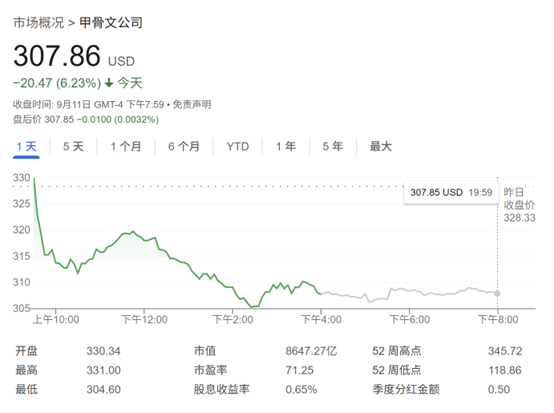
Core Insights - Oracle's stock price fell over 6% after reaching a record high, with analysts raising concerns about the company's reliance on a single client, OpenAI, for future growth [1][3] - Oracle reported a significant increase in remaining performance obligations (RPO) to $455 billion, a 359% year-over-year growth, with $317 billion added in the first quarter alone [1][2] - The company anticipates cloud infrastructure revenue to grow 14 times by 2030, driven by its competitive position in the AI computing market [1] Financial Performance - Oracle's first-quarter earnings report revealed a surge in future contract revenue, with a notable contract with OpenAI valued at $300 billion over five years, starting in 2027 [2][3] - The recent quarterly report indicated that nearly 95% of the new future contract revenue was attributed to the OpenAI deal [2] Market Reaction - Following the earnings announcement, Oracle's stock rose by 30% in after-hours trading and nearly 36% the following day, reaching a closing price of $328.33 [1] - However, after the concerns regarding customer concentration emerged, Oracle's stock price dropped to $307.86, a decrease of 6.23% [3][4] Analyst Concerns - Analysts expressed skepticism about Oracle's order backlog, highlighting risks related to customer concentration and the potential delay in revenue recognition [3] - Morgan Stanley estimated that only about 10% of the $455 billion RPO would be recognized as revenue within the next 12 months, raising questions about the sustainability of Oracle's growth [3]
巨额订单风险重重?甲骨文股价大跌6%
财联社· 2025-09-12 01:39
Core Viewpoint - Oracle's stock price experienced a significant drop of over 6% after reaching a historical high, primarily due to concerns about its reliance on a single client, OpenAI, for future growth [1][4]. Financial Performance - Oracle reported a remarkable increase in its Remaining Performance Obligations (RPO), which surged to $455 billion, reflecting a year-on-year growth of 359%. In the first quarter alone, the company added $317 billion to its RPO [1]. - The CEO of Oracle, Safra Catz, indicated that the backlog of orders is expected to exceed $500 billion in the coming months due to multiple large contracts signed with different clients [1]. Market Dynamics - Oracle forecasts that its cloud infrastructure revenue will grow 14 times by 2030, positioning itself strongly in the competitive AI computing market against giants like Amazon, Microsoft, and Alphabet's Google [2]. - The company has partnered with NVIDIA to deploy large-scale GPU clusters in its cloud infrastructure, enhancing its capabilities for AI model training and inference [2]. Stock Market Reaction - Following the earnings announcement, Oracle's stock price surged by 30% in after-hours trading and closed nearly 36% higher at $328.33, marking a record high [3]. - However, reports of a $300 billion contract with OpenAI, which accounts for nearly 95% of Oracle's new future contract revenue in the first quarter, raised concerns about customer concentration risk [3][5]. Analyst Concerns - Analysts have expressed skepticism regarding Oracle's heavy reliance on OpenAI for its order backlog, which could pose risks to the company's revenue stability [4][5]. - Concerns were raised about the low profit margins associated with AI model training contracts and whether Oracle has sufficient resources to support the massive infrastructure needed for these orders [5]. - Morgan Stanley estimated that only about 10% of the $455 billion RPO would be recognized as revenue within the next 12 months, highlighting the long-term nature of these contracts [5].