
GenAI智能手机

Search documents
Counterpoint Research:预计全球智能手机平均售价将从2025年的370美元升至2029年的412美元
智通财经网· 2025-09-26 01:33
Core Insights - The global smartphone market's Average Selling Price (ASP) is projected to increase from $357 in 2024 to $370 in 2025, reaching $412 by 2029, with a CAGR of 3% driven by high-end trends and 5G adoption [1][4][10] - Smartphone shipments are expected to grow by 2.5% year-on-year in 2025, up from a previous forecast of 1.9%, but lower than the initial estimate of 4% due to price increases, supply chain adjustments, and macroeconomic pressures [1][4] - The combined effect of rising ASP and shipment growth is anticipated to drive smartphone revenue to increase by nearly 6% year-on-year in 2025, with a long-term revenue CAGR of 5% from 2025 to 2029, reaching $564 billion by 2029 [1][4] ASP Trends - North America's ASP is expected to rise by 7% year-on-year in 2025, driven by high-end models and ongoing promotions, with projections for ASP to reach $984 by 2026 [5][6] - In China, the ASP growth forecast for 2025 has been slightly revised down to 3.6%, influenced by Huawei, OPPO, and vivo, while Apple's ASP is expected to increase by about 2% [5][6] - India's ASP is projected to remain below $250 in 2025 but is expected to rise to $287 by 2029 due to the ongoing high-end trend [6] Brand Performance - Apple is expected to maintain its high-end market position, with ASP rising from $919 in 2025 to nearly $1,000 by 2029, despite a 9% year-on-year decline in Q1 2025 due to the introduction of the iPhone 16e [6][9] - Samsung's ASP is anticipated to remain stable, with flagship models impacting overall ASP but supported by foldable phones and GenAI integration for long-term growth [9] - Huawei is strengthening its ASP growth in China, driven by its Mate and Pura series, with expectations for overseas market expansion [9] Market Dynamics - The smartphone market is gradually normalizing after years of volatility due to pandemic demand fluctuations and supply chain challenges, with expectations for a more stable market environment by late 2025 to 2026 [4][10] - The introduction of GenAI smartphones is expected to increase the Bill of Materials (BoM) cost by $40-$60 per device, shifting ASP growth from cost-driven to value-driven as consumers are willing to pay a premium for AI-centric devices [9][10] - Foldable smartphones, although currently representing less than 2% of global shipments, are expected to influence consumer perceptions of high-end products, with Apple planning to launch its foldable model by the end of 2026 [10]


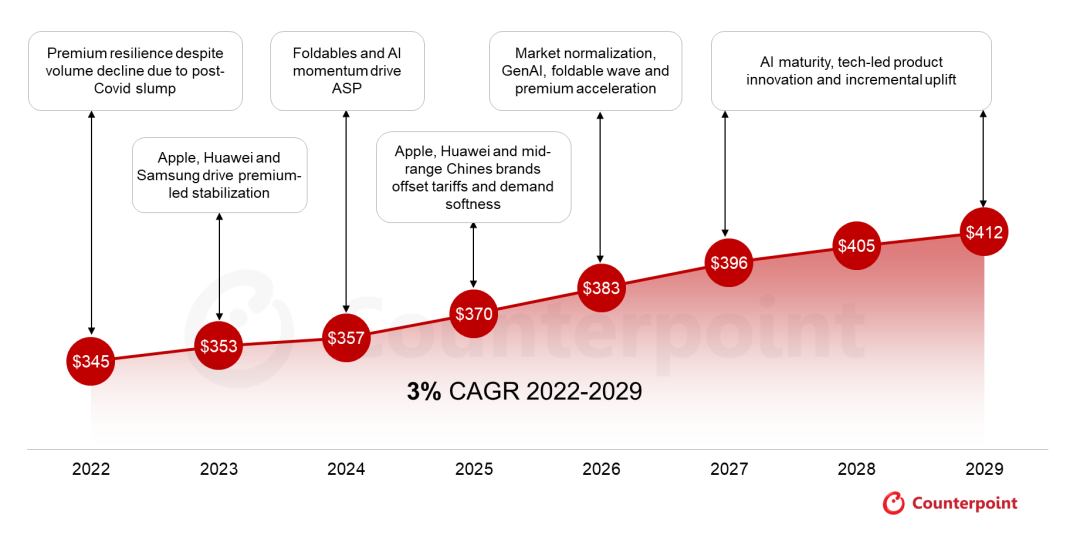
全球智能手机平均售价将从2025年的370美元升至2029年的412美元
Counterpoint Research· 2025-09-26 01:02
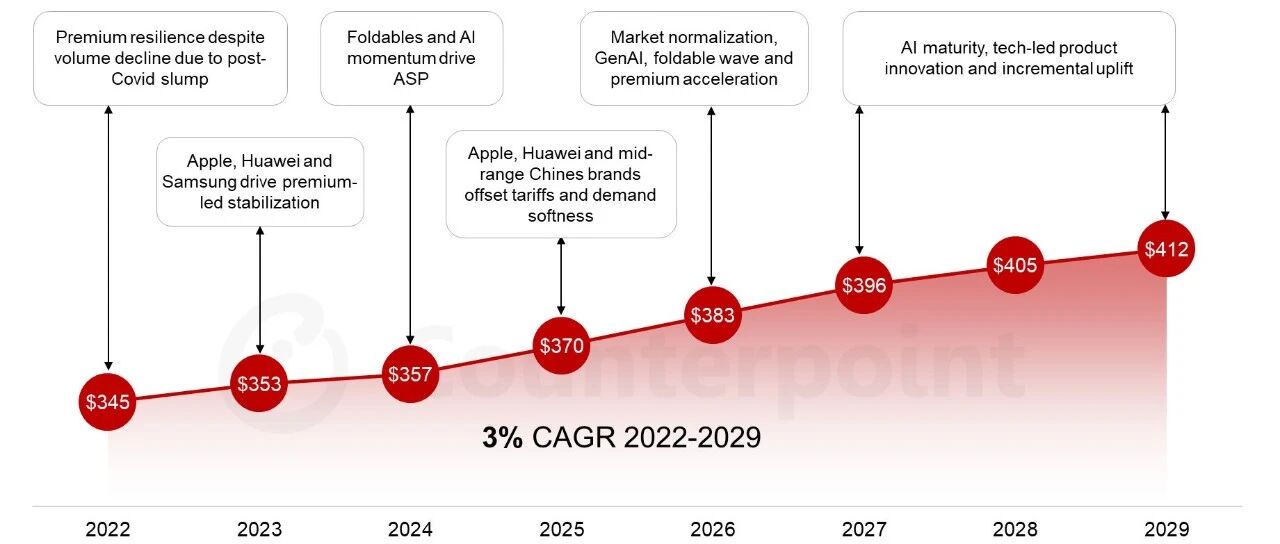
Core Viewpoint - The global smartphone average selling price (ASP) is projected to increase from $370 in 2025 to $412 in 2029, with a compound annual growth rate (CAGR) of 3% driven by high-end trends and the adoption of 5G technology [4][6][10]. Market Trends - The global smartphone market is expected to see a 2.5% year-on-year growth in shipments in 2025, an increase from the previous forecast of 1.9% [6]. - The ASP is anticipated to rise by 3.5% to $370 in 2025, influenced by price increases in North America and economic recovery in India and other Asia-Pacific regions [6][10]. - Smartphone revenue is projected to grow nearly 6% year-on-year in 2025, with a long-term CAGR of 5% from 2025 to 2029, reaching $564 billion by 2029 [10]. Regional Insights - In North America, the ASP is expected to grow by 7% year-on-year, while in China, it is projected to increase by 3.6%, primarily driven by high-end models [10][11]. - India’s ASP is expected to remain below $250 in 2025 but will gradually rise to $287 by 2029 due to the high-end trend [12]. Brand Performance - Apple is projected to maintain its position as a leader in high-end smartphone ASP, with an expected increase from $919 in 2025 to nearly $1000 by 2029 [10][12]. - Samsung's ASP is expected to remain stable, with flagship models impacting overall ASP but supported by foldable phones and GenAI integration [14]. - Huawei is strengthening its ASP growth in China, driven by its Mate and Pura series, as well as foldable phones [14]. Technology Impact - The introduction of GenAI smartphones is expected to increase the bill of materials (BoM) cost by $40-60 per device, initially raising prices but transitioning to value-driven ASP growth as AI features become more integrated [14][15]. - Foldable smartphones, although currently representing less than 2% of global shipments, are anticipated to elevate consumer perceptions of high-end products [15]. Conclusion - The global smartphone ASP outlook is optimistic, with stabilizing supply chains and diminishing tariff impacts, alongside the proliferation of high-end smartphones, GenAI, and foldable innovations driving gradual ASP increases [15].
一切硬件皆有AI,这样的时代正在奔来
Di Yi Cai Jing· 2025-08-27 10:39
Group 1 - The core viewpoint of the articles is that the Chinese government has initiated a push towards the integration of artificial intelligence (AI) into various hardware sectors, aiming for over 70% of terminal devices to achieve smart upgrades within the next two years [1][2][3] - The "AI+" action plan outlines a clear timeline for the proliferation of new generation smart terminals, with expectations of over 90% adoption by 2030 and a complete transition to an intelligent economy by 2035 [1][2] - The AI transformation is expected to redefine human-computer interaction and reconstruct product value logic and industry ecosystems [1][3] Group 2 - The PC industry is experiencing a revival driven by AI, with IDC forecasting a global PC shipment of 262.7 million units in 2024, marking a 1% year-on-year growth, the first increase in three years [4] - Lenovo's AI PC sales have already reached one-third of total PC sales, surpassing previous expectations, indicating strong user engagement with AI features [4][5] - The smartphone sector is witnessing significant changes as AI redefines interaction methods and reshapes the industry ecosystem, with AI capabilities becoming standard in high-end devices [5][6] Group 3 - The integration of AI in household appliances is becoming mainstream, with traditional appliances like refrigerators and washing machines undergoing upgrades towards higher intelligence and personalization [7][8] - AI penetration rates in various appliance categories are notable, with 90% in robotic vacuums and air purifiers, and over 70% in AI televisions [8] - The smart home appliance market in China is projected to reach approximately 756 billion yuan in 2024, with a growth rate of 3% [8] Group 4 - The future of AI hardware may involve new forms beyond current PCs and smartphones, as existing devices may not meet the demands of next-generation AI [9][10] - The concept of AI as a personal assistant is evolving, with expectations for devices to understand user intent and interact more naturally [10][11] - Emerging technologies such as embodied AI and brain-computer interfaces are expected to drive the next wave of hardware innovation, leading to devices that are seamlessly integrated into daily life [11][12]
