H2机器人

Search documents
王兴兴点评Seedance 2.0:全球遥遥领先
经济观察报· 2026-03-18 06:55
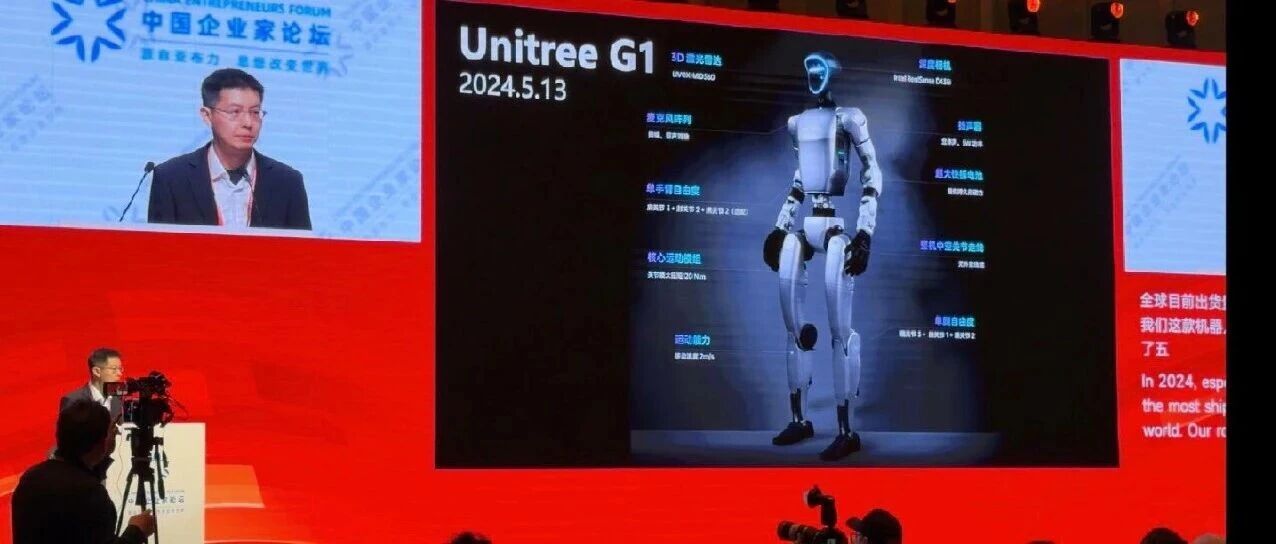
Core Viewpoint - The article discusses the advancements in robotics and AI, particularly focusing on the potential of achieving "embodied intelligence" akin to a "ChatGPT moment" in the near future, driven by technologies like Seedance 2.0 [2][3][4]. Group 1: Technological Advancements - Wang Xingxing emphasizes the importance of Seedance 2.0, a video generation model that could allow robots to perform tasks by aligning generated videos with robotic actions, addressing a significant global challenge [4]. - The development of a full-body remote operation system by Yushu Technology aims to synchronize human and robot actions, facilitating large-scale data collection and remote control capabilities [2][3]. - The prediction of a "ChatGPT moment" in embodied intelligence suggests that AI models could perform 80% of tasks in unfamiliar scenarios using language and text instructions without prior mapping [2][3]. Group 2: Challenges in the Industry - The industry faces challenges in achieving embodied intelligence, primarily due to the insufficient generalization ability of AI models [3]. - Improving the generalization capability of robots requires enhancing the expression of robotic movements and increasing data utilization, as the current data in the robotics field is still scarce compared to other domains [3]. - The two main model approaches in embodied intelligence are VLA models, which integrate language and robotic models, and world models, which allow robots to imagine actions before executing them [3]. Group 3: Product Developments and Market Potential - Yushu Technology plans to release a new generation of industrial-grade robots by 2025, featuring enhanced capabilities such as dust and water resistance and a range of over 20 kilometers on a single charge [4]. - The company anticipates a significant increase in robot shipments, potentially reaching one million units annually if AGI reaches a critical point, with current global shipments of the G1 model expected to be around 5,000 units by the end of 2025 [5]. - Recent performances by Yushu robots on national television demonstrate their advanced capabilities in AI reinforcement learning, showcasing high-level movements and flexibility [5].

春晚“人机大战”,总台台长曾提出明确修改意见
Xin Lang Cai Jing· 2026-02-17 23:50
Group 1 - The 2026 Spring Festival Gala showcased advanced humanoid robots performing traditional Chinese martial arts, highlighting the evolution of robotics in entertainment [1][3] - The performance featured a collaboration between martial arts actors and robots, emphasizing the theme of "human-machine combat" to demonstrate the capabilities of Chinese robotics [3][4] - The technical team utilized laser radar to create a precise navigation map for the robots, allowing them to perform autonomously on stage without remote control [4] Group 2 - The robots, including models G1 and H1, have been in development for about a year and a half, with H2 being released in October of the previous year, indicating rapid advancements in robotics technology [4] - The performance aimed to bridge the gap between traditional martial arts and modern technology, showcasing the potential for future collaborations in cultural heritage and robotics [3][4] - The integration of robotics into traditional performances reflects a growing trend in the entertainment industry, where technology enhances cultural expressions [1][3]

春晚机器人的“台上一分钟”
Bei Jing Shang Bao· 2026-02-17 11:36
Core Viewpoint - The 2026 Spring Festival Gala showcased a significant advancement in humanoid robotics, featuring performances that integrated robots seamlessly into traditional entertainment, highlighting the industry's progress and potential for commercialization [3][12]. Group 1: Humanoid Robot Performances - The gala featured a lifelike humanoid robot resembling actress Cai Ming, designed to synchronize with her performance, demonstrating advanced facial expression control and natural movement [6][7]. - The performance involved a unique collaboration between the humanoid robot and Cai Ming, where the robot's emotional responses and movements were meticulously adjusted to match the live performance [5][6]. - Multiple humanoid robots from various companies, including Songyan Power and Yushutech, participated in different segments, showcasing their capabilities in synchronized movements and interactions [3][12]. Group 2: Technical Innovations - Songyan Power's humanoid robot was optimized for stage performance, featuring a redesigned neck structure for better movement and expression accuracy, addressing common issues in robotic performances [6][7]. - Yushutech's G1 robots demonstrated advanced capabilities in martial arts, performing complex movements in coordination with human actors, showcasing the integration of robotics in traditional arts [9][10]. - The preparation for these performances involved extensive collaboration and iterative improvements, indicating a strong focus on refining technology for real-world applications [10][12]. Group 3: Industry Implications - The Spring Festival Gala serves as a platform for companies to demonstrate their technological advancements and commercial potential, with a focus on real-world applications beyond entertainment [12][13]. - The integration of robotics into the gala is seen as a way to bridge the gap between the public and the technology, enhancing trust and interest in humanoid robots [12][13]. - Despite the successful showcase, challenges remain in adapting robots for complex real-life environments, emphasizing the need for ongoing development in cost control and adaptability [12][13].

盘点春晚机器人名场面
Xin Lang Cai Jing· 2026-02-17 09:07
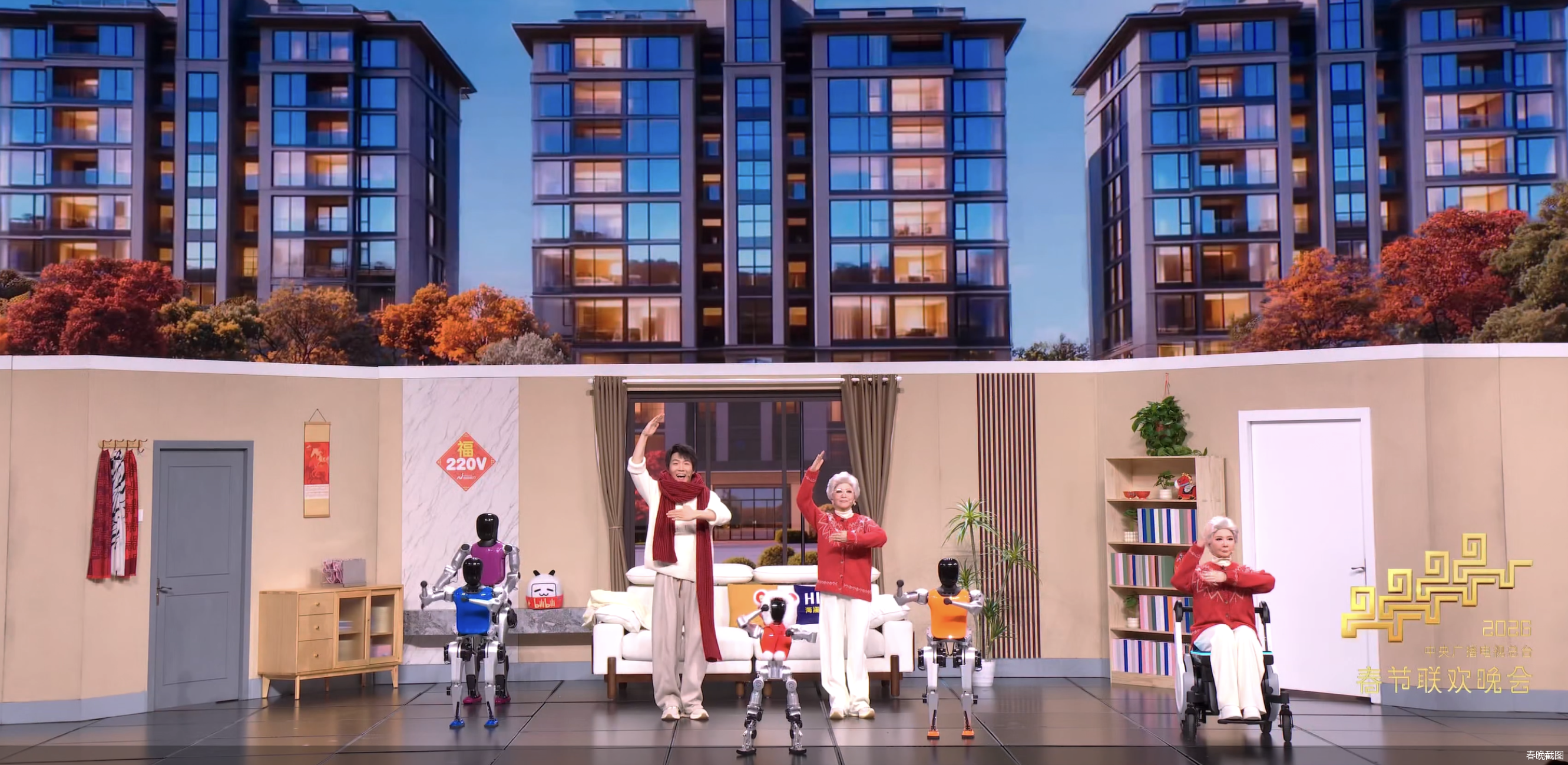
Group 1 - The 2026 CCTV Spring Festival Gala showcased a variety of robots, transforming them from cold mechanical devices into stage stars and symbols of technology [1] - The first performance featured four bipedal humanoid robots and one bionic robot collaborating with actors in a skit, highlighting the integration of robotics in entertainment [1] - Yushutech presented a martial arts program with multiple G1 robots and an H2 robot, demonstrating advanced martial arts movements and the fusion of traditional martial arts with modern technology [1] Group 2 - The performance of six humanoid robots MagicBot Z1 and two MagicBot Gen1 alongside popular artists showcased the synchronization and real-time collaboration capabilities of humanoid robots [1] - Galbot G1 participated in a microfilm, interacting with actors and demonstrating practical skills such as cleaning and object retrieval, bringing the application of intelligent robots into public view [1]
智元登顶全球人形机器人出货榜,宇树、优必选居二、三位
Xin Lang Cai Jing· 2026-01-09 02:45
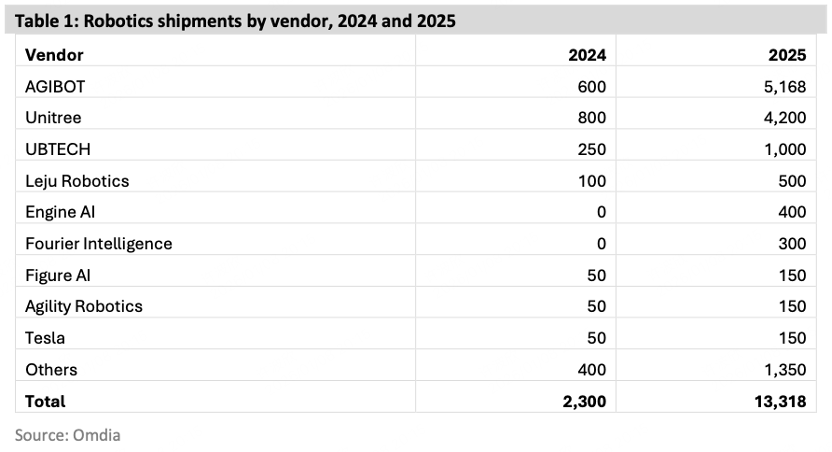
Core Insights - The global humanoid robot market is entering a rapid growth phase, with shipments expected to reach 13,318 units by 2025, indicating accelerated commercialization across various application scenarios [1][6]. Company Performance - Zhiyuan Robotics leads the market with a shipment of 5,168 units, capturing 39% of the global market share [1][6]. - Unitree Technology follows in second place with 4,200 units shipped, while UBTECH ranks third with 1,000 units [1][6]. - Zhiyuan Robotics has diversified its product matrix, covering full-size humanoid robots, compact half-size humanoid robots, and wheeled embodied intelligent robots, which have been commercialized in various fields such as reception services, entertainment, industrial smart manufacturing, and logistics sorting [2][7]. Future Projections - Zhiyuan Robotics anticipates that its shipment volume could reach tens of thousands by 2026, with sales revenue expected to exceed 1 billion yuan in 2025 [3][8]. - Unitree Technology has launched the Unitree R1 small robot at a price of 29,900 yuan, lowering the market entry barrier, and reported revenue exceeding 1 billion yuan in 2024 [3][8]. - UBTECH aims to deliver its 1,000th Walker S2 industrial robot by 2025, with total order amounts for the Walker series reaching 1.3 billion yuan [4][9]. Industry Trends - The integration of generative artificial intelligence with robotics is driving the evolution of robots from executing preset tasks to possessing autonomous learning and environmental adaptability [4][9]. - Omdia projects that global humanoid robot shipments will reach 2.6 million units by 2035, while Citigroup forecasts that the total number of robots worldwide could rise to 648 million by 2050, with China's leading position impacting the long-term competitive landscape [4][9].
成本砍到一辆中级车,夜班冷库不感冒不请假:当机器人卷进工厂,打工人该慌吗?
Sou Hu Cai Jing· 2025-10-25 17:45
Core Insights - The article highlights the rapid advancements in humanoid robotics, showcasing a specific robot's capabilities that surpass traditional expectations of machine performance [1][10] - The narrative emphasizes the potential for humanoid robots to replace human labor in various sectors, particularly in logistics and service industries, due to their efficiency and cost-effectiveness [6][10] Group 1: Technological Advancements - The humanoid robot demonstrated remarkable agility and precision, performing complex movements such as ballet and martial arts, which were previously thought to be exclusive to humans [1][3] - The robot's dynamic balance system allows it to maintain stability and perform tasks even when subjected to external forces, showcasing advanced computational capabilities [5] - The development timeline indicates that the company aims to produce a consumer version of the robot by 2026, with plans to make it affordable for widespread use [10][12] Group 2: Market Implications - The efficiency of the robot in warehouse settings suggests it can outperform human workers, completing tasks in a fraction of the time while reducing labor costs significantly [6][10] - The potential for these robots to be integrated into everyday life raises questions about the future of human jobs, particularly in sectors like security and logistics [8][10] - The company plans to sell the initial batch of robots at a price comparable to mid-range cars, which could lead to rapid adoption in various industries [8][10] Group 3: Societal Impact - The article reflects on the societal implications of humanoid robots, suggesting that as they become more integrated into daily tasks, human roles may shift significantly [10][12] - The narrative indicates a growing acceptance of robots in roles traditionally held by humans, as evidenced by discussions around their use in service industries [10][11] - The evolution of humanoid robots is positioned as a transformative force, akin to the historical shift from horse-drawn carriages to automobiles, suggesting a significant change in societal norms and job structures [10][12]