
H1

Search documents
宇树科技:史上“最奇怪”的IPO公司
水皮More· 2026-03-23 10:34
Core Viewpoint - The article highlights the paradoxical business model of a leading Chinese robotics company, which achieves high growth and profitability with low marketing and R&D expenditures, indicating a unique market positioning and brand strength in an immature industry [7][28]. Group 1: Revenue Growth - The company's revenue surged to 17.08 billion in 2025, reflecting a staggering growth of approximately 341% compared to previous years [8][9]. - The primary revenue sources are quadruped and humanoid robots, with humanoid robots becoming the largest revenue contributor at 5.95 billion, accounting for 51.53% of total revenue [12][13]. - The growth strategy involved reducing prices to increase sales volume, with the average price of humanoid robots dropping from 593,400 to 167,600, a decrease of about 71.7% [15][16]. - Sales volume of humanoid robots increased dramatically from 5 units in 2023 to 3,551 units in the first three quarters of 2025 [16][17]. - The company also experienced a significant increase in brand recognition, with domestic revenue share rising from 44.3% to 60.8% after a high-profile marketing event [24][25]. Group 2: Profitability - The company achieved a net profit margin of approximately 35% in 2025, comparable to established consumer brands, despite being in a nascent industry [30][31]. - The gross profit margin improved from 56.41% to 59.45% between 2024 and the first three quarters of 2025, indicating effective cost management [36]. - The company maintains low marketing and R&D expenses, with sales costs at only 6.51% of revenue and R&D spending under 100 million [42].


最新!宇树受理了
是说芯语· 2026-03-20 10:13
近日,宇树科技股份有限公司(以下简称"宇树科技")披露首次公开发行股票并在科创板上市招股说明书(申报稿),拟公开发行不低于4044.6434万 股,占发行后总股本比例不低于10%,募集资金将用于智能机器人模型研发、机器人本体研发、新型智能机器人产品开发及智能机器人制造基地建设四大 项目,总投资金额42.02亿元。 宇树科技成立于2016年8月26日,注册地址位于浙江省杭州市滨江区,法定代表人为王兴兴,主营业务为高性能通用人形机器人、四足机器人、机器人组 件及具身智能模型的研发、生产和销售。公司在全球率先实现高性能四足机器人公开销售及行业落地,人形机器人与四足机器人近年来全球销量保持领 先,产品被国内外众多知名高校、科研机构、科技企业及全球开发者广泛使用。 产品方面,公司构建了丰富的产品矩阵。人形机器人领域,已推出H1、G1、R1、H2及G1-D等系列产品,其中G1是2024年至2025年全球最畅销的人形机 器人,R1被《时代周刊》评为2025年度最佳发明;四足机器人领域,先后研发量产Laikago、AlienGo、A1、Go1、B1、Go2、B2、B2-W、A2等多款产 品,覆盖消费级与行业级应用场景;机器人 ...

未知机构:长城机械ys今日总结1人形第一文旅展览和-20260227
未知机构· 2026-02-27 02:55
Summary of Conference Call for Changcheng Machinery Industry Overview - The company operates in the robotics industry, focusing on humanoid robots and robotic dogs, with applications in various sectors including cultural tourism, education, and industrial automation [1][2]. Key Points Humanoid Robots - **Market Segmentation**: - Cultural tourism, exhibitions, and rental market account for 50% of sales, with a unit price around 100,000 RMB and a gross margin of 50% [1]. - Research and education market represents 20% of sales, with a similar unit price and a higher gross margin of 60%-70% [1]. - Industrial applications are challenging due to high reliability, stability, assembly yield, and consistency requirements [1]. - **Pricing and Profitability**: - The price for humanoid robots ranges from 200,000 to 300,000 RMB based on configurations [1]. - The company aims to compare costs and efficiencies between robots and human labor in industrial settings [1]. Robotic Dogs - **Market Segmentation**: - Industrial applications account for 50%, research and education for 20%, performances for 10%, and TOC (theater of operations) for 10% [2]. - Prices for TOC robotic dogs range from 80,000 to 100,000 RMB, while educational robotic dogs are priced around 50,000 RMB [2]. - Industrial robotic dogs used for inspection have prices of 300,000 RMB for large models and 200,000 RMB for medium models [2]. - **Profit Margins**: - Gross margins for robotic dogs are comparable to those of humanoid robots [2]. Technology and Development - **Data Utilization**: - The company primarily uses synthetic data for model training, with real data used for calibration [1]. - The models are specialized for specific tasks, such as kitchen operations and logistics [1]. - **Hardware Development**: - The dexterous hand features 20 degrees of freedom, with 16 active and 4 passive, utilizing expensive components like hollow cup motors and ball screws [1]. - The cost of actuators ranges from 2,000 to 3,000 RMB each, with tactile sensors being a more affordable option at several hundred RMB [1]. - **Production Capacity**: - By 2026, the company plans to achieve a production capacity of 40,000 to 50,000 robotic dogs and 20,000 humanoid robots annually [2]. Financial Performance - **Revenue Projections**: - Estimated revenue for 2025 is projected to be in the range of 2 to 3 billion RMB, with a gross margin of 50% and a net profit margin of 25%-30% [2]. - The company anticipates doubling sales volume, revenue, and profits by 2026 [2]. IPO Plans - The company is progressing normally towards an IPO, with no green channel application planned for this year, aiming for an IPO in the first half of the year [2].
未知机构:长城机械宇树今日总结1人形第一文旅展览和-20260227
未知机构· 2026-02-27 02:50
Summary of Conference Call for Changcheng Machinery Industry Overview - The company operates in the robotics industry, focusing on humanoid robots and robotic dogs, with applications in various sectors including cultural tourism, education, and industrial automation [1][2]. Key Points and Arguments 1. **Market Segmentation**: - The humanoid robot market is segmented into three main areas: - Cultural tourism, exhibitions, and rental market: 50% market share, with a price range of hundreds of thousands per unit and a gross margin of 50% [1]. - Research and education market: 20% market share, primarily using the G1 model, priced similarly, with a gross margin of 60%-70% [1]. - Industrial applications: More challenging due to high reliability, stability, assembly yield, and consistency requirements, with a gross margin of around 30% [1]. 2. **Robotic Dog Market**: - The robotic dog market is divided as follows: - Industrial applications: 50% market share. - Research and education: 20% market share. - Performance and other applications: 20% market share (10% each for performance and TOC) [1]. - Pricing for robotic dogs ranges from 80,000 to 100,000 for TOC models, while educational models are priced around 50,000 [1]. 3. **Production and Capacity**: - The company aims to achieve an annual production capacity of 40,000 to 50,000 robotic dogs and 20,000 humanoid robots by 2026 [2]. - Estimated revenue for 2025 is projected to be in the range of 2 to 3 billion, with a gross margin of 50% and a net profit margin of 25%-30%, translating to a profit of approximately 600 to 700 million [2]. 4. **Research and Development**: - The company develops its own actuators and control algorithms, with a focus on proprietary software and algorithms [1][2]. - The dexterous hand features 20 degrees of freedom, with a cost structure that includes expensive components such as motors and actuators [1]. 5. **IPO Progress**: - The company is progressing normally towards an IPO, with no green channel application planned, and aims to complete the IPO process in the first half of the year [2]. Additional Important Information - The company utilizes cloud computing resources from Alibaba for computational needs [1]. - The production of structural and injection molded parts is outsourced, with the company designing the molds [2]. - The company has set ambitious targets for 2026, aiming to double both sales and profits [2].
春晚“人机大战”,总台台长曾提出明确修改意见
Xin Lang Cai Jing· 2026-02-17 23:50
Group 1 - The 2026 Spring Festival Gala showcased advanced humanoid robots performing traditional Chinese martial arts, highlighting the evolution of robotics in entertainment [1][3] - The performance featured a collaboration between martial arts actors and robots, emphasizing the theme of "human-machine combat" to demonstrate the capabilities of Chinese robotics [3][4] - The technical team utilized laser radar to create a precise navigation map for the robots, allowing them to perform autonomously on stage without remote control [4] Group 2 - The robots, including models G1 and H1, have been in development for about a year and a half, with H2 being released in October of the previous year, indicating rapid advancements in robotics technology [4] - The performance aimed to bridge the gap between traditional martial arts and modern technology, showcasing the potential for future collaborations in cultural heritage and robotics [3][4] - The integration of robotics into traditional performances reflects a growing trend in the entertainment industry, where technology enhances cultural expressions [1][3]

2025年全球人形机器人行业竞争分析 中国领跑硬件与集成端【组图】
Qian Zhan Wang· 2026-02-10 07:12
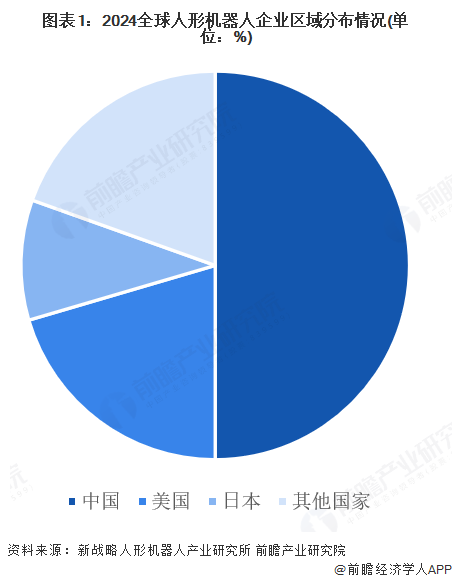
Core Insights - The global humanoid robot industry is predominantly led by China, which houses over 110 companies, accounting for more than 50% of the total 220 humanoid robot manufacturers worldwide [1] - China excels in hardware and integration segments, while the US leads in the "brain" segment, focusing on AI models and software [4][5] - China has filed approximately five times more humanoid robot patents than the US, with a total of 7,705 patents, indicating a strong emphasis on innovation and technology development [6] - The competition among China, the US, and Japan in the humanoid robot industry is characterized by distinct strategies and market focuses [9] Industry Overview - Major listed companies in China's humanoid robot sector include Huichuan Technology, Sanhua Intelligent Control, Lens Technology, Hengli Hydraulic, Top Group, Linying Intelligent Manufacturing, Zoomlion Heavy Industry, and Jinli Permanent Magnet [1] - The global humanoid robot industry is expected to reach a market size of 861 billion yuan by 2027, with China aiming for a fully controllable supply chain and over 70% localization of core components [9][11] Competitive Landscape - Chinese companies like Zhiyuan Robotics and UTree Technology are rapidly advancing in mass production and cost control, while US firms like Boston Dynamics and Tesla focus on core technology breakthroughs [11][12] - The strategic direction for Chinese firms includes low-cost strategies to expand into consumer and industrial markets, while US companies are investing heavily in AI and technology development [11] - Japan's approach is centered on precision manufacturing and specialized components, targeting healthcare and industrial applications [9][11] Patent and Innovation - China leads in humanoid robot patent applications, with 7,705 patents compared to the US's 1,561 and Japan's 1,102, showcasing its dominance in core technology areas [6] - The focus of Chinese patents includes body structure, intelligent perception, and drive control, indicating a comprehensive approach to technology development [6] Market Projections - By 2027, the humanoid robot market is projected to achieve significant growth, with China aiming for a market scale of 861 billion yuan and the US targeting over 40% of the global market share [9][11]




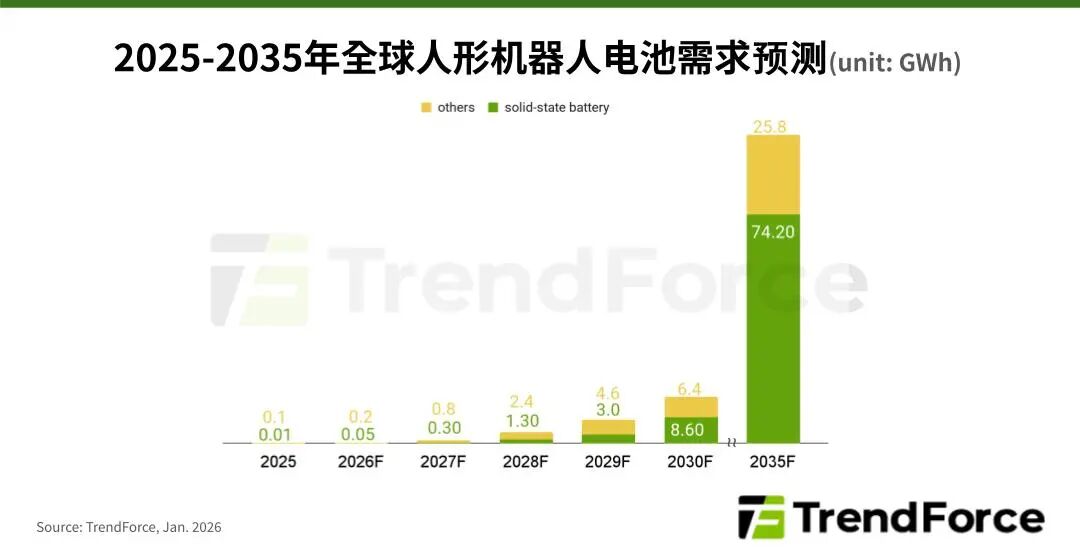
集邦咨询:预计人形机器人对固态电池的需求有望于2035年超74GWh
智通财经网· 2026-01-28 09:09
Core Insights - The development of humanoid robots is expected to reach a commercialization milestone by 2026, increasing the importance of batteries as an "energy supply" [1] - Solid-state lithium batteries are projected to become the mainstream solution due to their high energy density, with demand from humanoid robots expected to exceed 74 GWh by 2035, growing over a thousand times from 2026 [1] Group 1: Humanoid Robot Battery Market - Global humanoid robot shipments are forecasted to surpass 50,000 units in 2026, representing an annual growth of over 700% [4] - High-nickel ternary lithium batteries (NMC/NCA) are currently the mainstream choice for robot batteries due to their relatively high energy density, while lithium iron phosphate batteries (LFP) are used for lower endurance applications [4] - Most humanoid robots currently have a battery capacity below 2 kWh, with typical endurance ranging from 2 to 4 hours, such as Unitree's H1 with 0.864 kWh and Tesla's Optimus Gen2 with 2.3 kWh [4] Group 2: Challenges and Opportunities - The development of humanoid robot batteries faces two main challenges: the rapid iteration of core technologies affecting battery customization and the current focus on finding scalable commercial applications rather than improving endurance [5] - Despite these challenges, the demand for high energy density, high discharge rate, and high safety batteries in humanoid robots presents an opportunity for solid-state batteries to demonstrate their advantages [5] - Breakthroughs in solid-state battery technology and cost reductions are expected to help humanoid robots overcome power limitations [5]

穿越周期的力量:2025中国企业家年度榜单
Sou Hu Cai Jing· 2026-01-26 15:59
Core Insights - The article highlights the recognition of 3 "Special Contribution Entrepreneurs" and 20 "2025 Entrepreneurs" who exemplify long-termism and innovation across various industries in China, including liquor, manufacturing, energy, agriculture, internet, AI, and new consumption [1][2]. Group 1: Special Contribution Entrepreneurs - Ji Keliang, former chairman of Kweichow Moutai Group, transformed traditional brewing techniques into scientific data over 60 years, emphasizing quality over speed, which laid the foundation for Moutai's billion-dollar brand value [4][10][12]. - Zhang Ruimin, founder of Haier Group, is known for his continuous self-disruption and innovation, leading Haier from a struggling factory to a global leader in home appliances with over 400 billion yuan in revenue [18][20][21]. - Jiang Baoquan, founder of Nanjing Gold Foil Holdings, turned a failing workshop into the world's largest gold foil producer, emphasizing resilience and innovative management theories [25][27][29]. Group 2: 2025 Entrepreneurs - Ma Huateng, chairman of Tencent, focuses on "technology for good," committing to social responsibility and innovation in digital technology to drive high-quality economic development [31][34][41]. - Wang Ning, founder of Pop Mart, capitalizes on emotional value and consumer psychology, creating a successful business model around collectible toys that resonate with young consumers [43][45][46]. - Wang Xingxing, founder of Yushutech, leads advancements in humanoid robotics, achieving significant market presence and profitability while promoting technological innovation [48][49][51]. - Fang Hongbo, chairman of Midea Group, has successfully transformed Midea into a global technology group through strategic restructuring and a focus on efficiency and innovation [54][56]. - Liu Yonghao, chairman of New Hope Group, maintains a long-term vision in agriculture, achieving growth even during economic downturns by embracing new technologies [67][69][70]. - Liu Qiangdong, founder of JD.com, integrates the concept of "common prosperity" into business practices, ensuring fair profit distribution among stakeholders while enhancing supply chain efficiency [73][75][78]. - Li Dongsheng, founder of TCL, exemplifies global leadership in semiconductor display and photovoltaic sectors, driving innovation and sustainable growth through strategic partnerships [110][111].





宇树科技官宣上2026春晚,三机器人公司同台竞技
Bei Ke Cai Jing· 2026-01-26 13:53
Group 1 - Yushu Technology announced its partnership with the Central Radio and Television Station for the 2026 Spring Festival Gala, continuing its presence in the event after previous successful appearances [1] - The company has achieved the highest global shipment volume for its quadruped and humanoid robots in recent years, marking a significant milestone in large-scale delivery [1] - In 2025, Yushu Technology expects to exceed 5,500 units in actual shipments of humanoid robots, with over 6,500 units in mass production [1] Group 2 - Yushu Technology completed a Series C financing round in June last year, with investors including China Mobile, Tencent, Alibaba, and others, and is currently in a critical phase for its IPO [2] - Three companies have announced partnerships with the 2026 Spring Festival Gala, including Yushu Technology, Galaxy General Robotics, and Magic Atom [2][3] - Galaxy General Robotics, established in May 2023, has launched the Galbot G1 humanoid robot and completed a financing round exceeding $300 million, with a valuation over $3 billion [2] - Magic Atom, founded in January 2024, will also be a strategic partner for the 2026 Spring Festival Gala, showcasing its Magic Bot and Magic Dog robot series [3]

宇树科技官宣成为2026年央视春晚机器人合作伙伴
Bei Ke Cai Jing· 2026-01-26 13:29
Group 1 - Yushu Technology announced its partnership with China Central Television (CCTV) for the 2026 Spring Festival Gala as a robot collaborator [1] - The company highlighted its previous successful collaborations, including the debut of the robotic cow "Benben" in the 2021 Spring Festival Gala and the humanoid robot "YangBOT" directed by Zhang Yimou last year [2] - Yushu Technology reported that its quadruped and humanoid robots have achieved the highest global shipment volumes in recent years, marking a significant milestone in large-scale delivery [3] Group 2 - In the previous year's CCTV Spring Festival Gala, 16 Yushu H1 humanoid robots performed alongside human dancers, increasing public awareness and investment interest in humanoid robots [4] - Yushu Technology is known for its exceptional motion control and engineering capabilities in the humanoid robot sector, having launched four models: G1, H1, H2, and R1 [4] - The company revealed that it expects to exceed 5,500 units in actual shipments of humanoid robots by 2025, with over 6,500 units in mass production [4] - Yushu Technology completed a Series C financing round in June last year, with investors including China Mobile's fund, Tencent, Alibaba, and others, and is currently in a critical phase for its IPO [4] - As of the report, three other robotics companies have announced partnerships with CCTV for the 2026 Spring Festival Gala, including Galaxy General Robotics and Magic Atom [5] - Galaxy General Robotics, established in May 2023, has raised over $300 million in its latest funding round, achieving a valuation of over $3 billion [5] - Magic Atom, founded in January 2024, has introduced the Magic Bot and Magic Dog robot series, with capabilities for complex actions and social interaction [5]