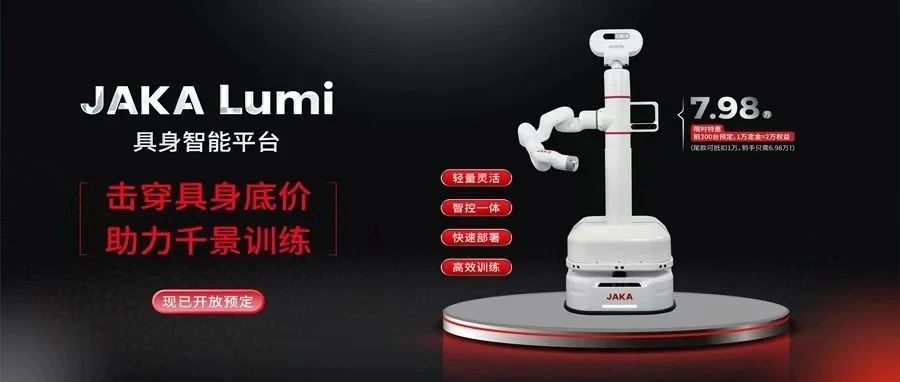
JAKA Lumi具身智能平台

Search documents
强强联合!节卡机器人×Intel达成战略合作,共推“算力与作业力融合”,引领具身智能新纪元
机器人大讲堂· 2026-01-08 11:21
Core Viewpoint - The strategic partnership between JAKA Robotics and Intel aims to integrate computing power with operational capabilities to advance the industrialization of embodied intelligence technology, providing adaptable and easily deployable intelligent robotic solutions across various industries [1][3]. Group 1: Partnership Overview - JAKA Robotics and Intel signed a memorandum of cooperation to establish a deep strategic partnership focused on the fusion of computing power and operational capabilities [1]. - Intel, as a leader in the semiconductor and computing innovation sectors, will support JAKA Robotics in exploring general-purpose intelligent robotics [3]. - JAKA Robotics has a comprehensive stack from core components to complete machines, including products like the JAKA Kargo wheeled dual-arm robot and the JAKA Lumi embodied intelligence platform [3]. Group 2: Focus Areas of Collaboration - The collaboration will focus on three main areas: 1. Exploring key fusion technologies in the embodied intelligence field based on Intel's advanced hardware platforms, such as the Intel® Core™ Ultra processors [5]. 2. Developing customized technology and integration work for specific scenarios in industrial manufacturing and commercial services, creating rapidly deployable intelligent robotic solutions [5]. 3. Joint market activities and ecosystem building to empower developers and academic-industry partners, fostering an open and collaborative industrial ecosystem [5]. Group 3: Statements from Executives - The CTO of JAKA Robotics emphasized the commitment to enhancing robots' perception, decision-making, and operational capabilities, aiming for robots to become valuable partners in human work and life [7]. - The General Manager of Intel China highlighted that the integration of a powerful, open computing platform with top-notch robotic technology is essential for the large-scale implementation of embodied intelligence [9]. - This strategic cooperation is seen as a significant step towards transitioning embodied intelligence from technology to large-scale industrial application, with plans for continued innovation in computing architecture and robotic technology [9].



现在,重新认识节卡!
机器人大讲堂· 2025-12-11 09:02
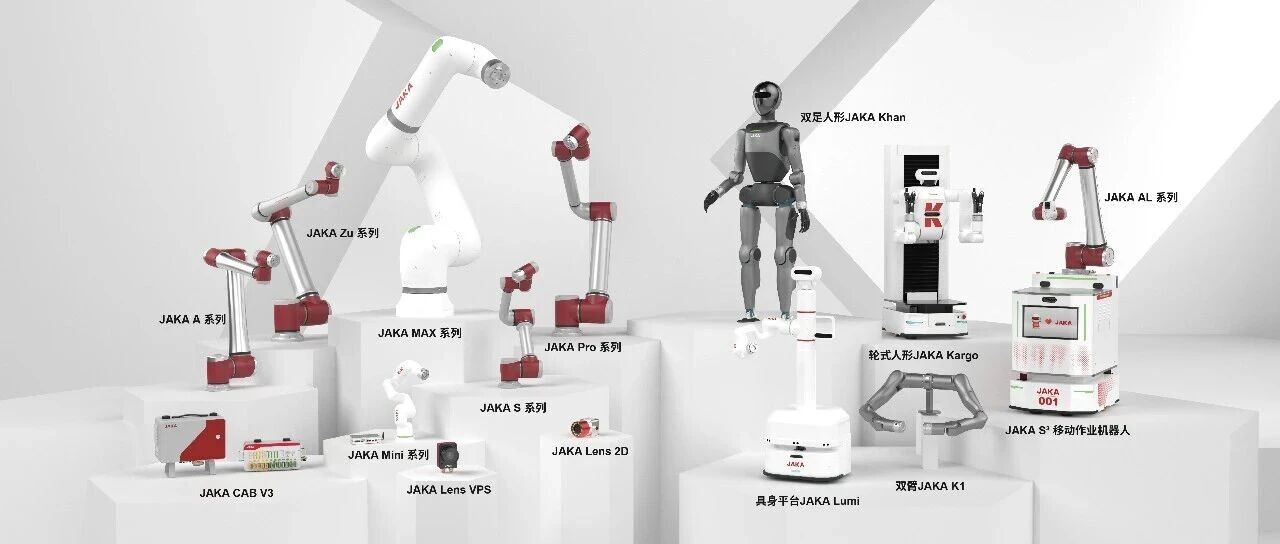
Core Insights - The article discusses the strategic evolution of JAKA Robotics from V1.0 to V2.0, emphasizing the transition from being a tool provider to becoming a partner in intelligent automation [3][11][19] - JAKA aims to establish itself as a global leader in general-purpose intelligent robotics, focusing on enhancing the capabilities of robots to understand tasks, adapt to changes, and solve real-world problems [3][6][16] Group 1: Strategic Transition - JAKA's V1.0 era was characterized by the development of safe, reliable, and user-friendly collaborative robots, addressing the essential needs for automation in industrial production [3][7] - The company has accumulated extensive know-how across various sectors, including automotive and electronics, which has become a critical foundation for its transition to V2.0 [4][10] - The shift to V2.0 is driven by the need for robots to possess higher flexibility, intelligence, and interaction capabilities, as global manufacturing trends move towards small-batch, diverse production [6][12] Group 2: Technological Advancements - JAKA's V2.0 robots integrate advanced sensory and decision-making capabilities, moving beyond traditional mechanical functions to embody "embodied intelligence" [12][15] - The company invests over 20% of its revenue into R&D, fueling advancements in perception and decision-making technologies [4][10] - JAKA's product range includes various models designed for specific industrial applications, showcasing its competitive edge in precision and reliability [7][8] Group 3: Value Reconstruction - The V2.0 vision redefines robots as intelligent partners rather than mere tools, enhancing human-robot collaboration and creating emotional resonance [14][16] - JAKA aims to provide solutions that not only automate tasks but also enrich human experiences in various sectors, including education and healthcare [17][19] - The company is building an open, evolving ecosystem around its robots, encouraging third-party developers to create applications that enhance robot capabilities [18][21]
揭秘2025中国工博会机器人展,展品亮点抢“鲜”看!
半导体芯闻· 2025-07-21 10:44
Core Viewpoint - The 2025 China Industrial Expo Robot Exhibition, themed "Embodied Industry, Intelligent Future," will showcase over 500 renowned global companies and highlight cutting-edge robotic technologies and applications in a vast space of 56,000 square meters [2]. Group 1: Collaborative Robots - ABB's PoWa is a compact collaborative robot designed for speed and efficiency, achieving industrial-grade speeds of up to 5.8 m/s, making it ideal for small and medium enterprises with its no-code programming and plug-and-play capabilities [4]. - JAKA Lumi is an embodied intelligent platform designed for lightweight scenarios, featuring a 12-degree-of-freedom collaborative motion system that enhances production efficiency and product quality in tight spaces [7]. - GBT-C12A from Jiebo is a collaborative robot with a repeat positioning accuracy of 0.03mm, suitable for high hygiene and precision requirements in food processing environments [10]. Group 2: Industrial Robots - FANUC's ROBODRILL DC series is a high-efficiency machining center that enhances processing speed and quality through structural optimization and AI algorithms [19]. - Yaskawa's MOTOMAN-ME1000 is a heavy-duty SCARA robot capable of handling loads up to 1 ton, specifically designed for electric vehicle battery assembly [22]. - KUKA's KR IONTEC ultra is optimized for battery handling and lightweight spot welding, offering high dynamics and precision in compact spaces [25]. Group 3: Humanoid Robots - The Doco humanoid robot from Siasun integrates intelligent interaction and autonomous operation, capable of performing complex assembly tasks and providing services in commercial settings [48][49]. - Kepler's K2 "Bumblebee" humanoid robot combines cloud-based models with physical capabilities, enabling it to autonomously complete tasks in logistics and hazardous environments [52]. - DexForce W1 is a humanoid robot designed for precise operations in complex environments, featuring 34 actuators for flexibility and real-time environmental sensing [56]. Group 4: Intelligent Perception - Mech-GPT from Mechamand is an intelligent system that combines perception, decision-making, and execution capabilities, enhancing robots' ability to understand and interact with their environment [58][60]. Group 5: Logistics Innovations - Jiateng's single-arm unmanned forklift is designed for low-profile material handling, improving logistics efficiency in warehouses [80]. - Sainade's iLoabot series includes intelligent robots capable of autonomous loading and unloading, with advanced navigation and operational capabilities [83]. Group 6: Industry Applications - Songchuan's AIS-200 mechanical arm box-opening machine offers high cost-effectiveness and compatibility across various industries, streamlining the box-opening process [87].
电新公用环保行业周报:山东广东出台136号文配套细则,装机及电价预期逐步明朗-20250518
EBSCN· 2025-05-18 14:43
Investment Ratings - Power Equipment: Buy (Maintain) [1] - Public Utilities: Buy (Maintain) [1] - Environmental Protection: Buy (Maintain) [1] Core Insights - The introduction of implementation details for Document 136 by Shandong and Guangdong provinces has clarified expectations regarding installed capacity and electricity prices, with a focus on market-based pricing to reflect supply and demand dynamics for renewable energy [3] - Shandong's guidelines favor existing projects with a mechanism price based on coal-fired benchmark prices, while new projects will face competitive bidding with a minimum application rate of 125% [3] - Guangdong's regulations are more favorable for new projects, particularly offshore wind, with a mechanism application cap of 90% and a 14-year execution period for offshore wind projects [3] Summary by Sections Investment Aspects - Photovoltaics: Production and prices in the supply chain have declined, with market acceptance of weaker domestic demand for 2025 and 2026. Some companies' stock prices have reverted to mid-2024 levels. A rebound opportunity may arise with new supply-side policies or company restructuring. Recommended to focus on Tongwei Co [4] - Wind Power: With a favorable output curve and better economic viability compared to photovoltaics, wind power is expected to recover as more provinces release Document 136 details. Suggested companies include Mingyang Smart Energy, Yunda Wind Power, and Goldwind [4] - Energy Storage and Power Equipment: Continued focus on high growth in Europe, Southeast Asia, and Africa for energy storage in 2025. Recommended companies include Deye Technology and Haibo Technology. Future attention should be on virtual power plants and integrated cloud distribution, with recommendations for Weisheng Information and Guoneng Rixin [4] - Thematic Investments: Focus on solid-state batteries and controllable nuclear fusion, with recommendations for Xinyuan Materials and Hezhong Intelligent [4] Wind Power - New installed capacity for onshore wind in 2024 is projected at approximately 75.8 GW, a year-on-year increase of 9.68%. Offshore wind capacity is expected to be around 4.0 GW, a decrease of 40.85% [6][7] - In the first quarter of 2025, domestic wind power installations reached 14.62 GW, a year-on-year decrease of 5.68% [6][7] Coal Prices - As of May 16, 2025, the price of 5500 kcal thermal coal at Qinhuangdao Port was 629 CNY/ton, down 14 CNY from the previous week [25] - The price of imported thermal coal from Indonesia was 700 CNY/ton, a decrease of 5 CNY, while Australian coal remained stable at 720 CNY/ton [25] Electricity Market - The weighted average electricity price in Guangdong and the real-time market clearing price in Shanxi have shown fluctuations, reflecting the dynamics of the electricity market [28]
不足8万!节卡JAKA Lumi 颠覆行业:全场景具身智能平台首发预售,开启一站式选购时代
机器人大讲堂· 2025-05-15 11:10
Core Viewpoint - The article highlights the rapid growth potential of the embodied intelligence market, predicting a market size of 232.63 billion yuan by 2030 with a compound annual growth rate of 64.18% [1] Market Challenges - The traditional embodied intelligence solutions face three major barriers: long deployment cycles, high costs, and a lack of integrated hardware-software solutions [1] - Deployment cycles are lengthy due to the need for developers to procure various components individually, leading to challenges in meeting customization demands [1] - High costs are a significant issue, with individual systems often exceeding 100,000 yuan, making large-scale research and training difficult [1][2] - The market lacks integrated embodied intelligence systems, requiring developers to create their own software and algorithms, complicating the integration process [1] JAKA Lumi Platform - The JAKA Lumi platform offers a one-stop solution priced at 79,800 yuan, significantly lowering the entry barrier for small and medium enterprises and individual developers [2][3] - It integrates core functionalities such as efficient data collection, model training, parameter tuning, and model deployment, targeting lightweight scenarios across various fields [3] - The platform features a highly integrated design with 12 degrees of freedom, an intelligent lifting module, and multi-modal sensors, enabling a complete toolchain for embodied intelligence [3][6] Competitive Advantage - JAKA Lumi's pricing is over 60% lower than similar products, which typically range from 200,000 to 500,000 yuan, potentially reshaping industry pricing dynamics [4] - The platform's development is backed by over a decade of technological expertise in integrated drive control joints, ensuring high quality and usability [5][4] Functionality and Usability - JAKA Lumi's hardware design includes a flexible motion capability and a 360° environment modeling ability, enhancing its operational efficiency in dynamic environments [8][13] - The platform supports a variety of end-effectors, making it adaptable for diverse applications in industrial and domestic settings [15] - It features an open software ecosystem, allowing seamless integration with major simulation platforms and facilitating rapid development cycles for developers [16][18] Application Scenarios - JAKA Lumi is positioned to enhance efficiency and user experience in various service sectors, including restaurants, hotels, and home care, by autonomously navigating and delivering items [19][20] - The platform can also serve as a low-cost testing ground for research institutions, accelerating the iteration of embodied intelligence technologies [21] Future Outlook - JAKA Lumi aims to redefine the future of embodied intelligence by breaking down cost barriers and making advanced robotics accessible to a broader audience, including small business owners and families [22]