
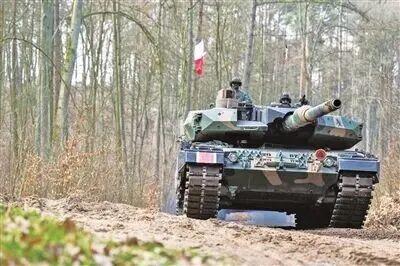
K2坦克

Search documents
波兰军费计划飙升至占GDP的4.81%
Bei Jing Ri Bao Ke Hu Duan· 2026-02-13 11:55
Core Viewpoint - Poland is significantly increasing its military spending and modernizing its armed forces in response to ongoing security concerns, particularly due to the Russia-Ukraine conflict and the perceived reduction of U.S. security commitments in Europe [1][4][5]. Group 1: Military Spending and Modernization - Poland plans to purchase an electronic warfare system from Turkey worth $410 million to enhance its electronic reconnaissance, jamming, and anti-drone capabilities [1]. - The Polish parliament has approved a budget for 2026 that allocates military spending to reach $55 billion, which is 4.81% of its GDP, marking a historical high [1][4]. - In 2023, Poland's military expenditure already accounted for 4% of its GDP, the highest among NATO member states [5]. Group 2: Strategic Goals and Regional Positioning - Poland aims to become a leader in Central and Eastern Europe, driven by historical tensions with Russia and the desire to strengthen its security by supporting Ukraine [5][8]. - The modernization efforts focus primarily on ground forces, with significant investments in advanced weaponry, including tanks and artillery systems from the U.S. and South Korea [7][8]. Group 3: Broader Security Implications - The substantial military investments by Poland have raised concerns among neighboring countries regarding regional security dynamics [11]. - Experts argue that true security in Europe cannot be achieved solely through military buildup; a more inclusive security framework that involves Russia and other stakeholders is necessary for lasting peace [12].

韩国举行大规模阅兵式 李在明:将大幅提高军费 收回作战指挥权
Mei Ri Jing Ji Xin Wen· 2025-10-01 05:51
Core Points - South Korea is significantly increasing its defense budget by 8.2% to 66.3 trillion won (approximately 340 billion RMB) in 2024, focusing on advanced technologies such as military drones, robots, advanced aviation engines, and stealth technology [3][4] - President Yoon Suk-yeol emphasized that the future battlefield will be dominated by armies equipped with AI combat robots, drones, and high-precision missiles, highlighting the importance of self-reliance for peace and prosperity [3][4] - South Korea plans to regain operational command in the future, reinforcing its defense capabilities based on a solid South Korea-U.S. alliance [3][4] Summary by Categories Defense Budget - South Korea will increase its defense budget by 8.2% to 66.3 trillion won (approximately 340 billion RMB) in 2024, compared to the 2025 baseline [3][4] Technological Advancements - The military will focus on investments in military drones, robots, advanced aviation engines, and stealth technology to adapt to changing warfare dynamics [3][4] Strategic Military Positioning - President Yoon Suk-yeol stated that South Korea will work towards regaining operational command while maintaining a strong alliance with the U.S. for joint defense [3][4]
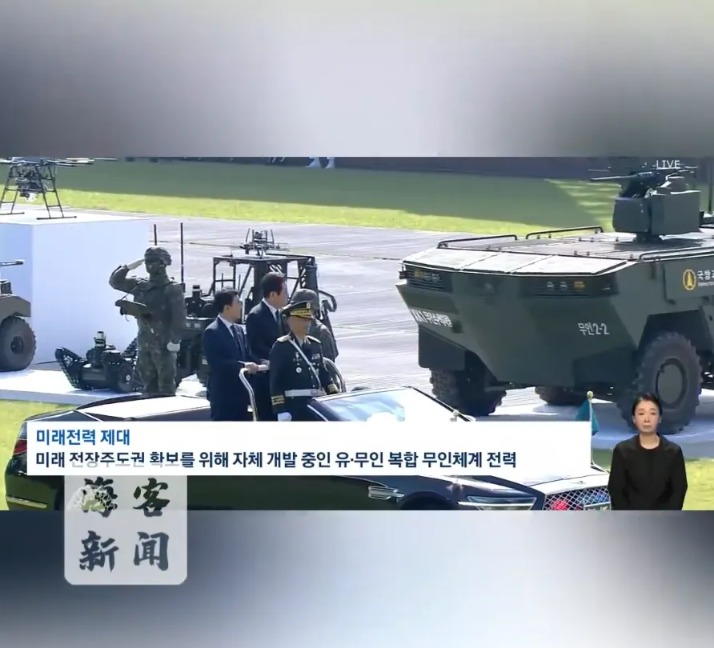
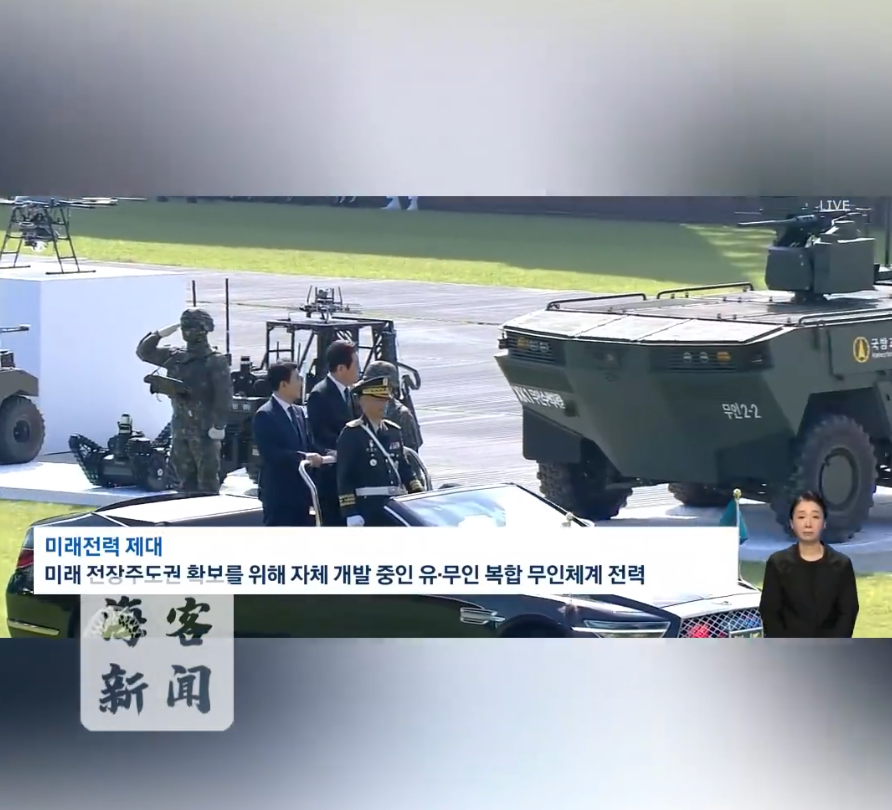
韩国举行大规模阅兵式:机器狗、无人机、钻地导弹亮相,现场视频曝光!李在明:将大幅提高军费,收回作战指挥权
Mei Ri Jing Ji Xin Wen· 2025-10-01 05:41
Core Points - The South Korean government is significantly increasing its defense budget by 8.2% to 66.3 trillion won (approximately 340 billion yuan) in 2025, focusing on advanced technologies such as military drones, robots, advanced aviation engines, and stealth technology [2] - President Lee Jae-myung emphasized the importance of self-reliance in defense, stating that South Korea should not depend on others for peace and prosperity [2] - The military parade showcased over 100 pieces of advanced weaponry, including the "Hyunmoo-5" missile, which has a warhead weight of 8 tons and strong underground penetration capabilities [2] Summary by Categories Defense Budget - South Korea plans to increase its defense budget by 8.2% to 66.3 trillion won (approximately 340 billion yuan) in 2025, focusing on investment in military drones, robots, advanced aviation engines, and stealth technology [2] Military Technology - The military parade featured over 100 advanced weapons, including machine dogs, drones, K9 self-propelled howitzers, K2 tanks, "Cheongung"-2 air defense missiles, L-SAM air defense systems, and the "Hyunmoo-5" missile [2] - The "Hyunmoo-5" missile is noted for its 8-ton warhead and significant underground penetration capabilities [2] Strategic Direction - President Lee Jae-myung highlighted that advanced technology is transforming modern warfare, with future battlefields dominated by armies equipped with AI combat robots, drones, and high-precision missiles [2] - He stated that South Korea will work towards regaining operational command based on a solid South Korea-U.S. alliance, aiming to lead the joint defense system [2]
据韩联社:波兰完成了与韩国现代Rotem公司的谈判,接收第二批K2坦克。
news flash· 2025-07-02 10:25
据韩联社:波兰完成了与韩国现代Rotem公司的谈判,接收第二批K2坦克。 ...
晨枫:欧洲好像醒了,又想要装睡
Guan Cha Zhe Wang· 2025-06-26 01:14
Core Points - The article discusses the shift in U.S. foreign policy under President Trump, indicating a long-term move away from Atlanticism and European alliances towards a focus on the Asia-Pacific region [1][2] - It highlights the challenges Europe faces in re-establishing its own defense capabilities amid a perceived abandonment by the U.S. and the need for increased military spending [4][7] - The article emphasizes the fragmentation of European military capabilities and the reliance on U.S. military technology, which complicates Europe's efforts to independently rearm [12][13] Group 1: U.S. Policy Shift - The U.S. is moving away from Europe, prioritizing the Asia-Pacific region and sacrificing Atlanticism as a result of strategic contraction [1][2] - This shift is not merely a temporary phenomenon tied to Trump's presidency but reflects a long-term trend that will persist regardless of which party is in power [1] Group 2: European Defense Challenges - Europe is attempting to bolster its own defense capabilities, with NATO countries aiming to increase defense spending from 2% to 3% of GDP and enhance military equipment by 30% over the next 5-10 years [7][10] - The European Union has proposed an €800 billion "rearmament plan," with €650 billion coming from member states and €150 billion from a new EU fund [10] Group 3: Military Capability Fragmentation - European NATO countries have a total military strength of around 1.5 million personnel, but much of this is non-combat support, leading to concerns about actual combat readiness [4][6] - The reliance on U.S. military equipment is increasing, with European NATO countries' arms imports rising by 105% from five years ago, 64% of which come from the U.S. [6][12] - European military industries are struggling to meet the demand for advanced military technology, particularly in areas like combat aircraft and naval systems, which are heavily reliant on U.S. technology [12][13]
6月10日电,据媒体报道,韩国可能很快与波兰签署60亿美元的K2坦克协议。
news flash· 2025-06-10 00:08
智通财经6月10日电,据媒体报道,韩国可能很快与波兰签署60亿美元的K2坦克协议。 ...