L4自动驾驶域控制器AD1

Search documents
小米通报两起汽车起火事件;2025年我国商业航天发射50次
2 1 Shi Ji Jing Ji Bao Dao· 2026-01-21 03:20
Group 1: Technology Developments - Elon Musk announced the open-sourcing of the recommendation algorithm for the X platform (formerly Twitter), stating that the algorithm is based on the same Transformer architecture as xAI's Grok model, and aims for transparency in improvements [2] - Alibaba Cloud introduced several new products at the PolarDB developer conference, including an AI data lake and model operator capabilities, emphasizing the "AI-ready database" concept with over 20,000 users and 3 million cores deployed globally [2] - WeChat projected that by 2025, global cross-border and overseas users will utilize mini-programs 5 billion times, with cross-border payments covering 78 countries and supporting 36 currencies [3] Group 2: Corporate Announcements - TCL and Sony signed a memorandum of understanding to establish a joint venture in the home entertainment sector, with TCL holding 51% and Sony 49%, aiming for a legally binding agreement by March 2026 [8] - GuoDun Quantum announced plans to sign a technology implementation license contract with the University of Science and Technology of China, involving multiple patents and proprietary technologies [9] - Yu Minhong appointed Chen Xingjia as a consultant for New Oriental Education, with an annual salary of 1.5 million RMB, and pledged annual donations to the Henghui Public Welfare Foundation [10] Group 3: Mergers and Acquisitions - Kailong High-Tech is planning to acquire control of Jinwangda, with shares suspended from trading starting January 21, 2026, as the transaction may constitute a major asset restructuring [14] - Yifan Transmission announced plans to purchase 87.07% of Beijing Helishi Electric Technology, which will become a subsidiary and enhance the company's competitive strength [15] - Kangxin New Materials intends to acquire 51% of Wuxi Yubang Semiconductor for 392 million RMB, marking a strategic shift towards the semiconductor industry [16]
联想车计算与SWM达成战略合作
Zhong Guo Qi Che Bao Wang· 2026-01-08 02:07
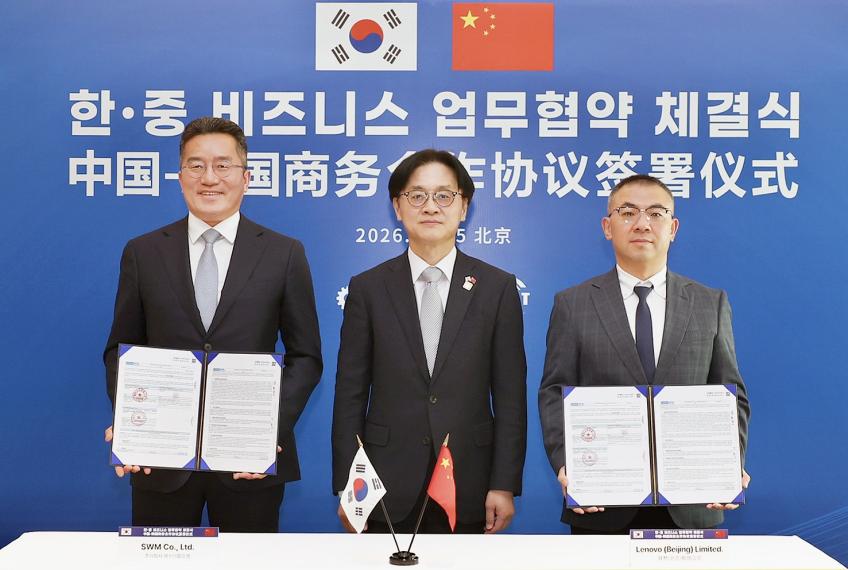
Core Insights - Lenovo and SWM have announced a strategic partnership to advance the development and deployment of next-generation L4 autonomous taxis (Robotaxi) during CES 2026 [1][10] - The collaboration aims to enhance safety and efficiency in smart mobility solutions, marking a significant step towards large-scale deployment of autonomous driving technology [1][10] Group 1: Partnership Details - The strategic cooperation was formalized through a Memorandum of Understanding (MOU) signed in the presence of key officials during a visit by the South Korean president to China [1] - SWM's "AP-700" autonomous driving platform is built on Lenovo's "L4 Autonomous Driving Domain Controller AD1," powered by NVIDIA DRIVE AGX Thor, providing over 2,000 TFLOPS of AI computing power [2][3] Group 2: Technology and Safety Standards - The AP-700 platform meets the highest safety and reliability standards in the automotive industry, including ISO 26262 ASIL-D and AEC-Q100 certifications [6] - The platform is optimized for advanced algorithms, enabling millisecond-level responses in complex urban traffic scenarios while ensuring system safety and stability [6] Group 3: SWM's Achievements and Future Plans - Since its establishment in 2017, SWM has focused on autonomous driving technology and achieved significant commercial success, including the first fully autonomous taxi service in Seoul's Gangnam area [7] - SWM aims to expand its autonomous driving services globally, starting with regions like Japan, Southeast Asia, and the Middle East, leveraging the partnership with Lenovo and NVIDIA [7][8] Group 4: Industry Implications - The collaboration exemplifies how NVIDIA DRIVE Hyperion platform empowers scalable and safety-validated autonomous taxi systems, indicating a shift from technology validation to large-scale deployment [8][10] - The global L4 autonomous driving technology is entering a new phase, with various applications like Robotaxi and Robobus moving towards mass production and deployment [10]