
LEAP系列发动机

Search documents
运输端春运启示:高客座率下高价格弹性初现;制造端继续看好国产大飞机产业链:华创交运 航空强国月报(第1期)
Huachuang Securities· 2026-03-01 13:25
Investment Rating - The report maintains a "Buy" recommendation for the aviation industry, highlighting strong demand and supply dynamics [1]. Core Insights - The report emphasizes the high passenger load factor and price elasticity observed during the Spring Festival travel period, indicating a robust recovery in the aviation sector [7][11]. - It notes that the domestic aviation market is experiencing a structural improvement in demand, driven by increased personal travel and a recovery in international travel [33][34]. - The report identifies key investment opportunities within the domestic aircraft manufacturing chain, particularly focusing on the development of indigenous large aircraft and commercial engines [53]. Summary by Sections Aviation Transportation - The Spring Festival saw a record high in cross-regional passenger flow, with a total of 6.72 billion trips, averaging 258 million trips per day, a 5.9% increase from the previous year [11][12]. - Domestic passenger volume increased by 6.3% year-on-year, while average ticket prices rose by 4.3% during the same period [12][13]. - The report highlights two key trends for the 2026 Spring Festival: a surge in secondary travel and concentrated return trips, reflecting a shift in travel patterns [14][15]. - Investment suggestions include focusing on major airlines such as Air China, China Southern Airlines, and China Eastern Airlines, as well as low-cost carriers like Spring Airlines [37]. Aviation Manufacturing - The report discusses the ongoing capacity ramp-up by major manufacturers Boeing and Airbus, with a combined backlog of over 15,000 aircraft orders [2][76]. - Boeing plans to increase its 737 production from 42 to 52 units per month by 2026, while Airbus aims to reach a production rate of 70-75 A320 aircraft per month by the end of 2027 [82]. - GE Aviation reported a significant increase in engine deliveries, with 2,386 commercial engines delivered in 2025, including 1,802 LEAP engines, reflecting a 28% year-on-year growth [93][100]. - The report recommends focusing on key suppliers within the commercial aircraft engine supply chain, including Aero Engine Corporation of China and other core component manufacturers [53][56].
运输端春运启示:高客座率下高价格弹性初现;制造端继续看好国产大飞机产业链:华创交运|航空强国月报(第1期)-20260301
Huachuang Securities· 2026-03-01 12:41
Investment Rating - The report maintains a "Recommended" investment rating for the aviation industry, highlighting strong demand and supply dynamics [1]. Core Insights - The report emphasizes the high passenger load factor and price elasticity observed during the Spring Festival travel period, indicating a robust recovery in air travel demand [7][11]. - It notes that the domestic aviation market is experiencing a structural improvement in demand, driven by increased private travel and a resurgence in international travel [33][34]. - The report identifies significant growth opportunities within the domestic large aircraft manufacturing sector, particularly for companies involved in the production of commercial aircraft and engines [53]. Summary by Sections Aviation Transportation - The Spring Festival saw a record high in cross-regional passenger flow, with a total of 6.72 billion trips, averaging 258 million trips per day, a 5.9% increase from the previous year [11][12]. - Domestic passenger volume increased by 6.3% year-on-year, while the average ticket price rose by 4.3% during the same period [12][13]. - The report highlights two key trends for the 2026 Spring Festival: a surge in secondary travel and concentrated return trips, reflecting a shift in travel patterns [14][15]. - Investment recommendations include major airlines such as Air China, China Southern Airlines, and China Eastern Airlines, as well as low-cost carriers like Spring Airlines, which are expected to benefit from high load factors and price elasticity [37]. Aviation Manufacturing - The report discusses the ongoing capacity ramp-up by major manufacturers Boeing and Airbus, with a combined backlog of over 15,000 aircraft orders [2][76]. - Boeing plans to increase its monthly production of the 737 model from 42 to 52 aircraft, while Airbus aims to reach a production rate of 70-75 A320 aircraft per month by the end of 2027 [82]. - GE Aviation reported a significant increase in engine deliveries, with 2,386 commercial engines delivered in 2025, including 1,802 LEAP engines, reflecting a 40% increase [93]. - Safran's LEAP engine deliveries reached a record high of 1,802 units, with a 28% year-on-year growth, driven by strong aftermarket activity [100]. - The report recommends focusing on the domestic large aircraft supply chain, particularly companies involved in engine manufacturing and key component suppliers [53][56].
如何看待本轮航空及航发板块行情?
2025-12-26 02:12
Summary of the Conference Call on the Aviation and Aerospace Industry Industry Overview - The domestic aviation and aerospace sector is supported by fundamentals, with companies like AVIC Shenyang Aircraft Corporation, AVIC Xi'an Aircraft Industry Group, and AVIC Chengdu Aircraft Industry Group expected to become domestic aviation giants through military-civilian integration and global expansion [1][4] - The C919 large aircraft project is progressing steadily, with a continuous increase in delivery volumes, although there is still room for improvement in the localization rate, which currently relies heavily on foreign engine and onboard equipment suppliers [1][5] Market Demand and Growth Potential - Over the next 20 years, the global demand for narrow-body and wide-body aircraft is projected to be significant, with a total market value of approximately $1.4 trillion, indicating substantial growth opportunities for domestic manufacturers, whose current revenue levels are far below market potential [1][6][7] - The aviation engine industry has immense potential, with the new aircraft engine market expected to reach RMB 130 billion annually, and the aftermarket potentially reaching RMB 500 billion, highlighting significant growth space for domestic leading enterprises [1][8] Competitive Landscape - GE Aviation dominates the global aerospace engine market, holding over 60% market share, while Rolls-Royce accounts for about 12% [1][9] - Domestic companies face challenges due to the monopoly of Western countries in the aerospace sector, with urgent needs for self-sufficiency and technological advancements to overcome these barriers [1][10] Challenges and Opportunities - The domestic aerospace industry is experiencing a supply-demand mismatch, with a significant backlog of orders and limited delivery capabilities, reflecting technological shortages and insufficient self-sufficiency [1][10][11] - Government policies have been supportive of the development of domestic commercial engines since the 13th Five-Year Plan, with expectations for technological breakthroughs by the end of the 15th Five-Year Plan, which will enhance localization rates and drive the development of the domestic industrial system [1][11] Investment Insights - Investment in aviation-related companies should focus on long-term growth potential rather than short-term valuations, with an emphasis on domestic substitution and mass production as key factors for future value growth [1][14] - The aviation sector's development is not solely reliant on individual events but also on the increasing interest in commercial space, active rocket markets, and the long-term accumulation of military companies, suggesting a positive long-term outlook for the industry [1][15] Key Players and Supply Chain - The core flight system sector includes major domestic companies such as AVIC Power, AVIC Technology, and AVIC Control, which are significant contractors in the sub-systems [1][13] - The relationship between civil aviation and military aviation is crucial, with many civil aviation components relying on military suppliers, indicating that companies involved in material supply will benefit from increased localization in civil aviation [1][12]

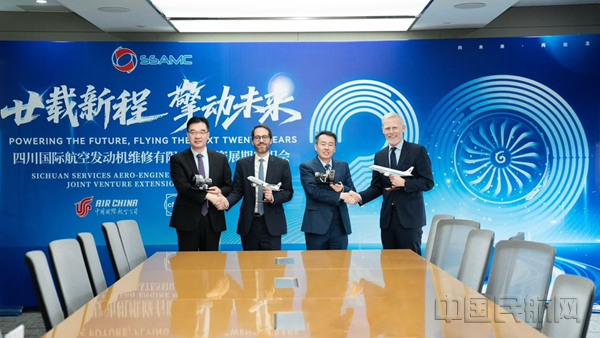
中国国际航空与CFM国际共庆25年合作并续签合资协议
Zhong Guo Min Hang Wang· 2025-11-20 03:51
Core Points - China International Airlines (Air China) and CFM International celebrate over 25 years of collaboration and extend their joint venture agreement for another 20 years [1][3] - The partnership emphasizes the commitment to providing world-class engine maintenance, repair, and overhaul (MRO) services in China and Asia [3][4] - The new agreement will enhance the LEAP engine maintenance capabilities of Sichuan International, supporting the growth of the LEAP engine fleet in China [3][4] Company Overview - Sichuan International was established in 1999 as a joint venture between Snecma (now Safran Aircraft Engines) and Southwest Airlines of China, later transitioning to a partnership between Air China and CFM International in 2010 [6] - The company has completed over 2,500 repairs on CFM56 engines and nearly 200 repairs on LEAP engines in the past seven years [6] - Sichuan International serves over 70 airlines in China and Asia, including Air China and its subsidiaries [6][8] Industry Context - The global aviation industry is currently undergoing a recovery and transformation, with Air China expressing confidence in the long-term development of the air transport market [3] - CFM International views China as a growth engine for its business in the Asia-Pacific region, with over 2,700 aircraft powered by CFM engines currently operating in China [4] - Sichuan International plays a crucial role in ensuring the reliability and operational efficiency of the CFM engine fleet in the region [4]


航亚科技(688510):首次覆盖报告:航发零部件先进制造商,远期发展动能强劲
GUOTAI HAITONG SECURITIES· 2025-10-17 11:01
Investment Rating - The report gives an "Accumulate" rating for the company with a target price of 32.32 CNY [5][11][15]. Core Insights - The company is a leading manufacturer of advanced components for aviation engines, benefiting from strong global demand and industry chain shifts, with expected performance growth exceeding expectations [2][11][19]. - The company is positioned to capitalize on the booming civil aviation market, with a projected market value of nearly 6.5 trillion USD over the next 20 years, leading to a significant increase in commercial aviation engine demand [11][19]. - The company has established strong relationships with major global engine manufacturers, enhancing its business prospects through advanced manufacturing techniques and customer loyalty [11][19]. Financial Summary - Total revenue is projected to grow from 544 million CNY in 2023 to 1.522 billion CNY in 2027, with a compound annual growth rate (CAGR) of approximately 27.2% [4][12]. - Net profit attributable to the parent company is expected to increase from 90 million CNY in 2023 to 313 million CNY in 2027, reflecting a CAGR of about 29.4% [4][12]. - Earnings per share (EPS) is forecasted to rise from 0.35 CNY in 2023 to 1.21 CNY in 2027, indicating strong profitability growth [4][12]. Business Overview - The company specializes in key components for aviation engines and medical orthopedic implants, having undertaken significant research and development projects in advanced manufacturing techniques [27][29]. - The company has established itself as a supplier to major international engine manufacturers, leveraging its expertise in precision forging technology [27][29]. - The company is expanding its business into the orthopedic implant sector, anticipating long-term demand growth due to an aging population and increasing joint replacement rates [11][19]. Market Position and Growth Drivers - The company is well-positioned to benefit from the ongoing global shift in the aviation industry supply chain, with a focus on deepening collaborations with domestic manufacturers [11][19]. - The civil aviation sector is experiencing a robust recovery, with the company expected to capture a significant share of the growing market for commercial aviation engines [11][19]. - The company’s advanced manufacturing capabilities create high barriers to entry, ensuring a competitive advantage in the market [11][19].

航亚科技20250910
2025-09-10 14:35
Summary of Hangya Technology Conference Call Company Overview - Hangya Technology specializes in precision forging and precision machining, with a strong technical advantage in both domestic and international markets [2][3] - The company was established in 2013 and went public on the Sci-Tech Innovation Board in 2020, initially partnering with Safran for low-pressure gas turbine blade manufacturing [2][6] - The chairman holds approximately 14% of shares, while Hangfa Assets holds about 5% [2][6] Core Business Segments - The core business consists of two main segments: precision forging and precision machining [4][21] - Precision forging is primarily used for compressor blade manufacturing, while precision machining covers critical components and has expanded into the medical field, supplying orthopedic parts to leading companies like Johnson & Johnson and Stryker [4][10] - The military aviation engine market is projected to demand approximately 40 billion RMB over the next five years, with the civil market averaging over 6 billion RMB annually [4][20] Market Performance and Growth - In the first half of 2025, the domestic aviation segment grew by approximately 8.3%, and the medical segment grew by about 16.7%, with domestic market growth exceeding 40% [2][14] - The international market is expected to see a decrease in overall business volume due to delivery expectations, but there is no long-term operational pressure [2][15] Competitive Landscape - Hangya Technology faces competition from companies in Germany, France, and Israel but has established stable relationships with major manufacturers like GE through its technological, quality, delivery, and cost advantages [2][8] - The company is involved in multiple engine models, including GE 9X, CFM 56, and LEAP series engines, indicating a strong position in the supply chain [11][9] Management and Strategic Direction - The management team has a strong technical background, with the chairman having over 30 years of experience in blade manufacturing [7] - The company has shifted its focus to profitable business segments since 2022, leading to a significant recovery in operational quality [6] Future Outlook - A stock incentive plan is set to be implemented in 2024, with a target net profit of 155 to 180 million RMB over the next three years, reflecting confidence in future growth [16] - The aviation manufacturing industry is experiencing a surge in orders, providing a strong demand outlook for Hangya Technology [23] Additional Insights - The precision forging process has evolved from cold to hot processing, offering advantages such as near-net shaping, improved manufacturing efficiency, and reduced costs [17] - The company’s international outsourcing capabilities are bolstered by stringent production controls and certifications, creating high industry barriers [18] - The medical sector's lower technical difficulty allows for quicker growth, enhancing overall profitability [10] Conclusion - Hangya Technology is well-positioned in the aviation manufacturing and medical sectors, with a robust growth trajectory supported by strategic partnerships and a focus on profitable operations. The company’s competitive advantages and market dynamics suggest a positive outlook for future performance.