LPO(线性驱动可插拔光模块)

Search documents
CPO,过热了?
半导体行业观察· 2025-12-25 01:32
Core Viewpoint - The article discusses the current state and future potential of Co-Packaged Optics (CPO) technology in the AI infrastructure landscape, emphasizing that while CPO is seen as a next-generation technology, its widespread adoption is not imminent due to existing technological limitations and market dynamics [1][24]. Group 1: Current Industry Sentiment on CPO - Broadcom's CEO Hock Tan stated that silicon photonics will not play a significant role in data centers in the short term, indicating that CPO is not a leapfrog technology but rather a last resort when existing technologies reach their limits [1][24]. - Major industry players, including Arista, Credo, Marvell, and Lumentum, echoed similar sentiments at the Barclays Global Technology Conference, suggesting a cautious approach towards CPO adoption [1][24]. Group 2: Shift in Industry Focus - The AI industry has shifted its focus from merely increasing computing power to addressing interconnectivity and system-level architecture, as the bottleneck has moved from computational capacity to interconnect capabilities [3][4]. - Companies are now prioritizing terms like Scale-Out, Scale-Up, and Scale-Across, indicating a deeper understanding of the infrastructure bottlenecks in AI [4]. Group 3: Horizontal and Vertical Scaling - Horizontal scaling (Scale-Out) is currently dominated by pluggable optics, with CPO technology not yet widely adopted due to the existing 800G and 1.6T technologies still being the main focus [7][8]. - Vertical scaling (Scale-Up) was initially seen as a promising application for CPO, but its timeline has been pushed back, with large-scale deployment expected around 2027-2028 [9][10]. Group 4: Challenges Facing CPO - CPO faces significant challenges, including higher costs, reliability issues, and power consumption concerns, which have delayed its mass production [18][24]. - The complexity of system design and the need for a mature supply chain are also major obstacles to the widespread adoption of CPO technology [19][24]. Group 5: Alternative Solutions - Transition solutions like LPO, AEC, and ALC are increasingly being recognized as viable alternatives to CPO, with many companies focusing on these technologies to meet current demands [15][25]. - LPO technology has already seen large-scale deployment, providing cost and power advantages, while AEC and ALC are being developed to offer reliability similar to copper cables with the bandwidth of optical solutions [15][25]. Group 6: Future Outlook - Industry predictions suggest that CPO will begin to see deployment in specific high-density systems around 2028, but the current focus remains on optimizing existing technologies [26][27]. - The industry consensus is that CPO will not be the immediate solution until existing technologies reach their limits in terms of power, density, and reliability [27].





OCP大会焦点:制造和封装已大幅扩产,AI芯片瓶颈转向下游,包括内存、机架、电力等
美股研究社· 2025-10-22 10:09
Core Insights - The AI semiconductor industry is expected to experience significant growth in 2026, with a shift in investment logic from upstream to downstream infrastructure [2][10] - The bottleneck in AI development has transitioned from chip manufacturing and packaging to downstream components such as data center space, power supply, and cooling systems [2][5] Upstream Capacity No Longer the Sole Bottleneck - Chip manufacturing and packaging have significantly expanded, alleviating previous supply concerns [4] - TSMC reported stronger-than-expected AI demand and a quick ramp-up in CoWoS capacity, indicating flexibility in the supply chain [4] - Despite ongoing tightness in advanced node wafer front-end capacity, AI semiconductors are prioritized over other applications like cryptocurrency ASICs [4] Bottleneck Shift - The current constraints are now focused on data center space, power availability, and supporting infrastructure, which have longer construction cycles than chip manufacturing [6] - The deployment of large-scale GPU clusters presents challenges in power consumption and heat dissipation, leading to a shift towards liquid cooling and high-voltage direct current (HVDC) solutions [6] Storage and Memory - AI workloads demand high-speed data storage and access, with companies like Meta opting for QLC NAND flash for cost efficiency [8] - The global demand for HBM (High Bandwidth Memory) is projected to surge, with NVIDIA expected to consume 54% of the total HBM by 2026 [8] Racks and Networking - OCP has introduced standardized blueprints for "AI Open Data Centers" and "AI Open Cluster Designs" to facilitate large-scale deployments [9] - Companies like Alibaba are focusing on pluggable optics for their cost-effectiveness and flexibility, while new technologies like CPO/NPO are gaining attention [9] Demand Forecast Indicates Explosive Growth for Downstream Components - Global cloud service capital expenditure is expected to grow by 31% in 2026, reaching $582 billion, significantly exceeding market expectations [11] - AI server capital expenditure could see approximately 70% year-over-year growth if its share in overall capital spending increases [11] AI Chip Demand Breakdown - NVIDIA is projected to dominate the CoWoS capacity consumption with a 59% share, followed by Broadcom, AMD, and AWS [12] - In AI computing wafer consumption, NVIDIA leads with a 55% share, followed by Google, AMD, and AWS [12] Investment Focus Shift - The signals from the OCP conference and industry data indicate a new direction for AI hardware investment, emphasizing the importance of downstream infrastructure [13] - Investors are encouraged to broaden their focus from individual chip companies to the entire data center ecosystem, identifying key players in power, cooling, storage, memory, and networking [13]



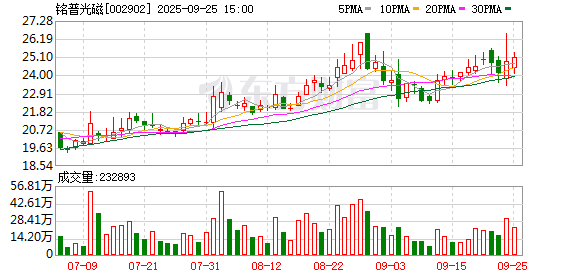
铭普光磁:公司已与客户合作开展LPO(线性驱动可插拔光模块)方案的ODM定制开发
Zheng Quan Ri Bao· 2025-09-25 14:08
Core Viewpoint - Mingpu Optoelectronics has initiated ODM custom development for 800G optical modules and has received initial orders, although profitability remains limited due to the current scale of operations [2] Group 1: Business Development - The company is collaborating with clients on the LPO (Linear Pluggable Optical Module) solution for 800G optical modules [2] - The 800G optical module segment has not yet achieved significant profitability due to its limited business scale [2] Group 2: R&D and Future Prospects - Mingpu Optoelectronics is jointly developing the next-generation 800G NPO (Near-Package Optical) with external customers, which is still in the R&D phase [2] - The project for 800G NPO has not yet reached mass production, and future progress remains uncertain [2]