
LightGen

Search documents
美团,投了临港一家企业! | 融资周报(2025年第47期)
Sou Hu Cai Jing· 2025-12-23 07:08
Financing Overview - A total of 20 financing events occurred in Shanghai from December 15 to December 21, with 7 disclosing amounts totaling approximately 1.171 billion yuan [3] - This period saw a decrease of 2 financing events compared to the previous week, which had 22 events [3] Company Dynamics - Moudian Intelligent won the highest award at the National Disruptive Technology Innovation Competition on December 12 [2] - Maikang Smart secured the first prize at the "Huawei Cloud Cup" 2025 AI Application Innovation Competition on December 17 [2] - Jieti Medical was selected for the "2025 China Sci-Tech Innovation Good Company" list by Zhito Finance on December 18 [2] - Jeno Bio's "Gong'anli®" successfully obtained registration in Thailand on December 20 [2] Industry Focus - The Shanghai Open Processor Industry Innovation Center was officially launched in the RISC-V Ecological Block on December 15 [2] - Muxi Co., a Zhangjiang enterprise, was listed on the Shanghai Stock Exchange's Sci-Tech Innovation Board on December 17 [2] - A team from Shanghai Jiao Tong University's Integrated Circuit Institute developed the all-optical computing chip LightGen on December 21 [2] Financing by Region - Nine districts in Shanghai experienced financing events, with Pudong New District having the highest number at 9 events, followed by Xuhui District with 3 events [5] Financing by Round - The majority of financing rounds were Series A, with 8 occurrences, followed by 6 angel rounds [5] Financing by Industry - The artificial intelligence sector led with 6 financing events, followed by the healthcare sector with 4 events [7] Notable Financing Events - Jeno Bio completed over 200 million yuan in Series B financing on December 16, led by Huagai Capital [10] - Anlingke Bio secured nearly 50 million USD in A+ round financing on December 16, with investments from multiple firms [12] - Fangqing Technology completed over 500 million yuan in angel+++ and Pre-A round financing on December 16 [14] - Yuanma Zhiyuan completed angel+ round financing on December 15, exclusively invested by Yifeng Capital [16] Industry Highlights - Five financing events related to the artificial intelligence industry occurred, with three involving AIGC [18] - Three financing events in the integrated circuit industry included two in EDA and one in logic chips [18] - The successful listing of Muxi Co. set a benchmark for the commercialization of domestic high-end chips [18] - The development of the LightGen chip provides a new method to address the computational power gap in generative AI deployment [18] - The Shanghai Open Processor Industry Innovation Center aims to strengthen policy guidance and ecological cultivation for the integrated circuit industry [18]



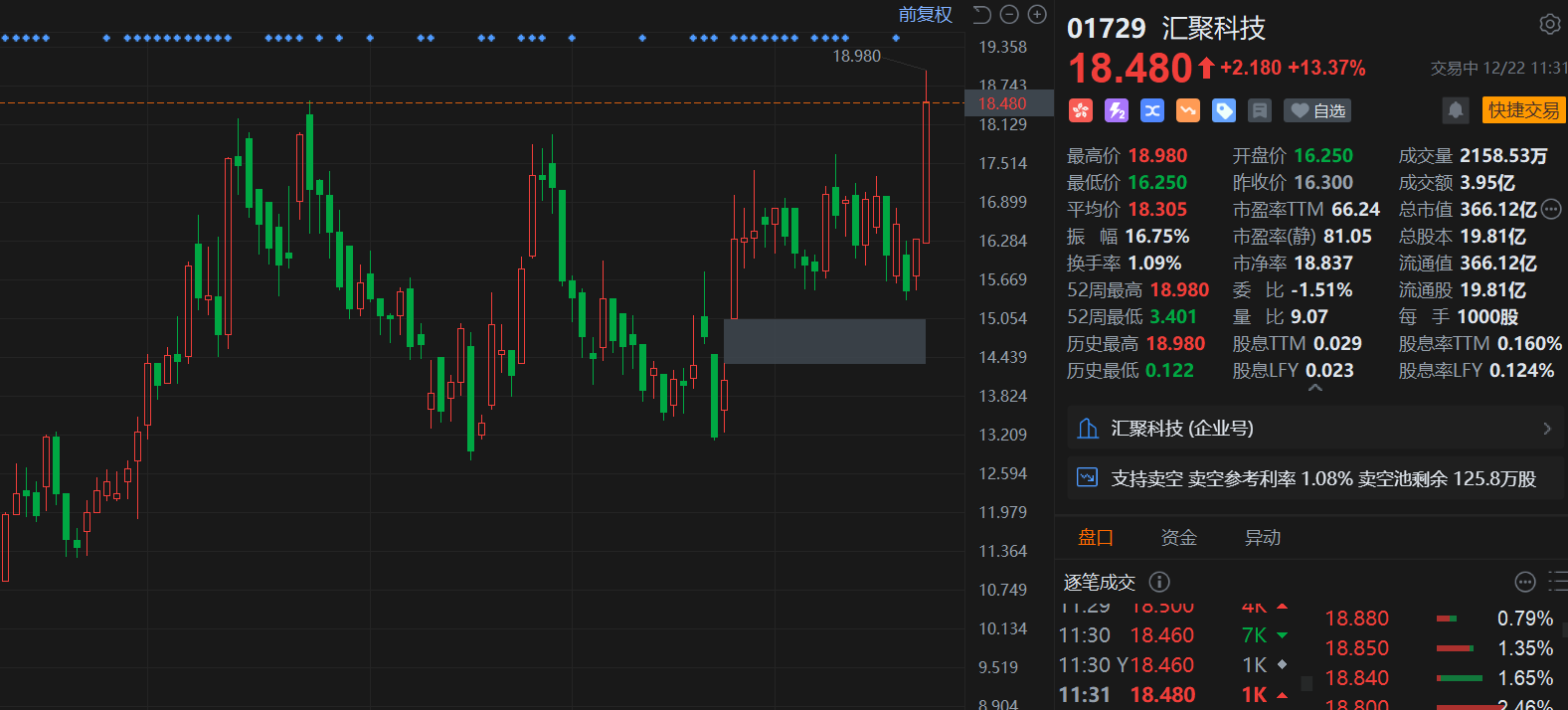
港股异动 光通信概念走势强劲 汇聚科技(01729)涨超13% 光计算芯片领域取得新突破
Jin Rong Jie· 2025-12-22 04:05
Group 1 - The optical communication sector is experiencing strong performance, with companies like Huiju Technology (01729) up by 13.44% to HKD 18.29, Changfei Optical Fiber (06869) up by 11.01% to HKD 57.45, Cambridge Technology (06166) up by 4.99% to HKD 85.2, and Huahong Semiconductor (01347) up by 3.54% to HKD 70.15 [1] - Researchers from Shanghai Jiao Tong University have made a breakthrough in the next-generation optical computing chip field, achieving the first all-optical computing chip, LightGen, which supports large-scale semantic media generation models. The chip demonstrates a two-order-of-magnitude improvement in computing power and energy efficiency compared to top digital chips, even with less advanced input devices [1] - According to Zhongyuan Securities, China's optical communication industry chain and value chain are gradually transitioning from low-end to high-end, indicating long-term prosperity. The research and expansion cycle for optical chips is lengthy with high barriers, leading domestic and foreign manufacturers to accelerate capacity expansion and process upgrades [1] - Guotou Securities reports that the demand for AI computing power continues to expand, sustaining the upward trend in the optical module industry, which presents opportunities for all segments of the industry chain [1]
港股异动丨汇聚科技涨超16%,股价创历史新高,行业迎重大突破
Ge Long Hui· 2025-12-22 03:36
Core Viewpoint - The Hong Kong optical communication sector is experiencing strong performance, particularly with Huiju Technology (1729.HK) which saw its stock price surge over 16%, reaching a historical high of 18.98 HKD and a total market capitalization exceeding 37 billion HKD. This surge is attributed to significant advancements in optical computing technology by a research team from Shanghai Jiao Tong University [1] Company Summary - Huiju Technology (1729.HK) achieved a notable stock price increase, peaking at 18.98 HKD, marking a historical high [1] - The company's market capitalization surpassed 37 billion HKD, reflecting strong investor interest and confidence [1] Industry Summary - The optical communication sector is currently robust, driven by technological advancements [1] - A major breakthrough was reported by a research team from Shanghai Jiao Tong University, which developed the "LightGen" chip, a full-optical large-scale semantic generation chip [1] - This new chip is the first of its kind to support large-scale semantic media generation models, indicating a significant leap in optical computing capabilities [1]
我国实现新一代光计算芯片突破,算力和能效大幅提升
Xuan Gu Bao· 2025-12-21 15:17
Core Insights - Shanghai Jiao Tong University researchers have achieved a breakthrough in the field of next-generation optical computing chips, realizing the first all-optical computing chip that supports large-scale semantic media generation models [1] - The LightGen chip demonstrates a performance leap by overcoming three key bottlenecks: integration of millions of optical neurons on a single chip, all-optical dimensional transformation, and a light-based generative model training algorithm that does not rely on truth values [1] - Optical computing chips utilize photons instead of electrons for information processing, offering three core advantages: ultra-high speed, ultra-low energy consumption, and high parallelism [1] Industry Implications - The development of optical computing chips represents a transformative shift akin to the transition from fuel vehicles to electric vehicles, moving competition from process technology to energy efficiency, parallelism, and optimization for specific scenarios [1] - This technological revolution presents a historic opportunity for China to "overtake" in the high-end AI computing chip sector [1] Related Companies - Relevant A-share concept stocks include Huagong Technology and Guangxun Technology [2]
芯片,突传重磅!
证券时报· 2025-12-21 10:40
Group 1: Chip Innovations - Samsung Electronics has launched the Exynos 2600 system-on-chip (SoC), the world's first mobile application processor built using 2nm technology, featuring a 113% increase in AI computing power compared to its predecessor Exynos 2500 [2][5] - The Exynos 2600 integrates a new tri-cluster CPU design with a maximum clock speed of 3.8GHz, achieving up to 39% improvement in overall computing performance and enhanced energy efficiency [5][6] - The new GPU architecture "Huagang" from Moore Threads has been introduced, with two chips "Huashan" and "Lushan" that enhance AI inference training and high-performance graphics rendering, achieving a 50% increase in computing density and a 10x improvement in energy efficiency [3][15] Group 2: Optical Computing Breakthroughs - Researchers from Shanghai Jiao Tong University have achieved a significant breakthrough in optical computing, developing the LightGen chip capable of supporting large-scale semantic media generation models, with results published in the journal Science [9][10] - LightGen demonstrates a two-order-of-magnitude improvement in computing power and energy efficiency compared to leading digital chips, addressing the challenges of running complex generative models [10][11] - The chip can perform high-resolution image generation, 3D generation, and video generation, while supporting various large-scale generative tasks [11][12]

【数智周报】MiniMax和智谱通过港交所聆讯;OpenAI据悉计划以8300亿美元估值筹资至多1000亿美元;寒武纪:拟使用27.78亿元资本公积金弥补亏损
Tai Mei Ti A P P· 2025-12-21 04:23
Group 1 - Elon Musk publicly criticized nuclear fusion power, stating that building small fusion reactors on Earth is economically foolish, as the sun itself is a massive, free fusion reactor capable of meeting all energy needs in the solar system [2] - Musk plans to deploy 100GW of solar-powered AI satellites annually, which is equivalent to about a quarter of the total electricity consumption of the United States [2] Group 2 - Zhongke Shuguang unveiled the scaleX Wanka supercluster at the HAIC2025 conference, marking the first appearance of a domestic 10,000-card AI cluster system in physical form [3] - Unisoc announced the establishment of a Central Research Institute to focus on new architectures and models for edge AI chips, particularly for applications in autonomous driving and robotics [3] Group 3 - Cambricon announced plans to use 2.778 billion yuan of its capital reserve to cover cumulative losses, with the aim of bringing its negative retained earnings to zero by the end of 2024 [4] Group 4 - MiniMax has passed the Hong Kong Stock Exchange hearing and plans to go public in January 2026, potentially becoming the fastest AI company to IPO globally within four years of its establishment [6] - Zhiyuan Technology has officially passed the Hong Kong Stock Exchange IPO hearing, with CICC as the sole sponsor [6] Group 5 - Tencent has established an AI Infra department to enhance its large model research framework, with Vincesyao appointed as the chief AI scientist [6][7] - The AI Infra department will focus on building technical capabilities for large model training and inference platforms [7] Group 6 - ByteDance is advancing a collaboration with Lenovo to develop AI smartphones, aiming to pre-install AIGC plugins to gain user access [8] - Doubao released version 1.8 of its large model, enhancing its capabilities for multi-modal agent scenarios [9] Group 7 - Qianwen APP has integrated with Alibaba's ecosystem, enabling it to access underlying services like Gaode Map for enhanced geographical understanding [10] - Alibaba launched the new generation of the Wanxiang 2.6 model, which supports role-playing functions for video production [11] Group 8 - Baidu launched the Wenxin Health Manager, positioning it as a 24/7 "all-in-one family doctor" service [14] - The application offers a comprehensive AI health service system covering light symptom consultations and complex disease planning [14] Group 9 - Aishi Technology signed a comprehensive cooperation agreement with Alibaba Cloud to enhance global deployment and compliance capabilities for its video generation model [15] - Xiaomi open-sourced its MiMo-V2-Flash model, which boasts competitive capabilities at a significantly lower inference cost compared to closed-source models [16] Group 10 - Muxi Technology officially listed on the Shanghai Stock Exchange's Sci-Tech Innovation Board, aiming to raise 4.197 billion yuan to accelerate the development of "Chinese chips" [17] - The company focuses on high-performance general-purpose GPU products for AI training and inference [17] Group 11 - Meituan released and open-sourced the LongCat-Video-Avatar model, which supports multiple video generation tasks [18] - The model has achieved significant breakthroughs in action realism and video stability [18] Group 12 - Chinese scientists achieved a breakthrough in optical computing chips, enabling large-scale semantic media generation [19][20] - The LightGen chip demonstrates significant improvements in performance and energy efficiency compared to traditional digital chips [20] Group 13 - Baidu's Kunlun chip business is reportedly nearing completion of its restructuring, aiming for a potential listing in Hong Kong [20] - SenseTime's Seko series models have successfully adapted to the domestic AI chip Cambricon [20] Group 14 - Nvidia's CEO revealed that the company has not yet made any payments to OpenAI as part of a planned $100 billion investment [22] - Nvidia launched the Nemotron 3 open-source model series, significantly improving throughput compared to its predecessor [23] Group 15 - OpenAI plans to raise up to $100 billion, potentially valuing the company at $830 billion [24] - The new image model GPT-image-1.5 was launched, enhancing image generation capabilities significantly [25] Group 16 - Intel is in talks to acquire AI chip startup SambaNova for approximately $1.6 billion [30] - Multiple AI companies have recently completed significant funding rounds to support their growth and technology development [31][32][33][34][35][36][37]



重大突破!芯片大消息!
天天基金网· 2025-12-21 03:12
Core Viewpoint - The article highlights a significant breakthrough in the field of optical computing chips by researchers at Shanghai Jiao Tong University, specifically the development of the LightGen chip, which supports large-scale semantic media generation models [3][4]. Breakthrough Details - The LightGen chip represents the first full-optical computing chip capable of supporting large-scale semantic generation models, addressing the performance gap in traditional chip architectures due to the increasing demands of deep neural networks and large-scale generative models [4]. - Optical computing utilizes light propagation within chips to perform calculations, offering inherent advantages such as high speed and parallelism, making it a promising direction for overcoming computational and energy consumption bottlenecks [4][5]. Performance Enhancements - LightGen has demonstrated a performance improvement of two orders of magnitude in computational power and energy efficiency compared to leading digital chips, even when using relatively outdated input devices [5]. - The chip achieves this leap in performance by overcoming three critical bottlenecks: integrating millions of optical neurons on a single chip, enabling full-optical dimensional transformation, and developing a light-based generative model training algorithm that does not rely on truth values [5][6]. Functional Capabilities - LightGen can complete a closed loop of "input-understanding-semantic manipulation-generation," enabling high-resolution image generation (≥512×512), 3D generation (NeRF), high-definition video generation, and semantic control, while also supporting denoising and feature transfer tasks [6]. Advantages of Optical Computing - Optical computing is characterized by scalability, low power consumption, ultra-high speed, wide bandwidth, and high parallelism, making it a key technology for rapid computation of large-scale data in AI, scientific computing, and multimodal perception [7]. - Recent advancements in optical computing have focused on increasing matrix scale and optical frequency, with notable examples including TSMC's optical computing chip matrix (~512x512) and Caltech's optical frequency exceeding 100GHz, indicating the challenges in achieving further breakthroughs [7]. Future Directions - Expanding computational parallelism is identified as a critical development direction for enhancing optical computing performance and making it practical for real-world applications [8]. - A recent achievement by the Shanghai Institute of Optics and Fine Mechanics has led to the development of a high-parallel optical computing integrated chip, demonstrating a parallelism greater than 100, which addresses key challenges in high-density information processing [8][9].

重大突破!芯片,大消息!
券商中国· 2025-12-20 12:54
Core Viewpoint - The article highlights a significant breakthrough in the field of optical computing chips, specifically the development of the LightGen chip by researchers at Shanghai Jiao Tong University, which supports large-scale semantic media generation models [2][3]. Breakthrough Achievements - Researchers have successfully developed the LightGen chip, which is capable of achieving two orders of magnitude improvement in computing power and energy efficiency compared to top digital chips, even when using less advanced input devices [4]. - The LightGen chip overcomes three critical bottlenecks: integration of millions of optical neurons on a single chip, all-optical dimensional transformation, and a novel optical training algorithm that does not rely on ground truth [4]. - LightGen can perform a complete closed-loop process of input, understanding, semantic manipulation, and generation, enabling high-resolution image generation (≥512×512), 3D generation (NeRF), and high-definition video generation [4]. Advantages of Optical Computing - Optical computing is recognized for its scalability, low power consumption, ultra-high speed, wide bandwidth, and high parallelism, making it a key technology for rapid computation of large-scale data in AI, scientific computing, and multimodal perception [5]. - The article notes that traditional chip architectures are struggling to keep pace with the increasing demands for computing power and energy efficiency due to the rapid evolution of deep neural networks and large-scale generative models [3][5]. Recent Developments in Optical Computing - A recent advancement by the Shanghai Institute of Optics and Fine Mechanics has led to the development of a high-parallel optical computing integrated chip, achieving a parallelism greater than 100, which addresses the challenge of high-density information processing on optical chips [6][7]. - The new optical chip system includes a self-developed integrated micro-cavity optical frequency comb and a high-performance parallel computing core, enabling a theoretical peak computing power of over 2560 TOPS with a power efficiency of over 3.2 TOPS/W [7].

我国科学家实现新一代光计算芯片研究新突破!
Mei Ri Jing Ji Xin Wen· 2025-12-19 16:45
Core Viewpoint - Shanghai Jiao Tong University has achieved a breakthrough in the field of next-generation optical computing chips, successfully developing an all-optical computing chip that supports large-scale semantic media generation models, with results published in the journal "Science" on December 19 [1] Group 1: Optical Computing Breakthrough - The rapid evolution of deep neural networks and large-scale generative models has led to a significant gap in performance growth of traditional chip architectures, prompting widespread interest in new architectures like optical computing [1] - Optical computing utilizes light propagation within chips to perform calculations, leveraging the inherent speed and parallelism of light, making it a promising direction to overcome computational power and energy consumption bottlenecks [1] Group 2: LightGen Chip Development - The research team led by Chen Yitong has proposed and implemented the LightGen chip, which demonstrates a two-order-of-magnitude improvement in computational power and energy efficiency compared to top digital chips, even with less advanced input devices [2] - LightGen overcomes three critical bottlenecks: integration of millions of optical neurons on a single chip, all-optical dimensional transformation, and a truth-independent optical generative model training algorithm, enabling end-to-end implementation for large-scale generative tasks [2] - LightGen can complete a closed loop of "input-understanding-semantic manipulation-generation," achieving high-resolution (≥512×512) image semantic generation, 3D generation (NeRF), high-definition video generation, and semantic control, while also supporting denoising and feature transfer tasks [2]
我国科学家实现新一代光计算芯片研究新突破
Xin Hua She· 2025-12-19 14:33
Core Viewpoint - Shanghai Jiao Tong University has achieved a breakthrough in the field of next-generation optical computing chips, successfully developing an all-optical computing chip that supports large-scale semantic media generation models, with results published in the journal "Science" on December 19 [1] Group 1: Optical Computing Breakthrough - The traditional chip architecture is facing a significant performance growth gap due to the rapid evolution of deep neural networks and large-scale generative models, leading to increased demand for computing power and energy [1] - Optical computing is viewed as a crucial direction to overcome the bottlenecks of computing power and energy consumption, utilizing light propagation in chips instead of electrons in transistors [1] Group 2: LightGen Chip Development - The LightGen chip developed by the research team demonstrates a performance improvement of two orders of magnitude in computing power and energy efficiency compared to top digital chips, even when using relatively outdated input devices [2] - Key breakthroughs in LightGen include the integration of over one million optical neurons on a single chip, full optical dimension conversion, and a novel light-based generative model training algorithm that does not rely on true values [2] - LightGen can complete a closed loop of "input—understanding—semantic manipulation—generation," enabling high-resolution (≥512×512) image generation, 3D generation (NeRF), high-definition video generation, and semantic control, while also supporting denoising and feature transfer tasks [2]