MOS类芯片

Search documents
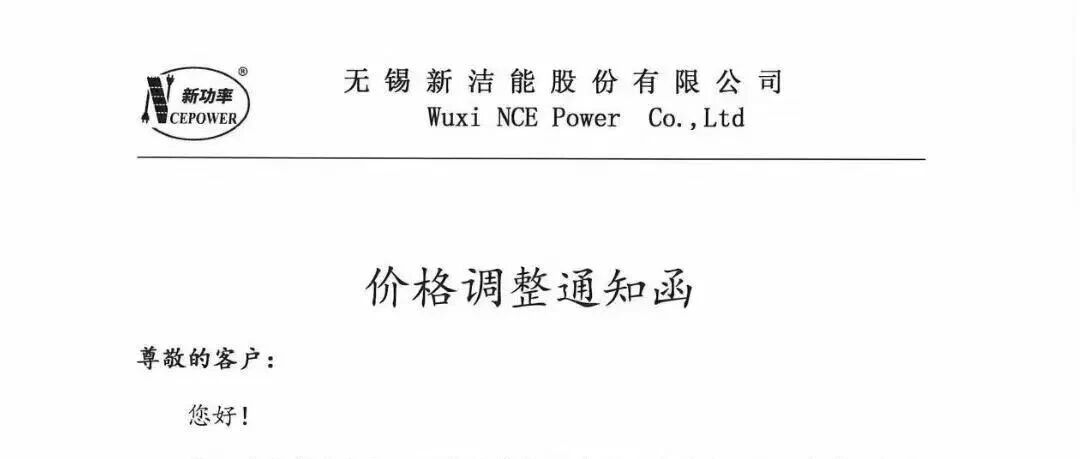
功率半导体厂商新洁能,传涨价!
芯世相· 2026-02-25 10:03
Core Viewpoint - The semiconductor industry is experiencing a wave of price increases due to rising costs of raw materials and key precious metals, with several companies announcing price hikes for their products starting in 2026 [3][5][6][10][13]. Group 1: Company Announcements - Wuxi Xin Jie Neng Co., Ltd. announced a price increase of at least 10% for its MOSFET products, effective from March 1, 2026, due to rising wafer processing and packaging costs [3][5]. - Jiangsu Hongwei Technology Co., Ltd. is set to raise prices for IGBT and MOSFET devices, with the increase also taking effect on March 1, 2026 [6]. - China Resources Microelectronics will implement a price increase of at least 10% for its entire range of electronic products starting February 1, 2026 [8]. - Silan Microelectronics plans to raise prices for small signal diodes, transistors, and MOS-type chips by 10%, effective March 1, 2026, with further details to be communicated directly to customers [10]. - Infineon has issued a price adjustment notice, stating that new prices will apply to all new orders and parts of existing orders scheduled for shipment on or after April 1, 2026 [13]. Group 2: Industry Context - The semiconductor industry, particularly in power devices, is seeing multiple companies announce price hikes, indicating a broader trend of increasing costs across the sector [5][6][10]. - The price adjustments are attributed to the significant rise in costs of upstream raw materials and key precious metals, impacting the overall cost structure of semiconductor manufacturing [3][5].


华润微、士兰微、英飞凌等多家半导体厂商涨价!
Xin Lang Cai Jing· 2026-02-14 05:12
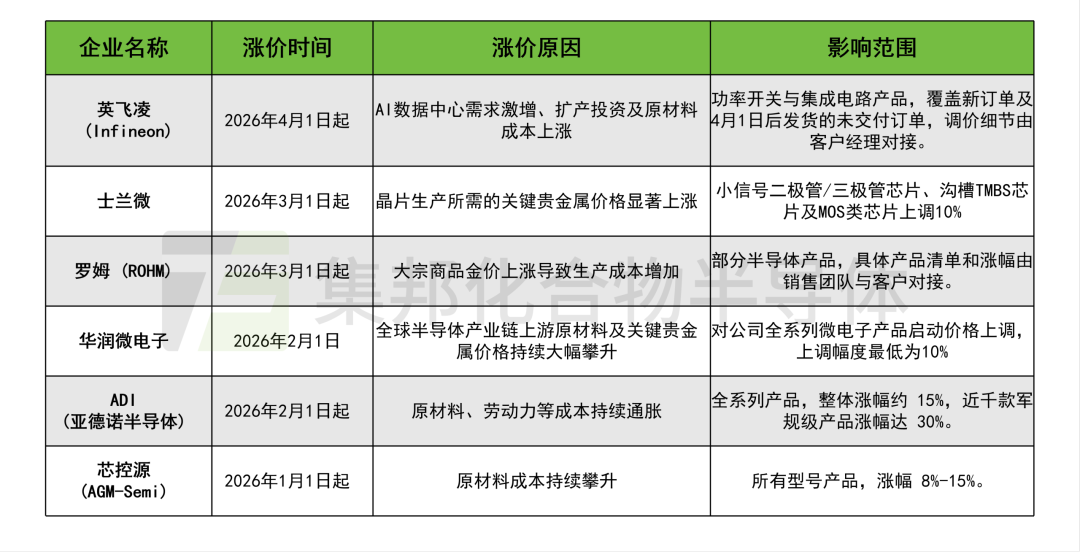
Core Viewpoint - The recent price increase announcements from multiple power semiconductor companies, including Silan Micro, Infineon, and China Resources Microelectronics, have drawn significant industry attention, indicating a broader trend of rising costs and demand in the semiconductor sector [1][14]. Price Increase Details - Infineon will raise prices for power switches and integrated circuit products starting April 1, 2026, due to surging demand from AI data centers, expansion investments, and rising raw material costs [2][19]. - Silan Micro will implement a 10% price increase on small signal diodes, transistors, trench TMBS chips, and MOS chips effective March 1, 2026, driven by significant increases in key precious metal prices [2][17]. - ROHM will also increase prices for certain semiconductor products starting March 1, 2026, due to rising commodity prices [2]. - China Resources Microelectronics will raise prices for its entire range of microelectronic products by at least 10% starting February 1, 2026, citing significant increases in upstream raw material prices [2][20]. - Analog Devices (ADI) will increase prices by approximately 15% across its entire product range, with some military-grade products seeing increases of up to 30% starting February 1, 2026 [2]. - AGM-Semi will raise prices by 8%-15% for all models starting January 1, 2026, due to rising raw material costs [2]. Reasons for Price Increases - The primary driver for the price increases is the sustained pressure on production costs, influenced by rising commodity prices, particularly precious metals, and increased costs in wafer manufacturing and packaging [10][23]. - The tightening of wafer foundry capacity, as leading foundries shift focus away from mature processes, has further exacerbated cost pressures [10][23]. - Demand for power semiconductors is structurally increasing due to rapid growth in sectors such as AI data centers, electric vehicles, energy storage, and industrial control [10][24]. Market Dynamics - The value of power components in AI servers has increased significantly, with the price per server component rising from $6-7 to $30-50, a nearly fivefold increase, which has driven demand for power switches and power management chips [11][24]. - The ongoing development in automotive electronics and energy storage is further amplifying the demand gap for power semiconductors, supporting price increases [10][25]. Impact on Third-Generation Semiconductors - The price increases from major power semiconductor manufacturers may facilitate a shift towards third-generation semiconductors, as the price gap between traditional silicon-based devices and SiC/GaN devices narrows [12][25]. - As traditional power device prices rise, downstream companies may reconsider their cost structures, potentially favoring SiC devices for their efficiency and reduced thermal management needs [12][26]. - In the AI server power market, rising traditional silicon power prices may drive manufacturers to adopt more efficient GaN solutions to lower operational costs [12][26]. Conclusion - The price increase trend among power semiconductor companies is a reflection of supply-demand imbalances, rising costs, and technological advancements, marking a significant phase of structural adjustment in the global power semiconductor industry [13][27]. - This trend not only accelerates the domestic substitution process for silicon-based power semiconductors but also acts as a catalyst for the cost-effective application of third-generation semiconductors, promoting a transition towards high-efficiency, energy-saving, and miniaturized high-end fields [13][27].

【太平洋科技-每日观点&资讯】(2026-02-12)
远峰电子· 2026-02-11 14:04
Market Overview - The major indices showed mixed performance with the Shanghai Composite Index up by 0.09%, while the Shenzhen Component, North 50, ChiNext, and Sci-Tech 50 indices declined by 0.35%, 0.44%, 1.08%, and 1.11% respectively [1] TMT Sector Performance - The TMT sector saw gains in sub-sectors such as SW Electronic Chemicals III (+0.65%), SW Passive Components (+0.55%), and SWIT Services III (+0.15%) [1] - Conversely, the TMT sector faced declines in SW Portal Websites (-4.68%), SW Marketing Agencies (-4.05%), and SW Mass Publishing (-4.03%) [1] Domestic News - Zunheng Semiconductor announced a significant breakthrough in advanced packaging electroplating technology, achieving a uniformity control of 2.7%, surpassing the industry standard of 3% and breaking the long-standing monopoly of foreign manufacturers in this core technology area [2] - Silan Microelectronics announced a 10% price increase for certain device products effective March 1, 2026, due to significant fluctuations in global metal market prices, particularly for key precious metals used in wafer manufacturing [2] - Huada Technology's acquisition of Huayi Microelectronics for 2.996 billion aims to leverage Huayi's R&D capabilities to extend its power device brand development and sales across automotive, industrial, and consumer sectors, creating a new revenue growth point [2] - Xinyi Huazhi's OLED deposition equipment has secured orders worth hundreds of millions from leading panel customers, marking a successful transition from technology R&D to mass production and breaking foreign manufacturers' long-standing dominance in this field [2] International News - Amazon is deepening its partnership with STMicroelectronics to enhance the performance and efficiency of AWS data centers, focusing on chip design optimization and tighter integration of manufacturing processes [3] - The South Korean government announced a plan worth 1 trillion KRW (approximately 687.8 million USD) to develop AI semiconductors for equipment applications, aiming to produce about 10 types of AI chips for autonomous vehicles, smart appliances, and humanoid robots over the next five years [3] - TrendForce predicts that Google's Ironwood cabinet system will boost the global shipment share of 800G+ high-speed optical transceiver modules from 19.5% in 2024 to over 60% by 2026, becoming a standard in AI data centers [3] - imec announced the launch of its "NanoIC" pilot production line with a total investment of 2.5 billion euros, equipped with advanced High NA EUV lithography machines, expected to receive ASML's High NA EUV lithography machine by March 2026 [3] AI Insights - Kaiden Electronics launched the world's first AI solution for chip front-end design and verification, ChipStack™ AI, which can autonomously complete design and verification tasks, improving efficiency by up to 10 times [4] - Deepseek released a new version with a significant upgrade, increasing the context window from 128K to 1M tokens, indicating a major iteration based on new data training [4] - Tencent's HY-1.8B-2Bit model achieves a parameter reduction of six times compared to the original model while enhancing generation speed by 2 to 3 times on real edge devices [4] - Clawra, an AI girlfriend based on OpenClaw, has been launched, featuring a complete life trajectory and digital personality, capable of chatting, sending selfies, and video calls [4] Industry Tracking - The "Star Cloud II" large reusable launch vehicle's core propulsion system has made significant progress, completing ignition tests with the "Thunder-RS" engine, which has the highest thrust in China at 130 tons [5] - A Chinese team successfully completed the world's first clinical trial applying brain-machine interface technology for boundary identification in deep brain tumor surgery [5] - IDC forecasts that global humanoid robot shipments will reach approximately 18,000 units by 2025, a year-on-year growth of about 508%, with sales expected to reach around 440 million USD [5] - A Chinese team has successfully implemented Joule heating technology to achieve ultra-fast ceramicization of polycarbosilane precursors in one second, significantly improving pyrolysis efficiency [5]
涨!涨!涨!半导体行业掀涨价风暴
Xin Lang Cai Jing· 2026-02-11 10:16
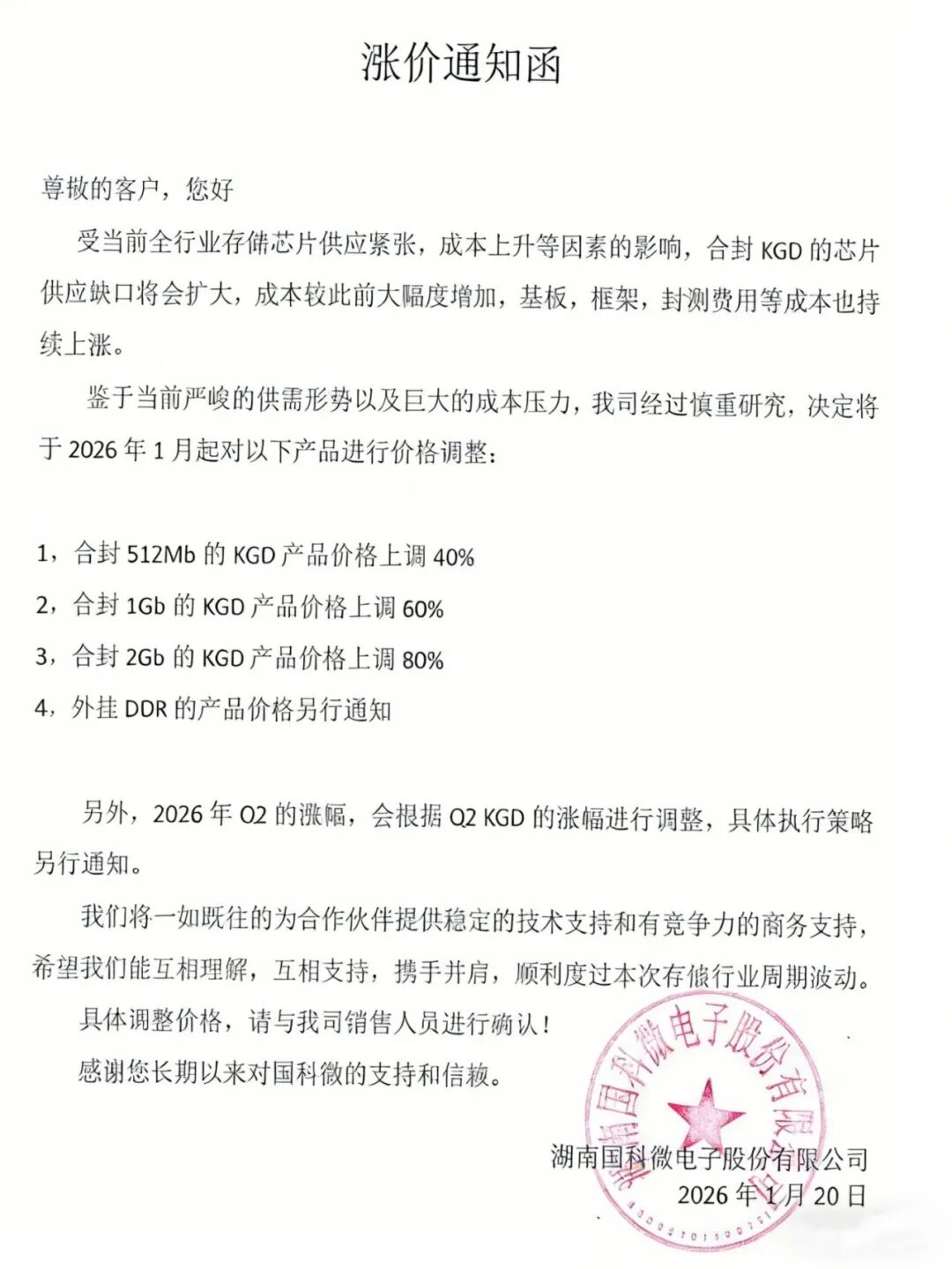
Core Viewpoint - The global semiconductor industry is experiencing a new wave of price increases across the entire supply chain, driven by surging AI demand and rising raw material costs [1][3][61]. Group 1: Price Increases in Domestic Semiconductor Companies - Over 20 semiconductor companies have officially announced price increases [2][62]. - Domestic chip manufacturers are significantly raising prices, with increases as high as 80% for certain products [4][63]. - Guokewai announced price hikes for its KGD storage products, with increases of 40% to 80% [6][66]. - Zhongwei Semiconductor is raising prices for MCU and NOR Flash products by 15% to 50% due to supply chain pressures [9][73]. - Biyiwei has also announced price increases across its entire product line, citing rising raw material costs [17][76]. Group 2: Price Increases in International Semiconductor Companies - International semiconductor giants are also raising prices, with ADI increasing prices by 15% to 30% starting February 1, 2026 [21][81]. - Infineon plans to raise prices for power switches and IC products due to increased demand from AI data centers [24][83]. - Texas Instruments is expected to raise prices by over 30% across nearly all categories due to rising costs [21][81]. Group 3: Price Increases in Wafer Foundry and Packaging - Wafer foundries are increasing prices, with TSMC raising advanced process prices by 3% to 10% [25][85]. - Packaging and testing services are seeing price increases of up to 30%, driven by high demand and capacity constraints [27][86]. Group 4: Impact of Raw Material Costs - The prices of precious metals like gold, silver, and copper are rising, significantly impacting chip manufacturing costs [57][116]. - The increase in raw material costs is leading to a ripple effect across the semiconductor supply chain, prompting many companies to raise their product prices [57][116]. Group 5: Effects on End Markets - The price increases in storage chips are affecting end markets, with PC manufacturers like Dell and Lenovo planning price hikes of 10% to 30% [59][118]. - In the smartphone sector, rising storage costs are pressuring new product pricing, particularly for low-end models [59][118]. - The automotive electronics sector is also feeling the impact, with companies like Xiaomi and NIO reporting cost pressures due to rising semiconductor prices [59][119].


头部 IDM 发函:3月1日涨价 10%
是说芯语· 2026-02-10 23:47
Core Viewpoint - Company Silan Microelectronics announced a price increase of 10% for certain device products due to fluctuations in global metal market prices and rising costs of key precious metals, effective from March 1, 2026 [1][4]. Group 1: Price Adjustment Details - The price adjustment will affect three core product categories: small signal diodes/transistor chips, trench TMBS chips, and MOS chips [4]. - The company cited significant increases in the prices of key precious metals necessary for wafer production, leading to a continuous rise in wafer manufacturing costs [4]. Group 2: Company Background and Strategy - Silan Microelectronics, established in 1997, is one of the largest integrated device manufacturers (IDM) in China, focusing on semiconductor chip design, wafer manufacturing, and packaging testing [4][6]. - The company has a complete industry chain layout with multiple wafer production lines and packaging testing bases in cities like Hangzhou, Chengdu, and Xiamen, and is actively upgrading its 8-inch and 12-inch wafer manufacturing processes [6]. - Silan Microelectronics is also investing in cutting-edge technologies in the third-generation semiconductor field, such as silicon carbide (SiC) and gallium nitride (GaN), emphasizing independent innovation and high-quality development of China's semiconductor industry [6].