MaaS服务

Search documents
宜信好望角:双轨并行,谁能率先跑通大模型闭环
Jin Tou Wang· 2026-02-03 08:30
Core Insights - The financial details and business models of two leading domestic large model companies, Zhipu AI and MiniMax, have been publicly revealed through their IPO filings, showcasing distinct paths in monetization despite operating in a high-growth, high-investment, and unprofitable industry phase [1][2] Group 1: Zhipu AI - Zhipu AI adopts a "technology-driven" approach, focusing on the B2B market, with revenue primarily derived from localized deployment projects for large enterprises and cloud-based API MaaS services for a broader range of small and medium clients [1] - The company's high gross margin is supported by its business model, although the overall gross margin is projected to decline from 64.6% in 2023 to approximately 50% by mid-2025 due to the increasing share of cloud services [1] - Zhipu AI's B2B strategy is built on strong technical barriers and industry understanding, leading to relatively stable and predictable growth, particularly in the current market emphasizing security and control [1] Group 2: MiniMax - MiniMax's C2B approach is characterized by greater imagination and uncertainty, with the potential for rapid scale and network effects if the product meets user needs, but it also faces intense competition from major internet companies and similar startups [2] - The company must continuously create hit products and excel in product iteration, user operations, and ecosystem development to succeed in the competitive landscape [2] - Both companies highlight their market positions in their IPO filings, with Zhipu AI focusing on its share in the domestic large language model development platform market, while MiniMax emphasizes its global ranking based on model revenue [2] Group 3: Market Implications - The IPOs represent only the initial challenge for both companies; Zhipu AI must demonstrate its platform services can achieve scalable growth while maintaining profitability, whereas MiniMax needs to prove its C2B applications can surpass profitability thresholds and establish a sustainable product matrix [2] - The paths taken by these companies will not only determine their own futures but also provide a clearer roadmap for the commercialization of large models for future entrants in the industry [2] - The evolving technology and market landscape indicates that there are multiple pathways to success, with the capital market's scrutiny just beginning [2]
盘点2025:模型服务,成为基础设施
Di Yi Cai Jing Zi Xun· 2025-12-30 11:11
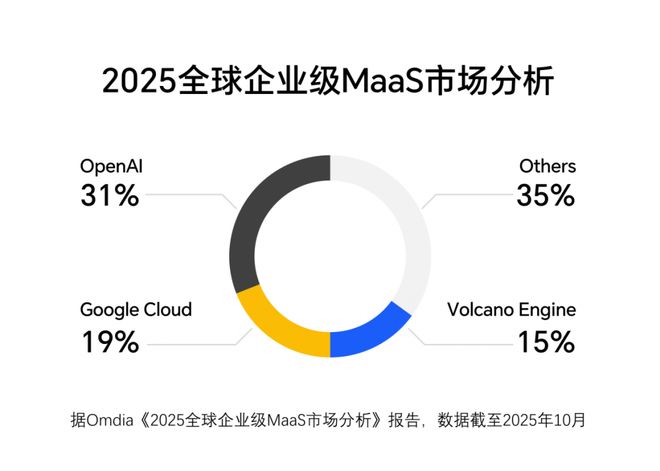
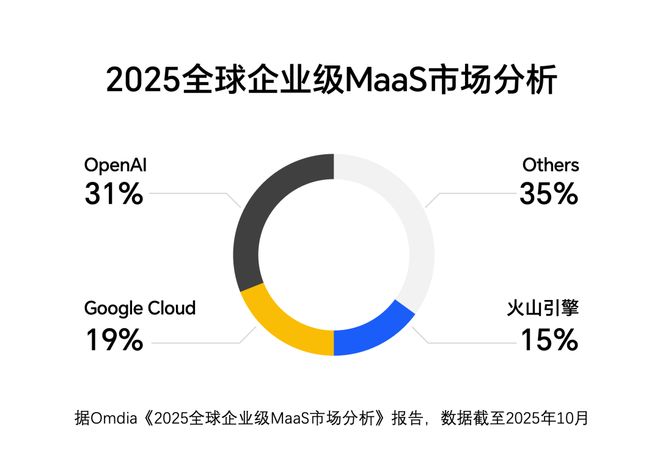
Core Insights - The report by Omdia highlights the rapid growth of the global MaaS (Model as a Service) market, with OpenAI, Google Cloud, and Volcano Engine capturing a combined 65% market share by October 2025 [1][4] - Volcano Engine has achieved significant milestones, including a daily token call volume of 30 trillion, positioning it as the third-largest player globally [4] - The company has experienced a 100% year-on-year revenue growth, surpassing 20 billion, and has revised its revenue target for 2030 upwards due to unexpected MaaS commercialization and model iteration [6] Market Position and Growth - Volcano Engine's strategic focus on MaaS has led to its rapid emergence in the AI cloud market, with the launch of the Doubao model family API service marking a significant shift in pricing strategy, reducing costs by up to 99.3% [7][12] - The company has seen exponential growth in token call volume since the launch of the Doubao model, with a notable increase in usage every three months [9][15] - By the first half of 2025, Volcano Engine is expected to account for 49.2% of the public cloud model service in China, producing one out of every two tokens generated [12] Technological Advancements - The introduction of various models, including Doubao 1.6 and Seedance 1.0 pro, has continuously unlocked new application scenarios, contributing to the growth of the MaaS market [9][15] - The company emphasizes the importance of large model call volumes in refining models and infrastructure, which in turn enhances the profitability of its MaaS services [15][20] Strategic Initiatives - Volcano Engine aims to lower the barriers to AI application through higher-level encapsulation and cost optimization, enhancing the usability of its MaaS offerings [22][24] - The company is also focusing on developing and operating agents, positioning itself as a leader in providing a comprehensive suite of agent development and operation products [21][24] Collaboration and Ecosystem - The synergy between Volcano Engine's B2B and B2C services, particularly leveraging ByteDance's extensive user base, has been crucial in driving model usage and service quality [16][19] - The company is committed to continuous innovation and long-term investment in technology to serve a broader market and meet diverse customer needs [20]

中国MaaS服务紧追美国云厂商:加速度缩小差距
Xin Lang Cai Jing· 2025-12-28 11:11
Core Insights - The global AI industry is undergoing a significant transformation, particularly in the Model as a Service (MaaS) sector, with a notable shift in the competitive landscape between China and the U.S. [1] - Chinese companies like Alibaba Cloud and Volcano Engine are rapidly closing the gap with U.S. giants such as OpenAI and Google Cloud in the MaaS market [1][2] Market Dynamics - As of October 2025, the daily average token usage for major MaaS providers is as follows: OpenAI at approximately 70 trillion, Google Cloud at 43 trillion, and Volcano Engine at over 30 trillion [3] - By the end of December 2025, Volcano Engine's daily token usage surged to 50 trillion, surpassing Google Cloud's previous levels [2][3] - The MaaS market is projected to grow tenfold in the coming year, driven by explosive growth in the Chinese market [2] User Segmentation - The user base for MaaS services is predominantly composed of individual users (80%), but enterprise users account for 80% of the token consumption [3] - The early growth of MaaS services was primarily in the consumer sector, but the enterprise market is rapidly emerging [2] Competitive Landscape - Chinese companies are achieving significant advancements in specific AI applications, such as video generation, where they are competitive with global counterparts [4][5] - The gap in foundational large language models remains, with U.S. companies like OpenAI having a head start [5] Strategic Approaches - Chinese firms are shifting focus from pure parameter competition to creating user-friendly, efficient, and commercially viable service ecosystems [5][6] - The MaaS market in China is characterized by a collaborative approach among local firms, aiming to expand the overall market rather than compete against each other [6] Differentiated Development Paths - The U.S. model emphasizes computational power and general large models, while the Chinese approach focuses on application, deployment, and industry penetration [6] - The market concentration in large models is expected to narrow down to a few key players, while smaller models tailored for specific industries are anticipated to see significant growth [6] Business Model Evolution - The MaaS pricing model is evolving from a token-based system to a more value-driven "Agent as a Service" model, allowing clients to purchase specific AI solutions [6] - This shift is expected to expand the MaaS market into the broader Business Process Outsourcing (BPO) sector, which is valued in the trillions [6] Challenges Ahead - The foundational large model sector still presents challenges due to existing technological barriers established by early movers like OpenAI [7] - Addressing concerns regarding the neutrality of Chinese MaaS platforms, especially those linked to large internet companies, remains a critical issue for the industry [7]



Omdia发布《2025全球企业级MaaS市场分析》,火山引擎名列全球第三
2 1 Shi Ji Jing Ji Bao Dao· 2025-12-24 07:24
Core Insights - The global enterprise MaaS market is rapidly growing, with OpenAI and Google Cloud leading in daily token usage, followed by China's Volcano Engine [1][4] - The latest data shows that the daily token usage of Volcano Engine's Doubao model has exceeded 50 trillion, marking a 66.7% increase from October and over tenfold growth year-on-year [4] - The introduction of multimodal models like GPT-5.2, Gemini 3.0, and Doubao 1.8 is expanding application scenarios and enhancing user experience [4][5] Market Position - As of October 2025, OpenAI and Google Cloud are projected to have daily token usage of approximately 70 trillion and 43 trillion, respectively, while Volcano Engine holds a 15% market share with over 30 trillion tokens [1] - Together, these three companies account for 65% of the global MaaS market [1] Growth Drivers - The MaaS services are noted as the fastest-growing and highest-margin AI cloud computing products [4] - Continuous innovation in model structure and hardware optimization is leading to high cost-performance ratios and superior margins compared to traditional IaaS products [4] - The emergence of image and video creation models, such as Nano Banano and Doubao Seedream 4.0, is lowering production barriers and expanding accessibility [5] Future Outlook - Omdia forecasts that the growth rate of the global MaaS market will further accelerate in 2026 as model vendors and cloud providers enhance AI cloud infrastructure [5]