Model Context Protocol(MCP)

Search documents
跨链协议 deBridge 宣布推出 Model Context Protocol
Xin Lang Cai Jing· 2026-02-16 14:09
Core Insights - deBridge has launched the Model Context Protocol (MCP), enabling AI agents and development tools to perform non-custodial cross-chain swaps, bridging, and multi-step on-chain operations across EVM chains and Solana [1] Group 1 - MCP offers deterministic execution and MEV-aware routing, ensuring users retain ownership of their assets [1] - Users can complete wallet orchestration, chain switching, and transaction retries through a single interface [1]
Bitget 宣布推出 Agent Hub,支持快速接入开启 AI 交易
Xin Lang Cai Jing· 2026-02-15 09:32
Core Viewpoint - Bitget has launched Agent Hub, enabling quick access to AI trading through a standardized interface for market data and trade execution [1] Group 1: Product Launch - Agent Hub is built on the Bitget API and includes the official Model Context Protocol (MCP) toolkit [1] - The platform allows AI agents to securely access market data and trading capabilities [1] Group 2: Strategic Importance - Agent Hub is one of the three core strategies for Bitget in 2026 [1] - It will be integrated into the panoramic exchange architecture (UEX), supporting cross-asset operations under a unified account and risk system [1]
“商业的HTTP”来了:谷歌CEO劈柴官宣 UCP,Agent 直接“剁手”下单,将倒逼淘宝京东“拆家式重构”?
AI前线· 2026-01-20 06:35
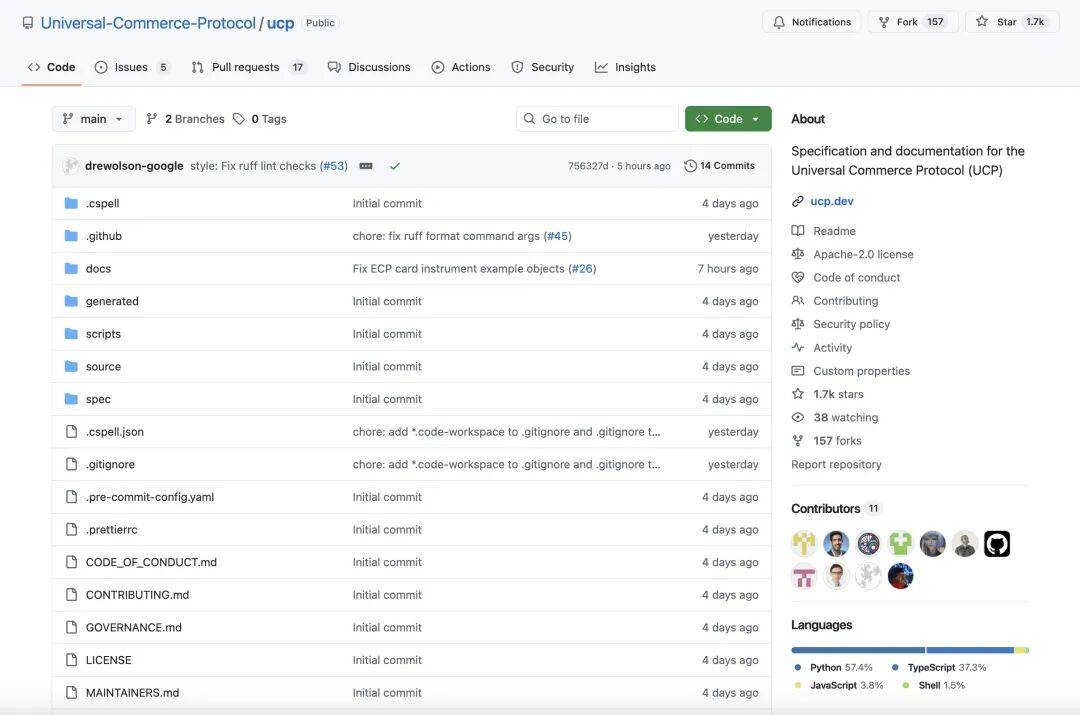
Core Viewpoint - Google has introduced the Universal Commerce Protocol (UCP), aiming to standardize online shopping through a new open standard that allows agents to facilitate direct purchases online [2][4]. Summary by Sections Introduction of UCP - Google CEO Sundar Pichai announced UCP at the NRF conference, which aims to break down the shopping process into reusable components, enhancing the interaction between agents and merchants [2][5]. Ambition of UCP - UCP is likened to HTTP for commerce, aiming to streamline the traditional e-commerce process from "search-ad-product page-checkout" to "intention-agent reasoning-purchase" [5][6]. Structure and Capabilities of UCP - UCP aims to connect various stages of the purchasing process, including product discovery, checkout, and post-purchase support, under a unified standard [7][10]. - The protocol includes six core capabilities: product discovery, shopping cart, identity linking, checkout, order management, and other vertical capabilities [10][11]. Communication and Integration - UCP is designed to work alongside other agent protocols like Agent Payments Protocol (AP2) and Agent2Agent (A2A), allowing flexibility in how agents and merchants interact [11][14]. Product Discovery and Shopping Cart - Product discovery is expected to be linked with Google Shopping Feed, while the shopping cart aims to create a unified experience across merchants, potentially revolutionizing e-commerce [12][19]. Data and Discoverability - UCP focuses on enhancing product discoverability by requiring merchants to provide extensive product data, which is crucial for AI-driven searches [16][18]. - Google is expanding its Merchant Seller tools to include new data attributes, which will help brands optimize their product listings for better AI search rankings [17][19]. Industry Partnerships - UCP has attracted significant partners from both retail and payment sectors, including Shopify, Walmart, and Visa, indicating a strong collaborative effort to establish the standard [21][23]. Future Implications - The introduction of UCP signals a shift in the retail landscape, where agents will play a crucial role in transactions, potentially reshaping the relationship between consumers and brands [24][25].



“商业的HTTP”来了:谷歌CEO劈柴官宣 UCP,Agent 直接“剁手”下单,将倒逼淘宝京东“拆家式重构”?
Sou Hu Cai Jing· 2026-01-17 16:02
Core Insights - Google has introduced the Universal Commerce Protocol (UCP), aiming to standardize online shopping through agents, allowing for a seamless end-to-end shopping experience [1][2][4] - UCP is designed to enable interoperability among various agents and merchants, facilitating direct communication and transactions without the need for traditional web navigation [2][4] - The protocol is released under the Apache 2.0 open-source license, indicating a commitment to community collaboration and development [3] Group 1: UCP Overview - UCP aims to streamline the entire shopping process, from product discovery to post-purchase support, under a unified standard [6][12] - The protocol includes six core capabilities: product discovery, shopping cart, identity binding, checkout, order management, and other vertical capabilities [8][10] - UCP is not an isolated protocol; it is designed to work alongside other agent protocols like Agent Payments Protocol (AP2) and Agent2Agent (A2A) [9][12] Group 2: Market Impact - The introduction of UCP is seen as a transformative move in e-commerce, potentially reshaping the traditional sales funnel into a more efficient process [4][12] - Major retailers and payment systems, including Shopify, Walmart, and Visa, have already joined the UCP initiative, indicating strong industry support [17] - The protocol's focus on discoverability aims to change how products are accessed and purchased, moving away from traditional web pages to data-driven interactions [12][14] Group 3: Future Implications - The evolution of UCP suggests a significant shift in the retail landscape, where AI-driven agents may redefine the roles of traditional e-commerce platforms [18][20] - As agents become more integrated into commerce, the potential for a new business model emerges, combining social, e-commerce, and service elements [18][20] - The ongoing development of UCP and its adoption by major players signals a trend towards a more automated and efficient retail environment [17][19]
2026年,AI将从炒作走向务实
Xin Lang Cai Jing· 2026-01-05 03:29
Core Insights - 2026 is anticipated to be a pivotal year for AI, transitioning from large-scale model development to practical applications that integrate AI into real-world workflows [2][34] - The focus is shifting towards deploying lightweight models and embedding intelligence into physical devices, moving away from mere demonstrations to targeted deployments [2][34] Group 1: Scaling Law and Model Development - The AI industry is nearing the limits of the Scaling Law, prompting a shift towards new architectural research and smaller, more efficient models [4][21] - Experts suggest that smaller language models (SLMs) will become the standard in AI applications by 2026 due to their cost-effectiveness and performance advantages [5][22] - The trend towards SLMs is supported by advancements in edge computing, making them more suitable for deployment on local devices [6][22] Group 2: World Models and Gaming Industry - 2026 is expected to be a key year for world models, which learn how objects interact in three-dimensional space, enhancing predictive capabilities [8][25] - The gaming industry is projected to see significant growth in the world model market, with estimates rising from $1.2 billion in 2022 to $27.6 billion by 2030 [9][25] Group 3: Agent Integration and Practical Applications - The introduction of the Model Context Protocol (MCP) is seen as a critical advancement, enabling AI agents to interact with external tools and databases, thus facilitating their integration into real-world systems [11][27] - As MCP reduces friction in connecting AI agents to practical systems, 2026 may mark the year when these agents transition from demonstration to everyday use [12][28] Group 4: Human-AI Collaboration - There is a growing belief that AI will enhance human workflows rather than replace them, with expectations of new job roles emerging in AI governance and data management [14][31] - The narrative is shifting towards how AI can assist human tasks, with predictions of a low unemployment rate as companies begin to hire for new roles related to AI [14][31] Group 5: Physical AI and Market Trends - Advances in small models, world models, and edge computing are expected to drive the adoption of physical AI applications, including robotics and wearable devices [16][34] - The market for physical AI is anticipated to grow, with wearable devices becoming a cost-effective entry point for consumers [17][34]
MCP:金融市场的下一个前沿领域
Refinitiv路孚特· 2025-11-10 06:03
Core Insights - The introduction of the Model Context Protocol (MCP) by Anthropic is revolutionizing data-driven innovation in the financial sector, allowing institutions to extract deeper value from existing data and seamlessly integrate it into daily workflows [1][2]. Group 1: Importance of MCP - MCP is an open standard developed by Anthropic that facilitates AI models' access to external data and systems, ensuring compliance with enterprise security standards while enabling necessary data access and execution capabilities [1][2]. - LSEG is leveraging MCP to structure financial data for AI model access, enhancing the models' ability to understand and utilize data for task execution, thereby expanding the coverage and value of authorized data [2]. Group 2: Practical Applications of MCP - MCP has already made a significant impact in various areas of financial services, particularly in research, where it allows analysts to connect multiple data sources, improving efficiency and research quality [2]. Group 3: Recommendations for Institutions - Institutions considering adopting MCP should focus on data structuring, context information, and permission management to maximize its effectiveness. LSEG's AI Ready Content serves as a prime example of data designed specifically for AI [3].