
NFC支付

Search documents
2025年中国第三方支付行业研究报告
艾瑞咨询· 2026-03-11 00:07
Core Insights - The comprehensive payment transaction scale in China is expected to reach 577 trillion yuan by 2025, with a year-on-year growth of 3.0%, driven by a 2.9% increase in personal payment transactions and a 3.2% increase in enterprise payment transactions, indicating that enterprise payment growth has surpassed personal payment growth [1][13]. Group 1: Industry Overview - The third-party payment industry in China has entered a stage of deepening stock competition, with regulatory normalization and compliance requirements becoming the foundation for industry development [1]. - The industry has evolved from a phase of rapid growth and diversification of services (2010-2019) to a more mature phase characterized by stricter regulations and stable development since 2019 [4][5]. Group 2: Payment Segmentation - The third-party payment business is divided into personal and enterprise payments, with a focus on enterprise payment solutions as personal payment growth has plateaued [2]. - The personal payment market is projected to decline by 3.7% in 2025, while enterprise payments are expected to maintain a growth trajectory due to digital transformation and the expansion of cross-border e-commerce [19][33]. Group 3: Regulatory Environment - The implementation of the Non-Bank Payment Institutions Supervision and Management Regulations in 2024 has led to a significant transformation in the industry, with a marked increase in compliance and accelerated consolidation [7]. Group 4: Technological Integration - The industry is actively embracing AI technology to enhance operational efficiency and customer service, with AI being utilized for smart risk control, process automation, and personalized services [10][12]. - AI is expected to reduce operational costs and improve service capabilities, thereby enhancing the overall payment experience [10]. Group 5: Market Dynamics - The enterprise payment market is showing resilience, with a stable growth outlook driven by ongoing digitalization and the integration of payment services with business scenarios [13][33]. - The cross-border payment market is projected to reach 3.3 trillion yuan by 2025, fueled by the growth of cross-border e-commerce and the need for efficient payment solutions [55]. Group 6: Future Trends - New payment methods, such as NFC and digital currencies, are expected to drive the evolution of payment experiences towards a more seamless and integrated approach [30][67]. - The introduction of stablecoins is anticipated to enhance cross-border payment capabilities, marking a significant shift in the payment infrastructure [71].


2025年中国第三方支付行业研究报告
艾瑞咨询· 2026-02-26 00:06
Core Insights - The comprehensive payment transaction scale in China is expected to reach 577 trillion yuan by 2025, with a year-on-year growth of 3.0%, driven by a 2.9% increase in personal payment transactions and a 3.2% increase in enterprise payment transactions, indicating that enterprise payment growth has surpassed personal payment growth [1][13]. Group 1: Industry Overview - The third-party payment industry in China has entered a stage of deepening stock competition, with regulatory normalization and compliance requirements becoming the foundation for industry development [1]. - The industry has evolved from a phase of rapid growth and diversification of services (2010-2019) to a more mature phase characterized by stricter regulations and stable development [4][5]. Group 2: Payment Segmentation - The third-party payment business can be divided into personal and enterprise payments, with a focus on the enterprise payment market due to the saturation of personal payment growth [2]. - The personal payment market is nearing saturation, while enterprise payments are showing stronger growth resilience, driven by digital transformation and the expansion of cross-border e-commerce payment scenarios [13]. Group 3: Regulatory Environment - The implementation of the "Non-Bank Payment Institutions Supervision Management Regulations" in 2024 has led to a significant transformation in the industry, with a trend towards compliance normalization and accelerated consolidation [7]. - The regulatory environment is expected to tighten further, with increased penalties for non-compliance, impacting the operational landscape for both large and small payment institutions [7]. Group 4: Technological Integration - The industry is actively embracing AI technology to enhance operational efficiency and customer service, focusing on internal cost reduction and external service value enhancement [10]. - AI applications include intelligent risk control, process automation, and personalized customer service, which are expected to improve overall industry competitiveness and innovation capabilities [10][12]. Group 5: Market Dynamics - The personal mobile payment market is projected to decline by 3.7% in 2025, reflecting a saturation in daily consumption scenarios and weak consumer spending [19]. - The online and offline commercial payment markets are expected to grow steadily, with a compound annual growth rate of 4.8% from 2020 to 2025 [22]. Group 6: Enterprise Payment Trends - The enterprise payment market is expected to continue growing, driven by the digitalization of enterprises and the ongoing demand for cross-border payment solutions [33][47]. - Payment institutions are shifting from basic payment services to integrated solutions that help enterprises reduce costs and improve operational efficiency [35]. Group 7: Cross-Border Payment Growth - The cross-border payment market is anticipated to reach 3.3 trillion yuan by 2025, fueled by the expansion of China's cross-border e-commerce market [55]. - Cross-border payment service providers are focusing on building comprehensive solutions that address the needs of overseas enterprises, enhancing efficiency and compliance in cross-border transactions [57][60].

2025年中国第三方支付行业研究报告
艾瑞咨询· 2026-01-12 00:06
Core Insights - The comprehensive payment transaction scale in China is expected to reach 577 trillion yuan by 2025, with a year-on-year growth of 3.0%, driven by a 2.9% increase in personal payment transactions and a 3.2% increase in enterprise payment transactions, indicating that enterprise payment growth has surpassed personal payment growth [1][13]. Group 1: Industry Overview - The third-party payment industry in China has entered a stage of deepening stock competition, with regulatory normalization and compliance requirements becoming the foundation for industry development [1]. - The industry has evolved from a phase of rapid growth and diversification of services (2010-2019) to a more mature phase characterized by stricter regulations and stable development [4][5]. Group 2: Regulatory Environment - The implementation of the "Non-Bank Payment Institutions Supervision Management Regulations" in 2024 has led to a significant transformation in the industry, with a marked increase in compliance and accelerated consolidation [7]. - The regulatory environment is expected to intensify in 2025, with a notable increase in the number and amount of fines imposed on institutions [7]. Group 3: Payment Trends - The personal mobile payment market is projected to decline by 3.7% in 2025, reflecting a saturation in daily consumption scenarios and a slowdown in transaction growth [19]. - The enterprise payment market is expected to show resilience, driven by the ongoing digital transformation of enterprises and the expansion of cross-border e-commerce payment scenarios [13][33]. Group 4: Technological Integration - The industry is actively embracing AI technology to enhance internal operational efficiency and external service value, focusing on cost reduction and improved customer experience [10]. - AI applications include intelligent risk control, process automation, and personalized services, which are expected to significantly enhance the overall competitiveness of the payment industry [10][12]. Group 5: Market Dynamics - The enterprise payment sector is increasingly important, with a focus on providing integrated solutions that go beyond basic payment services to include cost reduction and efficiency tools [35]. - The cross-border payment market is anticipated to grow significantly, reaching 3.3 trillion yuan by 2025, driven by the expansion of China's cross-border e-commerce market [55]. Group 6: Future Directions - The industry is expected to explore new payment methods, such as NFC and digital currencies, which are anticipated to enhance payment convenience and security [30][67]. - Emerging markets in Southeast Asia, Latin America, and the Middle East are becoming new growth points for cross-border payment services, presenting both opportunities and challenges [60].

2025年中国第三方支付行业研究报告
3 6 Ke· 2026-01-08 01:14
Core Insights - The transaction volume of China's third-party comprehensive payment is expected to reach 577 trillion yuan by 2025, with a year-on-year growth of 3.0%, driven by a 2.9% increase in personal payment transactions and a 3.2% increase in corporate payment transactions [1][16] - The industry has entered a phase of intensified competition, with a focus on compliance and regulatory requirements, making it increasingly difficult to rely solely on transaction fees for profitability [1][7] - The report emphasizes the importance of "payment+" development, analyzing the value of third-party payment segments and predicting future industry trends [1] Industry Overview - The third-party payment industry in China has evolved from a nascent stage in 2000 to a mature and regulated market by 2019, with significant growth in transaction volumes and improved regulatory frameworks [4] - The market is now characterized by a dual focus on personal and corporate payments, with corporate payments gaining traction due to digital transformation and cross-border e-commerce [2][16] Regulatory Environment - The implementation of the "Non-Bank Payment Institutions Supervision Management Regulations" in 2024 has led to a normalization of compliance and accelerated industry consolidation, with increased regulatory scrutiny evident in the number and amount of fines imposed [7] Technological Integration - The industry is actively embracing AI technology to enhance operational efficiency and customer service, with applications in smart risk control, process automation, and personalized services [9][15] - AI is expected to reduce operational costs and improve service quality, thereby enhancing the overall competitiveness of the payment industry [9] Market Dynamics - The personal payment market is nearing saturation, with a projected decline in growth rates, while corporate payments are expected to continue growing at a faster pace due to ongoing digitalization [16][21] - The online commercial payment market is anticipated to grow steadily, with a compound annual growth rate of 4.8% from 2020 to 2025 [25] Payment Segmentation - The offline acquiring market is facing challenges due to saturation, while online industrial payments are expected to maintain stable growth driven by digital transformation [35][47] - Cross-border payments are emerging as a significant growth area, with the market projected to reach 3.3 trillion yuan by 2025, fueled by the expansion of cross-border e-commerce [55] Future Trends - The introduction of new payment methods, such as "look-and-pay," is expected to drive the evolution towards a more seamless payment experience [66] - The promotion of digital currency and stablecoins is anticipated to enhance cross-border payment efficiency and create new growth opportunities [68][74]
2025年中国第三方支付行业研究报告
艾瑞咨询· 2026-01-08 00:04
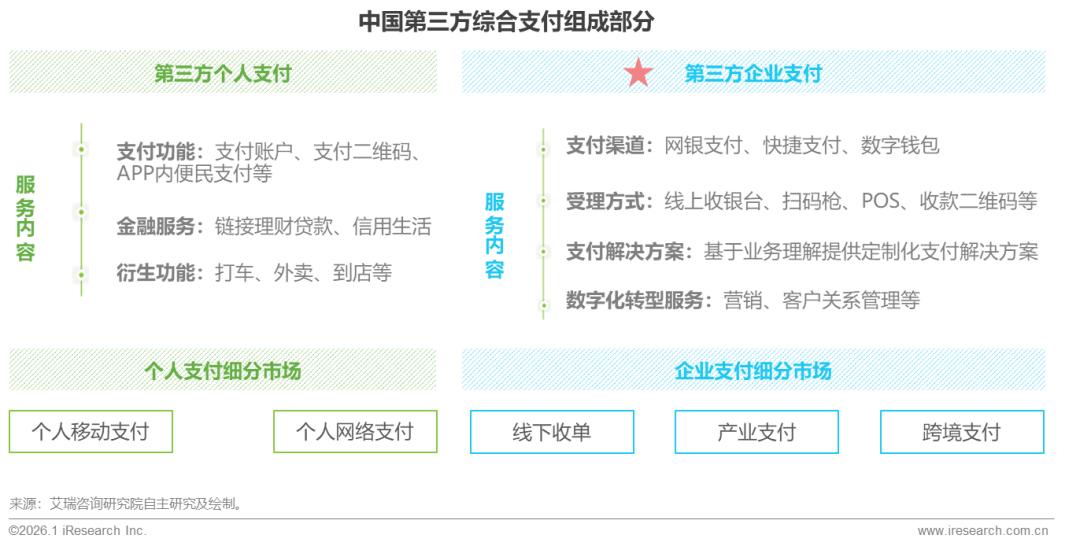
Core Insights - The comprehensive payment transaction scale in China is expected to reach 577 trillion yuan by 2025, with a year-on-year growth of 3.0%, driven by a 2.9% increase in personal payment transactions and a 3.2% increase in enterprise payment transactions, indicating that enterprise payment growth has surpassed personal payment growth [1][13]. Group 1: Industry Overview - The third-party payment industry in China has entered a stage of deepening stock competition, with regulatory normalization and compliance requirements becoming the foundation for industry development [1]. - The industry has evolved from a phase of rapid growth and diversification of services (2010-2019) to a mature phase characterized by stricter regulations and stable development [4][5]. Group 2: Regulatory Environment - The implementation of the "Non-Bank Payment Institutions Supervision Management Regulations" in 2024 has led to a significant transformation in the industry, with a marked trend towards compliance normalization and accelerated consolidation [7]. - The regulatory environment has intensified, with the number and amount of penalties for institutions in 2025 approaching those of 2024, indicating a substantial increase in regulatory scrutiny [7]. Group 3: AI Integration - The third-party payment industry is actively embracing AI technology to enhance internal operational efficiency and external service value, focusing on cost reduction and efficiency improvement [10]. - AI is being utilized for smart risk control, process automation, and data decision support, which helps reduce operational costs and improve risk management capabilities [12]. Group 4: Payment Market Dynamics - The personal mobile payment market is projected to decline by 3.7% in 2025, reflecting a saturation in daily consumption scenarios and a slowdown in transaction growth [19]. - In contrast, the enterprise payment market is expected to maintain stable growth due to the ongoing digital transformation of enterprises and the expansion of cross-border e-commerce payment scenarios [33][47]. Group 5: Cross-Border Payment Growth - The cross-border payment market is anticipated to reach 3.3 trillion yuan by 2025, driven by the continuous expansion of China's cross-border e-commerce market, which has a compound annual growth rate of approximately 15.5% from 2020 to 2024 [55]. - Cross-border payment service providers are crucial intermediaries in enhancing the efficiency and compliance of fund settlement between foreign buyers and Chinese sellers [55]. Group 6: Emerging Trends - New payment methods are driving the evolution towards "no-sense" payment experiences, with innovations such as "look-and-pay" using smart glasses [65]. - The promotion of digital RMB is expanding its application in both C-end and B-end scenarios, with significant potential for cross-border payment enhancements [67]. - The implementation of stablecoin regulations in Hong Kong marks a new phase for stablecoins, which are becoming integral to global payment and settlement infrastructure [71].

“碰一下” 是NFC支付的峰回路转? 还是条码支付的创新升级?
Cai Jing Wang· 2025-04-29 13:08
Core Insights - Alipay's "Tap to Pay" has surpassed 100 million users, indicating a significant shift in the mobile payment landscape in China [1][8] - The emergence of "Tap to Pay" suggests a potential resurgence of NFC technology in a market previously dominated by barcode payments [1][5] Group 1: Payment Technology Comparison - Mobile payment technology has evolved into two main routes: NFC payments and barcode payments, with NFC pioneered by Apple Pay and barcode payments led by Alipay [1][2] - NFC payments offer a simpler user experience, requiring minimal actions for transactions, while barcode payments involve more steps, making them less user-friendly for certain demographics [2][3] - "Tap to Pay" combines the simplicity of NFC payments with the underlying technology of barcode payments, creating a hybrid model [5][12] Group 2: Market Dynamics and User Adoption - The rapid adoption of "Tap to Pay" is facilitated by Alipay's existing user base of nearly 900 million, which enhances trust and reduces barriers to entry for new users [8][11] - The integration of "Tap to Pay" into existing merchant systems is low-cost, as Alipay provides the necessary NFC devices for free, encouraging merchant participation [8][9] - The competitive landscape may shift as other payment providers like WeChat Pay and UnionPay respond to Alipay's new offering, potentially leading to a more fragmented market with multiple payment devices at merchant locations [11][12] Group 3: Future Implications and Ecosystem Development - The introduction of "Tap to Pay" is expected to catalyze new business models and consumer habits, similar to past innovations in the payment industry [10][12] - The new payment method could serve as a gateway for merchants to enhance customer engagement and operational efficiency, expanding beyond mere transactions [9][13] - The potential for a new industry ecosystem around "Tap to Pay" includes opportunities for service providers and hardware manufacturers to innovate and capture market share [13]