NVL576

Search documents
2026 年 GTC 展望:英伟达如何通过 LPX、CPO 与 Rubin 重新定义人工智能基础设施-GTC 2026 Outlook_ How NVIDIA Is Redefining AI Infrastructure with LPX, CPO, and Rubin
2026-03-01 17:23
Summary of NVIDIA GTC 2026 Outlook Industry Overview - The document focuses on NVIDIA and its advancements in AI infrastructure, particularly in the context of generative AI and large language models, which are driving a redesign of data-center computing architectures [4][6]. Key Points and Arguments Innovations in AI Infrastructure - NVIDIA introduced the Blackwell GB200 NVL72, which allows a single rack to house 72 GPUs and 36 Grace CPUs, achieving 400 Gb/s networking through NVLink 6 and Quantum X800 InfiniBand [4]. - The company is expected to unveil new technologies at GTC 2026, including LPX inference racks, CPX and NVL144, and Rubin Ultra NVL576, which will feature significant advancements in PCB materials, cooling, and assembly processes [7]. LPX Inference Racks - LPX is designed for inference workloads, leveraging Groq's LPU technology to eliminate bandwidth bottlenecks by integrating large amounts of memory on-chip [11]. - The architecture allows for deterministic scheduling and near-linear scaling across multiple LPUs, making it suitable for large language models and Mixture-of-Experts models [15][16]. Performance Enhancements - NVIDIA plans to scale LPX from 64 to 256 LPUs per rack, aiming for a fourfold increase in performance, with the ability to generate 10,000 "thought tokens" in approximately two seconds [17][16]. - The introduction of M9 Q-glass PCBs will support the dense integration of LPUs, enhancing performance and efficiency [18]. Rubin Platform Advancements - The Rubin GPU, fabricated on a 4 nm process, integrates 336 billion transistors and supports 288 GB of HBM4 memory, achieving up to 50 PFLOPS of inference performance [30][32]. - The Rubin NVL72 rack integrates 72 Rubin GPUs and 36 Vera CPUs, delivering significant improvements in inference and training performance compared to previous models [37][38]. CPX and NVL144 for Long-Context Inference - The CPX GPU, a variant of the Rubin architecture, will utilize GDDR7 memory to support long-context inference workloads, achieving 3× higher performance than the previous generation [50][51]. - The NVL144 CPX rack will integrate 144 Rubin and CPX GPUs, delivering 8 EFLOPS of compute and 1.7 PB/s bandwidth, with a modular design that simplifies assembly [52][54]. Future Networking Solutions - NVIDIA is set to introduce Spectrum X Photonics and Quantum X CPO switches, which will enhance data center networking capabilities with significant bandwidth improvements [66][87]. - The CPO architecture aims to reduce power consumption and improve signal integrity, fundamentally reshaping data center networking [65][71]. Additional Important Insights - The document highlights the importance of energy efficiency and sustainability, noting that even with advancements, the NVL576 rack will require significant power management solutions [96]. - The evolution of the software ecosystem is crucial, as new compilers and memory management strategies will be necessary to maximize the efficiency of the new hardware [97]. - Supply chain security is a concern, particularly regarding advanced materials and photonic components, which are sensitive to geopolitical factors [99]. - NVIDIA faces competition from other companies developing similar technologies, which may pressure the company to continue innovating rapidly [100][101]. Conclusion - NVIDIA's GTC 2026 is positioned to redefine AI infrastructure through innovations in inference and training technologies, emphasizing the integration of optics, materials, and system design [105]. The advancements presented will have significant implications for the industry, necessitating collaboration and rapid iteration among technology providers [102][103][104].

未知机构:广发海外电子通信英伟达NVDABuy指引小幅超预期增-20260228
未知机构· 2026-02-28 02:55
Summary of Conference Call Notes Company Overview - **Company**: NVIDIA (NVDA) - **Industry**: Semiconductor and AI technology Key Points and Arguments - **Earnings Guidance**: NVIDIA's revenue guidance for FY2027 is set at $78 billion, exceeding expectations of $76 billion and consensus of $75 billion, indicating a stable growth trajectory [1][2] - **Gross Margin Target**: The company aims for a mid-75% gross margin for FY2027, which aligns with expectations despite rising operational expenses [1][2] - **Quarterly Performance**: For F4Q26, NVIDIA reported revenue of $68.1 billion, a 20% quarter-over-quarter increase and a 73% year-over-year increase, driven by strong data center growth [3] - **Earnings Per Share (EPS)**: EPS for F4Q26 was $1.62, reflecting a 25% quarter-over-quarter increase and an 81% year-over-year increase [3] - **Operational Changes**: From F1Q27, NVIDIA will include stock-based compensation in its non-GAAP earnings, viewed positively by analysts [3] - **CSP Spending Outlook**: The top five Cloud Service Providers (CSPs) are projected to have capital expenditures nearing $700 billion by 2026, with NVIDIA emphasizing that increased CSP computing power will lead to higher revenue and cash flow [4] Additional Important Insights - **Market Dynamics**: The CEO highlighted that the industry is at a pivotal point for AI, with physical AI expected to be the next wave of innovation [4] - **Upcoming GTC 2026 Conference**: Anticipated to be a significant catalyst for NVIDIA, focusing on new product launches and advancements in AI technology [4] - **Product Development**: Key products mentioned include the LPX architecture and Rubin NVL72, which are expected to enhance NVIDIA's competitive position in the market [4] Adjustments to Forecasts - **EPS Adjustments**: EPS forecasts for FY2027 and FY2028 have been adjusted by -1% and +1% respectively, with a target price revised to $292 based on a 33x FY2027 P/E ratio [2]
未知机构:广发海外电子通信GTC2026前瞻LPXCPO及PCB关键-20260227
未知机构· 2026-02-27 02:50
Summary of Key Points from the Conference Call Industry and Company Involved - The conference call focuses on the semiconductor and electronics industry, specifically highlighting NVIDIA and its upcoming products and technologies. Core Insights and Arguments - **LPX Rack Enhancements**: The LPX (also known as LPU) is expected to utilize SRAM-based on-chip memory, providing rapid token generation and ultra-low latency, thereby strengthening NVIDIA's position in the inference domain [1][2] - **Collaboration with Groq**: Prior to a non-exclusive licensing agreement with Groq in December 2025, the LPX design will feature 64 Groq LPUs interconnected via RealScale chips [1][2] - **Future LPX Developments**: For GTC 2026, an enhanced LPX rack is anticipated to include 256 LPUs, utilizing multi-layer 52LM9 Q-glass PTH PCB, with an estimated PCB value of approximately $200 per LPU [2] - **VR200 NVL72 Performance**: The Rubin architecture is expected to enhance NVIDIA's product leadership, achieving a 5x/3.5x improvement in inference/training performance compared to GB300, aided by HBM4 technology [2] - **CPX Chip Design Changes**: Due to GDDR7 shortages, the CPX chip design is likely to shift to HBM4, with a smaller capacity than the conventional Rubin [3] - **NVL576 Architecture**: The NVL576 is expected to showcase a hybrid CCL orthogonal backplane, with potential designs including various layers of PTFE and Q-glass M9 to improve signal transmission [3] - **Optical Interconnect Solutions**: NVIDIA plans to introduce Scale Up optical interconnect solutions for the NVL576 architecture in the second half of 2027 [4] Additional Important Insights - **Scale Out CPO Switches**: NVIDIA may launch a new generation of Scale Out CPO switches, which are expected to significantly improve thermal performance and cost-performance ratio compared to previous generations [4] - **Sales Projections**: The forecast for NVIDIA's Scale Out CPO switches has been revised upwards to 20,000/100,000 units for 2026/2027, driven by aggressive promotion and bundling strategies [4] - **Beneficiaries of Growth**: Key beneficiaries from these developments include suppliers such as FAU, CW Laser, and various connector manufacturers like Lumentum and Sumitomo, with Chinese FAU suppliers expected to capture significant market share [4] - **Stock Recommendations**: 1. NVIDIA (NVDABuy) due to strong short-term quarterly performance and positive outlook from OpenAI financing [5] 2. Lumentum (LITEBuy) for its leadership in CPO and CW Laser market expansion [5] 3. Other companies like 波若威 and 台虹 are noted for their advancements in CPO and PTFE-CCL development [5] - **PCB Market Outlook**: The PCB market is expected to benefit significantly from increased backplane value, with cabinet value projected at $300,000 and backplane ASP at over $2 [5]
AIDC供配电千亿级市场 SST有望加速渗透
Zheng Quan Shi Bao Wang· 2025-10-24 01:57
Group 1 - The core viewpoint is that AI monetization is accelerating, with strong capital expenditure from cloud vendors, leading to rapid growth in global data center installations [1] - The overall power density of AIDC (Intelligent Computing Centers) is increasing, and high-voltage direct current (HVDC) distribution solutions are becoming a trend [1] - According to CITIC Securities, the market for power distribution equipment corresponding to global data centers is estimated to be approximately 42.7 billion in 2024, with a potential growth to 100.9 billion by 2028, reflecting a CAGR of about 24% from 2024 to 2028 [1] Group 2 - SST (Solid State Transformer) is identified as the latest technology route under high-voltage direct current distribution, offering advantages in conversion efficiency, construction cycle, space occupation, and new energy access compared to HVDC and other solutions [2] - The SST distribution solution is expected to gradually penetrate the market as NV Rubin Ultra chips and NVL576 enter mass production [2] - The selection of targets should focus on product maturity, technological heritage, and customer base [2]
中信证券:预计SST配电方案将逐步开启渗透
Xin Lang Cai Jing· 2025-10-24 00:21
Core Viewpoint - The monetization of AI is accelerating, with strong capital expenditure from cloud vendors, leading to rapid growth in global data center installations [1] Group 1: AI Monetization and Capital Expenditure - AI monetization is gaining momentum, driven by robust capital spending from cloud service providers [1] - The global data center's new installed capacity is expected to maintain a rapid growth trend [1] Group 2: Power Distribution Technologies - The overall power density of intelligent computing centers (AIDC) is accelerating [1] - High voltage direct current (HVDC) distribution solutions are becoming a prevailing trend [1] - Solid-state transformers (SST) represent the latest technological route under high voltage direct current distribution, offering advantages in conversion efficiency, construction period, footprint, and renewable energy integration compared to HVDC and Panama power solutions [1] Group 3: Market Opportunities and Recommendations - SST distribution solutions are anticipated to gradually penetrate the market as subsequent NV Rubin Ultra chips and NVL576 enter mass production [1] - Companies are advised to select targets based on product maturity, technological synergies, and customer base [1]

华为徐直军:Atlas 950超节点算力超越英伟达
第一财经· 2025-09-18 09:16
Core Viewpoint - Huawei's rotating chairman Xu Zhijun emphasized that the supernode has become the dominant product form in the construction of large AI computing power infrastructure, with the Atlas 950 SuperPoD expected to launch in Q4 2023 and the Atlas 960 SuperPoD projected for Q4 2027 [1] Group 1 - The Atlas 950 SuperPoD has a computing power scale of 8192 cards and is expected to remain the world's strongest supernode for many years, significantly surpassing major industry products in various capabilities [1] - Compared to NVIDIA's NVL144, which is set to launch in H2 2024, the Atlas 950 supernode's scale is 56.8 times larger, total computing power is 6.7 times greater, memory capacity is 15 times larger at 1152TB, and interconnect bandwidth is 62 times greater at 16.3PB/s [1] - Even when compared to NVIDIA's NVL576, which is planned for release in 2027, the Atlas 950 supernode remains superior in all aspects [1]


华为徐直军:Atlas 950超节点算力超越英伟达
Di Yi Cai Jing· 2025-09-18 09:09
Core Viewpoint - Huawei's rotating chairman Xu Zhijun announced that the supernode has become the dominant product form in the construction of large AI computing power infrastructure, with the Atlas 950 SuperPoD expected to launch in Q4 2023 and the Atlas 960 SuperPoD projected for Q4 2027 [1] Group 1: Product Details - The Atlas 950 SuperPoD has a computing power scale of 8192 cards and is expected to be the strongest supernode globally for many years, significantly outperforming major industry products [1] - Compared to NVIDIA's NVL144, which is set to launch in H2 2024, the Atlas 950 SuperPoD's scale is 56.8 times larger, total computing power is 6.7 times greater, memory capacity is 15 times larger at 1152TB, and interconnect bandwidth is 62 times greater at 16.3PB/s [1] - Even when compared to NVIDIA's NVL576, expected to launch in 2027, the Atlas 950 SuperPoD remains superior in all aspects [1] Group 2: Future Outlook - Huawei expresses confidence in providing sustainable and abundant computing power for the long-term rapid development of artificial intelligence [1]
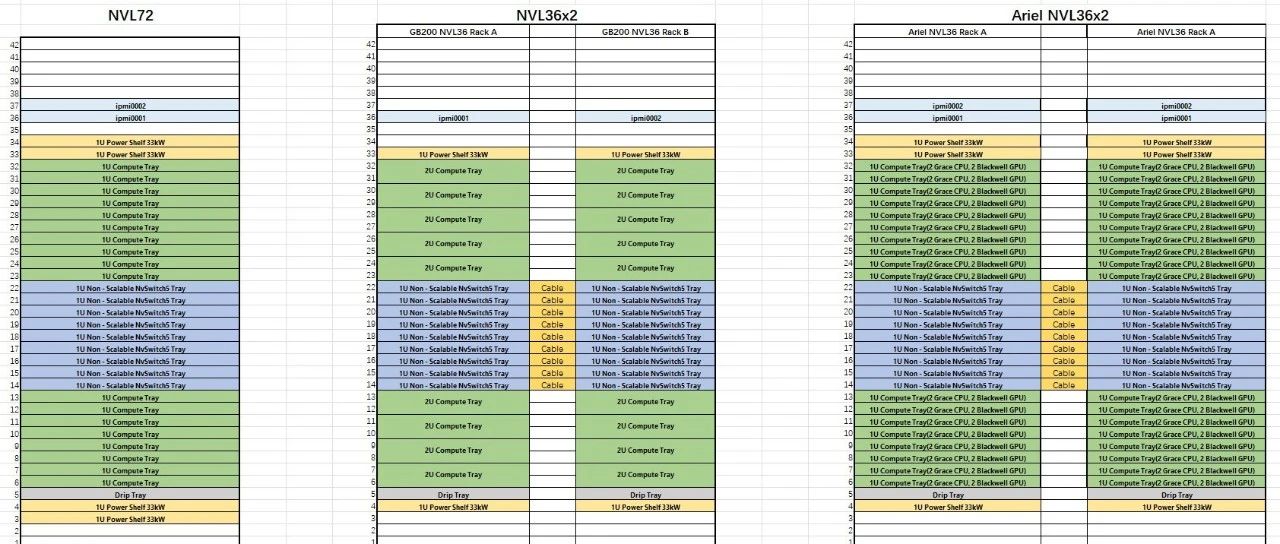
被抛弃的NVL72光互联方案
傅里叶的猫· 2025-07-17 15:41
Core Viewpoint - The article discusses the architecture and networking components of the GB200 server, focusing on the use of copper and optical connections, and highlights the flexibility and cost considerations in the design choices made by different customers [1][2]. Frontend Networking - The frontend networking in the GB200 architecture serves as the main channel for external data exchange, connecting to the internet and cluster management tools [1]. - Each GPU typically receives a bandwidth of 25-50Gb/s, with total frontend network bandwidth for the HGX H100 server ranging from 200-400Gb/s, while GB200 can reach 200-800Gb/s depending on configuration [2]. - Nvidia's reference design for frontend networking may be over-provisioned, leading to higher costs for customers who may not need such high bandwidth [2][4]. Backend Networking - The backend networking supports GPU-to-GPU communication across large-scale clusters, focusing on internal computational collaboration [5]. - Various switch options are available for the backend network, with initial shipments using ConnectX-7 cards and future upgrades planned for ConnectX-8 [6][10]. - Long-distance interconnections primarily utilize optical cables due to the limitations of copper cables over longer distances [6]. Accelerator Interconnect - The accelerator interconnect is designed for high-speed communication between GPUs, significantly impacting communication efficiency and system scalability [13]. - The GB200's NVLink interconnect has evolved from the HGX H100, requiring external connections due to the separation of NVSwitches and GPUs across different trays [14]. - Different configurations (NVL72, NVL36x2, NVL576) balance communication efficiency and scalability, with NVL72 being optimal for low-latency scenarios [15]. Out of Band Networking - The out-of-band networking is dedicated to device management and monitoring, focusing on system maintenance rather than data transmission [20]. - It connects various IT devices through baseboard management controllers (BMC), allowing for remote management and monitoring of system health [21]. Cost Analysis of MPO Connectors - The article estimates the value of MPO connectors in the GB200 server, indicating that the cost per GPU can vary significantly based on network architecture and optical module usage [22][23]. - In a two-layer network architecture, the MPO value per GPU is approximately $128, while in a three-layer architecture, it can rise to $192 [24]. - As data center transmission rates increase, the demand for high-speed optical modules and corresponding MPO connectors is expected to grow, impacting overall costs [25].