NZD

Search documents
G10 国家外汇策略- 最新观点-G10 FX Strategy-Our Latest Views
2026-03-22 14:24
Summary of Key Points from Morgan Stanley's G10 FX Strategy Conference Call Industry Overview - The conference call focuses on the G10 foreign exchange (FX) market, analyzing various currencies and their expected performance in the current economic environment. Key Currency Views USD (US Dollar) - **View**: Neutral - **Skew**: Neutral - **Insight**: The DXY is expected to trade sideways as the market transitions to a Defense Regime, with elevated volatility and uncertainty impacting the outlook. The potential for a sustained rally in the USD appears limited, and caution against outright selling is advised due to market conditions [2][12][17]. EUR (Euro) - **View**: Neutral - **Skew**: Neutral - **Insight**: The EUR/USD remains neutral, influenced by global factors such as risk sentiment and commodity prices. There are risks of downside pressure due to USD safe-haven demand, but options market signals suggest that negative expectations may be overestimated [3][19]. JPY (Japanese Yen) - **View**: Neutral - **Skew**: Neutral - **Insight**: The correlation between USD/JPY and oil prices has increased, potentially leading to upward pressure on the pair. Market sentiment may be affected by the possibility of FX intervention if the JPY depreciates rapidly past the 160 level against the USD [4][20]. GBP (British Pound) - **View**: Neutral - **Skew**: Neutral - **Insight**: Elevated volatility and uncertainty lead to a neutral stance on GBP. A prolonged pause from the BoE is unlikely to support GBP significantly, as the market shifts focus to downside growth risks [5][22]. CHF (Swiss Franc) - **View**: Bullish - **Skew**: Bullish - **Insight**: A recommendation to short EUR/CHF is maintained, with expectations that the SNB will tolerate a gradual decline in EUR/CHF unless there is excessive CHF appreciation [6][25]. CAD (Canadian Dollar) - **View**: Neutral - **Skew**: Neutral - **Insight**: The BoC's focus on downside growth risks may weigh on market pricing, posing upside risks to USD/CAD. Current market pricing reflects inflation risks, but the outlook remains neutral [7][26]. AUD (Australian Dollar) - **View**: Neutral - **Skew**: Neutral - **Insight**: Despite a recent rate hike by the RBA, economic activity is slowing. The recommendation is to avoid short positions on AUD due to expected support from hedging activities [8][26]. NZD (New Zealand Dollar) - **View**: Neutral - **Skew**: Neutral - **Insight**: Weak GDP data indicates challenges in the recovery process. Market expectations for RBNZ hikes are uncertain, with attention on upcoming comments from the Governor [9][26]. SEK (Swedish Krona) - **View**: Neutral - **Skew**: Neutral - **Insight**: The SEK is expected to underperform in high volatility environments, but remains neutral due to uncertainty around energy prices and FX flows [14][15][26]. NOK (Norwegian Krone) - **View**: Neutral - **Skew**: Neutral - **Insight**: Medium-term downside risks to NOK are anticipated as the market shifts focus to growth-negative impacts of higher commodity prices [16][26]. Additional Insights - The overall sentiment in the G10 FX market is characterized by a cautious approach due to elevated volatility and uncertainty surrounding global economic conditions. The transition to a Defense Regime is a critical factor influencing currency performance across the board [2][12][17][22][26]. Trade Ideas - **Short EUR/CHF**: Entry at 0.9110, target at 0.8700, stop at 0.9400 [16]. - **Buy 1m EUR/USD straddle**: Market entry on March 3, 2026, due to underpricing of near-term USD volatility [27]. This summary encapsulates the key points discussed in the conference call, providing a comprehensive overview of the current G10 FX landscape and the strategic outlook for various currencies.
'Sell America' Trade Poses Further Risks For US Dollar
Benzinga· 2026-01-26 17:27
Market Overview - Wall Street experienced a decline as markets faced increasing policy uncertainty, particularly influenced by U.S. policy reversals and potential escalation points [1] - Earnings reports, such as Intel's significant 17% drop, contributed to stock-specific volatility, but the overall sentiment indicated investor fatigue [1] Currency and Commodities - Gold prices surged by 8.5% due to heightened safe-haven demand amid geopolitical tensions and concerns regarding Federal Reserve independence [2] - The U.S. dollar underperformed significantly, recording its worst week in months with losses exceeding 3% against the AUD and NZD, nearly 3% against CHF, and around 2% against EUR and GBP [2] Economic Indicators - Economic data remained resilient, with Fed rate expectations showing little movement, indicating that the market's weakness is attributed to a growing policy risk premium rather than traditional economic catalysts [3] - The U.S. dollar is viewed as the primary release valve for investor unease regarding policy risks [3] Geopolitical Influences - The Trump administration's threats of tariffs against Canada and potential oil blockades on Cuba have broadened the perceived range of U.S. policy options, impacting market sentiment [4] - The NZD and AUD performed well due to revived rate-hike speculations, while the JPY rebounded on suspected government intervention [4] Technical Analysis - The GBP has broken a key level at 1.73170 and is approaching another critical level at 1.73790, indicating potential upward momentum [5][7] - The AUD has shown strong performance, breaking long-term consolidation and trading close to 1.16, with a solid continuation possibility as long as it remains above the short-term support at 1.15500 [8][9] Upcoming Events - The upcoming week will focus on Big Tech earnings and a Federal Reserve decision, with companies like Apple, Microsoft, and Meta expected to provide important insights into the AI market [10] - Powell's press conference may offer clues on the timing of potential easing, with June being viewed as the first realistic window for rate cuts [11] Long-term Outlook - A break below 96.84 for the U.S. dollar could accelerate its decline, threatening the long-term uptrend channel established since the Great Recession [12] - Any new policy escalations could trigger a "Sell America" trend, pushing investors towards diversification away from U.S. assets, a theme likely to influence currency markets through 2026 [13]


G10 货币策略:全球最新观点G10 FX Strategy _ Global Our Latest Views
2026-01-23 15:35
Summary of Morgan Stanley's G10 FX Strategy Conference Call Industry Overview - **Industry**: Foreign Exchange (FX) Strategy - **Date**: January 16, 2026 Key Points by Currency USD (US Dollar) - **View**: Neutral - **Skew**: Bearish - **Insights**: - The DXY is expected to remain neutral as investors are holding back until clearer trends emerge - Anticipated USD weakness against risk-sensitive currencies such as SEK, AUD, and CAD [2][12][16] EUR (Euro) - **View**: Neutral - **Skew**: Bullish - **Insights**: - Upside risks to EUR/USD due to potential USD weakness - Increased negative risk premium on USD could lead to gains in EUR/USD, especially amid domestic and geopolitical volatility [3][17] JPY (Japanese Yen) - **View**: Neutral - **Skew**: Neutral - **Insights**: - A resilient US economy and fiscal concerns in Japan may pressure JPY - Potential for imminent FX intervention as indicated by recent comments from the Ministry of Finance [4][18] GBP (British Pound) - **View**: Neutral - **Skew**: Bearish - **Insights**: - Tactical bearish stance ahead of inflation and employment data, which may trigger a GBP sell-off - Risks of dovish repricing by the Bank of England could amplify GBP weakness [5][19] CHF (Swiss Franc) - **View**: Neutral - **Skew**: Neutral - **Insights**: - Potential downside risks for EUR/CHF due to US tariff rulings - Reduced intervention risk from the Swiss National Bank (SNB) [6][20] CAD (Canadian Dollar) - **View**: Bullish - **Skew**: Bullish - **Insights**: - Recommendation to short USD/CAD as Canada diversifies its export partners - Rate convergence through 2026 favors CAD [7][21] AUD (Australian Dollar) - **View**: Bullish - **Skew**: Bullish - **Insights**: - Recommendation to long AUD/USD, with expectations of outperformance ahead of CPI data - Low pricing for a February RBA hike could rise on strong inflation [8][22] NZD (New Zealand Dollar) - **View**: Neutral - **Skew**: Neutral - **Insights**: - Mixed labor data and a hawkish shift from the RBNZ have limited NZD's performance - Expected to rise against USD but lag behind AUD [9][13][22] SEK (Swedish Krona) - **View**: Bullish - **Skew**: Bullish - **Insights**: - Positive outlook due to global risk demand and growth expectations - Tactical indicators suggest EUR/SEK may be oversold [14][23] NOK (Norwegian Krone) - **View**: Neutral - **Skew**: Neutral - **Insights**: - Strong correlation to oil prices may limit gains - Risks of a dovish Norges Bank pivot could weigh on NOK [15][25] Additional Insights - **Trade Ideas**: - Short USD/CAD at 1.3799 with a target of 1.34 - Long AUD/USD at 0.6604 with a target of 0.6900 - Short EUR/SEK at 10.9101 with a target of 10.20 [15][26] - **Market Sentiment**: - Investors are cautious and holding back on positions until clearer trends emerge, indicating a range-bound DXY for the near term [16] - **Economic Indicators to Watch**: - Key economic data releases such as ADP Employment, GDP Revision, Jobless Claims, and CPI are critical for future currency movements [16][17][19] This summary encapsulates the key insights and recommendations from Morgan Stanley's G10 FX strategy conference call, highlighting the current views on major currencies and the underlying economic factors influencing these perspectives.
跨境资金流动_第三季度半程观察-Liquid Cross Border Flows_ Q3 halfway mark
2025-08-22 01:00
Summary of Key Points from the Conference Call Industry Overview - The conference call focuses on the **foreign exchange (FX) market** and the **cross-border flows** as analyzed by BofA Global Research. Core Insights and Arguments 1. **Consolidation of FX Flows**: The FX flows in Q3 are characterized by consolidation, particularly after significant positioning adjustments in the first half of the year. Investors have favored USD, CHF, and emerging market (EM) currencies against JPY, GBP, and CAD [1][7][8]. 2. **Investor Positioning**: Among BofA investors, USD short positions are relatively light compared to historical levels, indicating a cautious approach towards USD selling [4][5]. 3. **Hedge Fund Activity**: Hedge Funds have shown a notable demand for Brazilian Real (BRL) and have been net sellers of EURGBP, while also supporting GBP recently [7][8][13]. 4. **G10 Currency Trends**: GBP has benefitted the least from USD supply year-to-date, with Hedge Funds primarily supporting it, joined by Asset Managers in the last week [9][10]. 5. **Emerging Market (EM) Focus**: Latin American currencies have seen strong demand in Q3, with BRL demand highlighted. In Asia, there was notable demand for Indonesian Rupiah (IDR), while in EMEA, Hungarian Forint (HUF) demand was significant amid geopolitical developments [13][20]. 6. **FX Options and Futures**: The report includes a snapshot of FX options and futures flows, indicating varied positioning across different currencies, with USD options showing a positive z-score recently [22]. Additional Important Details 1. **Aggregate Positioning Data**: The report provides detailed aggregate positioning data for various currencies, indicating shifts in investor sentiment and positioning over time [24][32]. 2. **Risk Considerations**: The report emphasizes that trading ideas and investment strategies discussed may involve significant risks and are not suitable for all investors, highlighting the need for experience and financial resources to absorb potential losses [6]. 3. **Future Reports**: The next report on Liquid Cross Border Flows is scheduled for release on September 1st, indicating ongoing monitoring of FX flows and positioning [6]. This summary encapsulates the key points discussed in the conference call, providing insights into the current state of the FX market and investor behavior.
G10 外汇策略-G10 FX Strategy_ Global
2025-08-18 02:53
Summary of Morgan Stanley's G10 FX Strategy Update Industry Overview - The report focuses on the G10 foreign exchange (FX) market, analyzing various currencies against the US dollar (USD) and providing strategic insights for investors. Key Currency Views USD (US Dollar) - **View**: Bearish - **Skew**: Bearish - The DXY is expected to weaken, particularly against EUR, JPY, and GBP. The risk premium has largely driven the post-Liberation Day move, with potential for further increases in risk premium [2][12][17]. EUR (Euro) - **View**: Bullish - **Skew**: Bullish - EUR/USD is under upward pressure due to increased USD-negative and EUR-positive risk premiums, alongside a compression in Fed-ECB rate expectations [3][18]. JPY (Japanese Yen) - **View**: Bullish - **Skew**: Bullish - Optimism regarding a potential Bank of Japan (BoJ) rate hike and concerns about the US labor market may lead to speculation about policy convergence, reducing appetite for JPY carry trades [4][19]. GBP (British Pound) - **View**: Bullish - **Skew**: Bullish - GBP/USD is seen as an attractive option for investors, reflecting a carry-neutral expression of a USD-negative, Europe-positive view. The carry remains crucial for GBP's outperformance [5][21]. CHF (Swiss Franc) - **View**: Neutral - **Skew**: Bearish - Short CHF positions are attractive from a carry perspective, but much of the CHF-negative tariff news is already priced in, potentially leading to underwhelming growth expectations [6][22]. CAD (Canadian Dollar) - **View**: Bullish - **Skew**: Bullish - Anticipation of a decline in USD/CAD, even if upcoming CPI shows signs of deceleration. The convergence of US-Canada rates is expected to weigh on USD/CAD [7][25]. AUD (Australian Dollar) - **View**: Bullish - **Skew**: Bullish - Strong domestic fundamentals and elevated yields could lead AUD/USD to re-test 0.6600, with potential upside towards 0.6900 if CPI surprises positively [8][26]. NZD (New Zealand Dollar) - **View**: Neutral - **Skew**: Neutral - A 25bp cut by the Reserve Bank of New Zealand (RBNZ) is fully priced in, but stronger-than-expected growth raises the risk of an NZD-positive surprise if the OCR forecast does not decline [9][27]. SEK (Swedish Krona) - **View**: Neutral - **Skew**: Neutral - The upcoming Riksbank meeting is not expected to be a major catalyst, but a rate cut in September is seen as underpriced [14][29]. NOK (Norwegian Krone) - **View**: Neutral - **Skew**: Bearish - A bearish tilt on NOK is noted, with expectations of a lower trough rate from Norges Bank, which may not be fully priced in by the market [16][30]. Additional Insights - The report emphasizes the importance of monitoring upcoming economic indicators such as CPI, jobless claims, and PMIs, which could influence currency movements [17][21][25]. - The analysis suggests that the USD's decline since April is primarily driven by risk premium dynamics, with potential for further declines if US rates converge lower towards global peers [12][17]. Trade Ideas - **Long GBP/CHF**: Entry at 1.0927, target 1.12, stop at 1.055 - **Short USD/JPY**: Entry at 147.04, target 135, stop at 151 - **Long EUR/USD**: Entry at 1.1686, target 1.20, stop at 1.11 [16].
野村:短期来看,特朗普关税的和非关税风险对美元的影响
野村· 2025-07-07 15:44
Investment Rating - The report maintains a high conviction level on several currency pairs, including short CNH against an equal-weighted basket (EUR, AUD, KRW) at 4/5, long EUR/INR at 4/5, and long USD/HKD outright at 4/5 [6][10][16] Core Insights - The report suggests a bias towards a weaker USD, despite some short-term headwinds from stronger-than-expected US nonfarm payroll data [8][12] - Key focus points include potential changes in US trade agreements and the influence of Fed Chair Powell's position on USD strength [11][20] - The report highlights the importance of monitoring developments in US tariffs, particularly concerning Japan and other major trading partners [19][20] Summary by Sections Asia FX Strategy - The conviction level on short CNH against an equal-weighted basket has been raised to 4/5, targeting a 4% return by the end of July [11] - Long EUR/INR is favored with a conviction level of 4/5, driven by RBI's bias to maintain FX reserves and local growth slowdown [17] - Short USD/TWD is maintained at a high conviction level of 4/5, with expectations of continued foreign equity inflows and robust local fundamentals [15] G10 FX Strategy - Long EUR/GBP is retained at a conviction level of 4/5 due to fiscal pressures on GBP and potential for further deterioration in economic data [21] - Short USD/JPY recommendations are maintained, with expectations of downward pressure on USD against JPY amid rising tariff risks [19][20] - The report indicates a modestly positive outlook for AUD, with expectations of a rate cut from the RBA [22] Asia Rates Strategy - Conviction on pay 10y HK IRS is raised to 4/5 due to increased HKMA intervention and expectations of upward pressure on USD/HKD forwards [25] - The conviction on pay 5y outright in China is maintained at 4/5, while the conviction on 2s5s steepener is reduced to 3/5 [26] - In India, a 2y NDOIS receive position is maintained, with limited near-term catalysts expected [27]
摩根士丹利:全球宏观-G10 货币汇率图表集
摩根· 2025-07-03 02:41
Investment Ratings - USD View: Bearish with a bearish skew [2][21] - EUR View: Bullish with a bullish skew [3][22] - GBP View: Neutral with a bullish skew [4][23] - JPY View: Bullish with a bullish skew [5][24] - CHF View: Neutral with a bullish skew [6][25] - NOK View: Neutral with a bearish skew [7][26] - SEK View: Neutral with a bearish skew [8][27] - AUD View: Neutral with a bullish skew [9][28] - NZD View: Neutral with a bullish skew [10][29] - CAD View: Bearish with a bearish skew [11][30] Core Insights - Dollar weakness is a prevailing theme in G10 FX views, driven by US growth and rate convergence with the rest of the world, alongside increased FX hedging [21][22] - The EUR/USD is expected to rise to 1.20 and beyond, supported by European investors hedging US assets [3][22] - GBP is seen as constructive due to its carry-to-vol ratio and low perceived trade tension risks [4][23] - JPY may benefit from US-Japan trade uncertainties and lower US terminal rate expectations [5][24] - The CHF is expected to face downside risks due to yield compression despite low inflation [6][25] - The NOK is viewed with a bearish skew due to lower oil price risks and rate headwinds [7][26] - SEK is anticipated to react to incoming economic data with a bearish bias [8][27] - AUD fundamentals remain strong, indicating potential for performance catch-up against the USD [9][28] - NZD's downside against AUD is limited due to minimal yield advantage [10][29] - CAD is recommended for short positions against CHF due to broad USD weakness and negative terms of trade [11][30] Summary by Sections USD - The USD is expected to weaken as growth and rates converge with the rest of the world, with a risk premium of approximately 6% due to increased FX hedging [63][65][68] - The current account deficit stands at 4.6% of GDP, indicating a widening trend [68][70] EUR - The EUR/USD is projected to rise significantly, with options markets underpricing the potential for it to reach 1.25 [99][101] - Europe's current account surplus is increasing, primarily from goods and services [104][106] GBP - GBP's strength is supported by a favorable carry-to-vol ratio and limited trade surplus with the US [135][137] - The UK's current account deficit is stable but financed by more volatile forms of investment [140][142] JPY - JPY may gain from continued weakness in US economic data affecting terminal rate pricing [171][173] - Japan's current account remains positive, with a narrowing trade deficit [176][178] CHF - The CHF is expected to strengthen due to low inflation and yield compression potential [206][209] - Switzerland's current account surplus is high, driven by a strong goods surplus [212][217] NOK - The NOK faces downside risks despite a higher neutral rate estimate from the Norges Bank [238][240] - Norway's current account surplus benefits from oil and gas exports [244][246] SEK - SEK is sensitive to yield differentials, with potential upside risks against EUR [269][271] - Sweden's current account surplus is improving, driven by trade [274][276] AUD - AUD's strong fundamentals suggest a potential catch-up against peer currencies [299][300] - Australia's current account has shifted to a deficit due to increased imports [305][307] NZD - NZD's downside potential against AUD is limited due to a lack of yield advantage [336][338] - New Zealand's current account deficit is narrowing after a peak in 2022 [341][343] CAD - CAD is expected to decline against CHF due to unfavorable terms of trade [371][373] - Canada's current account deficit has narrowed, primarily due to a lower income deficit [378][380]
摩根大通:关键货币观点-所有美好事物终会结束
摩根· 2025-06-10 07:30
Investment Rating - The report maintains a bearish outlook on the US dollar due to moderating US exceptionalism and a more growth-supportive monetary and fiscal mix overseas [6][11][14]. Core Insights - The report highlights that while tariffs remain a headwind for global growth, several currencies such as Antipodeans, NOK, EUR, and JPY are expected to turn the corner on growth [6][11]. - In developed markets (DM), the bearish USD recommendations are barbelled for either a US slowdown (long JPY) or a soft landing scenario (long Scandis, Antipodean, EUR) [6][11]. - In emerging markets (EM), there is a broadening overweight across regions with a preference for Asian creditor currencies (like KRW) and CEE euro-proxies (like CZK) [6][11]. - The report emphasizes that 2025 is different from previous years as no single factor is dominating global FX returns, necessitating a separate analysis of G10 and EM [6][11][24]. - G10 FX forecasts remain unchanged for EUR/USD at 1.22 and USD/JPY at 139, with upgrades for GBP, NZD, and CAD based on improved domestic prospects [6][11][48]. - EM forecasts include a reduction for USD/CNY to 7.15 and USD/ZAR to 17.50, reflecting a more favorable outlook for these currencies [6][11][48]. Summary by Sections Key Currency Drivers - The report identifies several macroeconomic factors influencing FX returns, including US-China trade talks and tariff adjustments [7][8]. - It notes that the reduction of tariffs from 145% to approximately 41% for a 90-day period is a significant development [7][8]. FX Models - The report discusses the performance of various currencies and highlights that the best-performing currencies are often those with current account surpluses [24][25]. - It also notes that the carry-to-value rotation is finally playing out in G10, with surplus countries outperforming [24][25]. G10 FX Short-term Fair Value - The report maintains forecasts for major currency pairs, with a bullish bias on EUR and JPY due to US moderation [56]. - It also highlights that GBP and NZD forecasts have been upgraded based on growth resilience and improved domestic conditions [56]. Technicals - The report indicates that external balances, particularly current account surpluses, have been among the best signals for global FX returns this year [24][25]. - It emphasizes that equity momentum has been a strong strategy for G10 currencies, benefiting from lower policy activity among central banks [24][25]. Trade Recommendations - The report suggests rotating AUD/USD into a long AUD and NZD basket against USD, citing improved domestic prospects for New Zealand [41][56]. - It also recommends an overweight position in EM currencies, particularly in Asia and EMEA, while remaining selective in commodity and frontier markets [23][56].
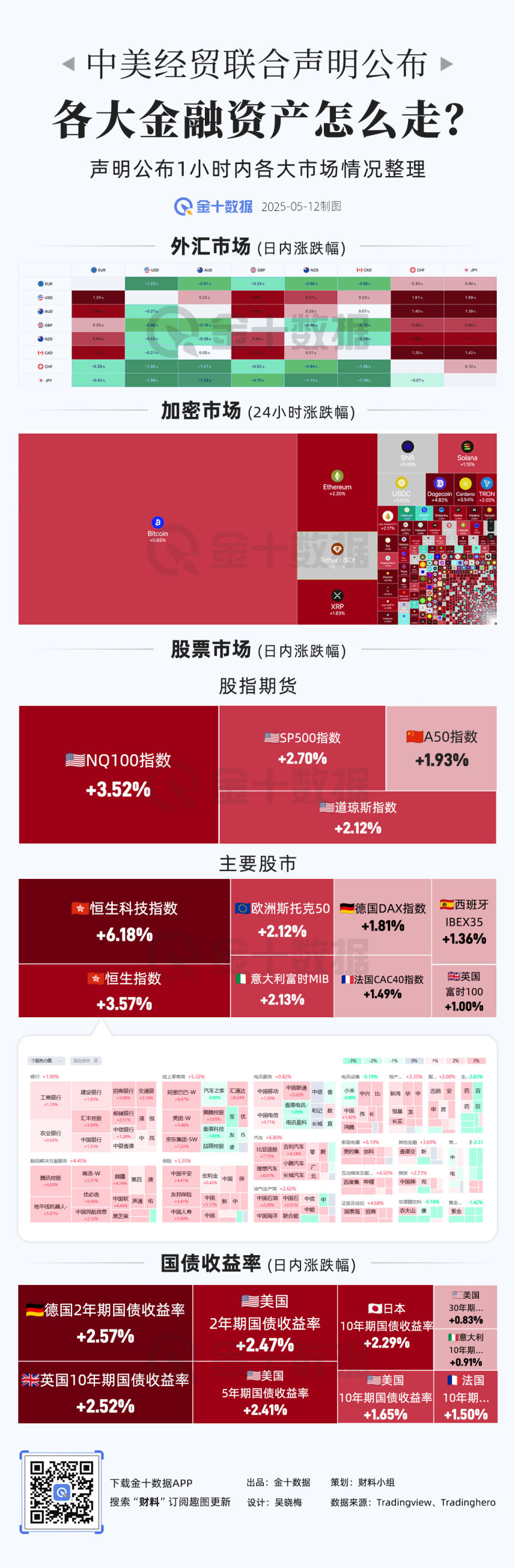
中美经贸声明重磅出炉,哪类金融资产是市场上“最靓的仔”?点击查看……
news flash· 2025-05-12 10:13
Group 1 - The S&P 500 index increased by 3.52%, indicating a strong performance in the U.S. stock market [6] - The Hang Seng Tech Index rose by 6.18%, reflecting positive sentiment in the technology sector [6] - Major European indices also showed gains, with the Euro Stoxx 50 and the German DAX index increasing by 2.12% and 1.81% respectively [6] Group 2 - U.S. Treasury yields experienced fluctuations, with the 2-year Treasury yield rising by 2.57% [9] - The 10-year Treasury yield also saw an increase of 2.29%, suggesting a shift in investor sentiment [9] - The 30-year Treasury yield rose by 1.50%, indicating a broader trend in long-term interest rates [9]