P8

Search documents
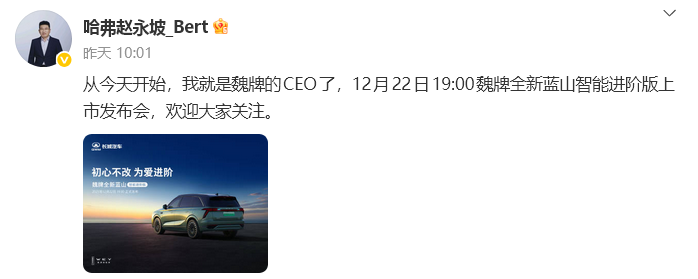
魏牌九年九帅,长城高端化之困待破局
Guan Cha Zhe Wang· 2025-12-22 10:37
Core Viewpoint - The appointment of Zhao Yongpo as CEO of WEY marks the ninth leadership change since the brand's establishment in 2016, reflecting ongoing strategic instability and challenges in positioning within the high-end automotive market [1][2][6]. Leadership Changes - WEY has experienced frequent CEO changes, with eight different leaders in nine years, indicating a lack of stability in its management [2][4]. - The longest-serving CEO, Yan Si, held the position for two years, while the shortest tenure lasted only two months [2][4]. - Recent CEOs, including Feng Fuzhi, have left due to various reasons, including failure to meet strategic goals such as establishing a direct sales channel [5][10]. Strategic Challenges - WEY's strategic direction has been inconsistent, with shifts in focus that have not solidified its market position [7][9]. - The brand initially aimed for a luxury market presence with models like VV7 and VV5 but struggled with innovation and market differentiation, leading to a decline in sales after 2019 [7][9]. - The decision to pivot to a "coffee series" of electric vehicles did not resonate with consumers, resulting in confusion and a loss of brand identity [9][10]. Market Performance - Despite a 93% year-on-year sales increase in the first eleven months of the year, WEY's total sales were only 89,000 units, representing just 4.4% of Great Wall's total sales [13]. - The brand's performance is significantly lower compared to competitors like Geely and Dongfeng, which have established stronger sales figures in the high-end market [13]. Broader Industry Context - Great Wall Motors faces challenges in high-end market penetration, electric vehicle transition, and global expansion, with its overseas revenue contributing nearly 40% of total income [11][13]. - The company is perceived as a follower in the competitive landscape, particularly in the smart vehicle sector, where it lags behind rivals like BYD and Chery [11][13].


一年卖出23万辆,中产撑起“折叠车第一股”
3 6 Ke· 2025-09-14 01:24
Core Viewpoint - Dahon, known as the "first stock of folding bicycles," successfully listed on the Hong Kong Stock Exchange, with a significant opening price increase and record oversubscription during its IPO [2][3]. Company Overview - Dahon was founded in 1982 by Han Dewei, who is recognized as the "father of modern folding bicycles" in China. The company has experienced rapid growth by meeting consumer demand for lightweight cycling options [4][6]. - Han Dewei holds approximately 88.56% of Dahon's shares, making him the controlling shareholder [6]. Market Position - Dahon ranks first in the folding bicycle industry in mainland China with a market share of 26.3% and holds the top position globally with a market share of 6.2% [9]. - The company sold 22.95 million bicycles in 2024, with a significant portion of sales coming from the mid-range market (priced between 2,500 to 5,000 RMB), which accounts for 69.7% of total revenue [10][11]. Financial Performance - Dahon's revenue increased from 254 million RMB in 2022 to 450 million RMB in 2024, with a gross margin improvement from 30.4% to 32.2% [14]. - The company sold 11.27 million bicycles in the mid-range market in the first nine months of 2024, with an average selling price of 2,129 RMB, nearly doubling sales from 6.61 million units in the same period of 2023 [11][12]. Consumer Trends - The growth of Dahon is supported by the increasing participation of the middle class in outdoor sports, with over 90% of its revenue coming from the Chinese market [15][17]. - The outdoor sports market is still in a growth phase, with consumers spending an average of 4,033 RMB on cycling annually, driven by a rising interest in health and leisure activities [17]. Industry Outlook - Recent government policies emphasize the development of the outdoor sports industry, providing a favorable environment for companies like Dahon [19]. - Dahon faces competition from both traditional bicycle manufacturers and emerging tech companies entering the folding bicycle market, necessitating a focus on product innovation and market expansion [19].