
Personal Intelligence

Search documents
X @TechCrunch
TechCrunch· 2026-03-17 16:01
Google’s Personal Intelligence feature is expanding to all US users https://t.co/Snv48JWZff ...

Google beats on revenue, projects significant AI spending increase
CNBC· 2026-02-04 21:11
Core Insights - Alphabet is expected to report its fourth-quarter earnings, with analysts anticipating significant interest in the results as the company has seen a stock increase of over 70% in the past six months, making it a top performer in 2025 [2][6] - The company has recently joined the $4 trillion club, alongside Nvidia, Microsoft, and Apple, highlighting its strong market position [2] Financial Performance - Earnings per share are projected at $2.63, with total revenue expected to reach $111.43 billion [9] - Google Cloud revenue is anticipated to be $16.18 billion, while YouTube advertising revenue is expected to be $11.84 billion [9] - Traffic acquisition costs are estimated at $16.20 billion [9] AI Developments - Alphabet has made significant strides in AI, including a deal to enhance Apple's Siri with its Gemini AI models, which could impact 2.5 billion active Apple devices [3] - The launch of Gemini 3 models received strong reviews, and the company introduced its seventh generation of tensor processing units, named Ironwood [4] - Google has also launched an AI feature called "Personal Intelligence" to provide personalized answers by integrating data from various apps [7] Strategic Moves - Alphabet's acquisition of data center company Intersect for $4.75 billion is aimed at bolstering its AI infrastructure, which is critical for meeting growing demand [5] - Waymo, Alphabet's driverless car unit, has expanded its robotaxi services to major U.S. cities and raised $16 billion in funding, valuing the company at $126 billion [10] Legal and Competitive Landscape - Google is appealing a federal ruling regarding its alleged monopoly in internet search, which may delay any potential remedies [8]



Google brings more Gemini AI features to Chrome browser
CNBC· 2026-01-28 18:00
Core Insights - Google is enhancing its Chrome browser by integrating more Gemini AI features, positioning its technology prominently for users [1][3] Group 1: New Features - The Gemini-powered features include Nano Banana for image generation, "Personal Intelligence" for personalized responses, and "Auto browse," which allows users to command the browser with a single prompt [2] - A new design for Chrome introduces a right-side panel that keeps the Gemini chatbot accessible while users navigate the web [2] Group 2: Competitive Landscape - These updates are crucial for Google as it competes with OpenAI and Anthropic, with browsers serving as the main entry point for users to access AI services [3] Group 3: Personalization Efforts - Google aims to make Chrome more personalized, as demonstrated by the "Personal Intelligence" feature that connects data from apps like Gmail and Google Photos to provide tailored answers [4] - Chrome will remember context from previous conversations to deliver uniquely tailored responses, allowing users to add specific instructions for more customized interactions [5] Group 4: Vision for the Future - The updates align with Google DeepMind CEO Demis Hassabis's vision of creating a "universal assistant" that can plan and act on behalf of users across devices [6]
Gemini盘活了谷歌全家桶,“原生”自带你10年的记忆
3 6 Ke· 2026-01-15 11:38
Core Insights - Google is transforming the concept of a personal assistant, akin to "JARVIS" from science fiction, into a reality with the launch of the "Personal Intelligence" feature powered by the Gemini3 model [1] Group 1: Product Features - The Personal Intelligence feature connects data pools from four major Google applications: Gmail, Photos, YouTube, and Search, allowing AI to access and integrate information across these platforms [2][3] - This integration enables the AI to create a comprehensive personal life map by linking emails, memories from photos, and video viewing habits, thus addressing the issue of AI not understanding individual users [3] - A natural language correction mechanism is built into the system to rectify any misinterpretations of personal data, making it easier for users to manage their data models [5] Group 2: Competitive Landscape - Google and Apple have announced a collaboration to integrate the Gemini model into Apple's intelligence system, although their implementation strategies differ significantly [6] - Google's approach is cloud-native, leveraging extensive data centers for processing, while Apple's strategy is a hybrid model that prioritizes local processing with cloud support only when necessary [6][8] - The competition in AI is shifting from model comparisons to building ecosystem barriers, with companies aiming to connect independent applications into a cohesive intelligent platform [9][12] Group 3: Industry Trends - Other tech giants, such as Alibaba and ByteDance, are also pursuing similar strategies to integrate AI into their existing applications, aiming to create comprehensive service ecosystems [11] - The future of the industry suggests that the true competitive advantage will lie in the ownership of private contextual data rather than just technological capabilities [12]
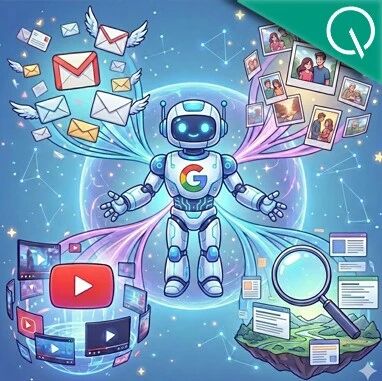
Gemini盘活了谷歌全家桶,“原生”自带你10年的记忆
量子位· 2026-01-15 08:53
Core Insights - Google is transforming the concept of a personal assistant, akin to "JARVIS" from science fiction, into a tangible product through its new "Personal Intelligence" feature powered by the Gemini3 model [1][2] Group 1: Personal Intelligence Feature - The Personal Intelligence feature connects data pools from four major Google applications: Gmail, Photos, YouTube, and Search, allowing AI to access and integrate information across these platforms [3][4] - This integration enables the AI to handle "private context," extracting details from vast historical data to assist with current inquiries [6] - A natural language correction mechanism is built into the system to address potential misinterpretations of personal data, allowing users to correct the AI's understanding in real-time [8] - Currently in Beta testing, this feature is initially available to paid subscribers of Google AI Pro and AI Ultra, with plans to extend it to free users in the future [9][10] Group 2: Comparison with Apple - Google and Apple have announced a collaboration to integrate the Gemini model into Apple's intelligence system, marking a rare convergence between the two tech giants [11] - Despite using the same underlying model, Google employs a "cloud-native" architecture, leveraging extensive data center capabilities, while Apple adopts a hybrid approach, utilizing local processing power primarily and resorting to cloud capabilities only when necessary [12] - This architectural difference leads to distinct capabilities: Google's AI focuses on deep memory, utilizing a decade's worth of user data, while Apple's AI emphasizes real-time awareness of user actions [14] Group 3: Industry Competition and Future Outlook - Google's recent developments signal a shift in AI competition from model comparison to building ecological barriers [15] - Other tech giants are also moving towards integrating AI with existing applications, aiming to connect isolated apps into a cohesive intelligent ecosystem [16][17] - Companies like Alibaba and ByteDance are exploring ways to link workflows and consumer services, while Tencent is expected to integrate AI deeply into its WeChat ecosystem, potentially transforming it into a personal digital operating system [19][20] - The future landscape suggests that the true competitive advantage will lie in the ownership of private contextual data, as users may easily switch AI assistants but find it challenging to migrate their entire social networks and digital assets [21]
谷歌(GOOGL.US)加码升级Gemini 全面打通谷歌系应用生态
Zhi Tong Cai Jing· 2026-01-15 01:57
Core Insights - Google announced an upgrade to its AI tool Gemini, integrating it with applications like YouTube and Gmail to enhance user personalization through a feature called "Personal Intelligence" [1] - The feature aims to provide tailored services by allowing users to access information across various Google applications with a simple interface while prioritizing privacy [1] Group 1: Product Features - The "Personal Intelligence" feature enables users to connect Gmail, photos, YouTube, and search functionalities, designed to be simple and secure [1] - CEO Sundar Pichai highlighted two core advantages: reasoning across complex information sources and precise information retrieval for specific scenarios like emails and photos [1] - The feature is currently in testing for Google AI Pro and AI Ultra subscribers in the U.S., available on web, Android, and iOS platforms [1] Group 2: Competitive Landscape - Gemini's integration with more Google services creates a competitive edge over OpenAI's ChatGPT, which has also introduced new features to enhance user experience [2] - Google and Apple announced a collaboration where Gemini will provide technical support for the upcoming version of Siri, aiming to create new user experiences [2]
Google launches Personal Intelligence feature in Gemini app, challenging Apple Intelligence
CNBC· 2026-01-14 18:10
Core Insights - Google is introducing a new AI tool called Personal Intelligence that integrates information from various apps like Gmail and Google Photos to provide personalized responses in its chatbot [1][3] - The feature aims to enhance reasoning capabilities within the Gemini app, allowing it to provide proactive insights by understanding context without explicit instructions [2][3] Product Features - Personal Intelligence will initially be available to Google AI Pro and AI Ultra subscribers in the U.S. and will be integrated into Google's search tool "AI Mode" in the future [4] - The feature will be off by default, and Google is seeking user feedback during its beta phase to improve functionality [4] Competitive Landscape - This development positions Google against competitors like OpenAI and Apple, with Apple also integrating AI features into its systems, including a major upgrade to Siri [3] - Gemini 3's ability to reason across user data is a key differentiator in the competitive generative AI market [3] Limitations and User Guidance - The beta version of Personal Intelligence may still contain errors, and users are encouraged to provide feedback [4] - The AI aims to avoid making assumptions on sensitive topics like health and will only discuss such data if prompted by the user [5] - Google clarifies that its AI models are not trained directly on personal data from Gmail or Google Photos but use limited information to enhance functionality over time [6]

