Rubin架构GPU

Search documents
带宽战争前夜,“中国版Groq”浮出水面
半导体行业观察· 2026-01-15 01:38
Core Viewpoint - NVIDIA is transitioning from a "computing powerhouse" to a "king of inference" by acquiring Groq's core technology for $20 billion, aiming to dominate the AI inference market [2][6]. Group 1: NVIDIA's Strategy and Market Position - NVIDIA has established a strong technical barrier in AI training with its GPU architectures like Hopper and Blackwell, but faces challenges in low-batch, high-frequency inference tasks due to traditional GPU latency issues [1]. - The acquisition of Groq's technology signifies NVIDIA's intent to enhance its capabilities in AI inference, particularly by integrating Groq's Language Processing Unit (LPU) into its upcoming Feynman architecture GPU [2][4]. - The competition in the AI industry is shifting from pure computing power to maximizing bandwidth per unit area, aligning with NVIDIA's findings that a significant portion of inference latency stems from data movement [4]. Group 2: Emergence of Domestic Competitors - In the Chinese market, the AI wave has led to the rise of domestic AI chip companies, with ICY Technology (寒序科技) being highlighted as a potential "Chinese version of Groq" due to its focus on ultra-high bandwidth inference chips [6][7]. - ICY Technology has been developing a 0.1TB/mm²/s bandwidth streaming inference chip, directly competing with Groq's technology [7]. - The company employs a dual-line strategy, focusing on both magnetic probabilistic computing chips and high-bandwidth magnetic logic chips aimed at accelerating large model inference [7][9]. Group 3: Technical Innovations and Advantages - ICY Technology's choice of on-chip MRAM (Magnetic Random Access Memory) over traditional DRAM or SRAM solutions is seen as a more innovative and sustainable approach, addressing the limitations of existing technologies [9][11]. - The MRAM technology offers significant advantages, including higher storage density and lower costs, making it a viable alternative to SRAM and HBM in AI applications [11][20]. - The SpinPU-E chip architecture aims to achieve a bandwidth density of 0.1-0.3TB/mm²·s, significantly outperforming NVIDIA's H100 [12]. Group 4: Industry Trends and Future Outlook - The global MRAM market is projected to grow from $4.22 billion in 2024 to approximately $84.77 billion by 2034, with a compound annual growth rate of 34.99% [30]. - The strategic importance of MRAM is heightened by geopolitical factors and the need for supply chain independence, positioning it as a critical technology for China's semiconductor industry [21][22]. - The industry is witnessing a shift towards MRAM as a mainstream solution, with major semiconductor companies actively investing in its development [23][26].



老黄All in物理AI!最新GPU性能5倍提升,还砸掉了智驾门槛
创业邦· 2026-01-06 04:28
Core Viewpoint - NVIDIA is shifting its focus entirely towards AI, marking its first appearance at CES in five years without showcasing gaming graphics cards, indicating a strategic pivot towards AI technologies [2][4]. Group 1: New AI Products and Architectures - NVIDIA introduced the next-generation Rubin architecture GPU, which boasts inference and training performance that are 5 times and 3.5 times better than the Blackwell GB200, respectively [4][17]. - The company unveiled five new product families targeting various AI applications, including the NVIDIA Nemotron for Agentic AI, NVIDIA Cosmos for physical AI, and a new model family for autonomous driving called NVIDIA Alpamayo [7][8][29]. - The Vera Rubin NVL72 architecture was officially launched, featuring six core components designed to enhance AI data center capabilities, including the Vera CPU and Rubin GPU [15][17]. Group 2: Performance Metrics and Innovations - The Rubin GPU achieves an inference performance of 50 PFLOPS and a training performance of 35 PFLOPS, significantly enhancing computational capabilities for AI applications [17][25]. - Each Rubin GPU is equipped with 288GB of HBM4 memory and a bandwidth of 22 TB/s, supporting the demands of large-scale AI models [17]. - The NVLink 6 interconnect technology increases the inter-GPU bandwidth to 3.6 TB/s, facilitating efficient communication between expert modules in large models [17]. Group 3: Open Source Initiatives - NVIDIA announced ongoing contributions to open-source training frameworks and multimodal datasets, including 100 trillion language training tokens and 100TB of vehicle sensor data [8][10]. - The Alpamayo model for autonomous driving is the world's first open-source, large-scale visual-language-action inference model, designed to enhance vehicle decision-making capabilities [29][31]. Group 4: Industry Applications and Collaborations - The new models and frameworks are expected to be integrated into various industries, with the Alpamayo model set to debut in the Mercedes-Benz CLA in 2025, showcasing NVIDIA's commitment to advancing autonomous driving technology [29][34]. - The Nemotron models are tailored for specific applications such as speech recognition and safety, enhancing the reliability and efficiency of AI systems [37][39]. - The Cosmos model has been upgraded to generate synthetic data that adheres to real-world physical laws, with applications in robotics and autonomous driving [41][44]. Group 5: Healthcare and Life Sciences - NVIDIA Clara is focused on healthcare and life sciences, aiming to reduce costs and accelerate treatment solutions, with specialized models for protein design and drug discovery [48][49]. - The company is providing datasets of 450,000 synthetic protein structures to researchers, further supporting advancements in personalized medicine [49][50].

黄仁勋回击AI泡沫论,GPU全卖光,Q3净赚2200亿
3 6 Ke· 2025-11-20 01:12
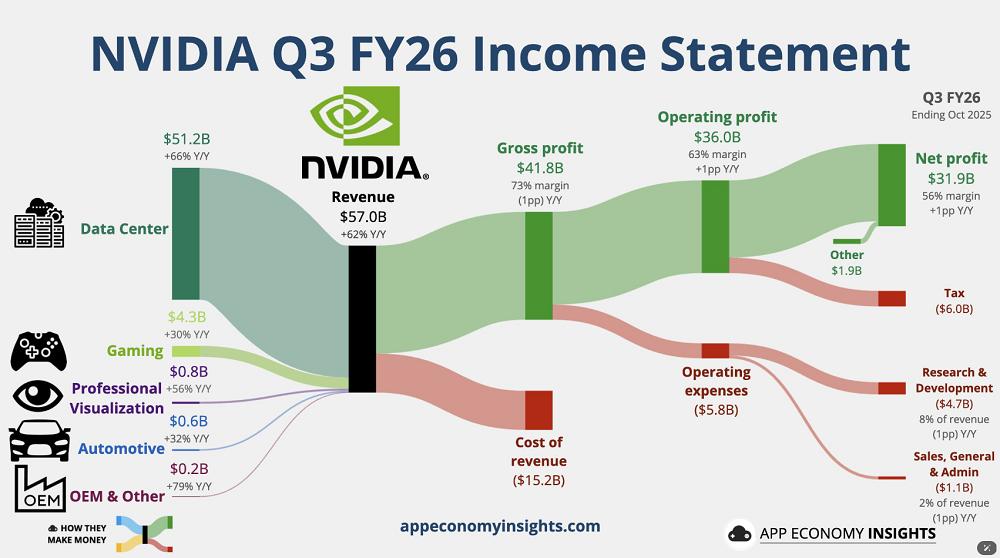
Core Viewpoint - Nvidia's Q3 FY26 financial results exceeded Wall Street expectations, showcasing significant growth in revenue and net profit driven by strong demand for AI infrastructure and GPU sales [1][2]. Financial Performance - Nvidia reported revenue of $57.006 billion, a year-over-year increase of 62% and a quarter-over-quarter increase of 22% [1][9]. - Non-GAAP net income reached $31.767 billion, reflecting a 59% year-over-year growth and a 23% quarter-over-quarter increase [9]. - The company achieved a non-GAAP gross margin of 73.6%, up 0.9 percentage points from the previous quarter but down 1.4 percentage points year-over-year [8][9]. Revenue Breakdown - The data center segment generated $51.215 billion, a 66% increase year-over-year and a 25% increase quarter-over-quarter [7][9]. - The compute segment contributed $43.028 billion, with a 56% year-over-year growth and a 27% quarter-over-quarter increase [7][9]. - Networking revenue surged by 162% year-over-year, reaching $8.187 billion [7][9]. - Gaming and professional visualization segments also saw growth, with gaming revenue at $4.265 billion (30% year-over-year) and professional visualization at $760 million (56% year-over-year) [7][9]. Market Dynamics - Nvidia's CEO highlighted three major platform transitions: the shift from CPU to GPU computing, the rise of generative AI applications, and the emergence of Agentic AI [1][10]. - The demand for AI infrastructure is outpacing Nvidia's expectations, with major cloud service providers experiencing sold-out capacities [2][10]. - Nvidia's partnership with Anthropic, involving a combined investment of $15 billion, underscores the company's strategic positioning in the AI market [12]. Future Outlook - Nvidia anticipates revenue of $65 billion for Q4 FY26, with a projected non-GAAP gross margin of 75% [9][14]. - The company expects to benefit from increased capital expenditures in the AI infrastructure sector, with top cloud providers' spending projected to reach $600 billion, up $200 billion from earlier estimates [14].