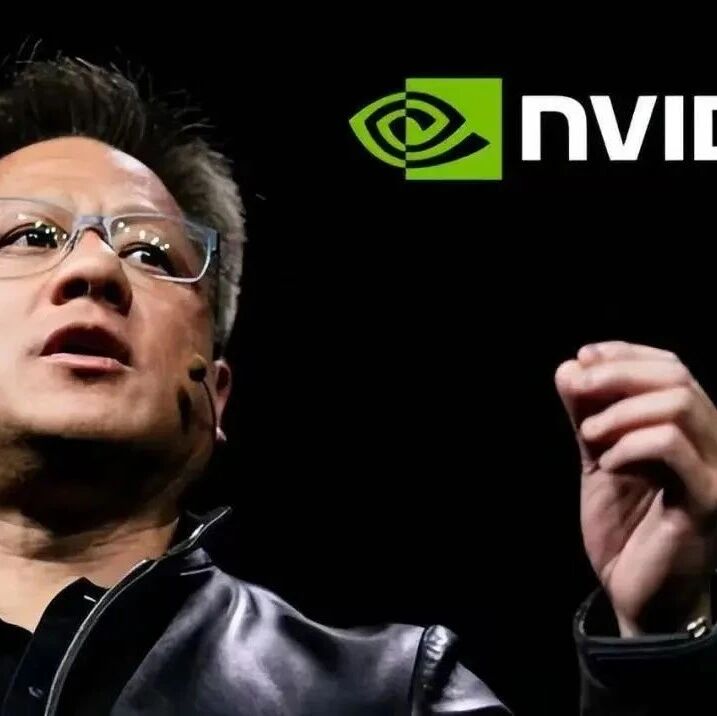
Blackwell架构GPU

Search documents
“世界前所未见”!芯片,突传重磅!黄仁勋最新发声
证券时报· 2026-02-19 09:57
Core Viewpoint - NVIDIA is set to unveil a groundbreaking new chip at the GTC 2026 conference, which is expected to further solidify its leadership in AI infrastructure [1][3]. Group 1: Upcoming Events and Innovations - The GTC 2026 conference will take place from March 16 to 19 in San Jose, California, focusing on the new era of AI infrastructure competition [1]. - NVIDIA's CEO Jensen Huang hinted at multiple new chips that will push current physical limits, with speculation that one of them may be based on the Rubin architecture [3]. Group 2: NVIDIA Rubin Platform - The NVIDIA Rubin platform, launched on January 5, consists of six new chips designed for building advanced AI supercomputers, setting a new benchmark for cost-effective deployment and operation of large-scale AI systems [5]. - The Rubin platform introduces five innovative technologies, including next-generation NVIDIA NVLink, Transformer engines, confidential computing, RAS engines, and NVIDIA Vera CPUs, which significantly reduce the GPU count needed for training MoE models [5]. Group 3: Industry Partnerships and Collaborations - Major tech leaders, including OpenAI and Microsoft, have endorsed the Rubin platform, emphasizing its role in enhancing AI capabilities and efficiency [6][7]. - Meta has announced a long-term partnership with NVIDIA, planning to deploy millions of NVIDIA chips in its data centers, marking a significant step in challenging the dominance of traditional x86 architectures [12]. Group 4: Market Trends and Financial Insights - Despite the increasing capital expenditures by major tech companies in AI infrastructure, NVIDIA's stock price has remained relatively stagnant, with a decline of 6.49% since its peak in October 2025 [10][11]. - A report from Huafu Securities indicates that the narrative of "selling shovels upstream" in the AI industry is still ongoing, with projected capital expenditures for major Chinese and American tech giants reaching $404.49 billion in 2026, an 18% year-over-year increase [12][13].


Meta(META.US)与英伟达(NVDA.US)达成“万亿级”芯片合作,剑指x86霸权引爆盘前行情
智通财经网· 2026-02-18 12:48
Group 1: Core Insights - The collaboration between Nvidia and Meta Platforms marks a significant strategic partnership, focusing on the supply of next-generation AI chips, which has positively impacted market sentiment and stock prices [1][2] - Meta will deploy millions of Nvidia's high-performance AI chips across its data centers and cloud infrastructure, indicating a shift towards Arm architecture and challenging the dominance of traditional x86 architecture in data centers [2][3] - The partnership includes deep co-design agreements for optimizing hardware and software integration for Meta's next-generation language models, enhancing Meta's AI capabilities [2][3] Group 2: Market Reactions - Nvidia's stock showed strong performance following the announcement, alleviating concerns about major clients reducing external chip purchases due to in-house chip development [3] - Meta's significant capital expenditure is viewed as a defensive strategy against competitors like Google and Microsoft, boosting investor confidence in its AI commercialization prospects [3] - The collaboration signals a potential shift in the competitive landscape, posing challenges for traditional chip giants like Intel and AMD as Meta leans towards Arm architecture [3][4] Group 3: Broader Industry Trends - Microsoft announced a $50 billion investment in AI infrastructure over the next decade, focusing on emerging markets, which reflects the high investment resilience among tech giants [5] - Major companies, including Amazon and Alphabet, are expected to maintain high capital expenditures, driving demand for Nvidia's GPUs in data center construction [5] - Geopolitical stability and positive signals in negotiations have contributed to a rebound in risk assets, with funds flowing back into the tech sector [5][6]

英伟达的“引力”与“孤岛”:业绩增速再度抬头,中国市场仍是缺口
Hua Xia Shi Bao· 2025-11-21 04:10
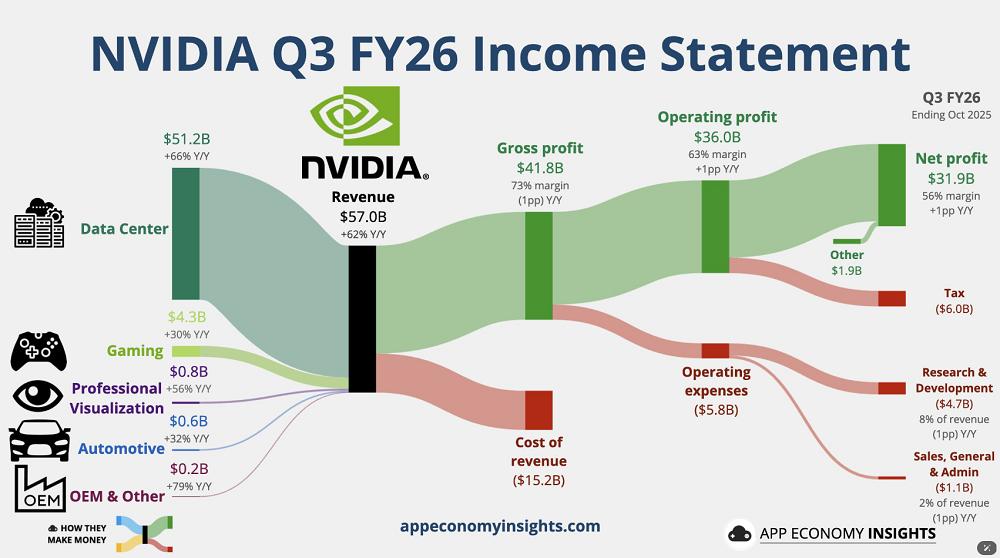
Core Viewpoint - Nvidia's recent financial report indicates a significant recovery in revenue and net profit growth, driven primarily by strong demand in the data center business, despite challenges in the Chinese market [3][4]. Financial Performance - For the third quarter of fiscal year 2026, Nvidia reported revenue of $57 billion, a 22% increase from the previous quarter and a 62% increase year-over-year; net profit reached $31.9 billion, up 65% year-over-year and 21% quarter-over-quarter [4]. - The revenue growth rate had previously slowed down, but this quarter marks the first simultaneous increase in both revenue and net profit after several quarters of decline [4]. - The data center segment remains the primary revenue driver, generating $51.215 billion, a 66% increase year-over-year; gaming revenue was $4.265 billion, up 30%; professional visualization revenue was $760 million, up 56%; and automotive revenue was $592 million, up 32% [5]. Market Dynamics - Nvidia's CEO Jensen Huang dismissed concerns about an "AI bubble," asserting that the company is well-prepared to succeed in all stages of AI development [6][7]. - The demand for Nvidia's Blackwell architecture GPUs has exceeded expectations, contributing significantly to revenue growth [5][7]. - Despite Nvidia's strong performance, major stakeholders, including SoftBank and Huang himself, have sold off significant shares, raising concerns about potential market bubbles [6][7]. Strategic Investments - Nvidia continues to invest strategically in companies like Intel, OpenAI, and Nokia to expand its AI ecosystem and ensure optimal performance across its product range [8]. - The company aims to maintain a robust cash flow management approach while pursuing these investments [8]. Challenges in the Chinese Market - Nvidia's market share in China has plummeted from 95% to 0% for high-end AI chips due to U.S. export controls, leading to a complete withdrawal from the Chinese market [10]. - The company expressed disappointment over missed large purchase orders in China due to geopolitical issues and increased competition [10]. - Nvidia's absence in the Chinese market has created opportunities for local AI chip manufacturers, such as Cambrian, which reported a 1332.52% year-over-year revenue increase [11].

黄仁勋回击AI泡沫论,GPU全卖光,Q3净赚2200亿
3 6 Ke· 2025-11-20 01:12
Core Viewpoint - Nvidia's Q3 FY26 financial results exceeded Wall Street expectations, showcasing significant growth in revenue and net profit driven by strong demand for AI infrastructure and GPU sales [1][2]. Financial Performance - Nvidia reported revenue of $57.006 billion, a year-over-year increase of 62% and a quarter-over-quarter increase of 22% [1][9]. - Non-GAAP net income reached $31.767 billion, reflecting a 59% year-over-year growth and a 23% quarter-over-quarter increase [9]. - The company achieved a non-GAAP gross margin of 73.6%, up 0.9 percentage points from the previous quarter but down 1.4 percentage points year-over-year [8][9]. Revenue Breakdown - The data center segment generated $51.215 billion, a 66% increase year-over-year and a 25% increase quarter-over-quarter [7][9]. - The compute segment contributed $43.028 billion, with a 56% year-over-year growth and a 27% quarter-over-quarter increase [7][9]. - Networking revenue surged by 162% year-over-year, reaching $8.187 billion [7][9]. - Gaming and professional visualization segments also saw growth, with gaming revenue at $4.265 billion (30% year-over-year) and professional visualization at $760 million (56% year-over-year) [7][9]. Market Dynamics - Nvidia's CEO highlighted three major platform transitions: the shift from CPU to GPU computing, the rise of generative AI applications, and the emergence of Agentic AI [1][10]. - The demand for AI infrastructure is outpacing Nvidia's expectations, with major cloud service providers experiencing sold-out capacities [2][10]. - Nvidia's partnership with Anthropic, involving a combined investment of $15 billion, underscores the company's strategic positioning in the AI market [12]. Future Outlook - Nvidia anticipates revenue of $65 billion for Q4 FY26, with a projected non-GAAP gross margin of 75% [9][14]. - The company expects to benefit from increased capital expenditures in the AI infrastructure sector, with top cloud providers' spending projected to reach $600 billion, up $200 billion from earlier estimates [14].
英伟达财报前,花旗高喊:买入!AI需求远超供应,泡沫之说站不住脚
美股IPO· 2025-11-11 04:48
Core Viewpoint - Citigroup expects Nvidia's upcoming earnings report on November 19 to exceed revenue expectations and raise guidance, maintaining a "Buy" rating and raising the target price to $220 [1][2] Group 1: Earnings Expectations - Citigroup predicts Nvidia's sales for the quarter ending in October will reach $57 billion, surpassing the market average expectation of approximately $55 billion [4] - For the January quarter, Citigroup anticipates Nvidia's sales guidance will be $62 billion, also above the market expectation of around $61 billion [5] - The report indicates that Nvidia's data center sales are expected to grow by 24% and 12% in the October and January quarters, respectively, compared to market expectations of 19% and 15% [6] Group 2: Market Dynamics - Citigroup refutes the notion of an "AI bubble," arguing that the main issue in the AI chip market is supply constraints rather than weak demand, with AI supply expected to remain below demand until 2026 [10] - The report highlights that large cloud service providers' revenues are projected to show a turning point starting in 2025, driven by the adoption of enterprise-level AI applications [10] Group 3: Valuation and Target Price - Citigroup has raised Nvidia's target price to $220 based on a projected EPS of $7.24 for the 2026 calendar year, applying a 30x price-to-earnings ratio [11] - The EPS forecasts for Nvidia for the fiscal years 2026, 2027, and 2028 have been increased by 2%, 7%, and 8%, respectively, to align with the revised global AI capital expenditure model [11] Group 4: AI Semiconductor Market Outlook - Citigroup has significantly raised its forecast for the global data center semiconductor market, predicting it will reach $654 billion by 2028, up 16% from the previous estimate of $563 billion [12] - The upward revision is attributed to higher-than-expected demand from key AI players like OpenAI [12]

英伟达财报前,花旗高喊:买入!AI需求远超供应,泡沫之说站不住脚
Hua Er Jie Jian Wen· 2025-11-11 04:31
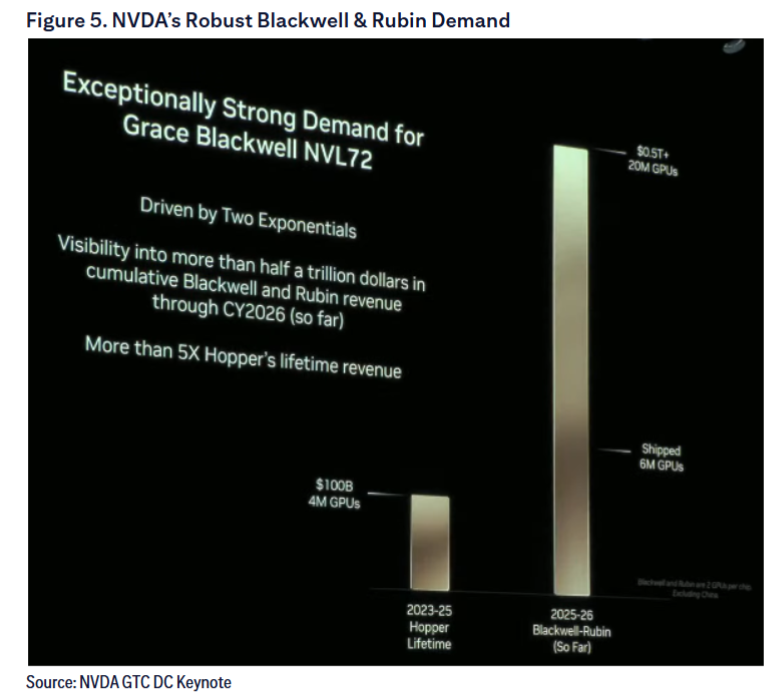
Core Viewpoint - Citigroup has maintained a "buy" rating on Nvidia and raised its target price from $210 to $220, indicating strong confidence in the company's upcoming earnings report expected on November 19, which is anticipated to exceed revenue expectations and provide an upward guidance [1][2]. Financial Performance Expectations - Citigroup predicts Nvidia's sales for the quarter ending in October will reach $57 billion, surpassing the market average expectation of approximately $55 billion [2]. - For the January quarter, Citigroup expects Nvidia's sales guidance to be $62 billion, also above the market expectation of around $61 billion [2]. - The optimistic forecast is supported by strong shipment momentum of Nvidia's Blackwell architecture GPUs, with 6 million GPUs shipped as reported during the GTC Washington conference [2]. AI Market Dynamics - Citigroup counters the narrative of an "AI bubble," asserting that the primary issue in the AI chip market is supply constraints rather than lack of demand [4]. - The report highlights that due to limitations in CoWoS capacity, AI supply will remain below demand until at least 2026, with a potential catch-up only around 2027 [4]. - Large cloud service providers are expected to see a turning point in cloud revenue starting in 2025, driven by the adoption of enterprise-level AI applications [4]. Target Price and Earnings Forecast - Based on strong growth prospects, Citigroup has raised its target price for Nvidia to $220, based on a projected EPS of $7.24 for the calendar year 2026 and applying a 30x price-to-earnings ratio [5]. - Citigroup has also increased its EPS forecasts for Nvidia for the fiscal years 2026, 2027, and 2028 by 2%, 7%, and 8% respectively, aligning with revised global AI capital expenditure models [5]. AI Semiconductor Market Outlook - Citigroup's bullish outlook extends beyond Nvidia to the entire AI semiconductor market, predicting that the global data center semiconductor market will reach $654 billion by 2028, a 16% increase from the previous estimate of $563 billion [7]. - The upward revision is attributed to higher-than-expected demand from key AI players like OpenAI [7].
英伟达与韩国政企达成里程碑式合作,人工智能AIETF(515070)午后跌幅收窄至0.11%
Mei Ri Jing Ji Xin Wen· 2025-11-03 07:46
Group 1 - The A-share market saw all three major indices turn positive in the afternoon, with the storage chip sector experiencing a sustained rebound [1] - Nvidia has reached a milestone collaboration with the South Korean government and four major corporate groups to supply approximately 260,000 latest Blackwell architecture GPUs to enhance South Korea's AI infrastructure [1] - The agreement includes the South Korean government receiving 50,000 GPUs for a national AI computing center, while Samsung, SK Group, and Hyundai Motor Group will each receive 50,000 GPUs for AI factory construction, and NAVER Cloud will obtain 60,000 GPUs to strengthen cloud service capabilities [1] Group 2 - CICC analysis indicates that the continuous advancement of AI technology is driving the semiconductor industry into a new cycle characterized by "going abroad" and "upgrading" [2] - Despite the end of the domestic substitution dividend period for mature products, high growth in AI-related demand and the backdrop of trade friction present commercialization opportunities for domestic computing chip companies [2] - The demand for cloud computing driven by AI applications and the upgrade of terminal hardware such as AI phones and AR/VR will jointly constitute the core driving force for industry development [2]


贝莱德与英伟达达成400亿美元协议,收购全球最大数据中心运营商
Sou Hu Cai Jing· 2025-10-16 00:39
Core Insights - BlackRock and NVIDIA announced a $40 billion acquisition of Aligned Data Centers, marking one of the largest mergers of the year [1][2] - The acquisition targets the growing demand for AI infrastructure as tech giants accelerate the construction of AI-specific data centers [1][2] Group 1: Acquisition Details - The acquisition is led by BlackRock's Global Infrastructure Partners (GIP), with NVIDIA as a strategic partner and Mubadala's MGX joining the consortium [1][2] - Aligned Data Centers operates 50 campuses and 78 data centers across the U.S. and South America, serving major clients like Microsoft and Amazon [1] Group 2: Financial Background - Aligned recently completed over $12 billion in equity and debt financing, indicating its expanding power capacity critical for AI model training [2] - The deal values Aligned at $40 billion, with the transaction expected to close in the first half of 2026, pending regulatory approval [2] Group 3: Future Plans - Post-acquisition, Aligned will be rebranded as "GIP-Aligned AI Infrastructure" and will initiate a global expansion plan focusing on emerging markets in Southeast Asia and the Middle East [2] - NVIDIA plans to deploy its latest Blackwell architecture GPUs in Aligned's data centers to provide dedicated computing services for clients like OpenAI and Anthropic [2]

当科技开始成为市场的共识
远川投资评论· 2025-09-25 07:07
Core Viewpoint - The emergence of stock market leaders like Cambrian reflects the extreme manifestation of market trends, particularly in the AI sector, which has shown significant growth and profitability in recent reports [2][3]. Group 1: AI Industry Performance - Cambrian's revenue for the first half of 2025 reached 2.881 billion yuan, a year-on-year increase of 4347.82%, with a net profit of 1.038 billion yuan, marking a 295.82% growth [2]. - Other companies in the AI supply chain, such as New Yisheng and Shenghong Technology, also reported impressive growth, with revenue increasing by 282.64% and net profit by 366.89% respectively [2]. - The recovery of the tech market has provided a significant opportunity for public equity funds, with the Wind data showing a 31.45% increase in the Wande mixed equity fund index year-to-date, outperforming the 14.41% increase in the CSI 300 index [2]. Group 2: Global Supply Chain Insights - The deep globalization of the tech industry complicates the relocation of production to the U.S., as highlighted by Nvidia's plan to build a $500 billion AI infrastructure in the U.S. over four years [5][6]. - The production of advanced semiconductors relies on a global supply chain, with critical components sourced from various countries, making complete localization challenging [6][9]. - A report from the Belfer Center emphasizes that no country can fully control the advanced semiconductor supply chain, underscoring the need for a global perspective in tech investments [9]. Group 3: Investment Strategies - The tech investment landscape is characterized by a focus on high-growth sectors such as innovative pharmaceuticals, robotics, and AI, necessitating a deep understanding of global industry dynamics [3][10]. - Fund managers are encouraged to integrate a mid-level framework for tracking tech industry changes, which aids in identifying investment opportunities [10][12]. - The investment philosophy emphasizes the importance of long-term factors over short-term market noise, with a focus on business model sustainability and industry leadership [15][17]. Group 4: Case Studies and Examples - Fund managers like Ouyang Liangqi have successfully identified undervalued internet companies in the AI space, leading to significant returns [15][19]. - The investment team at Yifangda has built a robust research framework that allows for continuous tracking of over 500 Taiwanese companies, enhancing their ability to gauge industry trends [24]. - The team’s approach to identifying companies that can navigate through the technology lifecycle stages is crucial for capturing excess returns in the evolving market [23][24].

英伟达电话会:“将Blackwell带到中国市场”的机会真实存在,今年毛利率仍有望达70%中段水平
美股IPO· 2025-08-28 04:59
Core Insights - The global AI capital expenditure is expected to reach $3-4 trillion by 2030, driven by significant growth in AI infrastructure investments [5][12][45] - NVIDIA's sovereign AI revenue is projected to reach $20 billion this year, more than doubling from the previous year, with substantial opportunities in the Chinese market [9][19] - The new Blackwell architecture is setting a new standard for AI inference performance, with a 10x return on investment per token and a 50x improvement in efficiency compared to previous architectures [7][17] Group 1 - NVIDIA's Q2 revenue showed double-digit growth, with Blackwell chip revenue increasing by 17% quarter-over-quarter, indicating strong demand [3][12] - The data center revenue continues to lag, partly due to a decrease in H20 chip sales, with no sales to China in the quarter [3][15] - The company expects significant growth opportunities in the coming years, particularly in AI infrastructure [3][12][66] Group 2 - The Chinese market presents a $50 billion opportunity this year, with an expected annual growth rate of 50% [4][48] - NVIDIA is in discussions with the U.S. government regarding the importance of meeting the Chinese market's needs and aims to sell Blackwell architecture GPUs there [4][48] Group 3 - The anticipated $3-4 trillion in AI capital expenditure is considered reasonable, given the rapid expansion of AI infrastructure projects globally [5][12] - Major cloud service providers have doubled their capital expenditures to $600 billion over two years, indicating a robust market for AI infrastructure [5][12][43] Group 4 - Factors driving continued investment growth include the need for increased training and inference computing, the global development of sovereign AI, and the adoption of enterprise AI [6][16] - Blackwell's NVLink and CUDA architecture redefine inference economics, enabling unprecedented scalability and monetization of computing resources [7][17] Group 5 - The gross margin is expected to reach the mid-70% range by year-end, reflecting strong profitability potential [8][28] - The company is accelerating investments to capitalize on future growth opportunities, with a focus on enhancing product performance and customer profitability [8][39] Group 6 - The company anticipates total revenue of $54 billion for Q3, excluding any assumptions for H20 shipments to China [27][66] - The expected GAAP and non-GAAP gross margins for Q3 are projected to be 73.3% and 73.5%, respectively [27][28]