Lynparza

Search documents
Will AbbVie's Oncology Drugs Aid Top Line in 2026?
ZACKS· 2026-03-31 14:32
Core Insights - AbbVie has established a strong presence in the oncology market, primarily driven by blood cancer drugs Imbruvica and Venclexta, while also diversifying its portfolio with newer drugs like Epkinly, Elahere, and Emrelis, which are expected to contribute significantly to future revenues [1][2]. Sales Performance - In 2025, AbbVie's oncology segment generated $6.66 billion, representing approximately 11% of total revenues, with a year-over-year increase of 1.4%, mainly due to rising sales of Venclexta, Epkinly, and Elahere [2]. - A projected decline in oncology sales to $6.5 billion in 2026 is attributed to lower pricing for Imbruvica, although this decrease is expected to be partially offset by increasing sales of other drugs in the portfolio [3][10]. Portfolio Development - AbbVie is enhancing its oncology portfolio by focusing on antibody-drug conjugates (ADCs), which are seen as a disruptive innovation in cancer treatment, allowing for more targeted therapies [4]. - The company currently has two ADCs in its commercial portfolio and is awaiting FDA review for a third ADC therapy, pivekimab sunirine, while also developing another investigational ADC, Temab-A, for various cancers [5][6]. Competitive Landscape - Major competitors in the oncology space include AstraZeneca, Merck, and Pfizer, with AstraZeneca's oncology sales accounting for 44% of total revenues and experiencing a 14% year-over-year growth in 2025 [7]. - Merck's Keytruda, a PD-L1 inhibitor, represented about 49% of its total revenues in 2025, while Pfizer's oncology revenues grew by 8%, driven by several key drugs [8]. Valuation and Market Position - AbbVie shares are currently trading at a P/E ratio of 14.23, which is below the industry average of 16.73, indicating a discount relative to peers [12].



PFE's Atirmociclib 2L Breast Cancer Study Hits Goal, Aid Pipeline Push
ZACKS· 2026-03-18 16:27
Core Insights - Pfizer is a leading oncology drugmaker with a strong portfolio and pipeline across various cancer types, including breast, genitourinary, thoracic, gastrointestinal, and blood cancers [1] - The company's oncology revenues grew by 8% year over year in 2025, accounting for approximately 27% of total revenues [2] Oncology Pipeline and Development - Key candidates in late-stage development include atirmociclib for metastatic breast cancer and sigvotatug vedotin for metastatic non-small cell lung cancer [3] - A regulatory application for vepdegestrant for ER+/HER2- metastatic breast cancer is under review in the U.S., and sasanlimab for high-risk non-muscle invasive bladder cancer is under review in the EU [3] Clinical Study Results - The FOURLIGHT-1 study showed that atirmociclib combined with fulvestrant met its primary endpoint, demonstrating a statistically significant improvement in progression-free survival [4][5] - Atirmociclib treatment resulted in a 40% reduction in the risk of disease progression or death [5] - The treatment was well tolerated and had a manageable safety profile, particularly in a hard-to-treat patient population [6] Competitive Landscape - Pfizer competes with major players like AstraZeneca, Merck, Johnson & Johnson, and Bristol-Myers in the oncology space [9] - AstraZeneca's oncology sales rose 14% in 2025, while Merck's Keytruda generated $31.7 billion in sales, up 7% year over year [11][12] - Johnson & Johnson's oncology sales increased by 20.9% to $25.4 billion, and Bristol-Myers' Opdivo sales rose 8% to $10 billion [13][14] Financial Performance and Valuation - Pfizer's shares have increased by 10.2% year to date, contrasting with a 0.1% decline in the industry [17] - The company is trading at a price/earnings ratio of 9.33, below the industry average of 17.65 and its five-year mean of 10.15 [18] - The Zacks Consensus Estimate for 2026 earnings has slightly declined from $2.99 to $2.97 per share [19]


Can Pfizer Reignite Growth Amid COVID Declines and Patent Expirations?
ZACKS· 2026-03-05 14:46
Core Insights - Pfizer (PFE) is facing significant near-term challenges, including declining COVID-19 product sales, the impending loss of exclusivity (LOE) for several key drugs, and headwinds from U.S. Medicare Part D, which could negatively impact sales and profits starting in 2026 [2][12]. Revenue Impact - The LOE cliff is projected to result in a revenue decline of approximately $1.5 billion in 2026 as key products like Eliquis, Vyndaqel, Ibrance, Xeljanz, and Xtandi approach patent expirations [3][12]. - The redesign of Medicare Part D under the Inflation Reduction Act (IRA) is expected to adversely affect Pfizer's revenues in 2025 and continue into 2026, particularly impacting higher-priced drugs [4][12]. - COVID-19 product sales, specifically Comirnaty and Paxlovid, have sharply declined from their 2022 peak, with projected COVID revenues around $5 billion in 2026, down from approximately $6.7 billion in 2025 [5][4]. Strategic Initiatives - To address these challenges, Pfizer is focusing on rebuilding its pipeline in oncology and obesity, aiming for growth in 2028 and beyond. The company is actively acquiring assets to offset lost COVID revenues and has initiated a multi-year cost realignment program to enhance margins [6][12]. - Despite the introduction of new and acquired products, they have not yet compensated for the revenue losses from legacy products and the decline in COVID-related sales [7]. Competitive Landscape - Pfizer is a major player in the oncology market, competing with other large pharmaceutical companies such as AstraZeneca, Merck, Johnson & Johnson, and Bristol-Myers [8]. - AstraZeneca's oncology sales accounted for about 44% of its total revenues, with a 14% increase in 2025 driven by key products [9]. - Merck's Keytruda, a leading oncology drug, generated $31.7 billion in sales in 2025, marking a 7% year-over-year increase [10]. - Johnson & Johnson's oncology sales rose 20.9% in 2025, contributing significantly to its overall revenue growth [11]. - Bristol-Myers' Opdivo, a key cancer drug, accounted for around 21% of its total revenues, with sales increasing by 8% to $10 billion in 2025 [13]. Financial Performance - Pfizer's stock has increased by 1.4% over the past year, compared to an 8.6% rise in the industry [14]. - The company's valuation appears attractive, trading at a price/earnings ratio of 9.04, significantly lower than the industry average of 18.22 and its five-year mean of 10.20 [16]. - The Zacks Consensus Estimate for 2026 earnings has slightly decreased from $2.99 to $2.97 per share, while the estimate for 2027 remains stable at $2.83 [18].

AstraZeneca vs. Pfizer: Which Pharma Giant Has the Edge in 2026?
ZACKS· 2026-02-20 16:51
Core Insights - Pfizer (PFE) and AstraZeneca (AZN) are leading pharmaceutical companies with significant oncology segments, contributing 27% and 44% to their total revenues respectively [1][2] - Both companies have strong R&D pipelines that could drive future growth, but they face different challenges and opportunities in the current market [3] Pfizer Overview - Pfizer's oncology revenues grew by 8% in 2025, supported by products like Xtandi and Lorbrena [4] - Non-COVID operational revenues increased by 6% in 2025, with recently launched and acquired products generating $10.2 billion, growing approximately 14% year-over-year [5] - Pfizer invested around $9 billion in M&A deals in 2025, focusing on enhancing its pipeline through acquisitions [6] - The company anticipates a decline in COVID product sales, projecting revenues of around $5 billion in 2026, down from $6.7 billion in 2025 [7] - Pfizer expects a significant revenue impact from the loss of exclusivity for key products between 2026-2030, estimating a $1.5 billion sales drop in 2026 [8] AstraZeneca Overview - AstraZeneca has 16 blockbuster drugs, contributing to an 8% revenue growth and 11% core EPS growth in 2025 [9][10] - The company targets mid-to-high single-digit revenue growth for 2026 and aims for $80 billion in total revenues by 2030 [12] - AstraZeneca's newer drugs have offset losses from mature brands, and the rare disease segment is showing improvement [10] - The company plans to launch 20 new medicines by 2030, with many expected to generate over $5 billion in peak-year revenues [12] - AstraZeneca faces challenges such as generic competition and ongoing investigations in its China subsidiary [13] Financial Estimates Comparison - The Zacks Consensus Estimate for AstraZeneca's 2026 sales and EPS implies a year-over-year increase of 6.0% and 123.6% respectively [14] - In contrast, Pfizer's estimates indicate a decline of 2.5% in sales and 7.8% in EPS for 2026 [16] Stock Performance and Valuation - Over the past year, Pfizer's stock rose by 1.8%, while AstraZeneca's stock increased by 40.6% [18] - AstraZeneca's shares trade at a forward P/E ratio of 20.12, while Pfizer's shares are at 9.11, indicating a more attractive valuation for Pfizer [19] - Pfizer offers a dividend yield of 6.4%, significantly higher than AstraZeneca's yield of around 1% [22] Investment Outlook - AstraZeneca is viewed as a safer investment due to its clearer growth targets and efficient profitability, despite Pfizer's lower valuation and higher dividend yield [25]


Pfizer Targets Long-Term Oncology Growth Amid Competitive Pressure
ZACKS· 2026-02-19 16:15
Core Insights - Pfizer is a leading player in the oncology market with a diverse portfolio of approved cancer medicines and a strong pipeline focused on various modalities [1][9] Oncology Sales Performance - Oncology sales account for approximately 27% of Pfizer's total revenues, with an 8% growth in 2025 driven by key drugs such as Xtandi, Lorbrena, Braftovi-Mektovi combination, and Padcev [2][11] - Xtandi generated alliance revenues of $2.19 billion in 2025, up 8% year over year, while Lorbrena sales increased by 40% to $1.02 billion [3] - Padcev sales rose 22% to $1.94 billion, supported by strong demand trends, while Ibrance revenues declined by 6% to $4.1 billion [4][11] Pipeline and Future Growth - Pfizer is investing in Padcev, which has received FDA approval for a combination treatment with Merck's Keytruda for muscle-invasive bladder cancer, potentially expanding its patient population [5][9] - The oncology biosimilars segment contributed $1.3 billion in sales, reflecting a 26% year-over-year increase [6] - Pfizer's late-stage pipeline includes candidates like atirmociclib and sigvotatug vedotin, with expectations of having eight or more blockbuster oncology medicines by 2030 [7][11] Competitive Landscape - Pfizer competes with major players in the oncology space, including AstraZeneca, Merck, Johnson & Johnson, and Bristol-Myers [10] - AstraZeneca's oncology sales rose 14% in 2025, while Merck's Keytruda accounted for over 50% of its pharmaceutical sales, reaching $31.7 billion [12][13] Stock Performance and Valuation - Pfizer's stock has increased by 5.7% over the past year, compared to a 17.3% rise in the industry [18] - The company's shares are trading at a forward price/earnings ratio of 9.28, lower than the industry average of 18.86 and its own 5-year mean of 10.22 [20]

Can Pfizer's New & Acquired Drugs Offset Its Looming Patent Cliff?
ZACKS· 2026-02-11 14:11
Core Insights - Pfizer's COVID product sales have significantly declined from their peak, with projections of around $11 billion in 2024 and $6.7 billion in 2025, down from $56.7 billion in 2022. The company also faces challenges from U.S. Medicare Part D and upcoming patent expirations for key products between 2026 and 2030 [1][12] Non-COVID Revenue Growth - Non-COVID revenues for Pfizer are improving, driven by key products like Vyndaqel, Padcev, and Eliquis, as well as new launches and acquisitions. In 2023, Pfizer achieved a record number of FDA approvals, with nine new medicines and vaccines contributing to revenue growth [2][3] - Revenues from non-COVID products rose 6% operationally in 2025, with recently launched and acquired products generating $10.2 billion, reflecting a 14% operational growth year over year. Continued double-digit growth is expected for these products in 2026 [3] Strategic Acquisitions and Pipeline Development - Pfizer is focusing on rebuilding its pipeline through strategic acquisitions, investing approximately $9 billion in M&A deals in 2025, including the acquisition of Metsera and a licensing deal with 3SBio. The company plans to initiate 20 pivotal studies in 2026, targeting obesity and oncology [4][5] Competitive Landscape in Oncology - Pfizer is a major player in the oncology market, competing with companies like AstraZeneca, Merck, Johnson & Johnson, and Bristol-Myers. Each of these companies has seen significant growth in their oncology segments, with AstraZeneca's oncology sales rising 14% in 2025, Merck's Keytruda generating $31.7 billion in sales, and J&J's oncology sales increasing by 20.9% [6][8][9][10] Financial Performance and Valuation - Pfizer's stock has increased by 8.4% over the past year, compared to a 17.3% increase in the industry. The company's shares are trading at a forward price/earnings ratio of 9.33, which is lower than the industry average of 18.65 and its own 5-year mean of 10.23 [13][15] - The Zacks Consensus Estimate for Pfizer's 2026 earnings has slightly decreased from $2.99 to $2.98 per share, while the estimate for 2027 remains stable at $2.83 per share [17]
AZN Q4 Earnings Miss Estimates, Stock Up on Robust 2026 Growth Outlook
ZACKS· 2026-02-10 15:45
Core Insights - AstraZeneca reported fourth-quarter 2025 core earnings of $2.12 per share, missing the Zacks Consensus Estimate of $2.18 per share, with a 1% year-over-year increase on a reported basis but a 2% decline on a constant exchange rate (CER) [1] - Total revenues reached $15.5 billion, a 4% increase on a reported basis and 2% at CER, but fell short of the Zacks Consensus Estimate of $15.78 billion [1] Product Sales & Alliance Revenues - Product sales increased by 7% to $14.54 billion, while alliance revenues rose 33% to $959 million, driven by growth from partnered medicines [3] - Key oncology drugs such as Tagrisso and Imfinzi contributed significantly to revenue growth, with Tagrisso generating $1.9 billion (up 10%) and Imfinzi at $1.75 billion (up 37%) [5][7] Segment Performance - In the CVRM segment, Farxiga recorded product sales of $2.06 billion (up 2%), while Brilinta/Brilique sales fell 54% to $158 million due to generic competition [11][12] - In the R&I segment, Symbicort sales rose 2% to $704 million, and Fasenra sales increased by 10% to $530 million, although Fasenra missed estimates [13][14] Guidance and Future Outlook - AstraZeneca expects mid-to-high single-digit revenue growth and low double-digit core EPS growth for 2026 [19][20] - The company aims to achieve $80 billion in total revenues by 2030 and plans to launch 20 new medicines, with many expected to generate over $5 billion in peak-year revenues [24] Stock Performance - Despite missing fourth-quarter estimates, AstraZeneca's shares rose around 2% in pre-market trading, likely due to its positive outlook for 2026 [23]

阿斯利康2026高调登场
Xin Lang Cai Jing· 2026-02-10 10:11
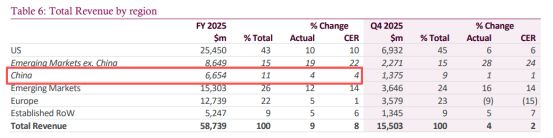
Core Insights - AstraZeneca reported a total revenue of $58.739 billion for FY 2025, reflecting an 8% increase year-over-year, with China contributing $6.654 billion, a 4% increase, representing 11% of AstraZeneca's global market share [2][5]. Financial Performance - The five major business segments contributed as follows: Oncology ($25.619 billion, +14%), CVRM ($12.861 billion, +2%), Rare Diseases ($9.126 billion, +4%), Respiratory & Immunology ($8.866 billion, +12%), and Vaccines & Immune Therapies ($1.268 billion, -14%) [5][6]. - Notable products in the oncology segment included Tagrisso ($7.254 billion, +10%), Imfinzi ($6.063 billion, +28%), Calquence ($3.518 billion, +12%), and Lynparza ($3.279 billion, +6%) [6][7]. Strategic Developments in China - AstraZeneca announced plans to invest over 100 billion RMB in China by 2030, marking its largest investment in the country, aimed at enhancing drug R&D, manufacturing, and commercial innovation [12]. - The company has been actively expanding its investment in China, including a recent agreement to invest in respiratory drug production in Qingdao, bringing total investments in the area to $886 million [13]. - AstraZeneca's R&D pipeline in China has achieved a 100% synchronization rate with global efforts, with the Chinese team leading nearly 20 global clinical trials [13][14]. Collaborations and Partnerships - AstraZeneca has entered into significant collaborations, including a $12 billion strategic R&D partnership with CSPC Pharmaceutical Group, setting a record for upfront payments in China [13]. - Additional agreements include a global licensing deal for the KRAS inhibitor JAB-23E73 worth over $2 billion and a partnership with Hengrui Medicine to develop innovative therapies [14]. Market Positioning - AstraZeneca's strategic shift reflects a broader trend in the pharmaceutical industry, where China is increasingly viewed as a hub for innovation rather than just a market for sales and manufacturing [14].
Will These 5 Drug Bigwigs Surpass Q4 Earnings Forecasts?
ZACKS· 2026-02-09 17:41
Core Insights - The fourth-quarter earnings season is ongoing, with major pharmaceutical companies set to announce their results, including AstraZeneca, Incyte, Gilead Sciences, Vertex Pharmaceuticals, and Moderna [1] Industry Overview - Several large pharmaceutical companies such as Johnson & Johnson, Lilly, AbbVie, Biogen, Merck, and Amgen reported better-than-expected fourth-quarter results, surpassing estimates for both earnings and revenues. In contrast, Novartis and Sanofi had mixed results, with earnings exceeding estimates but revenues falling short [2] - As of February 4, 40% of companies in the Medical sector, representing 73.9% of the sector's market capitalization, reported quarterly earnings. Among these, 87.5% exceeded earnings estimates, and 75% surpassed revenue estimates. Year-over-year, earnings increased by 3.3%, while revenues rose by 9.5%. Overall, fourth-quarter earnings for the Medical sector are expected to decline by 1.5%, while sales are projected to increase by 9.1% compared to the previous year [3] Company-Specific Insights AstraZeneca - AstraZeneca's performance has been mixed, with earnings beating estimates in two of the last four quarters, meeting once, and missing once, resulting in an average surprise of 3.81%. The consensus estimate for fourth-quarter sales is $15.78 billion, with earnings expected at $2.18 per share [5] - Key medicines, particularly cancer drugs and diabetes medicine, are expected to drive fourth-quarter sales, supported by strong demand trends [7] - AstraZeneca is scheduled to report its fourth-quarter and full-year 2025 results on February 10 [8] Incyte - Incyte has a mixed history of earnings surprises, beating estimates in three of the last four quarters, with an average surprise of 14.35%. The consensus estimate for fourth-quarter sales is $1.35 billion, with earnings expected at $1.94 per share [9] - Strong sales of Jakafi and expected growth in Opzelura sales are likely to contribute to revenue growth in the fourth quarter [11][12] - Incyte is also set to report its fourth-quarter and full-year 2025 earnings on February 10 [12] Gilead Sciences - Gilead Sciences has a mixed earnings surprise history, beating estimates in three of the last four quarters, with an average surprise of 7.80%. The consensus estimate for fourth-quarter sales is $7.57 billion, with earnings expected at $1.83 per share [13] - Increased sales from Biktarvy and Descovy, along with growth in the Liver Disease portfolio, are anticipated to drive top-line growth [14] - Gilead is scheduled to report its fourth-quarter and full-year 2025 results on February 10 [15] Vertex Pharmaceuticals - Vertex has a mixed earnings surprise history, beating estimates in two of the last four quarters, with an average surprise of 2.01%. The consensus estimate for fourth-quarter sales is $3.17 billion, with earnings expected at $5.07 per share [16] - Revenue growth is likely to be driven by higher sales of its cystic fibrosis medicine, Trikafta, and contributions from newer drugs [18] - Vertex is set to report its fourth-quarter and full-year 2025 results on February 12 [19] Moderna - Moderna has a strong earnings surprise history, beating estimates in all of the last four quarters, with an average surprise of 31.45%. The consensus estimate for fourth-quarter sales is $661.4 million, with expected earnings showing a loss of $2.60 per share [20] - Revenue is expected to be primarily driven by sales of COVID-19 vaccines, although demand has declined recently [22] - Moderna is scheduled to report its fourth-quarter and full-year 2025 earnings on February 13 [23]

AstraZeneca to Report Q4 Earnings: What's in Store for the Stock?
ZACKS· 2026-02-05 14:35
Core Insights - AstraZeneca (AZN) is set to report its fourth-quarter and full-year 2025 results on February 10, with a consensus estimate for quarterly sales at $15.71 billion and earnings at $2.18 per share [1][8] Group 1: Sales Drivers - Key medicines, particularly cancer drugs Calquence, Lynparza, Tagrisso, and Imfinzi, along with diabetes medication Farxiga/Forxiga, are expected to significantly contribute to fourth-quarter sales, driven by strong demand [2][8] - The Zacks Consensus Estimates for the key drugs are as follows: Calquence at $916 million, Lynparza at $881 million, Tagrisso at $1.88 billion, Imfinzi at $1.67 billion, and Farxiga/Forxiga at $2.01 billion [2] Group 2: Additional Contributions - Other drugs, including asthma medication Fasenra, COPD treatment Breztri, and lupus drug Saphnelo, are also anticipated to support sales growth, with estimates for Symbicort and Fasenra at $696 million and $544 million, respectively [4] - Sales from AstraZeneca's Rare Disease drugs, particularly Ultomiris and Strensiq, have shown significant growth and are expected to continue this trend in the upcoming quarter [5] Group 3: Financial Performance and Costs - The company is expected to see a rise in core operating costs due to investments in recent product launches and increased expenses for new clinical studies [6] - AstraZeneca has a history of decent performance, beating earnings estimates in three of the last four quarters, with an average surprise of 3.81% [7] Group 4: Earnings Prediction - The current Earnings ESP for AstraZeneca stands at -4.59%, indicating that an earnings beat is not predicted this time [10][11] - The Most Accurate Estimate for earnings is $2.08 per share, while the Zacks Consensus Estimate remains at $2.18 [11]