
Upper Zakum原油

Search documents
中东原油市场全线承压:现货疲软、沙特阿美连月下调对亚洲售价
智通财经网· 2026-01-06 07:04
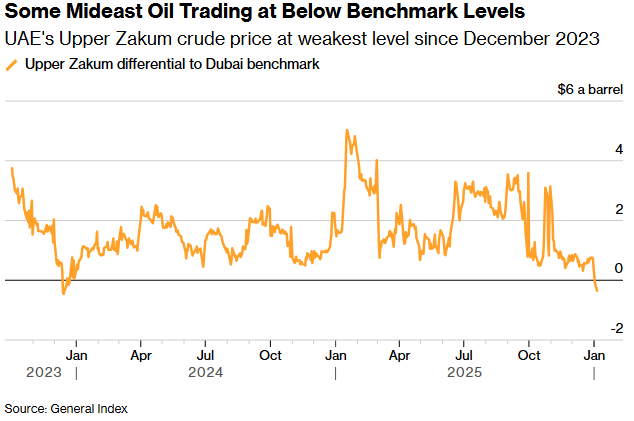
Core Viewpoint - The Middle East oil market is showing signs of weakness, raising concerns about a potential oversupply of global crude oil that could depress prices, while allowing Asian traders to overlook developments in Venezuela [1][5]. Group 1: Market Conditions - The Dubai benchmark crude's discount to Brent futures reached its widest level since August, indicating ample supply [1]. - The forward curve of Dubai swaps has reverted to a contango structure, characterized by recent contract prices being lower than future contracts, signaling bearish sentiment [1]. - The price differential between spot and Dubai benchmark prices is rapidly narrowing, suggesting weak demand [1]. Group 2: Price Trends - The premium for Oman crude, preferred by major importing countries like China, has dropped from nearly $1 per barrel at the end of last month to near parity with Dubai benchmark prices [1]. - The price of UAE's Upper Zakum crude has been set at a discount of $0.35, marking the weakest level since December 2023 [1]. Group 3: Supply and Demand Dynamics - Global crude oil supply has consistently exceeded demand due to increased production from OPEC+ and other oil-producing countries, leading to concerns in the market [5]. - Brent futures fell 18% last year, marking the worst annual performance since 2020, with several banks predicting further declines in oil prices [5]. - Saudi Aramco has lowered prices for its flagship Arab Light crude for the third consecutive month, reaching a five-year low in pricing differentials for major Asian customers [5]. Group 4: Impact of Geopolitical Events - U.S. intervention in Venezuela, including the arrest of Maduro and partial blockade of oil tankers, could have disrupted Venezuelan oil exports, but the ample supply from the Middle East has alleviated such concerns [5]. - Chinese refineries, typically major buyers of Venezuelan crude, have not shown signs of urgently seeking alternatives like Iraqi Basrah crude [5]. Group 5: Sales and Inventory Issues - Approximately 8 million barrels of crude oil scheduled for February shipment remain unsold, including grades like UAE's Upper Zakum and Qatar's Al-Shaheen, which is unusual as such transactions typically conclude by the end of December [6]. - The backlog of unsold oil indicates that Arabian Gulf crude has failed to find buyers for the fourth consecutive month, despite the region's historical ability to sell most of its crude supply [6].

中东原油市场疲态尽显,亚洲买家“淡看”委内瑞拉变局
Jin Shi Shu Ju· 2026-01-06 06:10
Group 1 - The Middle East oil market is showing signs of further weakness, raising concerns about a potential global supply surplus that could drive oil prices lower [1] - The price differential between Dubai benchmark crude and Brent crude futures has widened to its largest level since August, indicating ample supply [1] - The forward curve of Dubai swaps has returned to a "contango" structure, where near-term contract prices are lower than future contract prices, a typical bearish signal [1] Group 2 - Saudi Aramco has significantly lowered its selling prices to major Asian customers for the third consecutive month, pushing the price differential for its flagship Arab Light crude to a five-year low [2] - The current market conditions have alleviated concerns about U.S. intervention in Venezuela potentially disrupting oil flows from the South American country [2] - There is a notable lack of urgency among Asian buyers to purchase alternative Middle Eastern grades such as Iraq's Basrah crude [2] Group 3 - Approximately 8 million barrels of crude oil scheduled for shipment in February remain unsold, which is unusual as such supplies are typically sold by the end of December [3] - This backlog in sales indicates that it is the fourth consecutive month that Arabian Gulf crude has struggled to find buyers [3] - Historically, the region has been able to sell most of its oil offerings [3]
俄乌和谈利空退潮,油价连续第二天收涨,但供应过剩压力将继续压制油价
Xin Lang Cai Jing· 2025-12-04 23:10
Group 1 - Oil prices rose on Thursday, with WTI crude futures up by $0.15 to $59.1 per barrel and Brent crude futures up by $0.59 to $63.26 per barrel, indicating a slight recovery in the market despite ongoing geopolitical tensions [4][18] - The recent discussions led by Trump regarding the Russia-Ukraine peace negotiations have not yielded significant progress, with Putin expressing that some of the U.S. proposals are unacceptable, yet Russia remains open to further talks [3][6][21] - Saudi Arabia has set its official selling price for its flagship Arab Light crude oil to Asia at a premium of $0.6 per barrel, marking the lowest level in five years, as the global oil market faces oversupply issues [27][10] Group 2 - The recent weather and drone attacks have disrupted oil exports from Russia's Black Sea ports, with November exports expected to be about 1 million tons lower than planned [8][22] - Kazakhstan's oil production has decreased by 6% to 1.9 million barrels per day due to the impact of the CPC pipeline attack, which is crucial for its oil exports [9][23] - The market is closely watching Saudi Arabia's pricing decisions, as a significant price cut could trigger a new round of regional pricing competition, affecting refining margins [10][27]
