Waymo Robotaxi

Search documents
Tesla Robotaxi Rival Waymo Now Operates In 10 Cities, Touts 200 Million Autonomous Miles Driven: Here's How Other Companies Fair - Alphabet (NASDAQ:GOOGL)
Benzinga· 2026-03-01 17:00
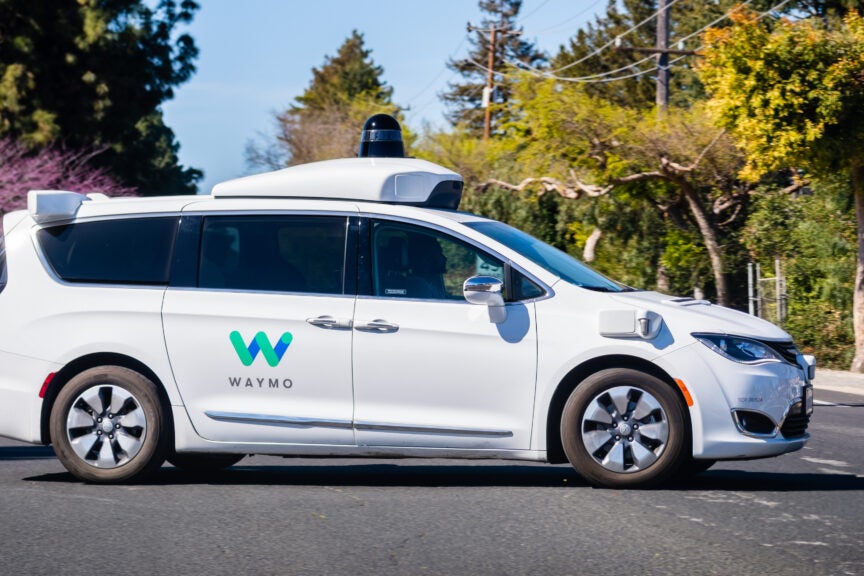
Core Insights - Waymo, backed by Alphabet Inc., has expanded its autonomous ride-hailing service to 10 cities, including four new locations: Dallas, San Antonio, Houston, and Orlando [2] - The company aims to serve over one million rides per week by the end of the year, up from the current 450,000 rides per week [2][3] - Waymo has driven over 200 million autonomous miles with its self-driving technology [3] Regulatory Scrutiny - Waymo is under investigation by the National Highway Traffic Safety Administration (NHTSA) due to multiple incidents involving its autonomous vehicles, including a crash into parked cars and a collision with a child in a school zone [4] - NHTSA is currently investigating over 3,000 Waymo autonomous vehicles following these incidents [4] Competitive Landscape - Baidu's Apollo Go has surpassed 20 million lifetime robotaxi rides and reported a 200% year-over-year increase in fully driverless rides in Q4 [5] - Analysts noted that while Waymo's rides are fully autonomous, only two out of 15 Tesla Robotaxis operate without onboard safety drivers, indicating a difference in operational models [6] - Waymo's system has also faced challenges, requiring human intervention on occasion and taking longer routes, which affects efficiency [6]


1111亿!自动驾驶史上最大融资诞生
创业邦· 2026-02-04 10:15
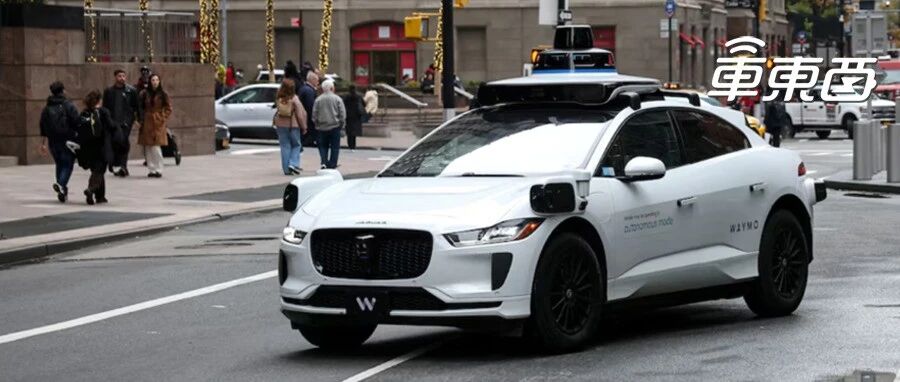
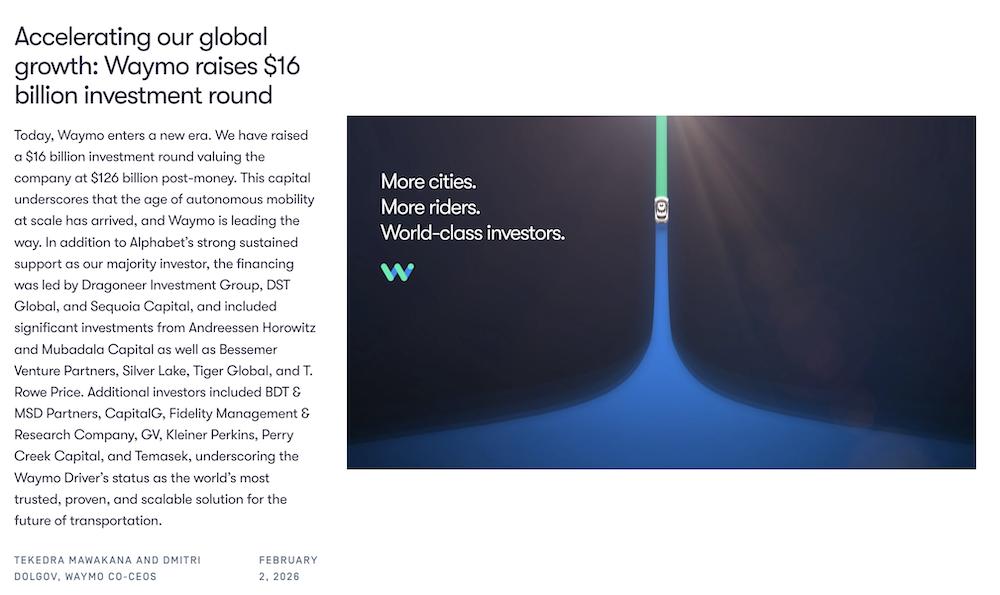
Core Viewpoint - Waymo has secured the largest financing in the history of the autonomous driving sector, raising $16 billion, which reflects strong confidence from the capital market in the commercial prospects of autonomous driving [6][31]. Financing Details - Waymo announced the completion of a $16 billion financing round, resulting in a post-money valuation of $126 billion [6][10]. - The financing round included major investors such as Alphabet, Dragoneer Investment Group, DST Global, and Sequoia Capital, among others [10]. - With this latest round, Waymo's total financing has exceeded $27.1 billion, making it the most valuable unicorn in the autonomous driving industry [13][14]. Operational Achievements - Waymo has achieved a total of 127 million miles in fully autonomous driving, equivalent to over 260 round trips to the moon, with a 90% reduction in serious accidents [10][12]. - The company has seen its annual order volume more than double to 15 million by 2025, with a cumulative order volume exceeding 20 million, laying the groundwork for ride-hailing services in over 20 cities, including Tokyo and London, by 2026 [12][14]. Expansion Plans - The new funding will accelerate Waymo's global expansion, with plans to introduce Waymo Driver to more cities worldwide [12][31]. - Currently, Waymo operates in six cities in North America, including Phoenix, San Francisco, Los Angeles, Austin, Atlanta, and Miami, with weekly paid order volumes exceeding 450,000 [17][19]. Safety and Regulatory Challenges - Despite the successful financing, Waymo faces significant challenges regarding safety and efficiency, highlighted by recent incidents involving its autonomous vehicles [20][30]. - A series of accidents, including a collision with a child and multiple instances of vehicles causing traffic congestion, have raised concerns about the safety of its autonomous systems [24][28]. - The National Transportation Safety Board (NTSB) has announced an investigation into Waymo following these incidents, emphasizing the need for the company to balance safety and operational efficiency [29][32].
Tesla's Robotaxi Plans for 2026: Is Musk's Timeline Finally Realistic?
ZACKS· 2026-02-03 14:05
Core Insights - Tesla is heavily investing in autonomous driving, with its robotaxi program being a crucial element of its long-term growth strategy. The first robotaxi service was launched in Austin, TX, on June 22, 2025, and has been expanding steadily since then [1] Group 1: Progress and Expansion - Tesla's robotaxis are currently operational in Austin and the California Bay Area, with Austin showing faster progress. Fully driverless rides began testing in December 2025, and safety monitors were removed in January for some customer trips, indicating increased confidence in the system [2] - The company plans to launch robotaxi services in seven new cities in the first half of the year, including Dallas, Houston, Phoenix, Miami, Orlando, Tampa, and Las Vegas, aiming to capture a significant share of the ride-hailing market [3] - Since their launch, Tesla's robotaxis have logged nearly 700,000 paid miles, with a fleet of over 500 vehicles that is doubling approximately every month. The company is also investing in service and infrastructure to support this growth [4] Group 2: Vehicle Development - Tesla is developing the Cybercab, a vehicle designed specifically for autonomous driving, which lacks a steering wheel and pedals. Volume production is expected this year, potentially accelerating Tesla's scaling efforts [5] Group 3: Competitive Landscape - Tesla's robotaxi services are in competition with Waymo, which is currently leading the market with over 450,000 paid rides per week in the U.S. Waymo is also expanding its services to multiple cities [9] - Amazon's Zoox is taking a different approach by building a vehicle from scratch for autonomy, featuring unique design elements for shared rides. Zoox has begun offering free public rides and plans to start charging customers in 2026 [11] Group 4: Future Outlook - Elon Musk has set ambitious targets for Tesla, including 10 million Full Self-Driving subscriptions and 1 million robotaxis in commercial use, contingent on regulatory approval and public trust [6] - There is skepticism regarding Musk's timeline for achieving these goals, especially given past missed targets. However, current progress on the ground makes these targets appear more plausible [8]

1111亿,自动驾驶史上最大融资诞生
3 6 Ke· 2026-02-03 04:11
Core Insights - Waymo has announced the completion of a $16 billion financing round, bringing its post-money valuation to $126 billion [1][4][9] Financing Details - The financing round was led by major investors including Alphabet (Waymo's parent company), Dragoneer Investment Group, DST Global, and Sequoia Capital, among others [4][9] - Waymo has raised a total of $27.1 billion across four financing rounds since its inception, making it the most valuable unicorn in the autonomous driving sector [7][9] Operational Achievements - Waymo has achieved a total of 127 million miles in fully autonomous driving, equivalent to over 260 round trips to the moon, with a 90% reduction in severe accidents [4][9] - The company has seen a significant increase in ride orders, with over 20 million cumulative orders and a projected 15 million orders in 2025, more than doubling from previous years [6][9] Expansion Plans - Waymo plans to expand its ride-hailing services to over 20 cities globally by 2026, including major cities like Tokyo and London [6][9] Safety and Regulatory Challenges - Despite the successful financing, Waymo faces challenges related to safety and regulatory scrutiny, with recent incidents involving its autonomous vehicles leading to investigations by the National Transportation Safety Board (NTSB) [11][16][17] - Recent accidents have raised concerns about the balance between safety and efficiency in autonomous driving technology [17]
Waymo Robotaxi Hits Child Near Elementary School, Prompting NHTSA Investigation
WSJ· 2026-01-29 16:54
Core Viewpoint - The incident involving a child being struck by an autonomous vehicle highlights safety concerns regarding self-driving technology and its interaction with pedestrians [1] Group 1 - The child ran across the street from behind a double-parked SUV before being struck by the autonomous vehicle [1] - The child sustained minor injuries as a result of the incident [1]

【AI智能汽车1月投资策略】特斯拉无接管横穿美国,工信部首批L3准入,看好智能化
东吴汽车黄细里团队· 2026-01-07 12:21
Core Viewpoint - The article emphasizes the significant advancements in L4 and L3 autonomous driving technologies, highlighting a dual stronghold in the U.S. and China, with notable developments in commercial applications and regulatory approvals [3][10]. Group 1: December Smartization Marginal Changes Summary - L4 commercialization is experiencing global resonance, while L3 policies have made a "0-1" breakthrough. Tesla has initiated pure unmanned testing in Austin without safety drivers or passengers, and the Chinese version of FSD has completed compliance construction in Shanghai [3][10]. - Waymo's monthly active users have increased by 96.6% year-on-year to 1.64 million, accelerating the validation of its business model. Domestic players like Pony.ai have integrated into the WeChat ecosystem, and CAOCAO's "Ten Years, One Hundred Cities, One Hundred Billion" Robotaxi strategy continues to expand [3][10]. - The policy side for L3 has seen a milestone breakthrough with the issuance of the first batch of L3 permits by the Ministry of Industry and Information Technology, marking a transition from assisted driving to conditionally automated driving in China [3][10]. Group 2: January Smartization Catalysts - The industry may enter a year of Robotaxi explosion, driven by both technology and policy, accelerating towards an "iPhone moment" for AI smart vehicles. CES 2026 is expected to be a key industry indicator, with NVIDIA's CEO focusing on the latest advancements in physical AI [4][10]. - In the L4 dimension, attention is on Tesla's FSD V14.2 performance across the U.S. without driver intervention and the expansion of its fleet. For L3, January 2026 will mark the first complete month for public road commercial trials in cities like Chongqing and Beijing, with a focus on operational takeover rates and accident liability cases [4][10]. Group 3: Investment Recommendations - The company maintains a strong outlook for the L4 RoboX theme in 2026, favoring B-end software stocks over C-end hardware stocks. Preferred H-shares include Xpeng Motors, Horizon Robotics, Pony.ai, WeRide, CAOCAO, and Black Sesame Intelligence, while A-shares include Qianli Technology, Desay SV, and Jingwei Hirain [5][10]. - Relevant downstream application stocks include those in the Robotaxi sector, such as Tesla and Xpeng Motors, as well as technology providers like Horizon and Baidu. The transformation of ride-hailing and taxi services involves companies like Didi, CAOCAO, and others [5][10]. Group 4: Supply Chain Insights - In the upstream supply chain, key players include B-end unmanned vehicle manufacturers like BAIC BluePark, GAC Group, and Jiangling Motors, along with core suppliers for testing services, chips, domain controllers, sensors, and other components [5][10]. - The investment landscape is characterized by a spiral upward iteration of hardware and software, with significant opportunities in both sectors as the industry transitions from the 0-1 stage to more advanced phases [15][10].


Tesla's Austin Robotaxi Project Is Smaller Than Elon Musk's Claims: Report - Tesla (NASDAQ:TSLA)
Benzinga· 2025-12-23 08:20
Core Viewpoint - Tesla's pilot Robotaxi operations in Austin may be significantly smaller in scale than previously claimed by CEO Elon Musk, with only 32 vehicles currently reported in operation compared to Musk's assertion of 1,000 [1][2]. Group 1: Tesla's Robotaxi Operations - An engineering student has reverse-engineered the Tesla Robotaxi app, revealing that only 32 Tesla Model Ys are part of the Robotaxi network in Austin, contradicting earlier claims of a larger fleet [2]. - The tracker indicates that only 1-5 Robotaxis are operational at any given time, with the service being unavailable approximately 60% of the time and an average wait time of 14 minutes [3]. - Tesla is testing driverless operations in Austin, which could enhance its goal of achieving fully autonomous operations by the end of the year [5]. Group 2: Competitive Landscape - In comparison, Waymo has a significantly larger fleet with over 2,500 vehicles and has achieved 450,000 weekly rides, highlighting its dominance in the Robotaxi sector [6]. - Waymo's performance is described as overwhelmingly superior, with a metaphor indicating a score of 50-2 in a hypothetical basketball game against Tesla [6]. - Additionally, Uber and Lyft are collaborating with Baidu's Apollo Go to launch Robotaxi services in London, with Apollo Go reporting 250,000 paid rides per week and over 140 million driverless miles logged [7]. Group 3: Market Performance - Tesla's stock has shown positive momentum, with a 1.56% increase to $488.73 at market close and a further rise to $489.99 in after-hours trading [8].
《机器人年鉴》第 6 卷:自动驾驶车辆-The Robot Almanac-Vol. 6 Autonomous Vehicles Morgan Stanley Global Embodied AI Team
2025-12-22 02:31
Summary of Key Points from the Document Industry Overview - The document focuses on the **Autonomous Vehicles (AV)** industry, highlighting the rapid advancements and market dynamics within this sector [21][41]. Core Insights and Arguments - **Global AV Sales Penetration**: The document discusses the increasing penetration of autonomous vehicles in the market, with a notable emphasis on the role of electric vehicles (EVs) as better candidates for autonomy due to their drive-by-wire capabilities and lower operational costs [44][50]. - **China's Dominance**: China is highlighted as a leader in the AV space, holding a **60% share of global L2+ vehicles** as of the report's date, indicating significant advancements in technology and market adoption [58]. - **Waymo's Expansion**: Waymo is noted for its rapid expansion across various U.S. cities, with plans to increase its fleet significantly in cities like Phoenix and San Francisco, projecting substantial growth in annual miles driven by 2030 [68][76]. - **Tesla's Position**: Tesla is described as being in the early stages of its autonomous vehicle rollout, with expectations for exponential growth in its robotaxi services [77][80]. Financial Projections - **AV Revenue Estimates**: The document provides projections for global AV sales, estimating significant revenue growth driven by hardware sales alone, with a focus on L4/L5 vehicles [137]. - **Funding Landscape**: It mentions the global venture funding landscape for autonomous vehicles, indicating a robust investment environment, although it notes that not all funding may be captured in the data [142]. Additional Important Insights - **Technological Debate**: The document discusses the ongoing debate between LiDAR and vision-only systems for AVs, emphasizing the importance of sensor redundancy versus simplicity in design [86][90]. - **Market Dynamics**: It highlights the competitive landscape, noting that both legacy OEMs and new tech companies are vying for a share of the AV market, which is expected to grow significantly in the coming decades [41][134]. - **Regulatory Considerations**: The document hints at the need for cooperation between the U.S. and China in advancing vehicle autonomy, suggesting that regulatory frameworks will play a crucial role in the industry's future [65]. Conclusion - The autonomous vehicle industry is poised for significant growth, driven by technological advancements, particularly in electric vehicles, and a competitive landscape that includes both established automakers and innovative startups. The document underscores the importance of strategic partnerships and regulatory cooperation to navigate the evolving market dynamics.

Ross Gerber 'Impressed' With Tesla FSD Improvements, But Says It's 'Still Not Good Enough' — Calls Waymo Robotaxi 'Leader' - Tesla (NASDAQ:TSLA)
Benzinga· 2025-11-28 04:59
Core Insights - Ross Gerber, co-founder of Gerber Kawasaki, commented on the advancements of Tesla's Full Self-Driving (FSD) technology and the competitive position of Waymo in the Robotaxi and self-driving sectors [1] Tesla Developments - Gerber expressed that Tesla's FSD v14.2 shows significant improvement, stating it "drives much better than before," but still requires supervision, classifying it as a level 2 system [2] - Achieving level 3 autonomy would necessitate Tesla taking liability for accidents caused by its system, which Gerber noted would signify a major advancement [3] - Tesla has recently obtained self-certification to deploy autonomous vehicles in Nevada, facilitating its Robotaxi commercial operations [6] Waymo's Position - Gerber labeled Waymo as the leader in the Robotaxi sector, highlighting its level 4 autonomy and rapid scaling of operations [4] - Waymo's recent expansion allows it to operate on highways across multiple cities without an onboard safety driver, contrasting with Tesla's current operations [5]
How Ride-Hailing Platforms Could Be The Real Winners Of The Autonomous Driving Push - Uber Technologies (NYSE:UBER)
Benzinga· 2025-09-20 15:01
Core Insights - The U.S. is increasing its focus on autonomous driving, with companies like Tesla, Waymo, and Zoox leading the charge, while ride-hailing platforms like Uber and Lyft stand to benefit significantly from this trend [1] Cost Savings - Autonomous taxis can reduce costs by eliminating the need for human drivers, allowing companies to offer more competitive prices, which could enhance adoption and profit margins [2] - A comparison showed that a Tesla Robotaxi ride was over $13 cheaper than a regular Uber ride for a trip to a coffee shop in Downtown San Jose [3] Growing Customer Adoption - There is a growing preference for Robotaxis over traditional cabs, as evidenced by Uber users in Atlanta opting for Waymo Robotaxis [4] - Tesla's Robotaxi app became one of the most downloaded free travel applications on the Apple App Store, surpassing Uber's own 30-day rollout record [4] Improved Safety Outcomes - Research indicates that autonomous vehicles may be safer than human drivers, with Waymo reporting a 91% higher likelihood of avoiding serious injuries compared to human drivers [5] - Waymo also noted a 79% reduction in airbag deployments and an 88% reduction in property damage claims compared to human drivers [6] Partnerships Could Be The Way Forward - Uber and Lyft are forming partnerships with companies like Waymo to integrate Robotaxis into their platforms, which could enhance their market reach [7] - Uber's CEO highlighted a $1 trillion total addressable market (TAM) opportunity for the autonomous driving industry, suggesting various revenue models for Robotaxis [8] Market Reactions - Waymo's partnership with Lyft in Nashville resulted in a 10% increase in Lyft's stock price, indicating positive market sentiment towards such collaborations [9] Operational Efficiency - Partnerships with autonomous vehicle companies could alleviate the costs associated with maintaining a fleet, allowing ride-hailing companies to focus on providing platforms for these vehicles [10] Challenges Ahead - Regulatory challenges persist, with varying state regulations in the U.S. and calls for stricter oversight from government officials [11][12] - Concerns from traditional cab drivers and lawmakers about the impact of autonomous vehicles on employment and livelihoods are emerging [13] Conclusion - Ride-hailing companies are investing in autonomous vehicles, with Uber planning to deploy over 20,000 Robotaxis through partnerships over the next six years, indicating a strong commitment to this evolving market [14]