Windows OEM

Search documents
AI投资进入“交卷期”,微软(MSFT.US)变现执行力将决定科技股下半场定价
Zhi Tong Cai Jing· 2026-01-26 07:10
Core Viewpoint - Microsoft is set to report its Q2 FY2026 earnings on January 28, with expected revenue of $80.23 billion, reflecting a 15.2% growth, and an anticipated EPS of $3.88, representing a 20.1% year-over-year increase. The market's focus is shifting from overall performance to the execution in cloud business growth, AI monetization, and profit margins [1][2]. Revenue Growth - Cloud Computing as Core Driver - Azure remains the central driver of the earnings narrative, with market concerns focusing on whether cloud growth has stabilized or is re-accelerating compared to the previous quarter. Key indicators such as commercial bookings and remaining performance obligations (RPO) will be closely monitored [3]. AI Monetization - Evidence vs. Narrative - AI is crucial to Microsoft's valuation, but the market is seeking tangible evidence of revenue generation from AI. Attention will be on the adoption rates of Copilot in both enterprise and consumer sectors, whether this adoption is through paid or bundled models, and if AI workloads are reflected in Azure billing [6]. Profit Margins - Cloud Efficiency and Rising Costs - Profit margins are a critical sensitivity point as Microsoft increases investments in AI and data centers. The market will compare operating margins with the previous quarter to assess whether cloud computing efficiencies can offset rising costs in computing power, energy, and infrastructure [7][8]. Productivity and Personal Computing - Beyond cloud and AI, Microsoft's productivity and PC segments may signal potential demand. Pricing power in Office and Microsoft 365 will be viewed as indicators of enterprise resilience, while Windows OEM demand may suggest stabilization in the PC cycle [9]. True Catalyst - Guidance and Outlook - Guidance is likely to drive post-earnings reactions, with the market focusing on the tone for Q1 and the full year, particularly regarding cloud demand and spending trends. Investors will look for clear responses from management on Azure's growth outlook and whether AI revenue expectations are quantified or remain qualitative [11]. Capital Expenditures and Investment Spending - As Microsoft continues to expand AI and data center investments, capital expenditure guidance will be scrutinized. The market remains sensitive to narratives of "spending first, profiting later," especially in a high-interest-rate environment. Indications that high capital expenditure intensity will persist longer than expected could pressure market sentiment [12].


财报前瞻 | AI投资进入“交卷期”,微软(MSFT.US)变现执行力将决定科技股下半场定价
Zhi Tong Cai Jing· 2026-01-26 07:03
Core Viewpoint - Microsoft is set to announce its Q2 FY2026 earnings on January 28, with expected revenue of $80.23 billion, reflecting a 15.2% growth, and an anticipated EPS of $3.88, representing a 20.1% year-over-year increase. The market's focus is shifting from whether Microsoft will exceed overall performance expectations to its execution in cloud business growth, AI monetization, and profit margins [1] Revenue Growth - Cloud Computing as Core Driver - Azure will be pivotal in determining the stock price reaction post-earnings. The market is less concerned about whether Microsoft will exceed consensus expectations and more focused on whether cloud business growth has stabilized or is beginning to accelerate again compared to the previous quarter [2] AI Monetization - Actual Signal or Narrative? - AI remains central to Microsoft's valuation, but the market now requires evidence of revenue generation. The focus is on whether AI has led to incremental sales and billable Azure demand, rather than merely supporting product positioning [4] Profit Margins - Cloud Efficiency and Rising Costs - As Microsoft increases investments in AI and data centers, profit margins remain a critical sensitivity point. The market will compare operating margins with the previous quarter to assess whether cloud computing efficiency offsets higher costs related to computing power, energy, and infrastructure [5] Productivity and More Personal Computing - Beyond cloud and AI, Microsoft's productivity and PC segments provide potential demand signals. Pricing power of Office and Microsoft 365 will be viewed as indicators of enterprise resilience, while Windows OEM demand may suggest stabilization in the PC cycle [6] True Catalyst - Guidance and Outlook - Guidance is likely to drive post-earnings reactions. The market will focus on the tone of guidance for Q1 and the full year, particularly regarding cloud demand and spending trends [7] Capital Expenditure and Investment Spending - As Microsoft continues to expand AI and data center investments, capital expenditure guidance will be closely scrutinized. The market remains sensitive to the narrative of "spending now for future profits," especially in a high-interest-rate environment [8]
计算机行业点评报告:微软(MSFT.O):Azure收入增速领跑云市场
Huaxin Securities· 2025-07-31 15:23
Investment Rating - The report maintains a recommendation for Microsoft (MSFT.O) [10] Core Insights - Microsoft reported Q4 FY2025 revenue of $76.44 billion, a year-on-year increase of 18%, with net profit reaching $27.2 billion, up 24% [2][4] - The Intelligent Cloud segment generated $29.88 billion in revenue, a 26% increase year-on-year, with Azure cloud revenue growing by 39% [4][8] - The introduction of the Edge Copilot mode is expected to revolutionize browser interactions, enhancing user experience and data privacy [5][8] - Azure AI Foundry was launched, providing a unified platform for developers to customize and manage AI applications, supporting over 1900 models [7][8] Summary by Sections Financial Performance - Microsoft’s Q4 FY2025 revenue was $76.44 billion, with a net profit of $27.2 billion, reflecting strong growth across multiple business lines [2][4] Cloud Business - The Intelligent Cloud segment's revenue reached $29.88 billion, with Azure's revenue growing 39% year-on-year, indicating robust demand for cloud services [4][8] AI and Innovation - The launch of Azure AI Foundry marks a significant advancement in enterprise-level AI development, allowing for the integration of various AI models and enhancing developer capabilities [6][7][8] Product Development - The Edge Copilot mode introduces a new level of interaction in web browsing, focusing on user privacy and seamless navigation [5][8]
微软2025财年净利润增长16%:云收入公布、市值破4万亿美元
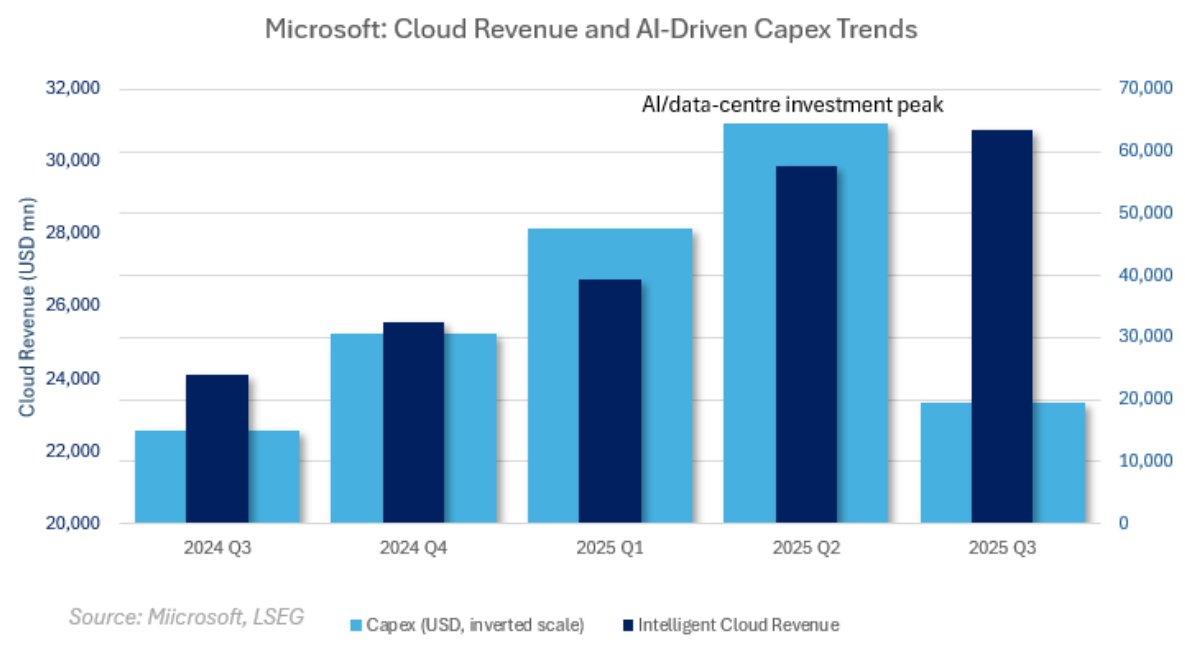
Feng Huang Wang· 2025-07-30 23:37
Core Viewpoint - Microsoft reported strong financial results for Q4 and the full fiscal year 2025, driven by significant growth in its cloud business and overall revenue increases across various segments [1][2][4]. Financial Performance - Q4 total revenue reached $76.441 billion, an 18% increase from $64.727 billion year-over-year, with a 17% increase when adjusted for constant currency [1][4]. - Net profit for Q4 was $27.233 billion, up 24% from $22.036 billion year-over-year, with a 22% increase on a constant currency basis [1][5]. - For the full fiscal year 2025, total revenue was $281.724 billion, a 15% increase from $245.122 billion in fiscal year 2024 [1]. - Full-year net profit was $101.832 billion, a 16% increase from $88.136 billion in the previous year [1]. Segment Performance - Productivity and Business Processes segment revenue was $33.112 billion, a 16% increase from $28.627 billion year-over-year [4]. - Intelligent Cloud segment revenue was $29.878 billion, a 26% increase from $23.785 billion year-over-year, with Azure and other cloud services revenue growing by 39% [4][6]. - More Personal Computing segment revenue was $13.451 billion, a 9% increase from $12.315 billion year-over-year [4]. Shareholder Returns - Microsoft returned $9.4 billion to shareholders through dividends and stock buybacks in Q4 [5]. Stock Performance - Following the earnings report, Microsoft's stock price surged over 7% in after-hours trading, reaching $551.50 [3].
微软财报会谈及如何应对经济衰退,下季度继续投资AI
Di Yi Cai Jing· 2025-05-01 05:41
Core Insights - Microsoft reported a revenue of $70.1 billion for Q3 FY2025, representing a 13% year-over-year growth, with a net profit of $25.8 billion, up 18% [1] - The stock price increased by over 6% in after-hours trading due to better-than-expected performance [1] - The Intelligent Cloud segment generated $26.8 billion in revenue, a 21% increase year-over-year, with Azure and other cloud services growing by 33% [1][3] Segment Performance - The cloud business's gross margin was 69%, although it decreased by 3 percentage points year-over-year due to AI infrastructure expansion [1] - The More Personal Computing segment generated $13.4 billion, a 6% increase, with Windows OEM and device revenue growing by 3% [4] - The Productivity and Business Processes segment reported $29.9 billion in revenue, a 10% increase, with LinkedIn revenue growing by 7% [4] Future Outlook - Microsoft expects Azure revenue growth for Q4 to be between 34% and 35% due to strong demand for its service offerings [4] - The company plans to continue investing in AI infrastructure, with capital expenditures of $21.4 billion in Q3, slightly below expectations [3] - Microsoft aims to independently develop AI models to complement its partnership with OpenAI, enhancing customer value [4][5]