WoW具身世界模型

Search documents
“WoW”具身世界模型来了!机器人实现从想象预演到动作执行“知行合一”
Yang Shi Wang· 2025-10-26 05:23
Core Insights - The rapid evolution of robotic movement capabilities is highlighted, but understanding complex tasks remains challenging for robots [1] - The introduction of the "WoW" embodied world model by a Chinese research team represents a significant advancement in robotic intelligence [1] Group 1: Technological Advancements - The "WoW" embodied world model allows robots to simulate human-like thinking and decision-making, generating future prediction videos that align with physical laws [5] - The model enables robots to connect imagined movements with real-world execution, enhancing their interaction with the environment [5] Group 2: Data Collection and Training - The research team has collected millions of real interaction data points to ensure the world model can operate effectively in diverse real-world scenarios [8] - The model is designed to adapt to various types of robots, including humanoid and robotic arms, and can be applied across multiple settings such as homes, supermarkets, and logistics [10] Group 3: Open Access and Applications - The "WoW" model is open to global researchers and developers, facilitating broader applications and innovations in robotics [10] - It can accurately simulate extreme scenarios, such as water spilling on a computer, providing crucial data for training that is difficult to obtain through real-world testing [10]



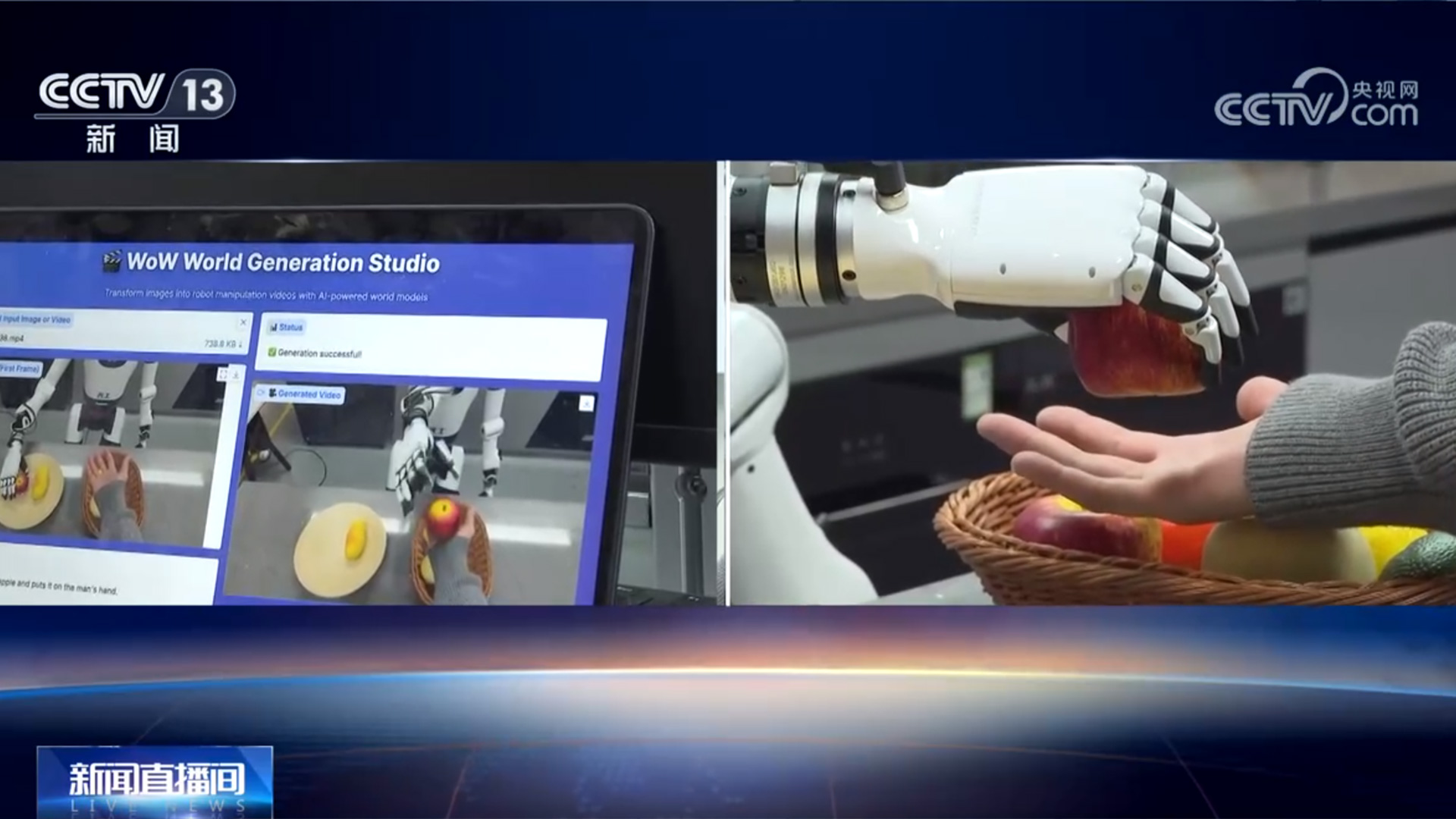
具身世界模型开源 让机器人学会“预演”未来
Yang Shi Wang· 2025-10-25 14:59
Core Insights - The rapid evolution of robotic movement capabilities is highlighted, with robots now able to perform complex actions like backflips and running, but understanding physical interactions remains a challenge [1] - The introduction of the WoW (World of Wonder) embodied world model allows robots to develop better imagination and execution capabilities, akin to human understanding [2] Group 1: WoW Embodied World Model - The WoW embodied world model enables robots to predict and understand physical interactions, such as anticipating the consequences of knocking over a cup, thereby connecting imagination with real-world execution [4] - Developed by a collaboration between the Beijing Humanoid Robot Innovation Center, Peking University, and the Hong Kong University of Science and Technology, the model is open to global researchers and developers [6] - The model can adapt to various robotic forms and scenarios, including home, retail, industrial, and logistics environments, and can simulate extreme situations for data collection [6] Group 2: Autonomous Evolution and Learning - The WoW model features a self-evolving capability, allowing robots to learn and improve through a virtual world that mimics real-world logic [7] - It employs a dual-model system combining the embodied world model for physical predictions and a visual language model for multi-modal understanding and task planning, creating a feedback loop for continuous learning [7] - A comprehensive benchmark for the embodied world model has been established, assessing core capabilities such as perception, prediction, reasoning, and decision-making [9]
人形机器人“爆单”,规模化落地何解?
2 1 Shi Ji Jing Ji Bao Dao· 2025-10-23 09:29
Core Insights - 2024 is anticipated to be the year of mass production for humanoid robots, while 2025 is expected to mark their commercialization [1] - There has been a surge in humanoid robot orders in the latter half of this year, with significant contracts awarded to companies like UBTECH and ZhiYuan Robotics [1][2] Group 1: Market Trends - Humanoid robots are increasingly being commercialized in various sectors, including data collection, automotive manufacturing, and 3C manufacturing [2][4] - The industry is focusing on eight major application scenarios: industrial manufacturing, logistics sorting, security inspection, commercial cleaning, data collection training, scientific research education, entertainment, and reception [4][6] Group 2: Implementation Challenges - The path to commercialization is seen as a gradual process, starting from scenarios that do not require physical interaction to more complex environments [3][4] - The difficulty of implementing humanoid robots in home settings is highlighted, with challenges related to cost, safety, and task complexity [7][8] Group 3: Technological Barriers - Key technological barriers include insufficient performance of core hardware, such as sensors, which are crucial for the effective operation of humanoid robots [8][9] - The need for advanced tactile sensors and high degrees of freedom in robotic hands is emphasized for achieving fine manipulation [8][9] Group 4: Industry Collaboration - The industry is promoting collaborative innovation through open-source large models and datasets, which are essential for training humanoid robots in diverse scenarios [9] - Companies are developing specific small models tailored to particular applications to enhance performance beyond a basic level [9]

北京人形创新中心开源 WoW,具身智能 “加速跑” 向生活!机器人ETF(562500) 盘中涨幅位居同类第一!
Mei Ri Jing Ji Xin Wen· 2025-10-21 02:36
Core Viewpoint - The Robot ETF (562500) is experiencing a strong performance, leading its category with a 0.81% increase, indicating robust investor interest and market activity in the robotics sector [1][2]. Group 1: ETF Performance - The Robot ETF (562500) has a market size exceeding 20 billion, making it the only ETF of its kind in the market with such scale, covering various segments including humanoid robots, industrial robots, and service robots [2]. - As of 10:08 AM today, the ETF's trading volume reached 291 million, with a volume ratio of 1.26, indicating active trading [1]. - In the current trading session, 52 stocks within the ETF rose while 21 fell, showcasing significant structural differentiation among holdings [1]. Group 2: Market Trends and Developments - Recent developments include the Beijing Humanoid Robot Innovation Center open-sourcing parts of the WoW embodied world model, which lowers the entry barrier for global researchers and accelerates the integration of embodied intelligent robots into daily life [1]. - Historical trends suggest that each technological wave, such as the rise of general artificial intelligence since 2020, tends to create new smart terminals, with humanoid robots poised to enter a golden development period similar to that of new energy vehicles in the coming years [1].
北京人形机器人创新中心提出具身世界模型WoW
Zheng Quan Ri Bao Wang· 2025-10-20 12:48
Core Insights - Beijing Humanoid Robot Innovation Center has launched a new embodied world model called WoW (World-Omniscient World Model), aimed at enabling robots to "see, understand, and act in the world" [1] - WoW outperforms its predecessor Sora2 in terms of spatiotemporal consistency and physical reasoning, integrating visual, action, physical perception, and reasoning into a unified framework [1][2] - The model allows AI to learn physical laws through interaction, marking a significant advancement from merely generating images to understanding the physical world [1][2] Innovative Technical Architecture - WoW is a multi-modal large model framework that combines world generation, action prediction, visual understanding, and self-reflection into a single system, addressing limitations in traditional architectures [2] - The model learns from real robot interaction data, generating high-quality, physically consistent robot videos in both known and unknown scenarios [2] - WoW adheres to the SOPHIA paradigm, enabling the model to improve its accuracy and realism through self-teaching [2] New Benchmark Development - Beijing Humanoid has introduced WoWBench, a comprehensive benchmark for embodied world models, evaluating capabilities across four core dimensions: perception understanding, prediction reasoning, decision-making, and generalization execution [3] - The benchmark employs a mixed evaluation mechanism to ensure model performance aligns with human cognition [3] - The open-sourcing of parts of the WoW model significantly lowers the entry barrier for world model research, accelerating the integration of embodied intelligent robots into various aspects of life [3] Broad Application Prospects - WoW's innovative architecture and performance enable its application across multiple scenarios, providing a unified benchmark platform for world model research [4] - The model facilitates data migration and augmentation, allowing AI to generate synthetic samples from limited real data, creating a self-cycling process of "imagine-generate-annotate-migrate" [4] - WoW can translate visual "imagination" into executable action commands, enabling robots to autonomously understand and execute natural task instructions in complex environments [5] Demonstrated Technological Leadership - Beijing Humanoid's "Embodied Tiangong Ultra" won the first humanoid robot half-marathon championship and achieved significant victories in the inaugural World Humanoid Robot Sports Competition, showcasing its leading technological capabilities [5] - The open-sourcing of the WoW model further highlights Beijing Humanoid's strengths in AI, moving from understanding to reconstructing the world, and reinforcing its commitment to making robots "the best to use" [5]
斯坦福具身智能大佬引用,Huggingface官方催更:北京人形开源WoW具身世界模型
Robot猎场备忘录· 2025-10-18 05:08
Core Insights - The article discusses the advancements in robotics, particularly focusing on the new embodied world model called WoW (World-Omniscient World Model) developed by the Beijing Humanoid Robot Innovation Center, which allows robots to understand and interact with the physical world more effectively [2][4][51]. Group 1: Model Development and Features - WoW represents a significant upgrade in visual models, integrating vision, action, physical perception, and reasoning into a unified framework, enabling robots to learn the physical laws of the world through interaction [4][5]. - The model has gained widespread attention from both academia and industry, with endorsements from notable organizations like Huggingface and Stanford, indicating its leading position in the field of embodied world models [3][4]. - WoW consists of four core components that allow it to predict future scenarios, deduce physical evolution, and reconstruct dynamic causal chains based on historical data [10][12]. Group 2: Performance and Evaluation - WoW has shown superior performance in simulating robotic operations, particularly in physical reasoning and temporal consistency compared to its predecessor, Sora 2 [5][12]. - The model was trained on a dataset of 8 million robot interaction trajectories, refining it down to 2 million high-quality training samples, which significantly improved its physical consistency and generative stability as the model size increased from 1.3 billion to 14 billion parameters [12][36]. - WoWBench, a comprehensive benchmark for evaluating embodied world models, assesses capabilities across perception, reasoning, decision-making, and execution, ensuring alignment with human cognitive performance [29][31]. Group 3: Practical Applications and Future Prospects - The open-source nature of WoW allows global researchers to replicate results and further develop applications, lowering the entry barrier for research in world models and accelerating the integration of embodied intelligent robots into various sectors [42][43]. - WoW's capabilities enable it to generate synthetic samples from limited real data, facilitating a self-cycling process of "imagination - generation - re-labeling - transfer," enhancing the AI's ability to perform complex tasks in real-world environments [53][56]. - The advancements demonstrated by WoW, including its success in various robotic competitions, highlight its potential to redefine the landscape of humanoid robotics and embodied intelligence [56][57].

斯坦福具身智能大佬引用,Huggingface官方催更:北京人形开源WoW具身世界模型
机器之心· 2025-10-17 11:53
Core Insights - The article discusses the launch of WoW (World-Omniscient World Model), a new world model framework aimed at enabling AI to understand and interact with the physical world through embodied intelligence [2][3][4]. Group 1: WoW Model Overview - WoW is designed to allow AI to "see, understand, and act in the world," focusing on learning physical causality through interaction rather than passive observation [3][5]. - The model is built on a dataset of 2 million high-quality interactions from 8 million robot-physical world interaction trajectories, demonstrating its ability to construct probability distributions of future physical outcomes [6][21]. - WoW integrates four core modules: SOPHIA self-reflection paradigm, DiT world generation engine, FM-IDM inverse dynamics model, and WoWBench evaluation framework [15][17]. Group 2: Model Capabilities - WoW exhibits impressive physical intuition in generating actions, indicating a significant step towards practical and generalized robotic applications [14][30]. - The model's architecture allows for a closed-loop system where it can imagine, understand physics, generate video, execute actions, and learn from the outcomes [16][21]. - WoW's performance in real-world tasks shows a success rate of 94.5% for simple tasks and 75.2% for medium difficulty tasks, marking a new state-of-the-art in the field [34]. Group 3: Evaluation and Benchmarking - WoWBench is introduced as the first comprehensive benchmark for embodied world models, covering dimensions such as perception understanding, predictive reasoning, decision-making, and generalization execution [36][40]. - The model achieved a score of 96.5% in understanding task instructions and over 80% in physical consistency, showcasing its advanced capabilities [36][40]. Group 4: Generalization and Adaptability - WoW demonstrates strong generalization capabilities across different robot platforms and tasks, indicating its ability to learn abstract physical representations independent of specific robot structures [52][55][57]. - The model can handle various action skills and adapt to different visual styles, showcasing its versatility in real-world applications [55][57]. Group 5: Future Directions - The article emphasizes the potential of WoW to evolve into a comprehensive system that not only generates but also understands and interacts with the world, paving the way for more advanced embodied intelligence [80][84]. - Future research will focus on enhancing WoW's multi-modal integration, autonomous learning, and real-world interaction capabilities [80][84].