XLeRobot

Search documents
都在说VLA,很多同学连demo都跑不好......
具身智能之心· 2025-12-03 10:00
Core Viewpoint - The article discusses the challenges and advancements in the field of VLA (Vision-Language Alignment) models, emphasizing the importance of real machine data and practical applications in robotics and embodied intelligence. Group 1: Challenges in VLA Implementation - Many students struggle with the transition from theoretical knowledge to practical application, often finding it difficult to achieve satisfactory results without hands-on experience [2][6] - The reliance on real machine data for effective training and deployment of VLA models is highlighted, with a focus on the limitations of simulation data [2][8] Group 2: Data Collection and Training - Data collection methods for VLA include imitation learning and reinforcement learning, with a particular emphasis on remote operation and VR techniques [8] - The training of VLA models requires careful tuning and optimization, with specific challenges noted for models like π0 and π0.5, which demand a high level of expertise [10][12] Group 3: Deployment and Optimization - Post-training, VLA models often require optimization techniques such as quantization and distillation to reduce parameter size while maintaining performance [12] - The deployment of VLA models on edge devices presents significant challenges due to their typically large parameter sizes [12] Group 4: Educational Initiatives - The article introduces a practical course aimed at helping individuals learn about VLA, covering various aspects such as hardware, data collection, algorithm implementation, and real-world applications [14][30] - The course is designed for a diverse audience, including students and professionals looking to transition into the field of embodied intelligence [27][30]

适配简单、效率高!U-Arm:你的具身通用遥操臂来啦~
具身智能之心· 2025-11-19 10:00
Group 1 - The core concept of U-Arm is to address the pain points of traditional remote operation devices, which include high costs, low efficiency, and compatibility issues, by providing a high-performance, cost-effective, and open-source solution [1][4]. - U-Arm's core advantages can be summarized into four dimensions: stability, universality, cost-effectiveness, and openness [2][5]. Group 2 - U-Arm is designed specifically for embodied intelligence research and multi-scenario remote operation needs, breaking through traditional remote operation device limitations [4]. - The device features a dual-axis fixed joint design for stability, a lightweight yet impact-resistant body made of 4mm thick resin, and compatibility with 95% of commercial robotic arms [7][8]. Group 3 - U-Arm significantly reduces the initial investment required for remote operation solutions, priced at only 1999 yuan per unit, compared to traditional devices that can cost tens of thousands of dollars [17][18]. - The product includes a complete set of accessories, ensuring no hidden costs for users [8]. Group 4 - U-Arm's modular design allows for easy adaptation to various robotic arms, eliminating the need for separate remote operation devices for different arms [10][15]. - The device supports three core configurations that cover a wide range of mainstream robotic arms, ensuring compatibility and ease of use [11][12]. Group 5 - U-Arm enhances data collection efficiency by 39% compared to traditional methods, providing high-quality data for model training [11]. - The open-source nature of U-Arm allows for customization and supports educational practices, making it suitable for research and teaching [8][17]. Group 6 - The assembly process for U-Arm is straightforward, requiring no specialized technical skills, and includes clear steps for setup and initial operation [25][27]. - U-Arm provides a user-friendly experience, allowing beginners to quickly learn and operate the device with available examples and resources [28]. Group 7 - U-Arm offers a warranty for product quality, allowing for returns within two weeks for structural issues, ensuring customer satisfaction [29].

移动操作&双臂操作开源硬件与方案
具身智能之心· 2025-10-20 00:03
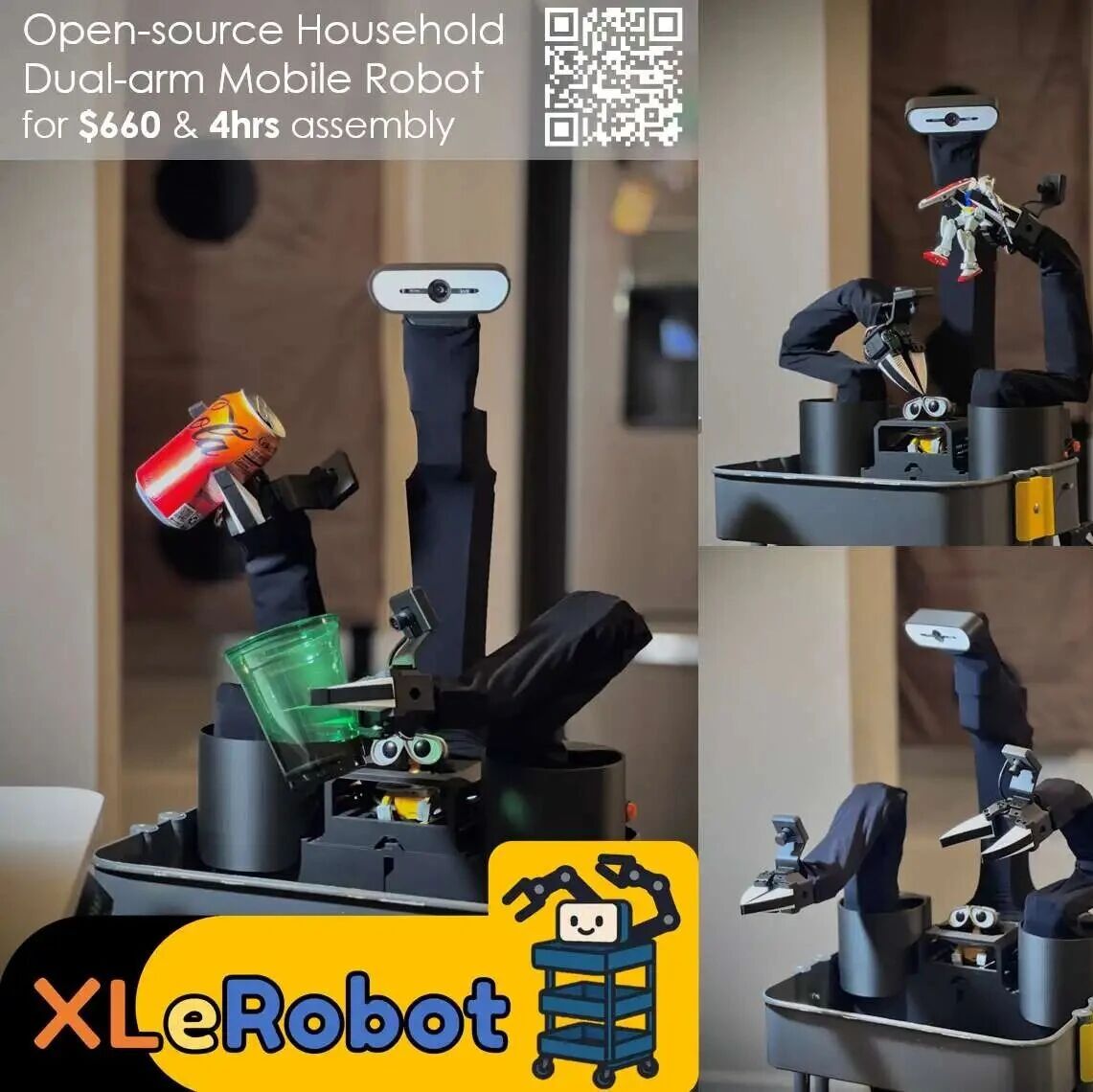
Core Viewpoint - The article emphasizes the importance of open-source projects in advancing mobile and dual-arm robotic operations, highlighting their role in breaking down technical barriers and accelerating innovation in various applications, from household robots to industrial automation [3]. Group 1: Open-Source Projects Overview - XLeRobot, developed by Nanyang Technological University, focuses on flexible movement and precise operation in complex environments, providing a reference framework for mobile and dual-arm control [4]. - AhaRobot from Tianjin University emphasizes autonomy and environmental adaptability in dual-arm operations, integrating perception, planning, and control modules for service robots [6]. - ManiGaussian++, released by Tsinghua University, optimizes dual-arm operation accuracy using Gaussian models, particularly in 3D environment perception and motion planning [8]. - H-RDT, a collaboration between Tsinghua University and Horizon Robotics, aims at efficient decision-making and real-time operations for mobile robots in various settings [11]. - RoboTwin 2.0, developed by Shanghai Jiao Tong University and the University of Hong Kong, integrates simulation and physical platforms for mobile and dual-arm operations [14]. - Open X-Embodiment, from Arizona State University, focuses on a generalized learning framework for robotic operations, supporting cross-scenario skill transfer [16]. - 3D FlowMatch Actor, a joint project by Carnegie Mellon University and NVIDIA, enhances dynamic adaptability in 3D space for mobile and dual-arm operations [19]. - OmniH2O, developed by Carnegie Mellon University, focuses on human-robot action mapping and humanoid operation, facilitating remote control and action teaching [24]. - TidyBot++, a collaboration between Princeton University and Stanford University, targets household organization tasks, integrating object recognition and dual-arm collaboration algorithms [27]. - robosuite, from the University of California, Berkeley, is a mature simulation platform for robotic operations, providing standardized tasks and evaluation tools [29]. - SO-ARM100, a standardized dual-arm operation hardware and software solution, aims to lower development barriers for educational and research purposes [32]. - GOAT, developed by UIUC and CMU, focuses on goal-directed movement and operation for robots, emphasizing robustness and versatility [34]. - Mobile ALOHA, from Stanford University, combines mobile chassis and dual-arm operations for low-cost, easily deployable service robots [35].
只要 3999 ?啥家务都能干,这机器人终于等到了
3 6 Ke· 2025-09-12 02:11
Core Viewpoint - The article discusses the emergence of affordable and versatile household robots, particularly focusing on the XLeRobot, which is a DIY project aimed at making robotic assistance accessible to a broader audience [2][28]. Group 1: Product Overview - The XLeRobot is an open-source project initiated by Chinese researcher Wang Gaotian, capable of performing various household tasks such as fetching drinks, watering plants, and cleaning [12][16]. - The base price of the XLeRobot is set at 3999 yuan, which is significantly lower than other household robots that can cost up to 560,000 yuan [7][18]. - The robot's modular design allows users to customize components, making it a flexible option for different needs [20][24]. Group 2: Market Potential - The market for multifunctional household robots is substantial, but existing products are often expensive and have high technical barriers, limiting their accessibility [28]. - By reducing the cost to under 10,000 yuan, the XLeRobot brings robotic assistance closer to average consumers, potentially transforming the household robotics market [29]. - The project aims to promote industry development by making robotic technology more affordable and user-friendly, which could lead to increased adoption in households [29].


腾讯研究院AI速递 20250908
腾讯研究院· 2025-09-07 16:01
Group 1 - Anthropic has implemented a policy to restrict access to its Claude service for entities with majority ownership by Chinese capital, citing legal, regulatory, and security risks [1] - The restriction also applies to entities from countries considered adversaries, such as Russia, Iran, and North Korea, with expected global revenue impact in the hundreds of millions of dollars [1] Group 2 - AI Key, an external AI assistant hardware for iPhone, sold out within 7 hours of launch, priced at $89, but is seen as redundant given the existing capabilities of iPhones [2] - The trend of AI hardware startups is viewed as short-lived, with future value lying in integrating AI as a system attribute rather than a standalone function [2] Group 3 - Tencent's "Hunyuan Game" platform has launched version 2.0, introducing features like game-to-video generation and custom model training [3] - The new AI capabilities allow users to create high-quality dynamic videos from game images and descriptions, significantly lowering the barrier for custom model training [3] Group 4 - Alibaba has released the Qwen3-Max-Preview model, boasting over a trillion parameters, outperforming competitors in various benchmarks [4] - The model supports over 100 languages and offers a maximum context of 256k, with a tiered pricing model based on token usage [4] Group 5 - ByteDance's Seed team has introduced Robix, a unified "robot brain" that integrates reasoning, task planning, and human-robot interaction [5][6] - Robix employs a hierarchical architecture to separate high-level decision-making from low-level control, enabling dynamic reasoning and execution [6] Group 6 - Rokid's AR+AI glasses sold 40,000 units within 5 days of launch, highlighting their lightweight design and user-friendly features [7] - The product includes customizable audio and translation capabilities, and Rokid has opened its SDK for developers, expanding its global reach [7] Group 7 - Anthropic has agreed to a $1.5 billion settlement in a copyright lawsuit involving the illegal download of 7 million books, marking a significant moment in AI and copyright disputes [8] - The settlement involves compensation for approximately 500,000 books, averaging $3,000 per book, while the financial impact is considered manageable relative to Anthropic's recent funding and revenue [8] Group 8 - The Sensor Tower report indicates that global downloads of generative AI applications reached nearly 1.7 billion in the first half of 2025, with in-app purchase revenue of $1.9 billion, reflecting a 67% quarter-over-quarter growth [10] - The report highlights a demographic shift, with female users of AI assistants exceeding 30%, and emphasizes the competitive pressure on vertical applications [10] Group 9 - OpenAI's recent paper defines "hallucination" in AI models and identifies its root causes, suggesting that current evaluation methods encourage guessing rather than acknowledging uncertainty [11] - The paper proposes a revised evaluation approach that penalizes confident errors more than uncertainty, aiming to improve the reliability of AI responses [11]

3999让机器人家务全包,抱抱脸联合创始人:开源YYDS
3 6 Ke· 2025-09-07 07:21
Core Insights - The XLeRobot project, initiated by Chinese researcher Wang Gaotian, offers a DIY robot at a low cost of 3999 yuan, which can perform various household tasks [1][7][20] - The project has gained significant traction in the open-source community, accumulating 1.6k stars on GitHub since its launch [2][23] - The affordability of the robot is attributed to the flexibility in component selection, allowing users to opt for cheaper alternatives [7] Pricing and Components - The base version of the robot costs approximately $660 in the US, €680 in the EU, and ¥3999 in China, with additional costs for upgraded components [8] - Key components include an open-source low-cost robotic arm, RGB cameras, Raspberry Pi, and other hardware, with detailed pricing provided for each part [8][11] - Assembly time is estimated to be around 4 hours, comparable to building with LEGO [11] Development and Community Engagement - The project has received endorsements from notable figures, including Thomas Wolf, co-founder of Hugging Face [3] - The open-source nature of the project has sparked interest among DIY enthusiasts, with many eager to experiment with the robot [12][23] - Future upgrades are planned to be modular, allowing for easy enhancements [25] Team and Research Background - Wang Gaotian, the project's lead, has a strong academic background in robotics and has collaborated with Boston Dynamics on advanced manipulation frameworks [30][33] - The team includes contributors responsible for various aspects of the project, such as reinforcement learning deployment and documentation [33]

3999让机器人家务全包,抱抱脸联合创始人:开源YYDS!
量子位· 2025-09-07 04:36
Core Viewpoint - The article discusses the launch of the XLeRobot, an open-source DIY robot project initiated by Chinese researcher Wang Gaotian, which is priced at only 3999 yuan, making it an affordable option for home use and DIY enthusiasts [8][12]. Summary by Sections Product Overview - XLeRobot is a versatile home robot capable of performing various tasks such as cleaning, watering plants, and playing with pets [2][4][6]. - The project has gained attention and recommendations from notable figures, including Thomas Wolf, co-founder of Hugging Face [9]. Cost and Components - The base cost of the robot is 3999 yuan in China, significantly lower than similar products in the US and EU, which are priced around $660 and €680 respectively [13]. - The robot's affordability is attributed to the ability to customize components and use cheaper alternatives [12]. - Key components include an open-source low-cost robotic arm, RGB cameras, Raspberry Pi, and other easily sourced parts [13][16]. Assembly and Usability - The estimated assembly time for the robot is around 4 hours, comparable to building with LEGO, making it accessible for DIY enthusiasts [17]. - The project provides comprehensive tutorials for setup and operation, enhancing user experience [22][24]. Community and Open Source - The project has sparked significant interest in the open-source community, achieving 1.6k stars on GitHub shortly after its release [30]. - Users express eagerness to experiment with the robot, highlighting the benefits of open-source innovation and cost savings [30]. Future Developments - Future upgrades for XLeRobot are expected to be modular, allowing users to enhance their robots with additional components [33]. - The project aims to provide a practical platform for those interested in robotics and embodied AI, while also serving as a testing ground for Wang Gaotian's research [41]. Team Background - Wang Gaotian, the project's initiator, has a strong academic background in robotics and has collaborated with Boston Dynamics on significant research [38]. - The team includes contributors responsible for various aspects of the project, such as reinforcement learning deployment and documentation [42][43].