TechCrunch

Search documents
Microsoft says Azure affected after cables cut in the Red Sea
TechCrunch· 2025-09-07 15:22
Core Insights - Microsoft reported that clients using its Azure cloud platform may face increased latency due to multiple undersea cables being cut in the Red Sea [1] - The affected traffic primarily involves routes through the Middle East or those ending in Asia or Europe [1] Company Response - Microsoft stated that undersea fiber cuts can take time to repair and that they will continuously monitor, rebalance, and optimize routing to minimize customer impact during this period [2] - By Saturday evening, Microsoft indicated that it was no longer detecting any issues with Azure services [2]


EU fines Google $3.5B over adtech ‘abuse'
TechCrunch· 2025-09-06 17:06
Group 1: Antitrust Fine and Violations - The European Commission has fined Google €2.95 billion (approximately $3.5 billion) for violating EU antitrust rules by favoring its own advertising services [1] - The commission found that Google "abused" its "dominant positions" by prioritizing its ad exchange AdX in both its publisher ad server and ad-buying tools [1][2] - This fine is the second largest antitrust fine in the EU's history, following a $5 billion fine against Google in 2018 [3] Group 2: Response and Future Actions - Google has 60 days to end its self-preferencing practices and implement measures to address conflicts of interest in the adtech supply chain [2] - A Google spokesperson stated that the company would appeal the commission's decision, arguing that there is nothing anticompetitive about its services [2] - U.S. President Donald Trump criticized the fine, highlighting concerns over penalties against American tech companies [3][4] Group 3: Related Developments in the U.S. - In a separate development, Google achieved an antitrust victory in the U.S., where a federal judge's ruling on its monopoly in online search did not align with the Justice Department's proposals for more severe remedies [6]

Roblox announces short-form video feed for gameplay clips, new AI tools for creators, and more
TechCrunch· 2025-09-05 17:30
Core Insights - Roblox is launching a new short-form video feature called "Roblox Moments" to enhance user engagement and content sharing [1][2] - The company is increasing earnings for creators by raising the Developer Exchange (DevEx) rate, allowing for higher cash conversion from earned Robux [4][5] - New AI tools and features are being introduced to improve creator capabilities and enhance user experience on the platform [9][10][11] Group 1: New Features - "Roblox Moments" will allow users aged 13 and above to capture and share gameplay clips up to 30 seconds long, with options to add music and descriptions [2] - The feature will include a community feed for users to scroll through and react to shared gameplay moments [2] - Roblox plans to introduce API-based capabilities for creators to build their own in-game systems for content discovery and showcasing [3] Group 2: Creator Earnings - The DevEx rate increase means that 100,000 earned Robux will now convert to $380 instead of $350, representing an 8.5% increase in earnings for creators [4] - The average revenue for a Top 1000 developer has risen to nearly $1 million, a 2.9x increase since 2020 [5] Group 3: AI Tools and Enhancements - New AI tools will allow creators to generate fully functional objects, enhancing the interactivity of in-game items [10] - Real-time voice chat translation will be introduced, supporting multiple languages, along with new Text-to-Speech and Speech-to-Text APIs [11][12] - Improvements in avatar motion and in-game physics are set to enhance realism and reduce cheating [12][14] Group 4: Safety and Moderation - Roblox is implementing a gradual rollout of the new features to test moderation systems and ensure age-appropriate content [4] - The company is expanding its age-estimation technology and partnering with the International Age Rating Coalition to improve content ratings [15]

Tesla's ad spend on X has shrunk to almost nothing
TechCrunch· 2025-09-05 17:00
Advertising Expenditure - Tesla spent $400,000 on advertising on Elon Musk's social media platform X in 2024, but is projected to spend only $60,000 in 2025 unless there is a significant increase in advertising efforts [1][2] - In the first two months of 2025, Tesla spent $10,000 on X ads, compared to $200,000 spent during the same period in 2024 [2] Advertising Strategy - Tesla had not engaged in advertising until CEO Elon Musk responded to shareholder pressure in 2023, leading to ads appearing on Google and YouTube in late 2023 and early 2024 [3] Active Advertisements - As of February 2025, Tesla has around 700 active advertisements across Google's platforms, although it is unclear if spending has increased since then [4] Expenses Related to Musk's Companies - Tesla paid SpaceX approximately $800,000 for the use of a private jet in 2024, but only $40,000 through February 2025, indicating a potential reduction in this expense [5] - Tesla paid a security company owned by Musk $2.8 million in 2024, an increase from $2.4 million in 2023, with $500,000 paid through February 2025 [6] - The largest transaction between Musk's companies was xAI paying Tesla $198.3 million for Megapack battery storage products, with an additional $36.8 million paid through the first two months of 2025 [6] Related Business Activities - Tesla paid Kimbal Musk's drone company, Nova Sky Stories, $300,000 for a show at the automaker's "We, Robot" event in October 2024 [9]

Warner Bros. sues Midjourney for AI images of Superman, Batman, and other characters
TechCrunch· 2025-09-05 16:56
Group 1 - Warner Bros. is suing AI startup Midjourney for copyright infringement, claiming that Midjourney allows users to generate images and videos of characters like Superman, Batman, and Bugs Bunny without permission [1] - The lawsuit alleges that Midjourney has made a profit-driven decision to offer no protection for copyright owners, despite being aware of the extent of its piracy and copyright infringement [2] - Warner Bros.' lawsuit follows a similar lawsuit filed by Walt Disney and Universal against Midjourney for copyright infringement involving characters such as Darth Vader and Bart Simpson [3] Group 2 - The lawsuit seeks unspecified damages, the return of profits earned from the alleged infringement, and a cessation of further violations [2] - Midjourney has argued that using copyrighted works to train generative AI models is legal under the fair use doctrine of U.S. copyright law [3] - Midjourney did not respond to requests for comment regarding the lawsuit [3]

Tesla shareholders to vote on investing in Musk's AI startup xAI
TechCrunch· 2025-09-05 14:23
Core Viewpoint - Tesla shareholders will vote on a proposal to invest in Elon Musk's AI startup xAI, aimed at enhancing Tesla's AI, robotics, and energy ambitions [1] Group 1: Investment Proposal - The proposal for Tesla to invest in xAI is presented by shareholder Stephen Hawk, who believes it will secure access to advanced AI capabilities and drive shareholder value [1] - If approved, this would mark Tesla's second investment in Musk's companies, following SpaceX's commitment of $2 billion to xAI as part of a $5 billion equity raise [3] - Some shareholders view xAI as a competitor to Tesla, raising concerns about potential conflicts of interest [3] Group 2: Current Challenges - Tesla is facing challenges with declining EV sales and a slow rollout of its robotaxi service, prompting a shift in focus towards AI initiatives [4] - The company is attempting to redirect investor attention from these challenges to its AI efforts, including autonomous vehicles and the Optimus humanoid robot [4] Group 3: Executive Compensation - Alongside the investment proposal, shareholders will also vote on a new 10-year compensation plan for Musk, which could increase his control over Tesla to more than 25% [5] - The new compensation plan aims to tie Musk's pay to ambitious benchmarks, including increasing Tesla's market value from approximately $1 trillion to over $8 trillion [7] Group 4: Market Potential - Analysts suggest that achieving an $8 trillion market cap may require the integration of xAI, as current offerings like Full Self-Driving and robotaxi services may not suffice [8] - The excitement surrounding the potential collaboration between Tesla and xAI could positively influence Tesla's valuation and shareholder returns [10]
Tesla proposes new pay package for Elon Musk worth up to $1T
TechCrunch· 2025-09-05 11:11
Core Viewpoint - Tesla has proposed a new 10-year compensation plan for CEO Elon Musk that could be valued at up to $1 trillion, despite challenges in its car business and a shift towards humanoid robotics and AI [1] Compensation Plan Details - The compensation plan is linked to benchmarks, including increasing Tesla's valuation from approximately $1 trillion to over $8 trillion, which would grant Musk more than 423 million additional shares, raising his control to about 25% [2] - The proposal will be presented to shareholders at Tesla's upcoming annual meeting, following a $29 billion compensation package announced after a previous plan was rejected by a judge in Delaware [3] Company Vision and Strategy - Tesla communicated to shareholders that it believes society is at a "critical inflection point" and aims to promote "sustainable abundance" through innovative and affordable technologies [4] - The company emphasized that Musk's "singular vision" is essential for navigating this pivotal moment, referencing the recently published "Master Plan Part IV," which Musk acknowledged but noted lacked specifics [5]
Rivian makes its second small workforce cut of the year ahead of R2 SUV launch
TechCrunch· 2025-09-04 23:03
Summary of Key Points Core Perspective - Rivian is laying off approximately 150 workers as part of its preparation for the launch of the more affordable R2 SUV next year [1] Group 1: Layoff Details - The recent layoffs primarily affected the "commercial" team, which is responsible for sales and service operations, with affected employees being eligible for rehire and encouraged to apply for other positions [2] - This round of layoffs follows a previous cut of around 1% of the total workforce reported in late June, which targeted Rivian's manufacturing team [2] Group 2: Workforce Adjustments - Over the past two years, Rivian has made several workforce adjustments, including a layoff of around 10% of its staff in early 2024 and another small cut in April 2024 [3] - At the beginning of the year, Rivian had approximately 15,000 employees worldwide [3]


GE Aerospace to invest $300M in Beta Technologies, pair up on hybrid-electric power
TechCrunch· 2025-09-04 16:51
Core Insights - GE Aerospace is investing $300 million in Beta Technologies to develop a hybrid-electric turbogenerator for next-generation aircraft, pending regulatory approval [1][5] - The partnership aims to enhance the advanced air mobility (AAM) sector, focusing on hybrid solutions that combine traditional turbines with electric power to improve flight time and payload capacity [2][4] Company Collaboration - GE Aerospace, a leader in jet and turboprop engines, is collaborating with Beta Technologies, a startup specializing in electric aircraft, leveraging their complementary expertise [3] - The new turbogenerator will utilize GE's established infrastructure and components, while Beta will contribute its knowledge in high-performance electric propulsion [3] Performance and Certification - The hybrid system developed by GE and Beta is expected to offer improved range, payload capacity, and overall aircraft performance [4] - Beta is also working towards certification for its Alia aircraft, which includes both conventional and eVTOL variants, and if the deal is finalized, it will increase Beta's total funding to $1.45 billion [5] Strategic Implications - If the investment is approved, GE will have the right to appoint a director to Beta's board, indicating a serious commitment to hybrid-electric technologies [6]


JetBlue will use Amazon's Project Kuiper satellites for free in-flight internet
TechCrunch· 2025-09-04 15:05
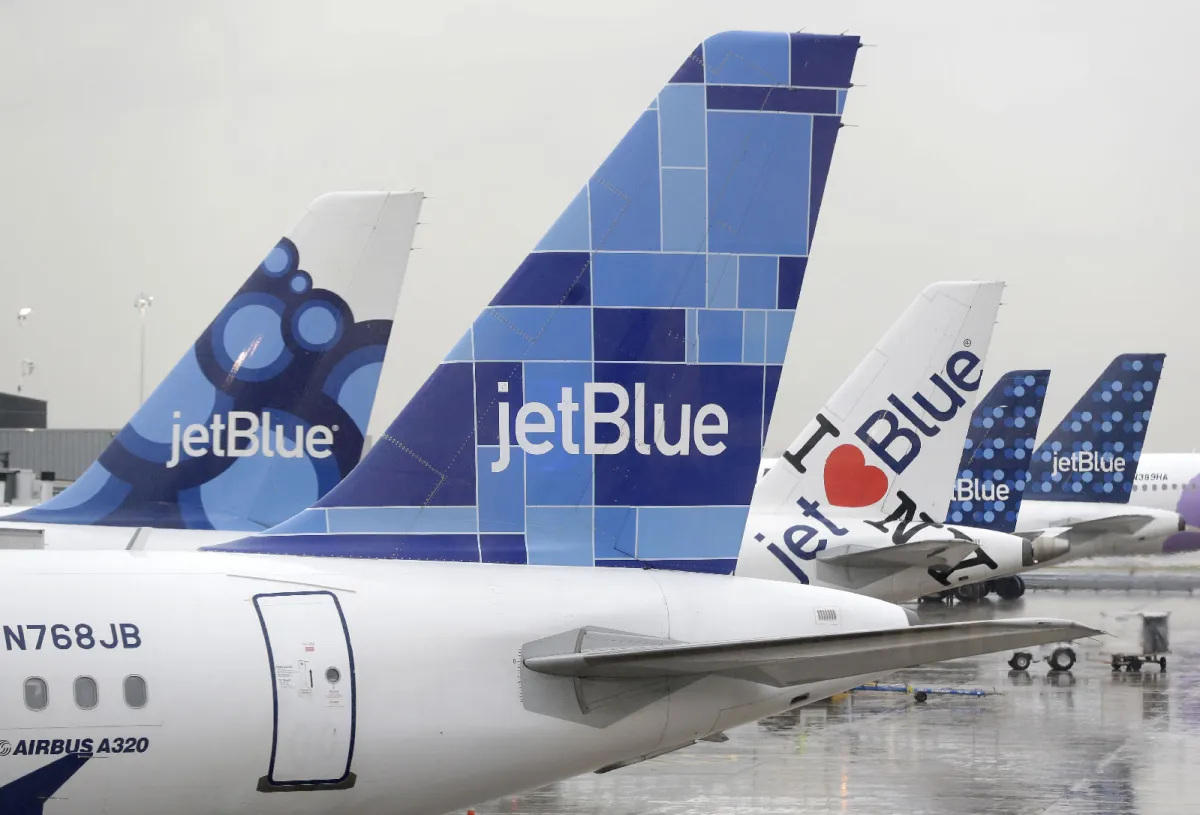
Core Insights - JetBlue is partnering with Amazon to utilize Project Kuiper satellites for in-flight connectivity, diverging from the trend of airlines using SpaceX's Starlink [1][3] - The service is set to launch in 2027, making JetBlue the first airline to implement Kuiper satellites [3] Group 1: Partnership and Technology - JetBlue will provide free in-flight internet with download speeds of up to 1 Gbps, surpassing Starlink's maximum of 250 Mbps [2] - Amazon plans to deploy a network of 3,226 satellites for Project Kuiper, significantly fewer than SpaceX's over 8,000 satellites [2] Group 2: Project Development and Challenges - Project Kuiper has faced production challenges but aims to meet the mid-2026 deadline set by the Federal Communications Commission for launching the first half of its satellite network [4] - Amazon has previously emphasized a focus on underserved communities, although this language has been removed from its website [2]