机器之心

Search documents
AI 硬件,将带来下一个「苹果」还是昙花一现?
机器之心· 2025-09-13 01:30
Group 1: Core Insights - The article discusses the potential shift from smartphones to AI hardware, suggesting that the next major leap in consumer technology may come from a revolutionary device that could render smartphones obsolete [5][6]. - Major tech companies like Meta, OpenAI, Apple, and Google are positioning themselves in the AI hardware space, with a focus on devices that integrate AI capabilities as foundational infrastructure [8]. Group 2: AI Hardware Landscape - The global wearable technology market is projected to grow from approximately $120 billion in 2023 to around $158 billion in the coming years, indicating a significant expansion in the AI hardware sector [9]. - Various innovative AI hardware products are emerging, including smart glasses, health-monitoring rings, and AI-enabled earbuds, showcasing diverse interaction forms and functionalities [9]. Group 3: Company Strategies - Meta plans to release multiple tiers of AI glasses within the next five years, emphasizing the importance of AI functionality for future cognitive advantages [5]. - OpenAI is collaborating with former Apple designer Jony Ive to launch a next-generation portable device by 2026 that relies solely on cameras and microphones for interaction [5]. - Google is developing new AI assistants and Android XR glasses, aiming to enhance user experience through real-time interaction and improved language understanding [7].



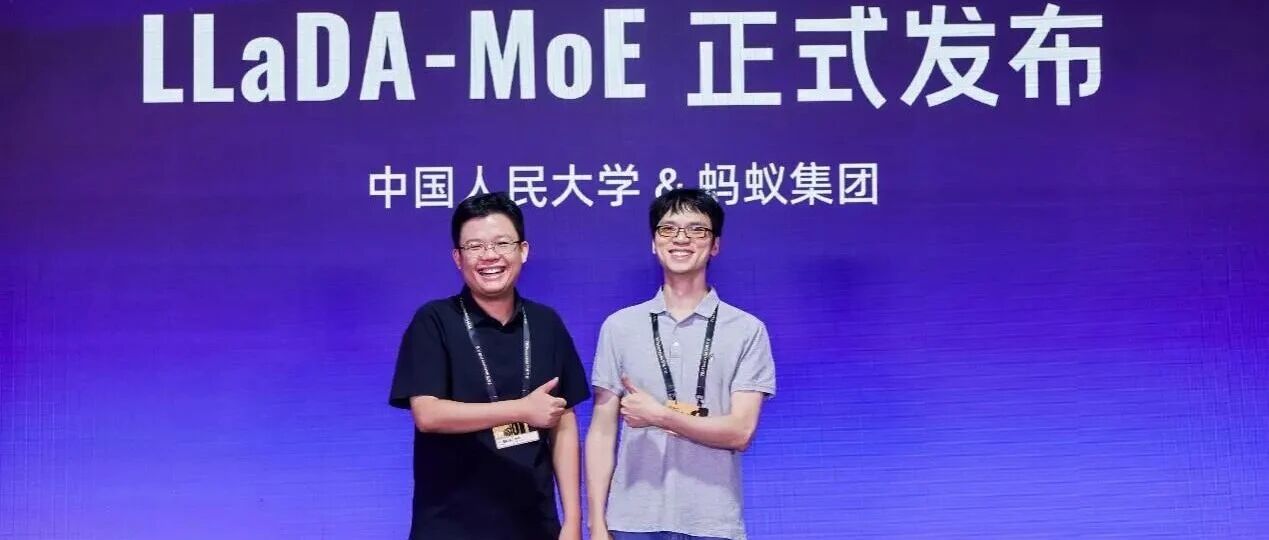
扩散语言模型也有MoE版本了!蚂蚁&人大从头训练LLaDA-MoE,即将完全开源
机器之心· 2025-09-12 11:31
Core Viewpoint - The article discusses the development of the LLaDA-MoE model, the first native MoE architecture diffusion language model trained from scratch, which demonstrates significant performance and efficiency advantages over traditional autoregressive models [2][15][18]. Group 1: Model Development and Performance - The LLaDA-MoE model was trained on 20 terabytes of data and features 1.4 billion active parameters, achieving performance comparable to denser autoregressive models like Qwen2.5-3B while maintaining faster inference speeds [15][17][29]. - The LLaDA series has rapidly evolved, with LLaDA-MoE being a notable milestone, surpassing previous models like LLaDA1.0/1.5 and Dream-7B in various benchmark tests [13][18][29]. - The model's architecture allows for significant scaling potential, with plans to explore higher sparsity ratios and larger MoE diffusion language models [29][40]. Group 2: Technical Innovations and Advantages - The diffusion model approach allows for parallel decoding, bidirectional modeling, and iterative correction, addressing limitations of autoregressive models such as serial bottlenecks and lack of error correction capabilities [38][40]. - Evidence suggests that diffusion language models can achieve better learning outcomes than autoregressive models, particularly in scenarios with limited data, demonstrating a data utilization efficiency that can exceed three times that of autoregressive models [40][41]. - The training framework and infrastructure developed by Ant Group, including the ATorch framework, supports the efficient training of large-scale MoE models [25][26]. Group 3: Strategic Vision and Future Directions - The development of LLaDA-MoE reflects a strategic choice to explore high-potential areas in AI, moving beyond established paths to enhance the limits of intelligence [44][47]. - Ant Group's commitment to innovation is evident in its previous projects and ongoing research in areas like dynamic MoE architectures and hybrid linear architectures, all aimed at achieving general artificial intelligence (AGI) [45][46][47].
腾讯优图重磅开源Youtu-GraphRAG,实现图检索增强技术新突破
机器之心· 2025-09-12 11:31
Core Viewpoint - Youtu-GraphRAG framework by Tencent Youtu Lab addresses key challenges in Graph Retrieval-Augmented Generation (GraphRAG) technology, achieving significant breakthroughs in cost and effectiveness [2][3][30]. Cost and Effectiveness Breakthrough - Youtu-GraphRAG demonstrates over 30% cost savings compared to the best similar solutions and achieves an accuracy improvement of over 16% in complex reasoning tasks [6][30]. Key Challenges in Current Solutions - High Costs: Building graphs and communities using LLM incurs significant token consumption and time, leading to high economic and temporal costs [5]. - Effectiveness Bottleneck: Limited precision in parsing complex queries presents a significant challenge [5]. - High Adaptation Costs: Lack of cross-task generalization necessitates full-chain adjustments when encountering new domains, resulting in high migration costs [5]. Technical Architecture Innovations - The framework features three major innovations that create a vertically unified solution, enhancing graph construction and reasoning capabilities [8]. - Hierarchical Knowledge Tree Construction: Introduces targeted entity types, relationships, and attributes for precise constraints in graph construction, enabling self-evolution and high-quality extraction across domains [9]. - Community Detection with Dual Semantic Perception: Combines structural topology features with subgraph semantic information to enhance reasoning capabilities, outperforming traditional algorithms [9]. - Intelligent Iterative Retrieval Mechanism: Transforms complex queries into sub-queries that align with graph features, improving reasoning and reflection abilities [10]. Core Application Scenarios - Multi-hop Reasoning and Summarization: Effectively addresses complex problems requiring multi-step reasoning, such as deep relational analysis and causal reasoning [13]. - Knowledge-Intensive Tasks: Efficiently handles tasks that rely on extensive structured knowledge, such as enterprise knowledge base Q&A and technical document analysis [14]. - Cross-Domain Expansion Applications: Supports various fields like academic papers and personal knowledge bases while minimizing manual intervention costs [15]. User Interaction and Deployment - The framework allows for quick setup through a four-step process, including code acquisition, environment configuration, one-click deployment, and interactive experience [19][20][21][22]. - Features include visual knowledge graph display, interactive intelligent Q&A, and real-time reasoning path tracking [23]. Community Contribution and Data Management - The framework encourages community contributions in areas such as seed schema development and custom dataset integration, aiming to enhance understanding of different data types [26][27]. - AnonyRAG dataset is provided to mitigate knowledge leakage during pre-training of large language models, ensuring robust retrieval performance [25]. Conclusion - Youtu-GraphRAG sets a new benchmark for enterprise-level knowledge management and intelligent Q&A systems, making high-quality services more accessible and sustainable [30].


如何为LLM智能体编写工具?Anthropic官方教程来了
机器之心· 2025-09-12 11:31
Core Insights - The article emphasizes the need to rethink tool development for agentic AI systems, moving away from traditional deterministic logic to accommodate the non-deterministic nature of AI agents [1][3][10] - It highlights that the effectiveness of AI agents is heavily dependent on the tools provided to them, and outlines a path for optimizing these tools [1][3][4] Tool Definition and Development - Tools for AI agents are defined as new software forms that bridge deterministic systems and non-deterministic agents, requiring a different approach to design [8][9][10] - The article suggests a rapid prototyping approach for tool development, followed by comprehensive evaluations to assess performance and make iterative improvements [12][14] Evaluation Process - Evaluation tasks should be generated based on real-world scenarios and data sources, ensuring that prompts are paired with verifiable responses [23][25] - The article advises against overly simplistic testing environments, advocating for complex conditions that can effectively stress-test the tools [27] Tool Design Principles - It is recommended to build a limited number of well-thought-out tools that align with high-value workflows, rather than creating numerous redundant tools [43][47] - Tools should be designed with clear and independent objectives to prevent confusion among AI agents when selecting the appropriate tool [45][50] Naming and Response Optimization - Implementing namespaces for tools can help clarify their functions and reduce confusion for AI agents [48][51] - Tools should return high-signal information, prioritizing context relevance over flexibility, to enhance the agent's performance [52][56] Future Outlook - The article concludes that the development of efficient tools for AI agents requires a shift from predictable deterministic patterns to non-deterministic approaches, with a focus on iterative, evaluation-driven processes [66]

姚顺雨离职OpenAI,「亿元入职腾讯」传闻引爆AI圈,鹅厂辟谣了
机器之心· 2025-09-12 02:17
Group 1 - The article discusses rumors about Shunyu Yao, a prominent researcher from OpenAI, allegedly joining Tencent's mixed model team, which sparked significant interest in the AI community, particularly due to claims of a "1 billion" annual salary [2][5][7] - Tencent officially denied the rumors regarding Yao's joining, but questions remain about whether the denial pertains to his employment status or the salary claims [5][7] - Despite the denial, multiple sources indicate that Yao has indeed left OpenAI, highlighting the intense competition for AI talent both domestically and internationally, with major companies like Meta aggressively recruiting top researchers [7] Group 2 - Shunyu Yao has made significant contributions to the field of AI, particularly in language agents, and has a citation count exceeding 15,000 for his research papers [9] - His notable works include the development of benchmarks like SWE-Bench and the WebShop environment, which have advanced the capabilities of AI agents [9] - Yao's research at OpenAI focused on practical applications of large language models, including the development of the Computer-Using Agent (CUA) and collaborations with notable figures like Jony Ive [18][19] Group 3 - Yao's recent blog post titled "The Second Half" is considered a pivotal discussion in AI research, suggesting a shift from merely training stronger models to defining and evaluating genuinely useful tasks [19][21] - He emphasizes the need for a fundamental rethinking of evaluation methods in AI, advocating for the creation of new benchmarks that challenge existing paradigms [21] - At the age of 27, Yao was recognized in the MIT Technology Review's "35 Innovators Under 35" list for the China region, marking him as the youngest recipient in that year [21]

告别错误累计与噪声干扰,EviNote-RAG 开启 RAG 新范式
机器之心· 2025-09-12 00:51
Core Insights - The article discusses the development of EviNote-RAG, a new framework aimed at enhancing retrieval-augmented generation (RAG) models, addressing issues of low signal-to-noise ratio and error accumulation in complex tasks [4][10][11]. Group 1: EviNote-RAG Framework - EviNote-RAG introduces a three-stage process: retrieval, note-taking, and answering, which contrasts with traditional RAG methods that directly rely on retrieval results [14][22]. - The framework utilizes Supportive-Evidence Notes (SEN) to filter out noise and highlight key information, mimicking human note-taking habits [20][22]. - Evidence Quality Reward (EQR) is incorporated to ensure that the notes genuinely support the final answer, thus reducing shallow matching and error accumulation [20][22]. Group 2: Performance Improvements - EviNote-RAG has shown significant performance improvements across various open-domain question-answering benchmarks, achieving a 20% increase in F1 score on HotpotQA, a 40% increase on Bamboogle, and a 91% increase on 2Wiki [25][24]. - The framework has demonstrated enhanced generalization capabilities and training stability, making it one of the most reliable RAG frameworks available [6][18]. Group 3: Training Dynamics - The introduction of SEN and EQR has transformed the training dynamics from unstable to robust, allowing for a smoother training curve and improved performance [27][28]. - Key findings indicate that structured instructions lead to stability, while noise filtering through SEN significantly enhances computational efficiency [28][29]. Group 4: Experimental Validation - Ablation studies confirm that both SEN and EQR are crucial for robust reasoning, with SEN providing structured constraints and EQR offering logical consistency supervision [41][45]. - The experiments highlight that effective supervision is more about how supportive evidence is organized and marked rather than merely enforcing summaries [42][45].

全新MoE架构!阿里开源Qwen3-Next,训练成本直降9成
机器之心· 2025-09-12 00:51
Core Viewpoint - The article discusses the launch of the next-generation large language model architecture, Qwen3-Next, by Alibaba's Tongyi team, highlighting its significant improvements in computational efficiency and performance compared to previous models [2][20]. Model Architecture and Innovations - Qwen3-Next features a total of 80 billion parameters, activating only 3 billion, achieving performance comparable to the 235 billion parameter Qwen 3 flagship model and surpassing Gemini-2.5-Flash-Thinking [2][20]. - The model is designed for future trends in context length scaling and total parameter scaling, incorporating various technical enhancements over the previous Qwen3 model, including a mixed attention mechanism and high sparsity MoE structure [5][11]. - The Gated DeltaNet and Gated Attention mechanisms improve efficiency in processing long contexts, with a 3:1 mix ratio yielding superior performance [9][10]. Training and Stability Enhancements - Qwen3-Next employs a high sparsity MoE architecture, activating only 3.7% of its parameters during inference, which maximizes resource utilization without sacrificing performance [11]. - The model includes design features to enhance training stability, such as the Zero-Centered RMSNorm and initialization normalization for MoE router parameters [12][13]. Performance Metrics - In terms of throughput, Qwen3-Next demonstrates significant advantages, achieving nearly seven times the throughput of Qwen3-32B during the prefill phase with a 4k token context length, and over ten times when exceeding 32k tokens [17][20]. - The model's performance in various evaluations, including programming and reasoning tasks, surpasses that of previous models, achieving high scores in mathematical reasoning assessments [21]. Availability and Deployment - Qwen3-Next has been made available on multiple third-party platforms, enhancing its accessibility for developers and researchers [24].

攻克大模型「表格盲区」!ST-Raptor框架发布,实现复杂半结构化表格的精准理解与信息抽取
机器之心· 2025-09-11 07:13
本工作核心作者为汤子瑞(上海交通大学)、牛博宇(上海交通大学)。合作者为李帛修、周炜、王健楠、李国良、张心怡、吴帆。通讯作者为上海交通大学计 算机学院博士生导师周煊赫。团队长期从事人工智能与数据交叉研究。 半结构化表格是我们日常工作中常见的 "拦路虎"—— 布局五花八门、结构复杂多变,让自动化数据处理变得异常困难。 | 学校名称: | | | | | | | | | | --- | --- | --- | --- | --- | --- | --- | --- | --- | | 编号 | 项目名称 | 한 그 | 出特點處 | | 编号 委目名称 | | | 매각 본선관회 | | | | | | | | 学生个人基础信息 | | | | 1 | 时名 | | | 8 | | | | 身份证件更型 | | 2 | 日常 | | | 9 | | | | 或份证件是 | | 3 | 出生日期 | | | 10 | | | | 难震台研究 | | 4 | 用体验 | | | 11 | 改治國說 | | | | | క | | | | | | | | | | లు | R& | | | 13 | | | | | | ...
3000亿美元OpenAI大单,让世界首富位置换人了
机器之心· 2025-09-11 07:13
Core Viewpoint - Oracle has become a focal point globally after announcing its Q1 FY2026 earnings, revealing a total revenue of $14.9 billion, a year-on-year increase of approximately 12%, but below market expectations. However, the remaining performance obligations (RPO) surged to $455 billion, a staggering 359% increase year-on-year [2][4]. Group 1: Financial Performance - Oracle's cloud business revenue is projected to soar to $144 billion by FY2030, driven by the demand for AI computing power, compared to less than $20 billion in the current fiscal year [3]. - Following the earnings announcement, Oracle's stock price surged over 35%, reaching a peak of $345.72 [4][5]. Group 2: Major Contracts and Partnerships - A significant portion of Oracle's RPO is attributed to a contract with OpenAI, which is expected to purchase $300 billion worth of computing power over approximately five years, marking one of the largest cloud computing contracts in history [8][12]. - The contract with OpenAI will require Oracle to secure 4.5 gigawatts of power capacity, equivalent to the electricity consumption of about four million households [9]. Group 3: Strategic Developments - Oracle is collaborating with data center builders to establish multiple data centers across the U.S. to support the anticipated demand from OpenAI [14]. - The company is also considering taking on debt to purchase AI chips necessary for its data centers [10]. Group 4: Market Position and Challenges - Despite the recent successes, Oracle faces stiff competition in the cloud computing sector from major players like Amazon, Microsoft, and Google, and has recently announced significant layoffs, planning to cut over 3,000 jobs globally [17]. - The CEO of OpenAI, Sam Altman, has indicated that the company may not reach profitability until 2029, with projected losses of $44 billion before then, highlighting the financial risks associated with such large-scale contracts [12].

交互扩展时代来临:创智复旦字节重磅发布AgentGym-RL,昇腾加持,开创智能体训练新范式
机器之心· 2025-09-11 04:53
Core Insights - The article emphasizes the transition of artificial intelligence from a "data-intensive" to an "experience-intensive" era, where true intelligence is derived from active exploration and experience accumulation in real environments [10][11][50]. - The introduction of the AgentGym-RL framework represents a significant advancement in training autonomous LLM agents for multi-turn decision-making, addressing the limitations of existing models that rely on single-turn tasks and lack diverse interaction mechanisms [12][50]. Group 1: Framework and Methodology - AgentGym-RL is the first end-to-end framework for LLM agents that does not require supervised fine-tuning, supports interactive multi-turn training, and has been validated in various real-world scenarios [3][15]. - The framework integrates multiple environments and rich trajectory data, simplifying complex environment configurations into modular operations, thus facilitating effective experience-driven learning [13][19]. - The ScalingInter-RL method introduces a progressive interaction round expansion strategy, allowing agents to gradually adapt to environments and optimize their interaction patterns, balancing exploration and exploitation [4][23][25]. Group 2: Performance and Results - The research team achieved remarkable results with a 7B parameter model, which demonstrated complex task handling skills such as understanding task objectives and planning multi-step operations after extensive interaction training [5][29]. - In various testing environments, the model not only surpassed large open-source models over 100B in size but also matched the performance of top commercial models like OpenAI o3 and Google Gemini 2.5 Pro [5][29]. - The ScalingInter-RL model achieved an overall accuracy of 26.00% in web navigation tasks, significantly outperforming GPT-4o's 16.00% and matching the performance of DeepSeek-R1-0528 and Gemini-2.5-Pro [29][30]. Group 3: Future Directions - Future research will focus on upgrading general capabilities to enable agents to make efficient decisions in new environments and with unknown tools [51]. - The team aims to expand into more complex scenarios that closely resemble the physical world, such as robotic operations and real-world planning [52]. - There is an intention to explore multi-agent collaboration training models to unlock more complex group decision-making capabilities [52].