Fujian Guohang Ocean Shipping(Group) (833171)

Search documents
国航远洋(920571):全资子公司签署船舶买卖协议
Sou Hu Cai Jing· 2026-02-12 10:46
Core Viewpoint - The company aims to expand its capacity, optimize its fleet, and enhance operational efficiency through the acquisition of a bulk carrier, thereby improving competitiveness and profitability [1] Group 1: Acquisition Details - The company’s wholly-owned subsidiary, Century Maritime Limited, signed a ship purchase agreement with Armonikos Shipping Corporation [1] - The transaction involves a bulk carrier with a total transaction amount of approximately $35.18 million, equivalent to about 245 million RMB based on the exchange rate as of February 9, 2026 [1] - Funding for the acquisition will come from the company's own funds and self-raised capital [1]
国航远洋:收到与收益相关的政府补助534.3万元
Zheng Quan Ri Bao Wang· 2026-02-06 11:50
Group 1 - The company, Air China Ocean, announced on February 6 that it received a government subsidy related to revenue amounting to 5.343 million yuan, which accounts for 23.58% of the audited net profit attributable to shareholders of the listed company for the most recent fiscal year [1]
国航远洋:船队更新采用“汰旧建新+绿色智能”策略
Zheng Quan Ri Bao· 2026-02-05 13:38
Core Viewpoint - The company is adopting a "phasing out the old and building the new + green intelligence" strategy for fleet renewal, focusing on low-carbon and smart new energy vessels while disposing of outdated and inefficient ships [2] Group 1: Fleet Renewal Strategy - The company plans to deliver 6 new ships by 2026, adding nearly 500,000 deadweight tons of capacity, with over 30% of the fleet being green capacity [2] - The average age of the fleet is currently 7 years, which is below the industry average [2] Group 2: Ship Type Planning - The ship type planning focuses on dry bulk core, primarily using Panamax vessels while also considering handy size [2] - The new additions include 63,500-ton low-carbon smart bulk carriers and 89,000-ton methanol dual-fuel bulk carriers, suitable for transporting bulk commodities like grain and iron ore [2] - Some new ships are designed with the capability for future methanol dual-fuel retrofitting, allowing for fuel transition [2] Group 3: Emission Reduction Initiatives - The company implements a "dual-wheel drive" approach for carbon reduction, focusing on "energy efficiency improvement + fuel transition," with new ships featuring reduced fuel consumption and meeting emission standards [2] - Four new ships are equipped with methanol dual-fuel main engines to hedge against carbon cost impacts [2] - The company is also advancing environmental retrofitting of existing vessels to comply with IMO emission reduction regulations and EU carbon tax [2] Group 4: Technological Innovations - The company is building an intelligent shipping platform and a Maritime Operations System (MOS) to optimize route planning and enhance operational efficiency [2] - Exploration of innovative scenarios such as drone maritime applications is also underway [2]

国航远洋:2026年干散货航运将呈“需求增长、供给偏紧、运价上行”态势
Zheng Quan Ri Bao· 2026-02-05 13:38
Core Viewpoint - The dry bulk shipping industry is expected to experience "demand growth, supply tightness, and rising freight rates" in 2026, driven by increasing global trade volumes and regulatory pressures on supply [2] Demand Side - Global dry bulk trade volume continues to grow, with long-haul iron ore shipments from Simandou driving ton-mile demand [2] - Demand for food and non-ferrous minerals is also contributing to the upward pressure on freight rates [2] Supply Side - New ship orders are projected to hit a five-year low in 2025, leading to a tighter supply environment [2] - The aging fleet and stricter IMO efficiency regulations are expected to slow the release of new capacity [2] - The company plans to retire older vessels in 2025, which will enhance its performance in 2026 [2] Fleet Expansion - The company has already put into operation one low-carbon intelligent bulk carrier with a deadweight of 63,500 tons and plans to deliver six new vessels in total for the year [2] - The new fleet will add nearly 500,000 deadweight tons, primarily servicing grain and mineral routes in Europe, North America, and East Asia [2] Environmental Compliance - New vessels are designed for lower fuel consumption and meet the highest EEDI requirements set by the IMO, aligning with new emission reduction regulations [2] - This compliance is expected to help secure high-quality customers and enhance profitability [2] Operational Efficiency - The company is focusing on deepening digital operations to dynamically optimize routes, thereby improving turnover rates and gross margins [2]
国航远洋:自营干散货运输船舶21艘,总运力超150万吨
Zheng Quan Ri Bao Wang· 2026-02-02 13:51
Core Viewpoint - The company, China National Offshore Oil Corporation (CNOOC), has a fleet of 21 self-operated dry bulk carriers with a total capacity exceeding 1.5 million tons, with over 30% of its capacity being green energy vessels [1] Group 1: Fleet and Capacity - The dry bulk fleet primarily consists of Panamax vessels, supplemented by handy-sized vessels [1] - The average age of the fleet is 7 years, significantly lower than the industry average [1] Group 2: Business Strategy - The company employs a dual trade strategy, focusing on domestic trade for coal and iron ore transportation, while international trade targets various bulk commodities such as grain, coal, iron ore, and bauxite [1] - The company adjusts its domestic and international trade structure and commodity types flexibly based on market conditions [1] Group 3: Route and Revenue - Domestic routes include major coal and iron ore transport ports, while international routes cover regions such as Europe, Australia, North and South America, Southeast Asia, East Asia, South Asia, and Africa [1] - By 2024, the company expects its overseas revenue share to increase to 67% [1] Group 4: New Developments - The company has already put into operation a low-carbon intelligent dry bulk carrier with a capacity of 63,500 tons and is currently constructing another similar vessel along with four methanol dual-fuel dry bulk carriers, each with a capacity of 89,000 tons [1]
国航远洋:从2025年年底至今,干散货运价涨幅明显,干散货运价与盈利水平同步上行
Zheng Quan Ri Bao Wang· 2026-02-02 13:47
Core Viewpoint - The Baltic Dry Index (BDI) has shown a significant upward trend since the end of 2025, with an average value of 1711.4 as of January 23, 2026, representing an 85.8% year-on-year increase. This growth is driven by increasing global dry bulk trade volume and demand for long-haul iron ore transportation, which boosts the demand for shipping capacity [1] Industry Summary - The global dry bulk trade volume is expected to continue growing, supported by increased demand for long-haul iron ore transportation, leading to a notable increase in demand for shipping capacity [1] - The supply side of shipping capacity is constrained, with new orders for bulk carriers at a five-year low in 2025, coupled with an aging fleet and stricter IMO energy efficiency regulations, resulting in a limited growth in shipping capacity [1] - The significant increase in dry bulk freight rates has been accompanied by a rise in profitability levels, driven by the growth in prices and demand for non-ferrous minerals, further supporting the increase in bulk shipping rates [1]
国航远洋:公司今年将陆续交付6艘新造船
Zheng Quan Ri Bao Wang· 2026-02-02 13:47
Core Viewpoint - The company plans to deliver six new vessels this year, significantly increasing its capacity by nearly 500,000 deadweight tons, primarily for transporting grain and ore, with routes covering the Americas, Europe, and East Asia [1] Group 1: New Vessel Delivery and Capacity Expansion - The company will deliver six newbuild vessels this year, adding approximately 500,000 deadweight tons of capacity [1] - The main cargo types for the new vessels will be grain and ore, indicating a focus on essential commodities [1] - The operational routes will span across the Americas, Europe, and East Asia, enhancing the company's market reach [1] Group 2: Environmental and Efficiency Standards - The new vessels utilize low-carbon and energy-saving technologies, resulting in a significant reduction in fuel consumption per vessel [1] - The Energy Efficiency Design Index (EEDI) of the new vessels meets the highest standards set by the International Maritime Organization (IMO) [1] - Nitrogen oxide (NOx) emissions from the vessels comply with Tier III standards, reflecting the company's commitment to green navigation [1] Group 3: Competitive Advantage - The strong demand for core cargo types such as grain and iron ore provides a stable market for the company's new vessels [1] - The combination of low-carbon technology advantages and stable demand for core cargo types enhances the company's profitability and operational efficiency, creating a competitive edge [1]
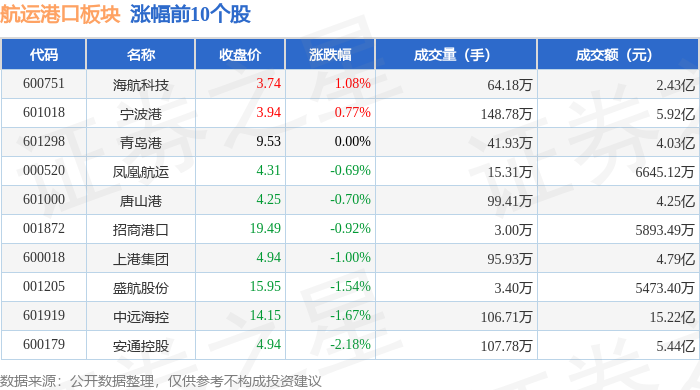
航运港口板块2月2日跌2.36%,国航远洋领跌,主力资金净流出9.52亿元
Zheng Xing Xing Ye Ri Bao· 2026-02-02 09:15
Core Viewpoint - The shipping and port sector experienced a decline of 2.36% on February 2, with significant losses in individual stocks, particularly China National Offshore Oil Corporation (CNOOC) leading the drop [1][2]. Market Performance - The Shanghai Composite Index closed at 4015.75, down 2.48% - The Shenzhen Component Index closed at 13824.35, down 2.69% [1]. Individual Stock Performance - Notable declines included: - CNOOC down 7.09% to 9.44 with a trading volume of 280,200 shares and a turnover of 271 million yuan - China Merchants Energy down 5.42% to 3.49 with a trading volume of 2,161,800 shares and a turnover of 765 million yuan - China Merchants Shipping down 5.02% to 10.79 with a trading volume of 1,279,300 shares and a turnover of 1.416 billion yuan [2]. Capital Flow Analysis - The shipping and port sector saw a net outflow of 9.52 billion yuan from institutional investors, while retail investors contributed a net inflow of 4.89 billion yuan [2]. - The main stocks with significant capital flow included: - HNA Technology with a net inflow of 29.49 million yuan from institutional investors - Chongqing Port with a net inflow of 4.41 million yuan from institutional investors [3].


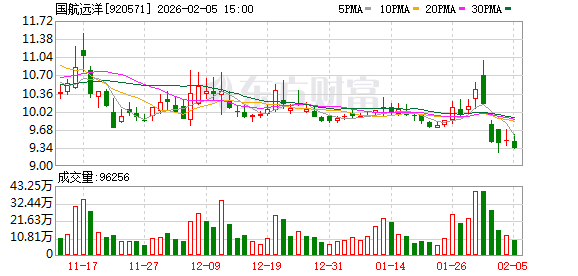
股市必读:国航远洋(920571)1月5日主力资金净流入259.82万元,占总成交额2.98%
Sou Hu Cai Jing· 2026-01-05 20:51
Trading Information Summary - On January 5, 2026, the stock of China National Ocean Shipping (920571) closed at 9.89 yuan, an increase of 0.51% with a turnover rate of 3.14% and a trading volume of 88,400 shares, resulting in a transaction value of 87.06 million yuan [1][2] - On the same day, the net inflow of main funds was 2.5982 million yuan, accounting for 2.98% of the total transaction value; retail investors had a net inflow of 1.8689 million yuan, accounting for 2.15% of the total transaction value, while speculative funds had a net outflow of 2.0615 million yuan, accounting for 2.37% of the total transaction value [1][2] Company Announcement Summary - On December 30, 2025, the wholly-owned subsidiary of China National Ocean Shipping, Shanghai Fujian National Ocean Shipping Management Co., Ltd., received a government subsidy of 3 million yuan, which is related to revenue and accounts for 13.24% of the audited net profit attributable to shareholders of the listed company for the year 2024 [1][2]
苏轴股份:突围高端轴承壁垒
Zheng Quan Ri Bao· 2025-12-17 15:48
Core Viewpoint - The high-end needle bearing market, traditionally dominated by international giants, is experiencing a shift with the emergence of Suzhou Bearing Co., Ltd. as a significant player, leveraging its technological advancements and integration into global supply chains for major automotive suppliers [1][2]. Group 1: Company Overview - Suzhou Bearing Co., Ltd. has over 60 years of history, starting with the production of China's first needle bearing and now supplying to top global automotive component suppliers like BorgWarner, Bosch, ZF Friedrichshafen, and Magna [1][2]. - The company focuses on a "specialized, refined, distinctive, and innovative" development path, emphasizing self-reliance in core technology [2]. Group 2: Technological Advancements - The company has developed a range of products centered around needle bearings, including cylindrical roller bearings and custom bearings, showcasing its commitment to high precision and quality [2]. - Suzhou Bearing's R&D center is equipped with advanced testing facilities, where products like high-speed cylindrical roller bearings for electric drive systems have achieved domestic leading and international advanced standards [2][3]. Group 3: Production Capabilities - The company has established a comprehensive production line that integrates advanced automation and minimal human intervention, allowing for rapid production cycles and high precision [3][4]. - The new production facility for needle bearings is expected to significantly increase annual production capacity, supporting the demand for high-end applications [6]. Group 4: Market Position and Strategy - Suzhou Bearing has become a global strategic supplier for several multinational companies, maintaining a strong foothold in core automotive sectors such as steering, transmission, and braking [5]. - The company has adapted its market strategies to address challenges in international trade, focusing on domestic sales growth and leveraging its German subsidiary to meet European market demands [6][7]. Group 5: Future Development Plans - The company plans to focus on aerospace, new energy vehicles, and robotics as core R&D directions over the next 3 to 5 years, aiming to capture emerging market opportunities [8]. - Suzhou Bearing is also exploring international expansion, particularly in Southeast Asia and Europe, to enhance its global competitiveness and brand recognition [8]. Group 6: Financial Performance - In the first half of 2025, Suzhou Bearing reported a net profit of 82.56 million yuan, a year-on-year increase of 11.56%, with high-end product revenue being a key driver of growth [4].