CHINA TELECOM(00728)

Search documents
中国电信股价下跌1.17% 参与成立AI推理工作组
Jin Rong Jie· 2025-08-26 16:26
Group 1 - As of August 26, 2025, China Telecom's stock price is 7.58 yuan, down 0.09 yuan or 1.17% from the previous trading day [1] - The trading volume on that day was 1.5598 million hands, with a transaction amount of 1.182 billion yuan [1] - China Telecom is a major state-owned telecom operator in the communication services industry, providing fixed and mobile communication services, internet access, and information services [1] Group 2 - Recently, China Telecom participated in the establishment of the "Advanced Storage AI Inference Working Group," which aims to promote the development of "storage-computing collaboration and ecological co-construction" in the AI inference field [1] - The company showcased its "Wide-area Intelligent Computing Lossless Networking Technology" at the 2025 China Computing Power Conference, which enables efficient collaboration between distant data centers [1] Group 3 - On August 26, 2025, the net outflow of main funds for China Telecom was 206 million yuan, accounting for 0.04% of its circulating market value [1] - Over the past five trading days, the cumulative net inflow of main funds was 2.00496 million yuan [1]

聊聊卫星互联网牌照那些事
Sou Hu Cai Jing· 2025-08-26 15:50
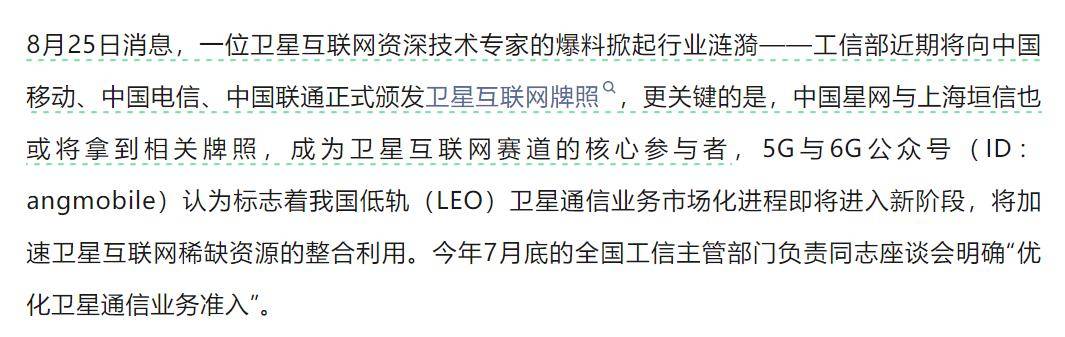
Group 1 - The Ministry of Industry and Information Technology (MIIT) is set to issue "satellite internet" licenses, which has generated significant interest and inquiries among the public [2] - A business license is a legal permit issued by the government or regulatory bodies that allows organizations or individuals to conduct specific commercial activities, ensuring market access and compliance with regulations [3] - The MIIT's role includes issuing licenses for telecommunications and internet services, ensuring that companies have the necessary technical capabilities and compliance qualifications to operate legally [3] Group 2 - The upcoming satellite internet licenses are expected to fill gaps in existing licenses for China Unicom and China Mobile, allowing them to legally conduct satellite-based mobile services [6] - Companies like Xingwang and Yuanshin are likely to obtain A13-1/2 operational licenses, which would significantly benefit their business development, especially for Yuanshin's focus on satellite internet services along the Belt and Road countries [6] - The rapid deployment of China's satellite constellation, particularly by Xingwang, is anticipated to enhance the country's satellite internet capabilities, with the issuance of operational licenses expected to accelerate the development of this sector [7][8]



卡不住我们!中国算力省电省钱十大绝招,个个硬核
2 1 Shi Ji Jing Ji Bao Dao· 2025-08-26 12:53
Core Insights - The 2025 China Computing Power Conference showcased significant breakthroughs in computing power, including the "Jiuzhou" computing power optical network developed by China Mobile, achieving 10 EFLOPS, capable of performing 100 trillion calculations in one second [1] - The conference highlighted ten major advancements in China's computing industry, focusing on both core underlying technologies and ecological solutions that enhance efficiency and sustainability [1][2] - These advancements are expected to drive GDP growth by over 12.6 billion yuan, indicating a strong economic impact from the computing power sector [1] Group 1: Major Breakthroughs - China Mobile's "Jiuzhou" optical network is the world's largest 400G all-optical inter-provincial backbone network [1] - Shanxi Qineng's integrated platform for computing and electricity saves 10 million yuan in electricity costs annually and reduces carbon emissions by 100,000 tons [1] - Super Fusion's FusionOne AI solution enables rapid deployment of AI applications, with over 500 projects already implemented [1] Group 2: Collaborative Technologies - China Telecom's "Wide-area Intelligent Computing Lossless Networking Technology" allows efficient collaboration between distant data centers [2] - China Unicom's "Distributed Training and Inference Key Technology" ensures efficient and secure AI training while protecting data privacy [2] - Lenovo's "Comprehensive Large Model Training and Inference Solution" enhances model inference performance by ten times and enables rapid fault recovery [2] Group 3: Ecosystem Development - Alibaba Cloud's heterogeneous GPU cloud platform facilitates collaboration among different brands of domestic GPUs, supporting over 100 major projects [2] - ZTE's intelligent computing supernode system enables large-scale high-speed interconnection of domestic GPU cards, supporting training of models with over one trillion parameters [2] - Shanghai AI Laboratory's DeepLink solution allows large-scale mixed training across provinces, optimizing national computing resources [2][3]


思特奇:与中国移动、中国联通、中国电信长期保持稳定的传统业务合作关系
Zheng Quan Ri Bao Zhi Sheng· 2025-08-26 08:39
Group 1 - The company, Sitergy, maintains a long-term stable traditional business cooperation relationship with major telecom operators in China, including China Mobile, China Unicom, and China Telecom [1] - Sitergy provides IT system architecture and business operation support services to these telecom companies [1]

为什么总有私人号码给你打电话,让你免费升级话费套餐?
3 6 Ke· 2025-08-26 03:04
Core Viewpoint - The article highlights the ongoing issue of deceptive marketing practices by telecom operators in China, where consumers are misled into upgrading their service plans under the guise of "free upgrades," resulting in increased monthly charges [1][3][7]. Group 1: Telecom Operators' Response - The three major telecom operators in China have announced a unified approach to combat misleading marketing calls by using official numbers for promotions, aiming to help consumers identify legitimate marketing channels [1][2]. - Despite the operators' statements, complaints related to telecom service plans continue to rise, with over 65,000 complaints recorded on consumer platforms regarding issues with service charges and plan changes [2]. Group 2: Nature of Deceptive Practices - Consumers often receive calls claiming to offer lower-cost plans, but these calls frequently result in higher charges due to hidden fees or changes in service plans that are not clearly communicated [3][4]. - A common tactic involves presenting a plan that appears cheaper but actually increases the total monthly cost when additional services are included, effectively manipulating consumer perceptions [3][4]. Group 3: Structure of Marketing Practices - The telecom industry is structured into three main components: the company headquarters, retail stores, and third-party channel partners, with the latter often responsible for aggressive marketing tactics [4][5]. - External call agents, who are under pressure to meet sales targets, typically lack comprehensive knowledge of the plans they are selling, focusing solely on pushing sales rather than providing accurate information [5][6]. Group 4: Consumer Experience and Challenges - Consumers face significant challenges in canceling or downgrading plans, as the process is often complicated and time-consuming, leading to frustration and increased costs [3][6]. - The system is designed in such a way that external agents can only increase service plans, while retail staff have limited authority to reduce plans, creating a barrier for consumers seeking to lower their expenses [6][7]. Group 5: Implications for the Industry - The article suggests that the telecom operators are aware of these deceptive practices but continue to allow them to persist, effectively placing the burden of accountability on consumers [7][8]. - The ongoing issue of unsolicited marketing calls indicates that these practices are likely to continue, as the operators gamble on consumers' ability to recognize and report such tactics [8].
英伟达产品安全存疑,利好国产算力链全方位闭环
Tebon Securities· 2025-08-26 02:49
Investment Strategy - Concerns over Nvidia's security may accelerate the replacement of domestic chips, creating a vacuum in the supply of computing chips in China. Recent advancements in domestic computing cards are expected to drive rapid development in the related industry chain. Nvidia's H20 computing chip has been reported to have serious security issues, which could negatively impact its future orders in the Chinese market. In 2024, over 50% of the data center accelerator cards in China are expected to be inference cards, with domestic computing cards projected to account for over 40% by the first half of 2025. The domestic accelerated computing server market is expected to grow by 97.3% year-on-year in 2024 and by 52.9% in 2025 [10][12][13] - The release of DeepSeek-V3.1 is expected to enhance the usability of domestic computing cards in large model applications. The V3.1 version supports UE8M0 FP8 precision, which significantly reduces storage and improves computational throughput compared to traditional FP16 and FP32 formats. This advancement is anticipated to lead to a qualitative leap in the application of domestic computing cards [11][14] - The demand for computing infrastructure from operators and cloud vendors is clear, with capital expenditures expected to increase in the second half of the year. The three major operators reported good growth in computing-related business revenues, with China Telecom's cloud service revenue at 57.3 billion yuan, China Unicom's at 37.6 billion yuan, and China Mobile's at 56.1 billion yuan. Capital expenditures for the first half of 2025 are projected to be 494 billion yuan for China Telecom, 348 billion yuan for China Unicom, and 928 billion yuan for China Mobile, accounting for 59.1%, 63.3%, and 61.4% of their annual expenditures respectively [12][13][18] Industry News - The successful launch of the low-orbit satellite internet 09 group marks a significant step in China's satellite internet development, with the country entering a high-density launch phase. This mission was the 590th flight of the Long March series of rockets, and it is expected to enhance the satellite internet network [15][16] - The budget for the 2025 rocket launch service procurement project by Shanghai Yuanxin Satellite Technology Co., Ltd. is approximately 1.336 billion yuan, with a focus on launching 94 satellites across seven missions. This indicates a growing emphasis on satellite internet and commercial space development in China [16][17] - Capital expenditures by the three major operators in the first half of 2025 were the lowest in recent years, totaling 112.8 billion yuan, a decrease of 16.5% year-on-year. However, there is an expectation of increased investment in AI and computing infrastructure in the second half of the year, which could significantly boost the domestic computing chain [18][19] Weekly Review and Focus - The communication sector saw a significant increase of 10.47% this week, outperforming major indices. The IDC and optical module sectors continued to lead gains, with increases of 14.59% and 14.41% respectively. The overall performance of the communication sector suggests strong investment opportunities in domestic computing chains and satellite internet [19][20]

中国电信8月25日获融资买入9856.45万元,融资余额8.37亿元
Xin Lang Cai Jing· 2025-08-26 02:00
Group 1 - The core viewpoint of the news highlights the trading performance and financial metrics of China Telecom, indicating a positive trend in financing activities and stock performance on August 25 [1] - On August 25, China Telecom's stock rose by 0.92% with a trading volume of 1.368 billion yuan, and the net financing purchase amounted to 10.71 million yuan [1] - As of August 25, the total financing and securities lending balance for China Telecom reached 842 million yuan, with a financing balance of 837 million yuan, representing 0.14% of the market capitalization [1] Group 2 - China Telecom, established on September 10, 2002, primarily engages in telecommunications and related services, with a revenue composition of 39.56% from mobile communication services, 27.78% from industrial digital services, and 23.80% from fixed-line and smart home services [2] - For the first half of 2025, China Telecom reported a revenue of 269.42 billion yuan, reflecting a year-on-year growth of 1.30%, and a net profit attributable to shareholders of 23.02 billion yuan, up by 5.53% [2] - The company has distributed a total of 78.61 billion yuan in dividends since its A-share listing, with 63.05 billion yuan distributed over the past three years [3]
中国电信发布中期业绩基础业务稳健增长 战略新兴业务快速发展
Zhong Guo Chan Ye Jing Ji Xin Xi Wang· 2025-08-25 23:55
Core Insights - China Telecom reported a revenue of 271.5 billion yuan for the first half of 2025, reflecting a year-on-year growth of 1.3% [1] - The company is transitioning its strategy from "cloud transformation" to "intelligent cloud transformation," focusing on high-quality development and embracing artificial intelligence [1][4] Financial Performance - Service revenue reached 249.1 billion yuan, up 1.2% year-on-year, with EBITDA at 80.6 billion yuan, a 4.9% increase [1] - Net profit for the period was 23 billion yuan, marking a 5.5% growth, with basic earnings per share at 0.25 yuan [1] - Capital expenditure totaled 34.2 billion yuan, while free cash flow increased by 13.9% to 13.1 billion yuan [1] Business Segments - Mobile communication service revenue was 106.6 billion yuan, growing 1.3% year-on-year, while fixed-line and smart home service revenue reached 64.1 billion yuan, up 0.2% [1] - The number of mobile users stood at 433 million, and broadband users reached 199 million, with mobile ARPU at 46.0 yuan and broadband ARPU at 48.3 yuan [1] - Revenue from digital industry services was 74.9 billion yuan, with AIDC revenue growing by 7.4% [1] Strategic Initiatives - China Telecom is focusing on building an intelligent cloud system centered around its core technology "Xirang," providing integrated intelligent cloud services [3] - The company aims to enhance its AI capabilities across 21 key areas, developing over 160 AI applications to improve efficiency and reduce costs [3][5] - The strategic shift emphasizes customer-centricity, technological innovation, and the integration of digital infrastructure [4][5] Shareholder Returns - The company announced an interim dividend of 0.1812 yuan per share, an increase of 8.4% year-on-year, reflecting its commitment to enhancing shareholder value [2]
京东物流被纳入恒指成分股 分析人士称有望获得增量资金青睐
Zheng Quan Ri Bao· 2025-08-25 13:16
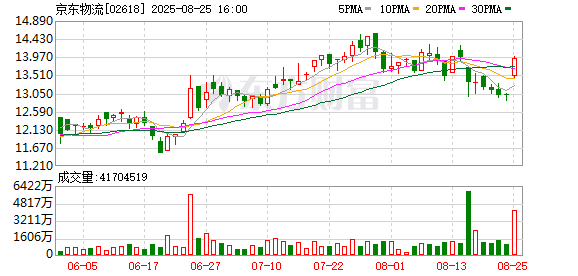
Core Insights - The Hang Seng Index Company announced an increase in the number of constituent stocks from 85 to 88, with the inclusion of China Telecom, JD Logistics, and Pop Mart International Group, effective September 8, 2025 [2] Group 1: Index Changes - The adjustment aligns with market expectations, reflecting the diversity and representativeness of the Hang Seng Index across different industries [2] - The three newly added stocks represent significant sectors: Pop Mart is a leading cultural product IP in China, China Telecom showcases the robust development of state-owned enterprises, and JD Logistics is recognized as an innovator in the logistics industry [2] Group 2: Market Impact - The adjustment is expected to influence substantial capital flows, with approximately $30.35 billion in ETFs tracking the Hang Seng Index needing to rebalance their portfolios [2] - Analysts suggest that the newly included stocks are likely to attract incremental capital, reinforcing the long-term investment value of Hong Kong stocks as a "global value trap," evidenced by the continuous inflow of southbound funds [2]

聚焦2025中国算力大会 | 中国电信以澎湃算力 护航AI等新科技向新而行
Sou Hu Cai Jing· 2025-08-25 11:53
Core Insights - The importance of computing power is increasingly recognized as a strategic resource in the digital age, with significant growth in China's computing power industry highlighted at the 2025 China Computing Power Conference [2][3] Industry Developments - During the 14th Five-Year Plan period, computing power infrastructure has been defined as a crucial foundation for building a digital China, with policies promoting the development of the computing power industry being implemented [3] - China's total computing power scale has seen an average annual growth rate of 30% over the past five years, with 10.43 million computing power standard racks and an intelligent computing power scale of 748 EFLOPS as of March this year [3] - The construction of a nationwide integrated computing power network is accelerating, allowing different regions to enjoy convenient computing services, with the total computing power scale of the eight major hub nodes in the "East Data West Computing" initiative reaching 215.5 EFLOPS, of which intelligent computing accounts for 80.8% [3] Company Initiatives - China Telecom is actively promoting the application of computing power services across various industries, enhancing digital infrastructure and application innovation [4] - In Guangxi, China Telecom is integrating 5G technology with port operations to drive the smart construction of the Beibu Gulf Port [4] - In Hunan, China Telecom collaborates with Zhuzhou Shangchi Electric to develop GPU intelligent computing capabilities for industrial applications, while also providing tailored computing and cloud network solutions for enterprises in the Changsha Malanshan Video Cultural and Creative Industry Park [4] - The company is investing over 2 billion yuan to establish the Poyang Lake Intelligent Computing Center in Jiangxi, which aims to be a core computing power engine for high-quality development along the Yangtze River Economic Belt [5] - In Hubei, China Telecom is leveraging advanced liquid cooling technology to create a central intelligent computing center, with a total computing power scale exceeding 600 PFLOPS, significantly enhancing regional computing resources [5]