Air China(00753)

Search documents
申万宏源交运一周天地汇(20260222-20260227):伊朗局势油运行情空中加油,集运造船联动关注 ST 松发、招商轮船
Shenwan Hongyuan Securities· 2026-03-01 07:29
Investment Rating - The report indicates a positive investment outlook for the shipping sector, particularly highlighting the strong performance of oil tankers and dry bulk carriers, with specific recommendations for companies like China Shipping and China Power [4][5]. Core Insights - The shipping industry is experiencing an upward cycle driven by the entire energy chain, with oil tanker rates significantly increasing due to geopolitical tensions and supply constraints. The VLCC (Very Large Crude Carrier) rates have surged to $206,763 per day, marking a 38% increase week-on-week [4]. - The report emphasizes the potential for further increases in shipping rates, particularly in the context of ongoing geopolitical conflicts and the tightening of shipping capacity controlled by major players like Sinokor [4][5]. - Recommendations include focusing on long-cycle shipping logic with lower volatility, while also considering mid-cycle shipping stocks that are expected to outperform [4]. Summary by Sections Shipping Sector - VLCC rates have reached $206,763 per day, with a 38% week-on-week increase, driven by tight supply and geopolitical tensions [4]. - The report notes that the market is entering a strong pricing phase for shipowners, with Sinokor controlling over 37% of the market capacity [4]. - Suezmax rates have also increased significantly, reflecting the overall bullish sentiment in the oil shipping market [4]. Dry Bulk Sector - The Capesize index remains high, with a slight increase in rates, while smaller vessels are showing resilience due to recovering coal demand [4]. - The BDI (Baltic Dry Index) recorded a 1.09% increase, indicating stable demand in the dry bulk market [5]. Container Shipping - The SCFI (Shanghai Containerized Freight Index) rose by 6.5%, with significant increases in rates for routes to the Mediterranean and South America [4]. - The report highlights potential risks associated with geopolitical tensions affecting shipping routes, particularly in the Red Sea [4]. Air Transport - The report discusses the ongoing challenges in the aircraft manufacturing supply chain and the aging fleet, which is expected to constrain supply and enhance profitability for airlines [4]. - Airlines are anticipated to experience a significant improvement in performance as demand for international travel increases [4]. Logistics and Express Delivery - The express delivery sector is expected to see a recovery in pricing due to policy changes aimed at stabilizing end-user costs, with a focus on leading companies like ZTO Express and YTO Express [4]. - The report notes that the logistics sector is showing resilience, with steady performance in rail and highway freight volumes [4].




*ST海钦(600753.SH):公司股票被叠加实施其他风险警示

Ge Long Hui A P P· 2026-02-27 13:57
Group 1 - The core point of the article is that *ST Haijin (600753.SH) has received an administrative penalty notice from the Fujian Regulatory Bureau of the China Securities Regulatory Commission, indicating that the company has triggered other risk warning situations as per the Shanghai Stock Exchange listing rules [1] - The company's stock will be subject to additional risk warnings starting from March 2, 2026, while maintaining its current stock abbreviation "*ST Haijin" and stock code "600753" [1] - The trading limit for the company's stock remains at 5%, and the stock will continue to trade on the risk warning board without suspension [1]
港股三大航集体走低 南方航空跌超4%
Mei Ri Jing Ji Xin Wen· 2026-02-27 06:38
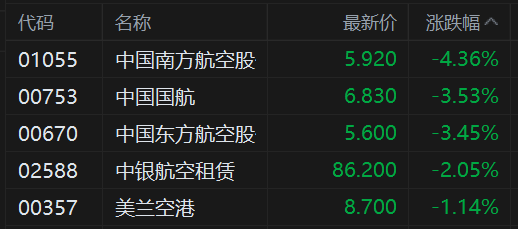
Group 1 - The three major airlines listed in Hong Kong experienced a collective decline in stock prices on February 27 [1] - China Southern Airlines (01055.HK) fell by 4.36%, trading at HKD 5.92 [1] - China Eastern Airlines (00670.HK) decreased by 3.28%, with a price of HKD 5.61 [1] - Air China (00753.HK) dropped by 2.68%, reaching HKD 6.89 [1]

港股异动 | 三大航集体走低 南方航空(01055)跌超4% 东方航空(00670)跌超3%
智通财经网· 2026-02-27 06:31
Group 1 - The three major airlines in China experienced a collective decline in stock prices, with China Southern Airlines down 4.36% to HKD 5.92, China Eastern Airlines down 3.28% to HKD 5.61, and Air China down 2.68% to HKD 6.89 [1] - The People's Bank of China announced a reduction in the foreign exchange risk reserve ratio for forward foreign exchange sales from 20% to 0%, effective March 2, to support enterprises in managing exchange rate risks and stabilize market expectations [1] - Analysts from Dongxing Securities indicated that domestic airline capacity for January 2026 is expected to decrease by approximately 4.3% year-on-year, while showing a 5.8% increase compared to December 2025, as the industry prepares for the Spring Festival travel rush [1] Group 2 - The report suggests that the timing of the Spring Festival in 2026, which is nearly three weeks later than in 2025, has led to a year-on-year decline in capacity deployment for January [1] - The formation and maintenance of a non-involution environment is expected to accelerate the process of industry rebalancing, which will significantly benefit the overall profitability of the airline sector [1]
人民币强势归来:升值逻辑、产业重构与投资新范式
Sou Hu Cai Jing· 2026-02-27 03:10
Core Viewpoint - The recent appreciation of the Renminbi (RMB) against the US dollar is driven by multiple factors, including a weakening dollar, asset revaluation, a surge in currency settlement, and policy guidance from the central bank [2][3]. Group 1: Drivers of RMB Appreciation - The primary external driver of the RMB's appreciation is the significant decline in the US dollar index, which fell approximately 9.7% in 2025 due to weak economic data and expectations of a more accommodative monetary policy from the Federal Reserve [3]. - Internal dynamics have shifted from an "Anything but China" strategy to an "AI & China" focus, with foreign capital reassessing the value of Chinese assets, leading to a noticeable trend of capital inflow [3][4]. - The peak period for currency settlement among export enterprises, particularly around the Chinese New Year, has led to a substantial sell-off of US dollars in favor of RMB, creating a positive feedback loop that amplifies the appreciation momentum [4]. - The central bank has maintained stability in the RMB through market-oriented measures rather than direct intervention, ensuring that the real effective exchange rate remains competitive for exports [4]. Group 2: Beneficiary Sectors of RMB Appreciation - Cost-compression industries, such as aviation and paper manufacturing, benefit significantly from RMB appreciation due to reduced costs associated with dollar-denominated debts and imported raw materials [5][6]. - Resource and commodity import sectors, including steel and petrochemicals, gain from enhanced global purchasing power, allowing them to stabilize profit margins amid fluctuating international prices [6][7]. - Financial and technology sectors are likely to see increased foreign investment, enhancing the relative return on RMB assets and boosting consumer purchasing power for cross-border consumption [7][8].


航空股走低 中国南方航空跌超5% 春节后多条航线机票现白菜价
Ge Long Hui· 2026-02-27 02:55
Group 1 - The core point of the article highlights a significant decline in Hong Kong airline stocks following the end of the Chinese New Year holiday, with China Southern Airlines dropping over 5%, and both Air China and China Eastern Airlines falling more than 4% [1] - The civil aviation market is entering a traditional off-peak season after the peak travel period during the Spring Festival, leading to a sharp drop in domestic flight ticket prices, with some prices falling below 10% of their original cost [1] - It is expected that the average ticket price will decrease by over 50% by March 13, with low prices continuing until the end of March for off-peak travel [1] Group 2 - The article notes that the phenomenon of drastically reduced ticket prices, such as flights from Beijing to Sanya for 300 yuan, is typical for the post-festival period in the civil aviation market [1] - The impact on airline stocks is viewed as a short-term emotional disturbance, but it is suggested that this could strengthen the long-term outlook for the industry [1]
港股异动丨航空股走低 中国南方航空跌超5% 春节后多条航线机票现白菜价
Ge Long Hui· 2026-02-27 02:45
Group 1 - The core viewpoint of the article highlights a significant decline in Hong Kong airline stocks following the end of the 2026 Lunar New Year holiday, with China Southern Airlines dropping over 5%, and both Air China and China Eastern Airlines falling more than 4% [1] - The civil aviation market is entering a traditional off-peak season, contrasting sharply with the high demand during the holiday period, where ticket prices have plummeted, with some domestic routes offering prices as low as 10% of their original cost [1] - From February 23, the peak travel period, domestic flight ticket prices have started to significantly decrease, with an expected average price drop of over 50% by March 13 [1] Group 2 - Analysts suggest that the post-holiday price drop, exemplified by tickets from Beijing to Sanya priced at 300 yuan, is a typical phenomenon in the civil aviation market, indicating a short-term emotional disturbance for airline stocks [1] - However, the long-term outlook remains positive, as this price adjustment may reinforce the overall industry dynamics and attractiveness [1]

飞机租赁行业跟踪报告:飞机交易市场韧性犹存,国际航线进一步修复
Mai Gao Zheng Quan· 2026-02-26 12:32
Investment Rating - The industry rating is "Outperform" [1] Core Insights - Aircraft manufacturers are slowly recovering their production capacity, but the backlog of aircraft orders remains at a historically high level. In January 2026, Boeing delivered 46 aircraft, while Airbus delivered 19. IBA predicts that Airbus will deliver slightly more than 900 aircraft in 2026, and Boeing is expected to deliver around 670 aircraft for the year. The demand for aircraft orders continues to be strong, with backlog levels remaining high [2][7][8]. - The secondary aircraft trading market has been strengthening since the pandemic's impact has diminished. Narrow-body aircraft, particularly the Airbus A320/A321 series and Boeing 737NG series, dominate the market. Demand comes from existing operators, as well as from dismantling traders and spare parts suppliers. The market value and rental levels for wide-body aircraft are also on the rise, driven by high engine overhaul costs and a shortage of maintenance slots. Despite limited availability of aircraft and engines for sale, the overall aircraft trading market is expected to remain strong [2][41]. - Overall, while aircraft manufacturers' production capacity has improved, it still struggles to meet the ongoing demand for aircraft. The aircraft leasing industry is expected to benefit from the tight supply-demand dynamics. The Asia-Pacific aviation market has significant growth potential, providing broader development space for Chinese aircraft leasing companies. Compared to global leasing leader AerCap, Chinese leasing companies are currently undervalued and possess higher order elasticity, making them worthy of attention [2]. Summary by Sections 1. Aircraft Supply Continues to be Tight - Aircraft manufacturers are facing production constraints due to supply chain issues and labor shortages, leading to delivery delays. The backlog of orders remains high, with a total of 15,560 aircraft orders as of the end of January 2026 [2][8]. 2. Civil Aviation Passenger Demand Update - Global aviation passenger traffic growth has slowed, with a year-on-year increase of 5.6% in December 2025, slightly down from 5.8% in November. The load factor was 83.7%, a slight decrease from 83.9% in December of the previous year [13][17]. - International routes are showing steady growth, with international passenger RPK increasing by 7.7% year-on-year in December 2025. The Asia-Pacific region's international passenger traffic remains strong, with a year-on-year growth of 7.5% [20]. 3. Aircraft Leasing Company Dynamics - As of June 30, 2025, Bohai Leasing has the highest number of owned aircraft (628), while China Aircraft Leasing has the least (151). In terms of aircraft orders, Bohai Leasing also leads with 442 orders [39][45]. - The average remaining lease term for China Aircraft Leasing is relatively long at 7.9 years, ensuring long-term stability for the company's leases [48].




港股异动 | 航空股全线走高 离岸人民币兑美元升破6.85 人民币升值有利于航司释放业绩
智通财经网· 2026-02-26 02:05
Group 1 - The aviation stocks have risen across the board, with Eastern Airlines up 5.42% to HKD 6.03, Southern Airlines up 3.9% to HKD 6.4, Air China up 2.66% to HKD 7.34, and Cathay Pacific up 1.11% to HKD 13.7 [1] - The offshore RMB has strengthened against the USD, breaking the 6.85 mark, the highest since April 14, 2023, which is beneficial for airlines with significant foreign currency liabilities, primarily in USD [1] - Guosen Securities indicated that the decline in oil prices and the appreciation of the RMB are favorable for airlines to improve their performance [1] Group 2 - Shenwan Hongyuan noted that the current aircraft manufacturing chain challenges are unprecedented, with supply highly constrained and passenger load factors reaching historical highs [1] - There is a confirmed growth trend in inbound and outbound passenger volumes, suggesting a potential golden era for aviation sector investments [1] - Warmer weather is expected to boost travel in March, and the upcoming meeting between Chinese and U.S. leaders may lead to an increase in China-U.S. flight routes [1]

大行评级丨高盛:春节旅游数据整体健康,基本面有利于华住、亚朵等
Ge Long Hui· 2026-02-25 02:55
Core Viewpoint - Goldman Sachs reports that the overall tourism data during the Spring Festival is healthy, with domestic tourist numbers increasing by 19% to 596 million and tourism spending rising by 19% to 803 billion yuan, with a daily growth rate of 6% [1] Group 1: Domestic Tourism - Domestic tourist volume increased by 19% to 596 million people [1] - Tourism expenditure rose by 19% to 803 billion yuan, with a daily growth of 6% [1] Group 2: International Travel - Outbound traveler numbers increased by 24% to 4.8 million [1] - Japanese routes saw a year-on-year decrease of approximately 50%, but demand shifts to Southeast Asia and South Korea routes increased by 10-40%, offsetting some of the impact [1] Group 3: Hotel and Airline Performance - Hotel industry performance was strong, with revenue per available room driven by average room prices, growing at a mid to high single-digit percentage year-on-year [1] - Airline ticket prices exceeded expectations, with domestic ticket prices rising by 7% and international ticket prices increasing by 15% due to tight capacity [1] Group 4: Duty-Free and Gaming Revenue - Hainan's duty-free stores underperformed expectations, with daily sales growth of only 15%, down from 45% in January, primarily due to a decline in per capita spending [1] - Macau's daily gaming revenue was 786 million patacas, a year-on-year increase of 5%, falling short of the expected 850 million to 900 million patacas, partly due to a decrease in VIP room win rates [1] Group 5: Investment Recommendations - The company believes the fundamentals are more favorable for hotel stocks rated as "buy," including Huazhu Group and Atour Hotel [1] - Macau stocks recommended include Galaxy Entertainment and Sands China, along with airline stocks such as Air China and China Eastern Airlines [1]