
CNCB(00998)

Search documents
中信银行三季报:规模逼近10万亿,净利润增长3%
2 1 Shi Ji Jing Ji Bao Dao· 2025-10-31 11:37
2025年前三季度,该行非利息净收入489亿元,同比下降6.40%,但核心中间业务——手续费及佣金净 收入同比增长 5.75%,达256.88亿元,成为营收结构中的"正向变量"。细分来看,手续费收入增长主要 依赖财富管理业务拉动:报告期内财富管理业务中收同比增长13.59%,显著高于整体手续费收入增 速。 资产质量方面,截至报告期末,该行不良贷款余额669亿元,较上年末增加4.54亿元;但不良贷款率维 持 1.16%,与上年末持平。从数据关联看,不良余额增长主要源于贷款规模自然扩张,并非整体资产质 量的恶化。 风险抵补能力方面,该行拨备覆盖率204.16%,较上年末下降5.27个百分点;贷款拨备率 2.36%,较上 年末下降0.07个百分点。尽管两项指标均有小幅下滑,但204.16%的拨备覆盖率仍高于200%的行业安全 线,意味着每1元不良贷款对应2.04元拨备资金,足以覆盖潜在信用风险。 科技金融与财富管理成主要增长抓手。 10月30日晚间,中信银行(601998)发布2025年第三季度报告。 整体来看,在报告期内该行资产规模逼近10万亿量级,净利润实现同比3%的正增长,但营收端受行业 环境影响呈现下滑,资 ...
中信银行股份有限公司2025年第三季度报告
Shang Hai Zheng Quan Bao· 2025-10-31 06:48
Core Viewpoint - The report highlights the financial performance and operational strategies of CITIC Bank for the first three quarters of 2025, showcasing steady growth in key financial metrics despite a challenging external environment. Group 1: Company Overview - CITIC Bank's total assets reached 98,981.28 billion RMB, a 3.83% increase from the previous year [9] - The bank's total loans and advances amounted to 57,824.81 billion RMB, reflecting a growth of 1.09% [9] - Customer deposits totaled 60,673.29 billion RMB, up 5.00% year-on-year [9] Group 2: Financial Performance - Net profit attributable to shareholders was 533.91 billion RMB, a year-on-year increase of 3.02% [10] - Operating income decreased by 3.46% to 1,565.98 billion RMB, with net interest income down 2.06% [10] - The cost-to-income ratio improved to 28.58%, a decrease of 0.21 percentage points year-on-year [10] Group 3: Business Strategies - The bank emphasized support for the real economy, with corporate loans increasing by 10.99% to 29,742.77 billion RMB [10] - Personal loans (excluding credit cards) reached 18,304.20 billion RMB, a slight increase of 0.83% [12] - The bank launched various consumer finance initiatives, with personal consumption loans amounting to 2,315.36 billion RMB [13] Group 4: Risk Management - The non-performing loan (NPL) ratio remained stable at 1.16%, with a total NPL balance of 669.39 billion RMB [36] - The bank's capital adequacy ratios met regulatory requirements, with a core tier one capital ratio of 9.59% [37] Group 5: Digital and Green Finance - Digital economy loans reached 2,733.51 billion RMB, a growth of 9.42% [19] - The bank's green loan balance increased steadily, with a focus on sustainable finance initiatives [15]
中信银行(601998.SH):2025年三季报净利润为533.91亿元、同比较去年同期上涨3.02%
Xin Lang Cai Jing· 2025-10-31 04:08
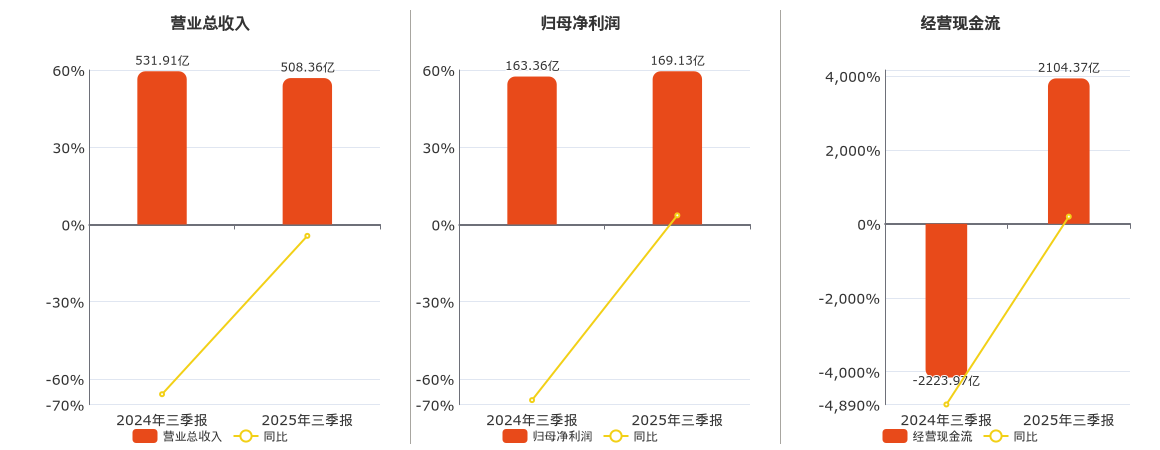
Core Insights - The company reported a total operating revenue of 156.598 billion yuan, ranking third among disclosed peers [1] - The net profit attributable to shareholders reached 53.391 billion yuan, also ranking third, with a year-on-year increase of 1.565 billion yuan, representing a 3.02% growth compared to the same period last year [1] - The net cash inflow from operating activities was 210.437 billion yuan, ranking second among peers, with an increase of 432.834 billion yuan year-on-year [1] Financial Ratios - The latest debt-to-asset ratio is 91.49%, ranking fourth among disclosed peers, with a decrease of 0.06 percentage points from the previous quarter [3] - The return on equity (ROE) stands at 6.48%, ranking fourth, with an increase of 0.10 percentage points compared to the same period last year [3] - The diluted earnings per share (EPS) is 0.89 yuan [3] Asset Management - The total asset turnover ratio is 0.02 times, ranking third among disclosed peers [3] - The number of shareholders is 125,800, with the top ten shareholders holding 53.180 billion shares, accounting for 95.57% of the total share capital [3] - The top shareholder is China CITIC Financial Holdings Limited, holding 64.7% of shares [3]

中信银行前三季度净利润增3%,零售AUM突破5万亿大关
Nan Fang Du Shi Bao· 2025-10-31 03:03
Core Viewpoint - CITIC Bank reported a mixed performance in its Q3 results, with a 3.46% year-on-year decline in operating income, while net profit attributable to shareholders increased by 3.02% [1][2] Financial Performance - For the first three quarters, CITIC Bank achieved a net profit of 53.391 billion yuan, up 3.02% year-on-year, while operating income was 156.598 billion yuan, down 3.46% [2] - Net interest income was 107.702 billion yuan, a decrease of 2.06% year-on-year, with a net interest margin of 1.63%, down 0.16 percentage points year-on-year but up 0.02 percentage points quarter-on-quarter [2] - Non-interest income totaled 48.896 billion yuan, down 6.40% year-on-year, with fee and commission income increasing by 5.75% to 25.688 billion yuan [2] Business Segments - CITIC Bank's corporate loan balance reached 29,742.77 billion yuan, growing by 10.99% compared to the end of the previous year, with significant increases in loans to the manufacturing sector and strategic emerging industries [3][4] - Wealth management income increased by 13.59% year-on-year, and retail assets under management (AUM) surpassed 5 trillion yuan, reaching 5.26 trillion yuan, a 12.12% increase from the end of the previous year [3][4] - The credit card business saw a 54.21% year-on-year growth in installment loans, with 48.37% of new customers acquired through this channel in Q3 [3] Asset Quality and Liabilities - As of the end of the reporting period, CITIC Bank's total assets were 98,981.28 billion yuan, up 3.83% from the end of the previous year, with total loans and advances increasing by 1.09% to 57,824.81 billion yuan [4] - The non-performing loan (NPL) balance was 66.939 billion yuan, with an NPL ratio of 1.16%, unchanged from the end of the previous year, and a provision coverage ratio of 204.16%, down 5.27 percentage points [4]
中信银行南京分行举办“对话招生官”活动 精准助力学子留学路
Jiang Nan Shi Bao· 2025-10-31 02:29
Core Viewpoint - The event organized by CITIC Bank Nanjing Branch aimed to provide personalized guidance and insights into the latest study abroad trends and application strategies for students and their parents [1] Group 1: Event Overview - CITIC Bank Nanjing Branch held a "Dialogue with Admissions Officers" meeting at Nanjing Foreign Language School Xianlin International High School in late October [1] - The event featured experienced overseas financial experts from CITIC Bank who shared detailed information about the bank's "Youth Journey" education service system and its unique advantages in the overseas financial sector [1] Group 2: Educational Guidance - The meeting included analysis of the latest trends in different study abroad countries and application pathways, helping parents to plan ahead for their children's educational development [1] - Local educational influencers and study abroad agencies were invited to provide comprehensive and personalized guidance on current junior and senior high school admission pathways, enhancing the practicality and relevance of the event [1] Group 3: Future Commitment - CITIC Bank Nanjing Branch emphasized that overseas financial services have become a distinctive brand for the bank, achieving widespread market recognition with the slogan "If you want to study abroad, find CITIC" [1] - The bank plans to continue focusing on customer-centric services, aiming to provide more comprehensive and high-quality "financial + non-financial" integrated services to support more students in achieving broader futures [1]
中信银行:10月30日召开董事会会议
Mei Ri Jing Ji Xin Wen· 2025-10-30 23:05
Group 1 - The core point of the article is that CITIC Bank held a board meeting on October 30, 2025, to review and approve the revision of its compliance management policy [1] - The bank's revenue composition for the first half of 2025 shows that interest income accounted for 137.22%, while non-interest income made up 20.83% [1]
\t中信银行(601998.SH)前三季度净利润533.91亿元,同比增长3.02%
Ge Long Hui· 2025-10-30 21:14
Core Insights - CITIC Bank (601998.SH) reported a total operating revenue of 156.598 billion yuan for the first three quarters of 2025, representing a year-on-year decline of 3.46% [1] - The net profit attributable to shareholders of the parent company was 53.391 billion yuan, showing a year-on-year increase of 3.02% [1] - The basic earnings per share stood at 0.89 yuan [1]
中信银行(601998.SH)发布前三季度业绩,归母净利润533.91亿元,增长3.02%
智通财经网· 2025-10-30 18:10
Core Viewpoint - China CITIC Bank (601998.SH) reported a decrease in operating revenue for the first three quarters of 2025, while net profit showed a modest increase [1] Financial Performance - The operating revenue for the first three quarters was 156.598 billion yuan, representing a year-on-year decrease of 3.46% [1] - The net profit attributable to shareholders of the listed company was 53.391 billion yuan, reflecting a year-on-year increase of 3.02% [1] - The net profit attributable to shareholders after deducting non-recurring gains and losses was 52.956 billion yuan, with a year-on-year growth of 2.69% [1] - Basic earnings per share stood at 0.89 yuan [1]
中信银行(601998.SH)前三季度净利润533.91亿元,同比增长3.02%
Ge Long Hui A P P· 2025-10-30 15:57
Core Insights - CITIC Bank (601998.SH) reported a total operating revenue of 156.598 billion yuan for the first three quarters of 2025, representing a year-on-year decline of 3.46% [1] - The net profit attributable to shareholders of the parent company was 53.391 billion yuan, showing a year-on-year increase of 3.02% [1] - The basic earnings per share stood at 0.89 yuan [1]
中信银行的前世今生:2025年三季度营收行业第三,净利润行业第三,均高于行业平均
Xin Lang Cai Jing· 2025-10-30 14:53
Core Viewpoint - CITIC Bank is a leading joint-stock commercial bank in China, with a diversified financial service capability and a broad customer base, focusing on corporate banking, retail banking, and capital market operations [1] Group 1: Financial Performance - As of Q3 2025, CITIC Bank reported operating revenue of 156.598 billion yuan, ranking third in the industry, surpassing the industry average of 124.31 billion yuan and the median of 108.509 billion yuan [2] - The bank's net profit for the same period was 54.267 billion yuan, also ranking third in the industry, above the industry average of 45.122 billion yuan and the median of 38.339 billion yuan [2] - The composition of revenue includes corporate banking at 49.072 billion yuan (46.40%), retail banking at 40.485 billion yuan (38.28%), and financial market operations at 15.197 billion yuan (14.37%) [2] Group 2: Financial Ratios - CITIC Bank's debt-to-asset ratio as of Q3 2025 was 91.49%, slightly lower than the industry average of 91.55%, indicating a better debt repayment capability compared to peers [3] - The gross profit margin for the same period was 41.78%, which is below the industry average of 43.53%, suggesting room for improvement in profitability [3] Group 3: Shareholder Information - As of June 30, 2025, the number of A-share shareholders decreased by 4.31% to 93,400, while the average number of circulating A-shares held per shareholder increased by 4.51% to 436,200 [5] - The top ten circulating shareholders include China Securities Finance Corporation, holding 1.019 billion shares, and Hong Kong Central Clearing Limited, holding 340 million shares, which saw a decrease of 32.2136 million shares [5] Group 4: Management and Governance - The chairman of CITIC Bank, Fang Heying, has over 30 years of banking experience and has held various significant positions within the bank [4] - The bank is controlled by CITIC Financial Holdings Limited, which is ultimately controlled by CITIC Group Corporation [4] Group 5: Future Outlook - According to Guosen Securities, CITIC Bank's revenue growth is slightly declining, while net profit shows a minor increase, with an expected annualized return on equity (ROE) decreasing year-on-year [5] - The bank's asset quality has slightly improved, with a reasonable provision coverage ratio, and it is expected to maintain a net profit growth of 1.3% to 4.3% from 2025 to 2027 [5][6]
