
CNCB(00998)

Search documents
国有大行主导手机银行市场,生态嵌入构筑护城河
Jing Ji Guan Cha Wang· 2026-02-18 05:47
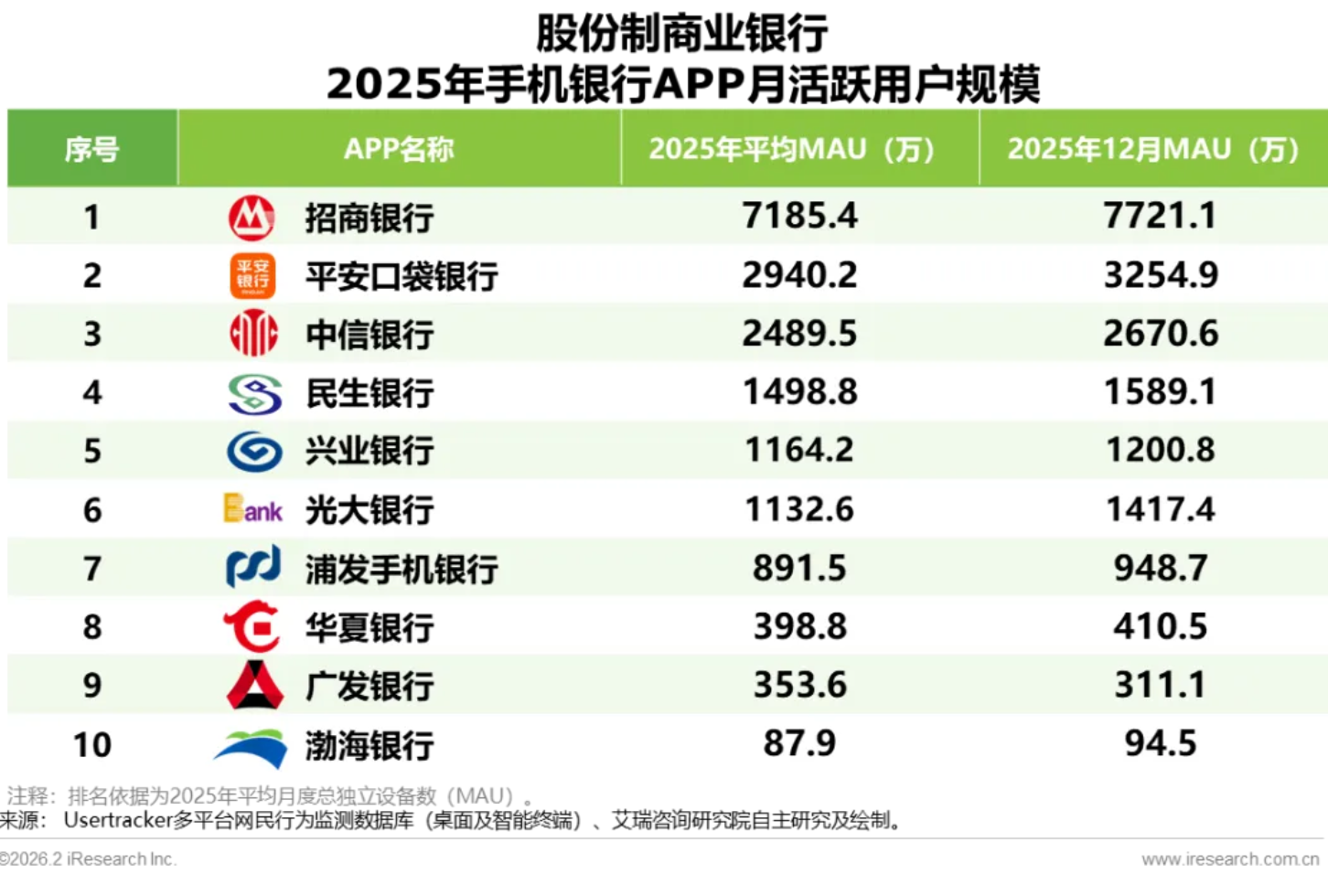
Core Insights - The Chinese mobile banking market is entering a stage of stock competition in 2025, with monthly active users (MAU) stabilizing between 648 million and 739 million [2] - State-owned commercial banks dominate the market due to their ecological embedding advantages, with Agricultural Bank of China leading at 249 million MAU, followed by Industrial and Commercial Bank of China (194 million) and China Construction Bank (109 million) [2] - Private banks are expected to collectively exit the top 50 MAU rankings in 2025 due to a lack of offline branch support and local living ecosystems [2] Group 1: Major Players - Agricultural Bank of China has the highest MAU at 249 million, followed by Industrial and Commercial Bank of China with 194 million and China Construction Bank with 109 million, forming the first tier of banks [2] - China Bank and Postal Savings Bank have MAUs exceeding 50 million, constituting the second tier [2] - China Merchants Bank leads the joint-stock banks with 71.85 million MAU, while Ping An Bank and CITIC Bank form the second tier, with other joint-stock banks generally below 20 million MAU [2] Group 2: Market Dynamics - The core advantage of state-owned banks lies in their "full-scenario integration" capabilities, embedding services deeply into high-frequency life scenarios such as government affairs, social security, healthcare, and education [2] - Agricultural Bank of China extends its services to rural areas through intelligent service matching and customer customization, while Industrial and Commercial Bank of China utilizes its "Gong Xiao Zhi" model for interactive service [2] - Regional banks like Jiangsu Bank, Beijing Bank, and Ningbo Bank show stable performance by focusing on local markets, with some rural commercial banks like Fujian Rural Credit exceeding 4.5 million MAU, indicating the sustainability of localized operations in the stock market [2]





2.7分钟定生死 手机银行存量厮杀谁在“断臂”,谁在“吃肉”?
Jing Ji Guan Cha Wang· 2026-02-18 04:57
Core Insights - The report by iResearch indicates that the monthly active users (MAU) of mobile banking apps in China have stabilized after fluctuating between 648 million and 739 million, signaling a ceiling in user growth and a shift from acquiring new users to enhancing existing user engagement [2] - User behavior is undergoing a structural reversal, with the effective daily usage time per device dropping from 4.9 minutes in 2023 to around 2.7 minutes by mid-2025, leading to a focus on high-frequency, short-duration, and functional usage [2] - Financial institutions are compelled to streamline operations and focus resources on core transaction scenarios to survive in this competitive landscape, where efficiency and precision are paramount [2] Mobile Banking Market Overview - The top three banks in terms of MAU are Agricultural Bank of China (2.49 billion), Industrial and Commercial Bank of China (1.94 billion), and China Construction Bank (1.09 billion), with all six major state-owned banks ranking in the top ten [3][5][6] - Private banks, represented by WeBank and MYbank, have faced significant setbacks, with many dropping out of the top 50 MAU rankings by 2025 [4] Competitive Landscape - State-owned banks are solidifying their dominance through extensive customer bases and integrated ecosystems, leveraging services embedded in high-frequency life scenarios such as government services and healthcare [7] - Joint-stock commercial banks are adopting a "specialized and precise" survival strategy, with China Merchants Bank leading among them with 71.85 million MAU, focusing on wealth management and intelligent interaction [8][10] - Regional banks are thriving by deeply engaging with local markets, while private banks struggle due to high customer acquisition costs and lack of local ecosystem support [13][14] Future Outlook - The mobile banking market is transitioning from a phase of scale expansion to one of value cultivation, with state-owned banks building moats through ecosystems, joint-stock banks seeking niches through specialization, and regional banks solidifying their local roots [14] - The ability to create irreplaceable value in a limited user engagement environment will be crucial, with technology applications such as AI reshaping service processes and enhancing risk management [15][16]

黄金跌了价,2026年2月16日,国内黄金新价格、人民币黄金新价格
Sou Hu Cai Jing· 2026-02-16 21:39
Group 1: Gold Market Prices - As of February 16, 2026, the domestic gold market shows a mixed trend with a real-time trading price of 1119 CNY per gram and a basic gold price set at 1125 CNY per gram [1] - The price range for jewelry brand gold products is between 1300-1579 CNY per gram, with major brands like Chow Tai Fook and Luk Fook uniformly priced at 1529 CNY per gram, while Lao Feng Xiang is slightly higher at 1548 CNY per gram [2] - The Shanghai Gold Exchange reports that the AuT D contract price is 1108.50 CNY per gram, down 1.47% from the previous day, and the Au9999 contract is at 1109.00 CNY per gram, with a decline of 1.20% [2] Group 2: Bank Gold Bar Pricing - Major banks are quoting investment gold bars in the range of 1121-1145 CNY per gram, with differences attributed to handling fees and brand premiums [4] - Among state-owned banks, Industrial and Commercial Bank of China is at 1143.43 CNY per gram, and China Construction Bank at 1141.30 CNY per gram, while joint-stock banks are slightly lower [5] - China Gold and Cai Bai Jewelry report prices of 1139 CNY per gram and 1137 CNY per gram respectively, while jewelry brands like Chow Tai Fook and Lao Feng Xiang have gold bar prices reaching 1342-1403 CNY per gram, exceeding bank channel prices [6] Group 3: Investment Case Studies - Investor Xue Di, with a strategy of gradual accumulation since 2023, turned an initial capital of 2.8 million CNY into over 5.6 million CNY by January 2026, emphasizing gold's value preservation [8] - In contrast, investor Shi Yue faced losses after buying at a high of 1200 CNY per gram, leading to an average cost of 1185.73 CNY per gram and a significant weekly loss [8] - Investor Tian Rui missed the opportunity to purchase gold at 553 CNY per gram in 2023, now facing much higher prices, highlighting the importance of timing in investment success [8] Group 4: Pricing Power Shift and Supply Variables - Since 2025, the pricing logic of gold has undergone structural changes, moving from a negative correlation with U.S. Treasury real interest rates to a new model influenced by global debt levels and central bank gold purchases [9] - In 2025, global gold demand reached a record high of 5002 tons, with central bank purchases of 863 tons stabilizing the market, indicating a shift in the pricing system towards a tripartite structure involving Asian demand, North American demand, and central bank purchases [9] - Supply dynamics are also changing, as seen in Ghana, where gold production reached a record 6 million ounces in 2025, with artisanal mining surpassing large commercial mines, indicating a surge in informal supply channels [10] Group 5: Consumer Awareness and Investment Strategies - Consumers are advised to be cautious of "one-price" gold products that may not clearly indicate weight, potentially leading to high per-gram prices upon resale [12] - For genuine investors, transparency is crucial, with institutions like China Construction Bank and Agricultural Bank of China offering gold bars at only a slight premium over market prices, making them preferable for risk-averse investments [12] - The strategic reserve demand from global central banks, alongside U.S. monetary policy expectations and geopolitical risk factors, supports high gold prices, emphasizing the distinction between jewelry and investment-grade gold [12]





最新21家系统重要性银行名单公布
Jing Ji Ri Bao· 2026-02-14 04:21
Group 1 - The People's Bank of China and the National Financial Regulatory Administration have conducted an assessment for the 2025 systemically important banks, identifying 21 domestic banks as systemically important, including 6 state-owned commercial banks, 10 joint-stock commercial banks, and 5 city commercial banks [1][3] - The list aims to establish a comprehensive macro-prudential management system and strengthen the regulation of systemically important financial institutions [2] Group 2 - Systemically important banks in China are categorized into five groups based on their importance scores, with the first group consisting of 11 banks, the second group having 4 banks, the third group with 2 banks, the fourth group containing 4 banks, and no banks in the fifth group [3] - The People's Bank of China plans to enhance the combined effect of macro-prudential management and micro-prudential regulation, continuing to solidify additional supervision for systemically important banks to promote their safe and sound operation and better serve the high-quality development of the real economy [3]




爱芯元智携手中信银行重庆分行,共推AI芯片赋能智慧金融
Cai Fu Zai Xian· 2026-02-14 02:06
Group 1 - Aixin YuanZhi Semiconductor Co., Ltd. has established a long-term strategic partnership with CITIC Bank Chongqing Branch to innovate AI applications in the financial sector, focusing on smart risk control and service optimization [1][2] - Aixin YuanZhi's self-developed mixed-precision NPU and multi-core AI processors offer high computing power, low power consumption, and strong perception, achieving large-scale applications in smart cities, intelligent transportation, and consumer electronics [1] - The company went public on the Hong Kong Stock Exchange on February 10, further solidifying its technical strength and market prospects, which supports its strategic collaboration with financial institutions [1] Group 2 - The collaboration between CITIC Bank Chongqing Branch and Aixin YuanZhi represents a deep exploration of building an "AI + finance" ecosystem, aiming to provide reliable and efficient intelligent solutions tailored to financial scenarios [2] - Both parties will form a joint project team to explore AI applications in inclusive finance, supply chain finance, and digital operations, creating a model for smart financial solutions in the industry [2] - The partnership is expected to enhance CITIC Bank's competitive edge in regional finance through the integration of cutting-edge AI technology, contributing to the acceleration of local economic development [2][3]
国内系统重要性银行名单发布 21家银行入选
Cai Jing Wang· 2026-02-14 02:03
Core Viewpoint - The People's Bank of China has conducted an assessment of systemically important banks for 2025, identifying 21 domestic banks categorized into five groups based on their systemic importance scores [1] Group 1: Assessment Overview - The assessment is part of a broader effort to establish a comprehensive macro-prudential management system and strengthen the regulation of systemically important financial institutions [1] - The evaluation was carried out in collaboration with the National Financial Regulatory Administration [1] Group 2: Classification of Banks - A total of 21 banks were recognized as systemically important, including 6 state-owned commercial banks, 10 joint-stock commercial banks, and 5 city commercial banks [1] - The banks are divided into five groups based on their systemic importance scores: - Group 1: 11 banks including China Minsheng Bank, China Everbright Bank, Ping An Bank, Huaxia Bank, Ningbo Bank, Jiangsu Bank, Beijing Bank, Nanjing Bank, Guangfa Bank, Zheshang Bank, and Shanghai Bank [1] - Group 2: 4 banks including Industrial Bank, China CITIC Bank, Shanghai Pudong Development Bank, and China Postal Savings Bank [1] - Group 3: 2 banks including Bank of Communications and China Merchants Bank [1] - Group 4: 4 banks including Industrial and Commercial Bank of China, Bank of China, China Construction Bank, and Agricultural Bank of China [1] - Group 5: No banks were classified in this group [1]

央行重要发布!名单公布
Sou Hu Cai Jing· 2026-02-14 01:14
Core Viewpoint - The People's Bank of China and the National Financial Regulatory Administration have conducted an assessment of systemically important banks for 2025, identifying 21 domestic banks categorized into five groups based on their systemic importance scores [1]. Group 1: Assessment of Systemically Important Banks - A total of 21 banks have been recognized as systemically important, including 6 state-owned commercial banks, 10 joint-stock commercial banks, and 5 city commercial banks [1]. - The banks are divided into five groups based on their systemic importance scores, with the first group containing 11 banks, the second group 4 banks, the third group 2 banks, the fourth group 4 banks, and the fifth group having no banks [1]. Group 2: Breakdown of Banks by Group - **First Group (11 banks)**: Includes China Minsheng Bank, China Everbright Bank, Ping An Bank, Huaxia Bank, Ningbo Bank, Jiangsu Bank, Beijing Bank, Nanjing Bank, Guangfa Bank, Zheshang Bank, and Shanghai Bank [1]. - **Second Group (4 banks)**: Includes Industrial Bank, China CITIC Bank, Shanghai Pudong Development Bank, and China Postal Savings Bank [1]. - **Third Group (2 banks)**: Includes Bank of Communications and China Merchants Bank [1]. - **Fourth Group (4 banks)**: Includes Industrial and Commercial Bank of China, Bank of China, China Construction Bank, and Agricultural Bank of China [1]. - **Fifth Group**: No banks are included in this group [1]. Group 3: Future Regulatory Actions - The People's Bank of China and the National Financial Regulatory Administration will implement additional regulatory measures for systemically important banks according to the "Regulations on Additional Supervision of Systemically Important Banks (Trial)" [1]. - The aim is to enhance the synergy between macro-prudential management and micro-prudential supervision, ensuring the safe and sound operation of systemically important banks and better supporting the high-quality development of the real economy [1].
我国系统重要性银行名单公布
新华网财经· 2026-02-14 01:10
Group 1 - The People's Bank of China and the National Financial Regulatory Administration have conducted an assessment for the 2025 systemically important banks, identifying 21 domestic banks, including 6 state-owned commercial banks, 10 joint-stock commercial banks, and 5 city commercial banks [3][4]. - The list aims to establish a comprehensive macro-prudential management system and strengthen the regulation of systemically important financial institutions [4]. - Systemically important banks are categorized into five groups based on their importance scores, with the first group including 11 banks such as China Minsheng Bank and China Everbright Bank, and the fourth group including major banks like Industrial and Commercial Bank of China and Bank of China [5]. Group 2 - The People's Bank of China and the National Financial Regulatory Administration will enhance the combined efforts of macro-prudential management and micro-prudential regulation to solidify additional supervision of systemically important banks, promoting their safe and sound operation to better serve the high-quality development of the real economy [5].

系统重要性银行名单出炉
Shang Hai Zheng Quan Bao· 2026-02-13 17:01
Core Viewpoint - The People's Bank of China has identified 21 domestic systemically important banks for the year 2025, aiming to enhance macro-prudential management and regulatory oversight of these institutions [1] Group 1: Identification of Systemically Important Banks - A total of 21 banks have been recognized as systemically important, including 6 state-owned commercial banks, 10 joint-stock commercial banks, and 5 city commercial banks [1] - The banks are categorized into five groups based on their systemic importance scores, with the first group containing 11 banks, the second group 4 banks, the third group 2 banks, the fourth group 4 banks, and the fifth group having no banks [1] Group 2: Breakdown of Bank Groups - Group 1 includes: China Minsheng Bank, China Everbright Bank, Ping An Bank, Huaxia Bank, Ningbo Bank, Jiangsu Bank, Beijing Bank, Nanjing Bank, Guangfa Bank, Zheshang Bank, and Shanghai Bank [1] - Group 2 consists of: Industrial Bank, China CITIC Bank, Shanghai Pudong Development Bank, and China Postal Savings Bank [1] - Group 3 includes: Bank of Communications and China Merchants Bank [1] - Group 4 comprises: Industrial and Commercial Bank of China, Bank of China, China Construction Bank, and Agricultural Bank of China [1] Group 3: Future Regulatory Actions - The People's Bank of China and the financial regulatory authority will implement additional regulatory measures as per the "Regulations on Additional Supervision of Systemically Important Banks (Trial)" to ensure the safe and sound operation of these banks [1] - The aim is to strengthen the macro-prudential management and micro-prudential regulatory synergy, promoting the healthy development of systemically important banks to better serve the high-quality development of the real economy [1]
21家系统重要性银行名单出炉!浙商银行新入选
Guang Zhou Ri Bao· 2026-02-13 15:09
Core Viewpoint - The People's Bank of China and the National Financial Regulatory Administration have published the list of systemically important banks for 2025, identifying 21 domestic banks, including 6 state-owned commercial banks, 10 joint-stock commercial banks, and 5 city commercial banks [1][2]. Group 1: Systemically Important Banks - The newly published list includes Zhejiang Commercial Bank as a new entrant among systemically important banks [1]. - The banks are categorized into five groups based on their systemic importance scores, with the first group containing 11 banks, the second group 4 banks, the third group 2 banks, the fourth group 4 banks, and the fifth group having no banks [1]. - The first group includes China Minsheng Bank, China Everbright Bank, Ping An Bank, Huaxia Bank, Ningbo Bank, Jiangsu Bank, Beijing Bank, Nanjing Bank, Guangfa Bank, Zhejiang Commercial Bank, and Shanghai Bank [1]. - The second group consists of Industrial Bank, China CITIC Bank, Shanghai Pudong Development Bank, and China Postal Savings Bank [1]. - The third group includes Bank of Communications and China Merchants Bank [1]. - The fourth group comprises Industrial and Commercial Bank of China, Bank of China, China Construction Bank, and Agricultural Bank of China [1]. - No banks are listed in the fifth group [1]. Group 2: Regulatory Measures - The People's Bank of China and the National Financial Regulatory Administration will implement additional regulatory measures for systemically important banks according to the "Regulations on Additional Supervision of Systemically Important Banks (Trial)" [2]. - The aim is to enhance macro-prudential management and micro-prudential supervision, ensuring the safe and sound operation of systemically important banks [2]. - This initiative is intended to better serve the high-quality development of the real economy [2].
