
AGRICULTURAL BANK OF CHINA(01288)

Search documents
农业银行(601288) - 农业银行关于董事变动的公告
2025-10-28 09:37
证券代码:601288 证券简称:农业银行 公告编号:临 2025-049 号 中国农业银行股份有限公司 关于董事变动的公告 中国农业银行股份有限公司董事会及全体董事保证本公告内容不存在任何虚假记 载、误导性陈述或者重大遗漏,并对其内容的真实性、准确性和完整性承担法律责任。 中国农业银行股份有限公司(以下简称"本行")收到《国家金 融监督管理总局关于王沛诗农业银行独立董事任职资格的批复》(金 复〔2025〕605 号)。根据相关规定及董事会决议,王沛诗女士担任 本行独立董事,以及董事会审计委员会委员、风险管理与消费者权益 保护委员会兼美国区域机构风险委员会委员、关联交易控制委员会委 员的任职已生效。 王沛诗女士的简历请参见本行 2025 年 6 月 7 日刊载于上海证券 交易所网站(www.sse.com.cn)的《中国农业银行股份有限公司 2024 年度股东大会会议资料》。 梁高美懿女士因任期届满不再担任本行独立董事,同时不再担任 董事会审计委员会委员、风险管理与消费者权益保护委员会兼美国区 域机构风险委员会委员、关联交易控制委员会主席及委员职务。 梁高美懿女士确认与本行董事会无不同意见,也没有就其离任需 ...
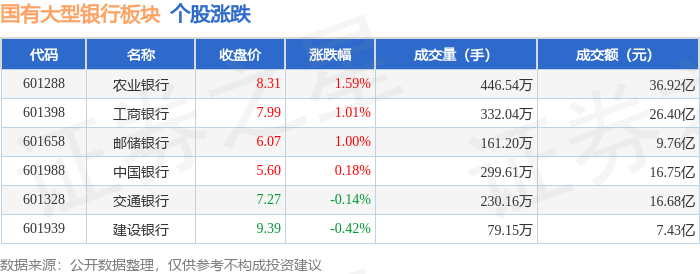
国有大型银行板块10月28日涨1.04%,农业银行领涨,主力资金净流出6180.68万元
Zheng Xing Xing Ye Ri Bao· 2025-10-28 08:40
Core Insights - The state-owned large bank sector saw an increase of 1.04% on October 28, with Agricultural Bank leading the gains [1] - The Shanghai Composite Index closed at 3988.22, down 0.22%, while the Shenzhen Component Index closed at 13430.1, down 0.44% [1] Bank Performance - Agricultural Bank (601288) closed at 8.31, up 1.59% with a trading volume of 4.4654 million shares and a transaction value of 3.692 billion [1] - Industrial and Commercial Bank (601398) closed at 7.99, up 1.01% with a trading volume of 3.3204 million shares [1] - Postal Savings Bank (601658) closed at 6.07, up 1.00% with a trading volume of 1.6120 million shares [1] - Bank of China (601988) closed at 5.60, up 0.18% with a trading volume of 2.9961 million shares [1] - Bank of Communications (601328) closed at 7.27, down 0.14% with a trading volume of 2.3016 million shares [1] - China Construction Bank (656109) closed at 9.39, down 0.42% with a trading volume of 791,500 shares [1] Fund Flow Analysis - The state-owned large bank sector experienced a net outflow of 61.8068 million from main funds, while speculative funds saw a net inflow of 248 million [1] - Retail investors had a net outflow of 187 million [1] - Agricultural Bank had a main fund net inflow of 127 million, while retail investors had a net outflow of 21.7 million [2] - Industrial and Commercial Bank had a main fund net inflow of 86.098 million, with a retail net outflow of 11.2 million [2] - Postal Savings Bank experienced a main fund net outflow of 63.7164 million, but had a retail net inflow of 23.7083 million [2] - Bank of China had a main fund net outflow of 48.2183 million, with a retail net inflow of 45.4291 million [2] - Bank of Communications had a significant main fund net outflow of 15.97 million, while retail investors had a net inflow of 88.9829 million [2]




农业银行再创历史新高 市值逼近3万亿元
Ge Long Hui· 2025-10-28 06:00
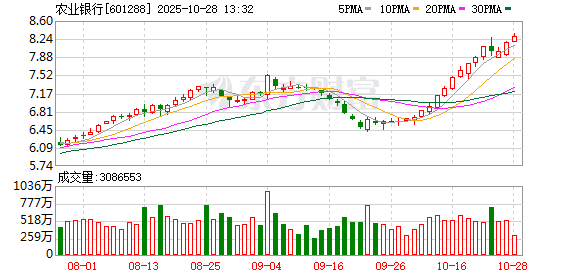
Core Viewpoint - Agricultural Bank of China (ABC) has seen its stock price rise significantly, reaching a historical high, with a market capitalization approaching 3 trillion yuan, reflecting strong investor confidence and performance in the A-share market [1] Group 1 - ABC's stock price increased by nearly 2%, reaching 8.34 yuan, marking a new historical high [1] - The bank's stock has accumulated a rise of over 62% year-to-date [1] - The market capitalization of ABC is nearing 3 trillion yuan [1]
农业银行涨近2%再创历史新高
Mei Ri Jing Ji Xin Wen· 2025-10-28 05:33
Group 1 - Agricultural Bank of China saw its stock price rise nearly 2% in the afternoon trading session on October 28, reaching a new historical high [2]
沪指突破4000点!银行股有力支撑
Zheng Quan Ri Bao Wang· 2025-10-28 04:51
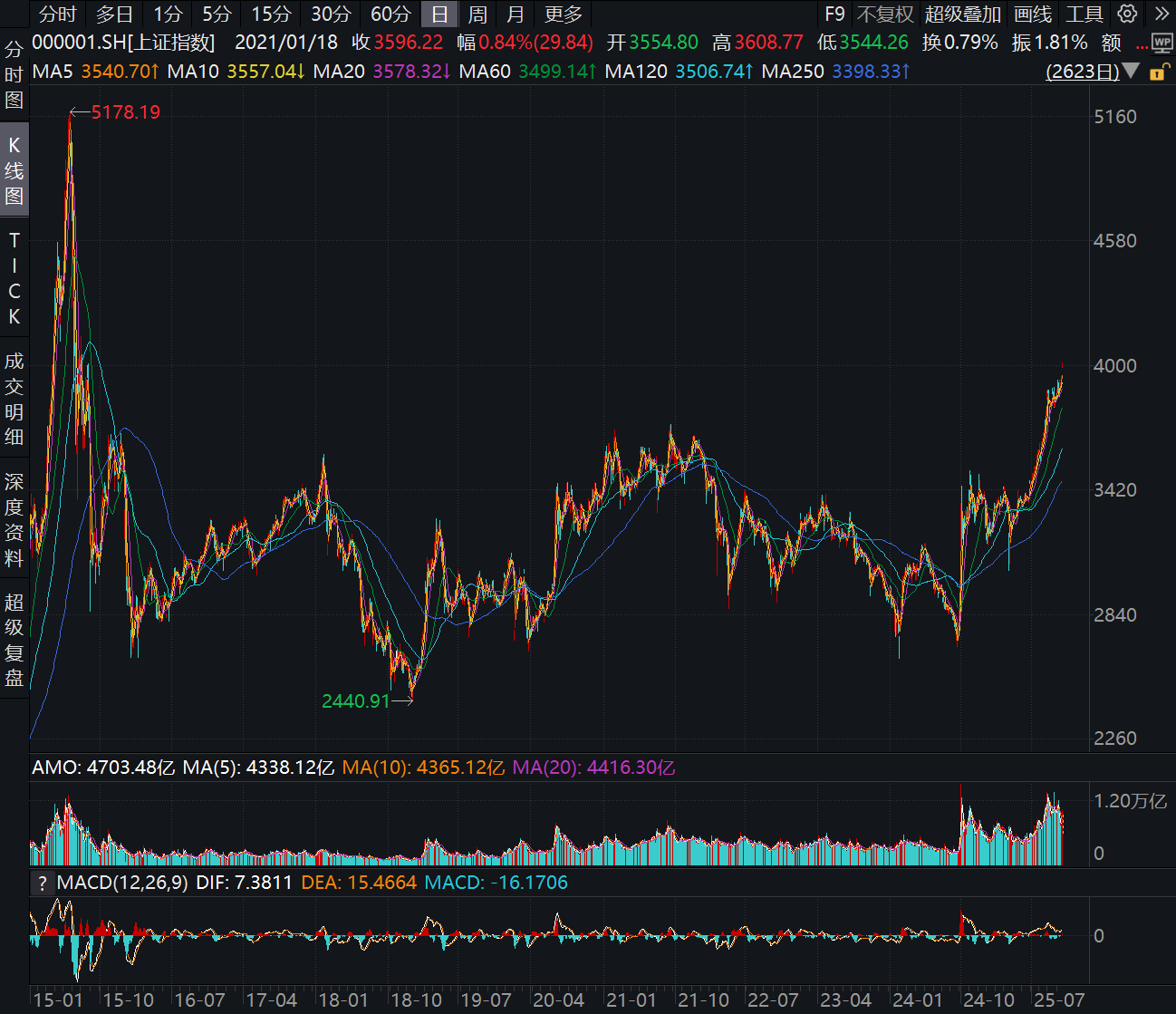
Core Viewpoint - The Shanghai Composite Index has surpassed the 4000-point mark for the first time since August 2015, with a year-to-date increase of over 19% [1]. Group 1: Market Performance - As of the midday close, the Shanghai Composite Index stood at 4005.44 points, reflecting a gain of 0.21%, with over 3000 stocks rising [1]. - Bank stocks, particularly Xiamen Bank, Postal Savings Bank, and Agricultural Bank, have significantly supported the index's strength [3]. - Agricultural Bank's stock price reached a new high, closing at 8.26 yuan per share, with a year-to-date increase exceeding 60% [3]. Group 2: Market Capitalization - The total market capitalization of Agricultural Bank is close to 2.9 trillion yuan, making it the largest by market cap in A-shares [3]. - The top three A-share market capitalizations are all bank stocks: Agricultural Bank (2.89 trillion yuan), Industrial and Commercial Bank (2.84 trillion yuan), and China Construction Bank (2.45 trillion yuan) [3]. Group 3: Regulatory Developments - Li Yunzhe, head of the National Financial Supervision Administration, emphasized the commitment to advancing financial development in line with China's unique path during the 2025 Financial Street Forum [3]. - Four major banks have established financial asset investment companies in Beijing, with Postal Savings Bank also in the process of setting up its own [3]. Group 4: Company Announcements - Postal Savings Bank announced the approval to establish a financial asset investment company, named China Postal Investment, with a registered capital of 10 billion yuan [4].

银行股走势分化
Di Yi Cai Jing· 2025-10-28 03:06
Core Viewpoint - Agricultural Bank of China has seen its stock price rise over 1%, reaching a historical high, with its market capitalization approaching 3 trillion yuan [1] Group 1: Company Performance - Agricultural Bank of China is leading the gains among major banks, with a notable increase in its stock price [1] - Postal Savings Bank and Industrial and Commercial Bank of China also experienced stock price increases, indicating a positive trend in the banking sector [1] - Shanghai Pudong Development Bank, in contrast, saw a decline in its stock price, dropping over 4% [1]
金融作笔 逐“绿”不辍
Jin Rong Shi Bao· 2025-10-28 02:08
Group 1: Green Finance Development - The People's Bank of China (PBOC) in Heyuan has been actively promoting green finance to support the local economy, with green loan balances expected to grow by 21.77% and 21.99% year-on-year by the end of 2023 and 2024 respectively [1] - As of mid-2023, the green loan balance in Heyuan reached 11.581 billion yuan, marking a year-on-year increase of 42.65%, significantly outpacing the overall loan growth rate by 40.99 percentage points [1] - The PBOC has established a comprehensive monitoring mechanism for green credit, implementing monthly monitoring, quarterly reporting, and annual evaluations to ensure banks fulfill their responsibilities in green development [3] Group 2: Renewable Energy Projects - A blueberry farm in Dongyuan County has integrated photovoltaic panels to generate over 100 million kilowatt-hours of clean energy annually, showcasing a successful model of combining agriculture with renewable energy [2] - The project has effectively reduced coal consumption and emissions of pollutants, while also alleviating local electricity shortages, supported by a loan of 138 million yuan from the PBOC [2] Group 3: Support for Traditional Industries - The PBOC is exploring financial solutions tailored to the needs of traditional industries undergoing low-carbon transitions, with several innovative green credit products being introduced [6] - A smart rice farm in Heyuan has benefited from the "Win-Win Plan + Transformation Finance" initiative, receiving a 5 million yuan credit line and a 1 million yuan low-carbon transformation loan to support sustainable agricultural practices [7] Group 4: Geographic Indication and Intellectual Property - The PBOC is focusing on geographic indications as a key area for enhancing financial support, establishing mechanisms for seamless project and funding connections with various government departments [5] - The establishment of "green branches" in local banks aims to support industries related to geographic indications, with loans of 167 million yuan and 4.469 million yuan allocated to specific agricultural products [4]
银行股走势分化,农业银行涨超1%再创历史新高
Mei Ri Jing Ji Xin Wen· 2025-10-28 02:07
Core Insights - The performance of bank stocks is showing divergence, with Agricultural Bank of China rising over 1% to reach a new historical high, approaching a total market value of 3 trillion yuan [1] - Postal Savings Bank and Industrial and Commercial Bank also saw gains, while Shanghai Pudong Development Bank experienced a significant drop of over 4% [1] Group 1 - Agricultural Bank of China has achieved a new historical high, with its market value nearing 3 trillion yuan [1] - Postal Savings Bank and Industrial and Commercial Bank are following the upward trend in bank stocks [1] - Shanghai Pudong Development Bank's stock has declined sharply, falling over 4% [1]
A股震荡走高,农业银行总市值逼近3万亿大关,中际旭创续创新高,国债大涨,人民币中间价创近一年高位
Hua Er Jie Jian Wen· 2025-10-28 02:04
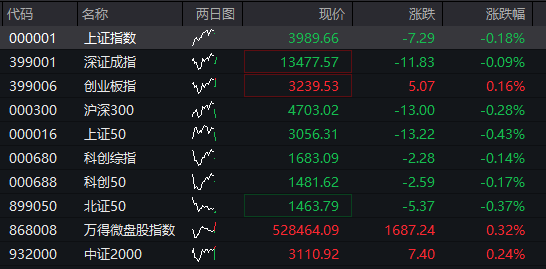
Market Overview - A-shares opened lower with the three major indices experiencing fluctuations and declines, particularly in technology stocks, storage chips, and copper-clad laminate concepts [1][12] - The Hang Seng Index opened higher but turned negative, with mixed performance in tech stocks and declines in Apple-related stocks [2][3] - The bond market saw a collective rebound in government bond futures, with the 30-year main contract rising by 0.56% [3][4] A-shares Performance - As of the report, the Shanghai Composite Index fell by 0.18% to 3989.66, while the Shenzhen Component Index decreased by 0.09% to 13477.57, and the ChiNext Index rose by 0.16% to 3239.53 [1][12] - The technology sector faced a general pullback, with significant declines in storage chips and copper-clad laminate concepts, and a notable drop of nearly 6% in Shenghong Technology post-earnings [12][13] Hong Kong Market Performance - The Hang Seng Index decreased by 0.30% to 26353.17, and the Hang Seng Tech Index fell by 0.42% to 6145.14 [2][3] - The performance of Chinese tech stocks was mixed, with some stocks like Xiaopeng Motors rising over 4% [16] Commodity Market - Domestic commodity futures mostly rose, with polysilicon and lithium carbonate increasing by over 2%, while other commodities like rapeseed, glass, and iron ore also saw gains [4][5] - Precious metals experienced declines, with gold and silver dropping over 2% [5][16] CPO Concept Stocks - CPO concept stocks showed a rebound, with Zhongji Xuchuang rising nearly 4% to reach a historical high, and Lian Te Technology increasing by over 10% [6][7] Banking Sector - The banking sector exhibited mixed trends, with Agricultural Bank of China rising over 1% to approach a market capitalization of 3 trillion, while other banks like Shanghai Pudong Development Bank fell over 4% [8][9] Robotics and Software Concepts - Robotics stocks surged, with Nanjing Julong increasing over 12%, while the domestic software sector saw stocks like Rongji Software hitting the daily limit [10][12]

百余家收粮大户获贷1.4亿元
Jin Rong Shi Bao· 2025-10-28 02:03
Core Insights - Agricultural Bank of China (ABC) has introduced a specialized loan product, "Grain Purchase Large Household Loan," to support grain purchase during the autumn harvest season, with a maximum credit limit of 5 million yuan, significantly higher than similar products from previous years [1][2] - The bank has implemented an efficient mechanism for loan approval, allowing for rapid response and processing, completing the loan approval and disbursement for a client in less than three days [1] - ABC has already disbursed over 140 million yuan in loans to more than 100 grain purchasing households in the Handan region, ensuring timely financial support for the autumn grain collection [2] Group 1 - The loan product "Grain Purchase Large Household Loan" has a maximum credit limit of 5 million yuan, which is a significant increase compared to previous years [1] - The bank has established a "frontline investigation + backend approval" mechanism to enhance efficiency in loan processing [1] - The rapid response mechanism allows for same-day investigation and approval, facilitating quick access to funds for farmers [1] Group 2 - The timely financial support has enabled farmers to invest in necessary equipment, such as drying machines, improving their operational efficiency [2] - The bank's financial services are crucial for mitigating risks associated with adverse weather conditions affecting the autumn harvest [1][2] - The successful disbursement of loans reflects the bank's commitment to supporting local agricultural development and ensuring food security [2]