HUA HONG SEMI(01347)

Search documents
智通港股通资金流向统计(T+2)|11月21日





智通财经网· 2025-11-20 23:36
Key Points - The top three companies with net inflows of southbound funds are Alibaba-W (09988) with 3.296 billion, XPeng Motors-W (09868) with 1.147 billion, and Xiaomi Group-W (01810) with 0.853 billion [1][2] - The top three companies with net outflows of southbound funds are Yingfu Fund (02800) with -0.559 billion, China Life (02628) with -0.427 billion, and China National Offshore Oil Corporation (00883) with -0.368 billion [1][2] - In terms of net inflow ratio, ICBC South China (03167) leads with 100.00%, followed by Xiaocai Garden (00999) with 74.08%, and Qingdao Bank (03866) with 67.42% [1][3] - The companies with the highest net outflow ratios include Q Tech (01478) at -58.31%, China National Heavy Duty Truck Group (03808) at -53.04%, and Nexperia (01316) at -43.99% [1][4] Net Inflow Rankings - Alibaba-W (09988) had a net inflow of 3.296 billion, representing a 20.59% increase in its closing price to 154.600 [2] - XPeng Motors-W (09868) saw a net inflow of 1.147 billion, with a 25.58% increase in its closing price to 85.950 [2] - Xiaomi Group-W (01810) experienced a net inflow of 0.853 billion, with a 9.75% increase in its closing price to 40.780 [2] Net Outflow Rankings - Yingfu Fund (02800) had a net outflow of -0.559 billion, with a -4.24% change in its closing price to 26.060 [2] - China Life (02628) experienced a net outflow of -0.427 billion, with a -23.81% change in its closing price to 26.140 [2] - China National Offshore Oil Corporation (00883) had a net outflow of -0.368 billion, with a -14.88% change in its closing price to 21.800 [2]
智通港股通活跃成交|11月20日
智通财经网· 2025-11-20 11:08
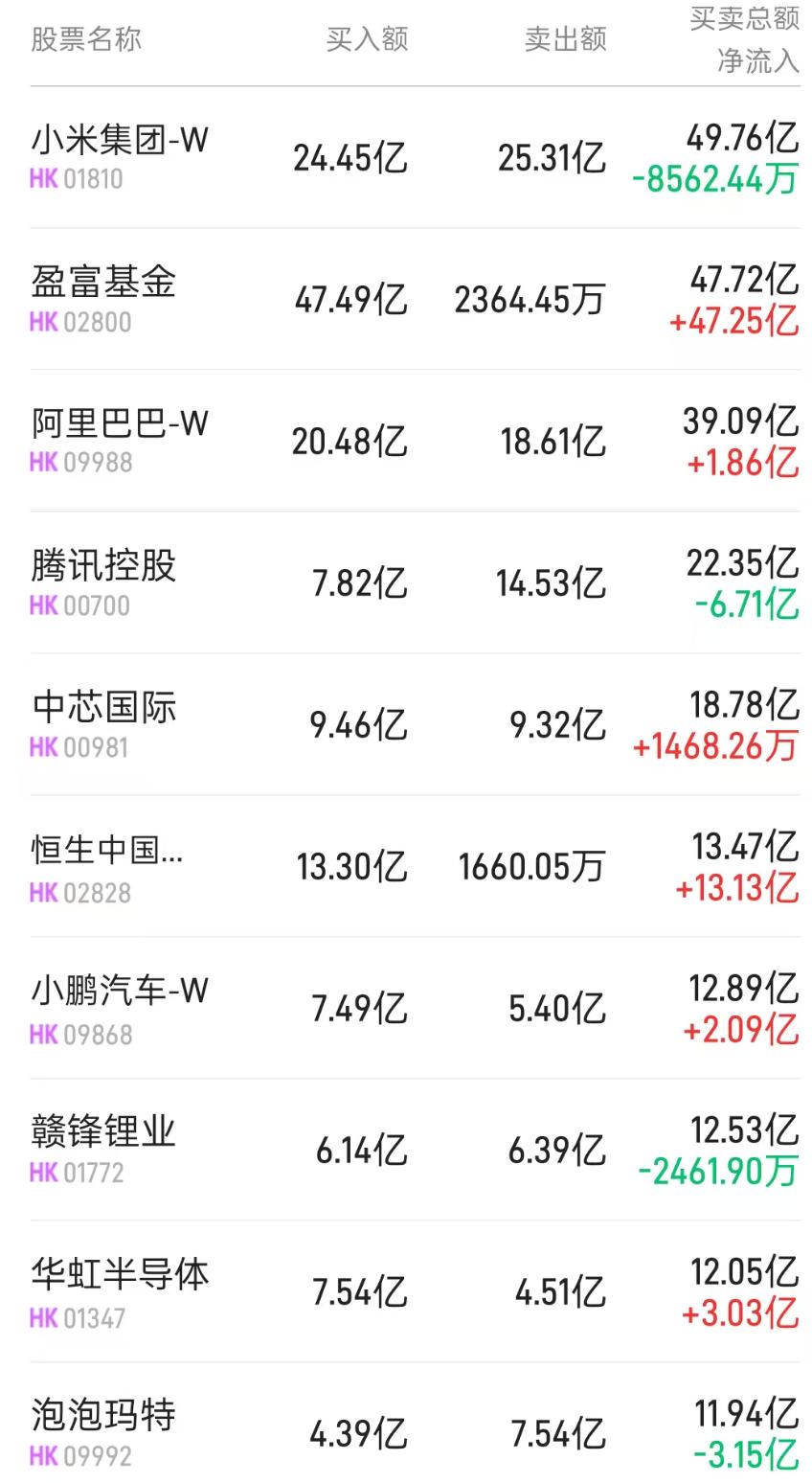
深港通(南向)十大活跃成交公司 | 公司名称 | 成交金额 | 净买入额 | | --- | --- | --- | | 小米集团-W(01810) | 33.45 亿元 | -5.20 亿元 | | 盈富基金(02800) | 27.09 亿元 | +26.95 亿元 | | 阿里巴巴-W(09988) | 26.28 亿元 | +8.81 亿元 | | 腾讯控股(00700) | 18.13 亿元 | +7.55 亿元 | | 中芯国际(00981) | 15.23 亿元 | -3364.83 万元 | | 南方恒生科技(03033) | 9.69 亿元 | +8.88 亿元 | | 小鹏汽车-W(09868) | 6.81 亿元 | +2.30 亿元 | | 华虹半导体(01347) | 6.40 亿元 | -614.67 万元 | | 恒生中国企业(02828) | 6.35 亿元 | +6.00 亿元 | | 赣锋锂业(01772) | 6.12 亿元 | -2587.36 万元 | 2025年11月20日当天,小米集团-W(01810)、盈富基金(02800)、阿里巴巴-W(09988)位居沪港通 ...





北水动向|北水成交净买入159.92亿 北水大举加仓港股ETF 全天抢筹盈富基金(02800)超74亿港元
智通财经网· 2025-11-20 09:58
Group 1: Market Overview - Northbound capital net bought 15.992 billion HKD in the Hong Kong stock market on November 20, with net purchases of 7.808 billion HKD through the Shanghai-Hong Kong Stock Connect and 8.184 billion HKD through the Shenzhen-Hong Kong Stock Connect [1] - The most net bought stocks include the Tracker Fund of Hong Kong (02800), Hang Seng China Enterprises (02828), and Alibaba-W (09988) [1] Group 2: Stock Performance - Xiaomi Group-W had a net inflow of 4.976 billion HKD, with a buy amount of 2.445 billion HKD and a sell amount of 2.531 billion HKD [2] - Alibaba-W received a net purchase of 1.067 billion HKD, with the launch of its AI assistant app, Qianwen, aimed at enhancing its AI application layout [5] - Tencent Holdings had a net inflow of 8.39 billion HKD, supported by better-than-expected Q3 results and a strong AI growth strategy [6] Group 3: Sector Insights - The semiconductor sector showed divergence, with Hua Hong Semiconductor (01347) receiving a net inflow of 2.97 billion HKD, while SMIC (00981) faced a net outflow of 189.6 million HKD [5] - Ganfeng Lithium (01772) experienced a net outflow of 504.9 million HKD, with a downgrade from Daiwa, citing an expected oversupply in the lithium market [6]

华虹公司预计闪存业务在未来几个季度有强劲增长,科创半导体ETF(588170)整固蓄势
Mei Ri Jing Ji Xin Wen· 2025-11-20 03:59
Group 1 - The Shanghai Stock Exchange Sci-Tech Innovation Board semiconductor materials and equipment theme index decreased by 1.60%, with component stocks showing mixed performance [2] - Tianyue Advanced led the gains with an increase of 7.35%, while ShenGong Co. experienced the largest decline at 4.89% [2] - The Sci-Tech Semiconductor ETF (588170) fell by 1.69%, with a latest price of 1.39 yuan and a turnover rate of 7.5%, amounting to a transaction volume of 246 million yuan [2] Group 2 - The Sci-Tech Semiconductor ETF (588170) saw a significant growth of 2.885 billion yuan over the past three months [3] - Huahong Company reported strong performance in its flash memory business, with a growth rate in Q3 exceeding the overall market, attributed to the ramp-up of 55nm NORFLASH and MCU production [3] - The storage industry has entered an accelerated upward cycle since Q3 2025, driven by explosive demand from the AI era, leading to a sustained supply-demand gap and rising prices [3] Group 3 - The Sci-Tech Semiconductor ETF (588170) and its linked funds track the Shanghai Stock Exchange Sci-Tech Innovation Board semiconductor materials and equipment theme index, focusing on semiconductor equipment (61%) and materials (23%) [4] - The semiconductor equipment and materials industry is a key area for domestic substitution, benefiting from low domestic replacement rates and high ceilings for domestic alternatives [4] - The semiconductor materials ETF (562590) also emphasizes the upstream semiconductor sector, with significant representation from semiconductor equipment (61%) and materials (21%) [4]
港股开评:恒生科技指数涨0.7% 华虹半导体、百度涨超3%
Zheng Quan Shi Bao· 2025-11-20 01:55
Group 1 - The Hang Seng Index opened with a gain of 0.65% [1] - The Hang Seng Tech Index increased by 0.7% [1] - Hua Hong Semiconductor and Baidu both rose over 3% [1] - Kingsoft experienced a decline of over 2% [1]

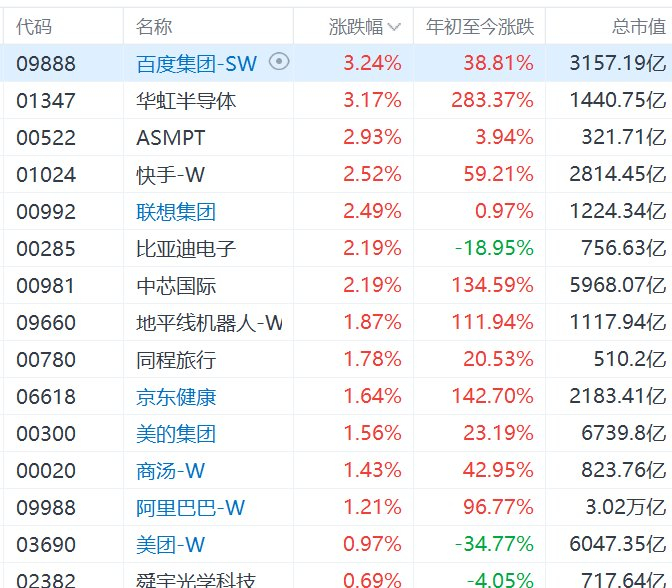
港股科技股普涨:百度、华虹半导体高开超3%




Ge Long Hui A P P· 2025-11-20 01:45
Core Viewpoint - The Hong Kong technology stocks experienced a broad rally, with the Hang Seng Technology Index opening up by 0.7% on November 20, 2023 [1] Group 1: Stock Performance - Baidu Group (SW) saw an increase of 3.24%, with a year-to-date gain of 38.81% and a total market capitalization of 315.72 billion [2] - Hua Hong Semiconductor rose by 3.17%, marking a significant year-to-date increase of 283.37%, with a market cap of 144.08 billion [2] - ASMPT increased by 2.93%, with a year-to-date gain of 3.94% and a market cap of 32.17 billion [2] - Kuaishou (W) rose by 2.52%, with a year-to-date increase of 59.21% and a market cap of 281.44 billion [2] - Lenovo Group increased by 2.49%, with a year-to-date gain of 0.97% and a market cap of 122.43 billion [2] - BYD Electronics rose by 2.19%, but has a year-to-date decline of 18.95%, with a market cap of 75.66 billion [2] - SMIC (中芯国际) increased by 2.19%, with a year-to-date gain of 134.59% and a market cap of 596.81 billion [2] - Horizon Robotics (W) saw an increase of 1.87%, with a year-to-date gain of 111.94% and a market cap of 111.79 billion [2] - Tongcheng Travel rose by 1.78%, with a year-to-date increase of 20.53% and a market cap of 51.02 billion [2] - JD Health increased by 1.64%, with a year-to-date gain of 142.70% and a market cap of 218.34 billion [2] - Midea Group rose by 1.56%, with a year-to-date increase of 23.19% and a market cap of 673.98 billion [2] - SenseTime (W) increased by 1.43%, with a year-to-date gain of 42.95% and a market cap of 82.38 billion [2] - Alibaba (W) rose by 1.21%, with a year-to-date increase of 96.77% and a market cap of 3 trillion [2] - Meituan (W) saw a smaller increase of 0.97%, with a year-to-date decline of 34.77% and a market cap of 604.73 billion [2]
两个月回撤超15%!恒科指数长期逻辑不改,市场关注AI落地效果
Zheng Quan Shi Bao· 2025-11-19 23:48
Core Viewpoint - Since 2025, the Hong Kong stock market, led by technology and innovative pharmaceuticals, has experienced a bull market, with the Hang Seng Index rising over 30% and the Hang Seng Tech Index exceeding 50%. However, since October, the Hang Seng Tech Index has seen a significant pullback of over 15% in less than two months, with a recent streak of four consecutive declines. Analysts believe that this short-term adjustment does not alter the long-term investment logic for leading tech stocks in Hong Kong, especially with the gradual implementation of AI technologies by companies like Tencent and Alibaba, which is expected to drive a second growth phase for internet enterprises. The long-term investment value of the Hang Seng Tech Index remains promising due to valuation advantages, funding support, and AI-driven industrial upgrades [1][3][4]. Group 1: Market Performance - Before October, Hong Kong tech stocks were performing well, with 9 out of 30 constituents of the Hang Seng Tech Index rising over 100%, and the top performer, Hua Hong Semiconductor, increasing nearly 270%. Other notable stocks like Tencent, Baidu, and Xiaomi also saw gains exceeding 50%, while only Meituan and Haier Smart Home experienced declines, with Meituan dropping over 30% [1][2]. - After October, the situation changed dramatically, with only 4 stocks rising, while 7 stocks fell over 20%, including Li Auto and Sunny Optical Technology, which both dropped over 27%. Tencent and Meituan also saw declines of around 5% [2]. Group 2: Fund Flows and Market Sentiment - There has been a noticeable outflow of southbound funds from certain Hang Seng Tech constituents, with Alibaba experiencing the highest net sell-off of 2.5 billion HKD, followed by Li Auto and Sunny Optical Technology with net sell-offs of 1.2 billion HKD and several hundred million HKD, respectively [2]. - The recent downturn in the Hang Seng Tech Index is attributed to three main factors: excessive prior gains leading to profit-taking, the U.S. imposing tariffs and tightening software export controls, and a mini-crash in U.S. AI stocks resulting in a significant drop in global tech risk appetite [2][3]. Group 3: Long-term Investment Logic - Despite short-term volatility, the long-term investment logic for the Hang Seng Tech Index remains intact, as it comprises internet giants and companies in semiconductors and electric vehicles that are considered scarce assets for both domestic and global investors [3][4]. - Analysts suggest that the current valuation of the Hang Seng Index and Hang Seng Tech Index is still significantly lower than their peaks in 2021, indicating potential for recovery and growth in the coming years [3]. Group 4: AI and Market Revaluation - The market is increasingly focused on the tangible effects of AI implementation, moving from a narrative-driven approach to one that emphasizes financial performance. Companies like Tencent and Alibaba are seeing revenue growth attributed to AI applications, with Tencent reporting a 15% year-on-year revenue increase and Alibaba planning substantial investments in AI and cloud infrastructure [5][6]. - The structural revaluation driven by AI and robotics is expected to benefit comprehensive platforms like Tencent, Alibaba, and Baidu, while smaller companies lacking their own ecosystems may face marginalization during the global de-bubble process [6].
成交额跌破900亿创近半年新低 短线继续流入阿里和小米
Xin Lang Cai Jing· 2025-11-19 11:23
Core Viewpoint - Southbound capital transactions today amounted to approximately HKD 839.46 billion, marking a decrease of about HKD 144 billion from the previous day, the lowest level since May 29, accounting for 39.71% of the total turnover of the Hang Seng Index, which fell further today [2] Group 1: Southbound Capital Flow - Southbound capital recorded a net buy of approximately HKD 65.91 billion today, with net inflows from the Shanghai-Hong Kong Stock Connect at about HKD 24.89 billion and from the Shenzhen-Hong Kong Stock Connect at about HKD 41.01 billion [2] - Over the past month, the total southbound capital flow reached approximately HKD 1,322.25 billion, with HKD 648.54 billion from the Shanghai-Hong Kong Stock Connect and HKD 673.71 billion from the Shenzhen-Hong Kong Stock Connect [5] Group 2: Individual Stock Performance - Xiaomi Group-W (01810.HK) saw a significant net buy of HKD 23.94 billion, despite a drop of 4.81% today, with short-term funds increasing their holdings by 95.87 million shares over the past five days [3][4] - Alibaba-W (09988.HK) experienced a net buy of HKD 20.96 billion and a price increase of 1.16%, although short-term funds have reduced their holdings by 12.02 million shares in the last five days [3][4] - China National Offshore Oil Corporation (00883.HK) had a net buy of HKD 2.53 billion and a price increase of 1.19%, with short-term funds increasing their holdings by 4.23 million shares over the past five days [3][4] - Tencent Holdings (0700.HK) faced a net outflow of HKD 1.04 billion, with a slight price decrease of 0.16%, while short-term funds increased their holdings by 1.52 million shares [3][4] - Pop Mart International (09992.HK) saw a net outflow of HKD 0.60 billion and a price drop of 2.27%, with short-term funds increasing their holdings by 5.40 million shares [3][4]



华虹公司:明年或后年将推出40nm NOR FLASH产品
Ge Long Hui A P P· 2025-11-19 08:55
Core Viewpoint - The company reported strong growth in its NOR FLASH storage business, which is a segment of the overall flash memory market, outpacing the market growth in the third quarter [1] Company Performance - The company noted that its third-quarter growth rate in the NOR FLASH segment is significantly higher than the overall market, attributed to its own advancements [1] - The 55nm NOR FLASH has entered mass production in recent quarters, contributing to the company's performance [1] - The 55nm MCU is also entering mass production, further enhancing the company's growth prospects [1] Future Outlook - The company plans to launch 40nm products in the next year or two, which is expected to provide an additional growth impetus [1]
美股AI巨震,瑞银:是时候将目光投向中国了!“港股芯片”估值吸引力亮眼
Xin Lang Ji Jin· 2025-11-19 02:53
Group 1 - The core concern is the increasing worries about an "AI bubble" leading to significant sell-offs in US tech stocks, with debates on whether AI has driven the market to a bubble state [1] - Pessimists argue that high valuations prompt a tendency to cash out, while optimists, including management from AMD and Nvidia, assert that the demand for AI data centers is real and growing rapidly, distinguishing it from the 2000 internet bubble [1] - UBS Global Wealth Management's Jason Draho suggests that the Chinese tech sector offers an attractive way to balance US tech stock holdings due to the high valuations in the US market [1] Group 2 - Many large Chinese tech companies are valued at only one-third to half of their US counterparts, yet they are launching competitive AI products [1] - The Chinese tech sector, particularly the Hong Kong market, is attracting investors due to its valuation advantages, with the Hong Kong tech index showing a PE ratio around 40% over the past three years, significantly lower than the NASDAQ [1] Group 3 - The first ETF focusing on the Hong Kong chip industry has been launched, comprising 70% hardware and 30% software, and includes 42 Hong Kong tech companies, with significant weights in companies like SMIC and Xiaomi [4] - The ETF aims to capture the potential of the Hong Kong AI hard tech market, excluding large internet firms like Alibaba and Tencent for a sharper focus [4] Group 4 - The ongoing trend of domestic AI chip localization is seen as a long-term necessity, with current conditions viewed as optimal for the development of domestic chips [4] - The ETF tracking the Hong Kong tech index is designed to adapt to market fluctuations, with individual stock weights adjusted semi-annually [5]