PING AN OF CHINA(02318)

Search documents
平安御享分红系列产品荣膺“年度领航保险产品案例”
2 1 Shi Ji Jing Ji Bao Dao· 2025-11-26 03:56
Core Viewpoint - Ping An Life has been recognized for its high-quality development and innovative insurance products, winning two prestigious awards at the 21st Century Financial Annual Conference, highlighting its industry-leading position [1] Group 1: High-Quality Development Achievements - Ping An Life emphasizes high-quality development as a core value, with significant progress in multi-channel reforms and the "insurance + service" model [2] - In the first three quarters of 2025, the new business value for life and health insurance reached 35.724 billion yuan, a year-on-year increase of 46.2%, indicating strong growth momentum [2] - The agent channel saw a 23.3% year-on-year increase in new business value, while the per capita new business value grew by 29.9%, reflecting improvements in team quality and productivity [2] Group 2: Product and Service System Upgrade - The upgrade of the "product + service" system is a highlight of Ping An Life's operations in 2025, leveraging the medical and elderly care ecosystem of Ping An Group [3] - Over 16 million customers have accessed health management services, and home care services have reached 85 cities, with nearly 240,000 customers qualifying for home care [3] - The "Enjoy Ping An" customer rights system has been launched, providing nearly 100 benefits across four major scenarios, serving over 2 million customers [3] Group 3: Investment Strength and Leading Products - The "Yu Xiang Jin Yue" series of participating insurance products has been recognized as the "Annual Leading Insurance Product," designed to meet customer needs for wealth protection and growth [4] - Participating insurance has become a mainstream product in the industry, with over 80% of currently sold life insurance products being participating types [4] - Ping An Life has over 25 years of experience in operating participating insurance, supported by a "Five Good" investment system to provide competitive returns [4] Group 4: Customer-Centric Product Design - The participating insurance products also feature designs such as dual insured parties and flexible withdrawal options, addressing customer needs for managing life risks [5] - The "21st Century Financial Competitiveness Excellent Case" awards are evaluated by experts to identify outstanding examples that can drive healthy and high-quality development in the financial industry [5]

“人工智能+”引领保险业加速转型
Jin Rong Shi Bao· 2025-11-26 02:01
Core Insights - The article emphasizes the transformative impact of the "Artificial Intelligence +" initiative on the insurance industry, highlighting its role as a core driver for the sector's transition from traditional services to intelligent and inclusive solutions [2][3][4] - The integration of AI into actuarial practices is identified as a key area for enhancing operational efficiency and decision-making capabilities within insurance companies [4][6] Policy and Strategic Framework - The "Artificial Intelligence +" initiative was first included in the government work report in March 2024, with a commitment to further integrate digital technologies with market advantages by 2025 [2] - The State Council's recent opinions on implementing the "Artificial Intelligence +" initiative emphasize the importance of innovation in service industries and the application of AI across various sectors, including finance and logistics [2] Industry Adoption and Innovation - Insurance companies are increasingly moving from isolated AI applications to comprehensive integration across their operations, as seen in the case of Guomin Pension Insurance, which aims to reshape its entire value chain using AI [3][6] - China Ping An has focused on AI applications in the healthcare and pension sectors, developing a unique competitive edge through its "Five Intelligence" strategy, which encompasses marketing, service, operations, management, and business practices [3] Actuarial Technology Revolution - The article discusses a significant shift in actuarial technology, driven by AI, which enhances the accuracy and reliability of actuarial assumptions critical for pricing and risk management [4][5] - The application of AI in actuarial practices is expected to lead to more precise pricing and improved risk quantification, ultimately benefiting customer interests [6] Data Governance Challenges - The insurance industry faces challenges in data governance, including insufficient data integration and standardization, which hinder the effective use of AI [7][8] - Experts suggest that enhancing data governance is essential for the successful integration of AI in insurance, advocating for improved data quality control and security measures [7][8] Future Directions - The article highlights the need for insurance companies to strengthen their data governance frameworks, ensuring comprehensive data management and security to support AI initiatives [8][9] - The establishment of clear data security responsibilities and guidelines is crucial for protecting sensitive customer information and facilitating the effective use of AI technologies [9]

险企竞逐“浮动收益”新赛道
Jin Rong Shi Bao· 2025-11-26 02:01
Core Insights - The insurance industry is witnessing a surge in the launch of new dividend insurance products, with major companies like China Life, Ping An Life, and Xinhua Insurance leading the way in this transformation towards dividend-based offerings [1][2][3] Product Launch Trends - Dividend insurance products have become the dominant category, with 65 out of 136 life insurance products being dividend-based, accounting for approximately 48% [2] - Major companies are actively introducing new dividend insurance products, such as Xinhua Insurance's "Shengshi Glory Celebration Edition" and Ping An Life's "Ping An Yuxiang Jin Yue" [2][3] Strategic Shifts - Companies are undergoing significant strategic transformations, with Xinhua Insurance reporting a 49.2% year-on-year increase in first-year premium income from individual channels for long-term insurance [3] - China Life and other insurers are also seeing substantial increases in the proportion of floating income products in their premium income [3] Market Dynamics - The shift towards dividend insurance is driven by multiple factors, including a declining interest rate environment, which has made dividend products more attractive compared to traditional fixed-rate products [4] - Regulatory policies are also encouraging the development of floating income insurance products, providing a clearer direction for innovation in the industry [4] Competitive Landscape - The success of dividend insurance hinges on insurers' investment capabilities, as the distribution of dividends is directly linked to investment returns [5] - Insurers face challenges in upgrading their sales models to meet the complexities of dividend products, requiring a shift from simple product sales to providing comprehensive asset allocation advice [5] Ecosystem Development - Insurers are exploring innovative "product + service" models to differentiate themselves in a competitive market, integrating health and wellness services with insurance offerings [7][8] - Companies like Ping An Life and Taikang Life are developing comprehensive service ecosystems that combine insurance with health management and elderly care services [7][8]


智通ADR统计 | 11月26日
智通财经网· 2025-11-25 22:22
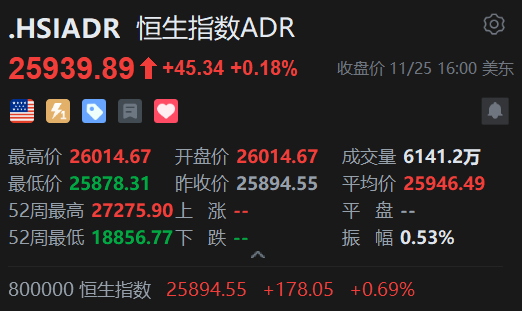
Core Viewpoint - The Hang Seng Index (HSI) showed a slight increase, closing at 25,939.89, up by 0.18% from the previous day, indicating a mixed performance among large-cap stocks in the Hong Kong market [1]. Group 1: Market Performance - The HSI closed at 25,939.89, with a daily increase of 45.34 points or 0.18% [1]. - The highest price during the day was 26,014.67, while the lowest was 25,878.31, resulting in a trading range of 0.53% [1]. - The average price for the day was 25,946.49, with a trading volume of 61.41 million shares [1]. Group 2: Individual Stock Performance - HSBC Holdings closed at 108.109 HKD, up by 1.23% compared to the previous close [2]. - Tencent Holdings closed at 622.043 HKD, down by 0.47% from the previous close [2]. - Alibaba Group's stock price increased by 2.14% to 157.800 HKD, while its ADR price was 152.624, reflecting a decrease of 3.28% [3]. - Other notable performances include Meituan, which rose by 0.10% to 98.250 HKD, and BYD, which increased by 0.95% to 95.750 HKD [3].






政策东风遇上生态先行,中国平安“银发产业”拔头筹
Ge Long Hui· 2025-11-25 11:12
Core Viewpoint - The insurance sector in Hong Kong and A-shares is experiencing significant activity, with the A-share insurance index rising over 2%, indicating sustained market interest in the insurance sector [1] Group 1: Market Dynamics - The insurance sector has recently benefited from multiple positive factors, including over 2 billion CNY net inflow into the securities insurance ETF since November, reflecting increased institutional investment interest [2] - Recent reports suggest that insurance companies are preparing for the 2026 "opening red" period, with positive outlooks on new orders and value rates, supported by stable long-term interest rates [2] - Policy developments in the pension finance sector are driving market momentum, particularly the integration of Guangdong's pension finance policies with China Ping An's comprehensive financial and medical pension strategy [2][4] Group 2: Policy Impact - Guangdong's pension finance policy includes 15 measures aimed at enhancing the financial supply system, optimizing product offerings, and activating industrial capital, marking a significant step in addressing the challenges of an aging population [4] - The policy framework aims for a well-established pension finance supply system by 2028, with a focus on replicable models in key cities [4] - The policy encourages the establishment of a "white list" and "project library" to guide insurance funds into the pension sector, with significant investments already made by insurance companies in various pension facilities [5] Group 3: Company Positioning - China Ping An, as the first professional pension insurance company in China, holds a unique market position with substantial asset management capabilities, managing 855.793 billion CNY in enterprise annuity assets by the end of 2024 [8] - The company has accumulated extensive experience in policy alignment, allowing it to quickly capitalize on policy opportunities in the pension finance sector [8] - Ping An's integrated service model combines insurance with healthcare and home care, creating a comprehensive ecosystem that enhances customer loyalty and competitive advantage [9] Group 4: Strategic Developments - Ping An has developed a full-scenario ecosystem covering high-end care, home care, and cross-border services, showcasing a differentiated competitive advantage [11] - The company has launched high-end care communities in major cities and partnered with international brands to enhance service offerings and attract high-net-worth clients [11] - Ping An's home care services have reached 85 cities, serving nearly 240,000 clients, effectively tapping into the largest segment of the pension market [12] Group 5: Future Outlook - The aging population in China presents a significant opportunity for the pension finance market, with projections indicating that the population aged 60 and above will exceed 310 million by 2024 [15] - Ping An is positioned to benefit from policy incentives and its strategic capabilities, making it a leading player in the pension finance sector [15] - The company's comprehensive financial licenses, healthcare resources, and technological capabilities enable it to leverage the pension finance transformation effectively [15]
人形机器人如何“放心用”?头部险企接连推专属产品,尚需跨越三大核心障碍
Mei Ri Jing Ji Xin Wen· 2025-11-25 11:08
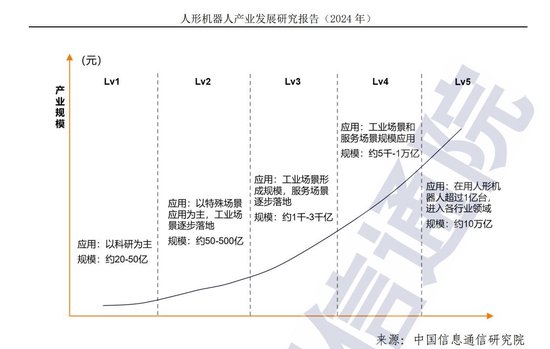
Core Viewpoint - The rapid advancement of artificial intelligence has led to a pressing need for humanoid robots, which are transitioning from laboratory demonstrations to commercial applications, indicating a new phase in industry development [1][3]. Industry Overview - The humanoid robot market in China is projected to reach a scale of 100 billion RMB by 2035, driven by applications in manufacturing, social services, and special operations [1][9]. - The insurance industry is responding to the emerging risks associated with humanoid robots by developing specialized insurance products to cover various dimensions such as property loss, third-party liability, cybersecurity, and data breaches [1][2]. Insurance Product Development - Major insurance companies like China Pacific Insurance and People’s Insurance Company of China have launched dedicated insurance products for humanoid robots, addressing risks from operational failures to third-party injuries [3][4]. - The "Smart Insurance" product by China Pacific Insurance offers integrated coverage for property loss, third-party liability, and flexible policy durations tailored to various commercial scenarios [3][4]. Risk Management Challenges - The application of humanoid robots faces significant challenges, including safety risks, property damage, and liability issues, which are critical for scaling their use [5][7]. - The complexity of humanoid robots, which integrate mechanical, electronic, and AI components, leads to multifaceted risks that traditional insurance products may not adequately cover [8][12]. Market Potential and Support - The humanoid robot market is expected to expand significantly, with projections indicating a market size of 1 trillion to 3 trillion RMB by 2040, and over 100 million humanoid robots in use by 2045 [9][11]. - Government initiatives are increasingly supporting the humanoid robot industry, including financial incentives for insurance premiums to encourage innovation and adoption [13][12]. Ethical and Regulatory Considerations - The industry faces ethical challenges and a lack of unified standards, complicating the insurance landscape and raising questions about liability in cases of malfunction or harm caused by humanoid robots [15][16]. - The need for new insurance products that address algorithmic responsibility and system failures is highlighted, along with the importance of establishing a risk database for accurate pricing [16][14].


中国平安涨2.00%,成交额20.29亿元,主力资金净流入7814.67万元
Xin Lang Zheng Quan· 2025-11-25 05:55
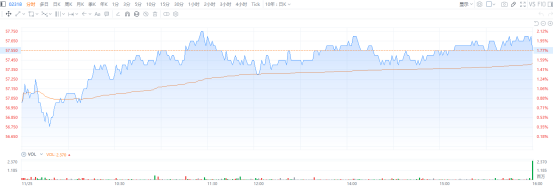
Core Viewpoint - China Ping An's stock price has shown a year-to-date increase of 18.91%, with recent fluctuations indicating a slight decline over the past five days and a modest increase over the past 20 days [1] Financial Performance - As of September 30, 2025, China Ping An reported a net profit attributable to shareholders of 132.86 billion yuan, reflecting a year-on-year growth of 11.47% [2] - The company has cumulatively distributed dividends amounting to 391.90 billion yuan since its A-share listing, with 134.54 billion yuan distributed over the past three years [3] Stock Market Activity - On November 25, 2023, China Ping An's stock price reached 59.57 yuan per share, with a trading volume of 2.03 billion yuan and a turnover rate of 0.32% [1] - The net inflow of main funds was 78.15 million yuan, with significant buying and selling activity from large orders [1] Shareholder Information - As of September 30, 2025, the number of shareholders for China Ping An was 696,200, a decrease of 3.43% from the previous period [2] - The average number of circulating shares per shareholder remained unchanged at 15,401 shares [2]
多重因素支持中国权益资产表现,A500ETF嘉实(159351)均衡覆盖各行业龙头
Xin Lang Cai Jing· 2025-11-25 02:43
Core Viewpoint - The Chinese equity market is expected to perform well due to multiple supporting factors, with a tactical overweight view on A/H shares maintained by Guotai Junan Securities [1] Group 1: Market Performance - On November 25, 2025, the three major A-share indices opened higher, with the CSI A500 index rising by 1.10% [1] - Key stocks such as Huadian Co., Ltd. and Shenzhen South Circuit rose significantly, with Huadian hitting the daily limit and others like Shenghong Technology and Fuhua also seeing substantial gains [1] Group 2: Investment Outlook - Guotai Junan Securities highlights that the recent volatility and panic selling have released micro trading risks, creating a favorable environment for the market to establish new expectations as the 14th Five-Year Plan begins [1] - The firm believes that the regulatory authorities are determined to stabilize the capital market, and factors that previously caused valuation discounts have dissipated, indicating a potential upward trend in valuations [1] Group 3: Index Composition - As of October 31, 2025, the top ten weighted stocks in the CSI A500 index include major companies like CATL, Kweichow Moutai, and China Ping An, accounting for a total of 19.36% of the index [1] Group 4: Investment Products - Investors without stock accounts can access the A500 ETF through the A500 ETF Jiashi linked fund, allowing for a one-click investment in the top 500 A-share companies [2]




智通港股沽空统计|11月25日
智通财经网· 2025-11-25 00:26
Core Insights - The article highlights the top short-selling stocks in the market, indicating significant investor skepticism towards these companies [1][2]. Short-Selling Ratios - Lenovo Group-R (80992) has the highest short-selling ratio at 87.71%, followed by Ping An Insurance-R (82318) at 69.65% and Shougang Resources (00639) at 62.81% [1][2]. - The short-selling amounts for Alibaba-SW (09988), Tencent Holdings (00700), and Xiaomi Group-W (01810) are the highest, amounting to 5.06 billion, 1.62 billion, and 1.17 billion respectively [1][2]. Deviation Values - Shougang Resources (00639) leads in deviation value at 48.27%, followed closely by Ping An Insurance-R (82318) at 46.76% and FIH Mobile Limited (02038) at 46.20% [1][2]. - The deviation value indicates the difference between the current short-selling ratio and the average short-selling ratio over the past 30 days, suggesting heightened market volatility for these stocks [3].
为湖南地区提供10亿元涉农贷款
Nan Fang Du Shi Bao· 2025-11-24 23:11
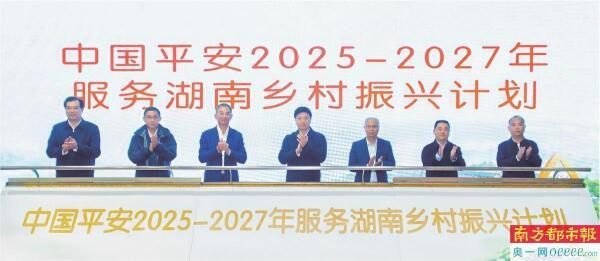
Core Viewpoint - China Ping An officially launched the "China Ping An 2025-2027 Hunan Rural Revitalization Plan," committing to support rural revitalization in Hunan through various initiatives, including financial assistance and industry support, with a total investment of 10 billion yuan in agricultural loans and 70 million yuan in industry support over the next three years [1][6]. Group 1: Financial Support and Investment - Over the next three years, China Ping An will provide 10 billion yuan in agricultural loans and 70 million yuan in industry support, along with 16 million yuan for agricultural insurance risk reduction services [6]. - In the past five years, China Ping An has invested over 140 billion yuan to support the county economy in Hunan, with a total of approximately 1.5 billion yuan in consumption assistance, including 1.3 billion yuan for agricultural products from the Eighteen-Dong Village [1][4]. - Ping An Bank has provided approximately 120 billion yuan in credit funds to Hunan Province, with 45.6 billion yuan in inclusive credit [4]. Group 2: Community and Social Support - China Ping An has established 132 party-building co-construction points across 14 cities, 84 counties, 120 townships, and 128 assisted villages in Hunan, donating 4.76 million yuan for party-building support [4]. - The company has invested nearly 4 million yuan in local livelihood assistance, recruited over 700 volunteers for teaching, and upgraded 50 rural health clinics [5]. - Ping An Property & Casualty has donated 800,000 yuan to support the care of left-behind elderly individuals in rural areas [2][5]. Group 3: Agricultural and Industrial Development - The "Ping An Revitalization Insurance" product has been launched, with 26 local specialty agricultural industries receiving 22.461 billion yuan in risk protection from 2022 to 2025 [5]. - The company aims to support the construction of agricultural product brands in Hunan, with a focus on local specialties such as mountain tea oil, committing to purchase 20 million yuan worth of these products [6]. - China Ping An plans to establish 100 grassroots party-building co-construction points in Hunan and conduct 40 financial promotion activities [6][7].