
PING AN OF CHINA(02318)

Search documents
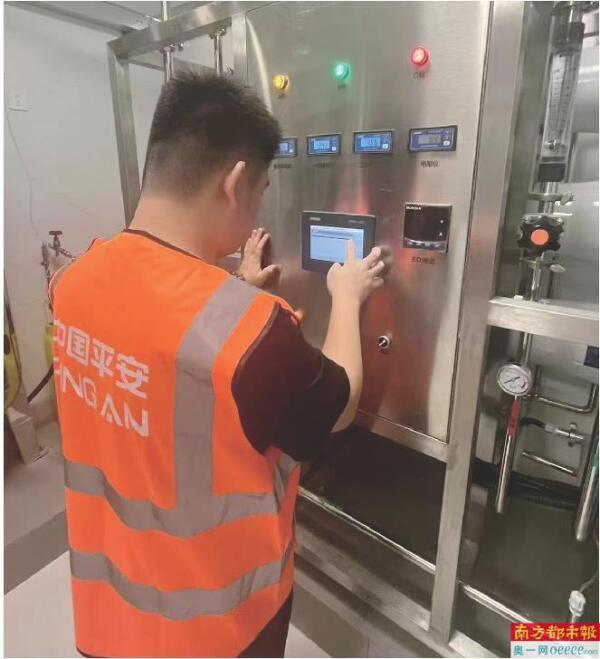
“三省”服务焕新 全国首个“医疗设备全生命周期保障保险”落地
Nan Fang Du Shi Bao· 2025-11-24 23:11
Core Insights - The signing of an innovative cooperation agreement between Ping An Property & Casualty Insurance Shenzhen Branch and Shenzhen Traditional Chinese Medicine Hospital marks the launch of the first "Medical Equipment Full Lifecycle Guarantee Insurance" in China, transforming 800,000 in maintenance costs into insurance coverage [2][3] - This insurance integrates maintenance cost compensation with safety guarantees for over 2,200 medical devices, representing a significant advancement in risk management within the medical equipment sector [2][3] Group 1: Insurance Product Features - The "Medical Equipment Full Lifecycle Maintenance Cost Loss Compensation Clause" focuses on covering repair and replacement losses due to equipment failures, including third-party liability for accidents during maintenance [3] - The insurance product fills a market gap in medical equipment risk management and establishes a "1+N" ecological development model, extending coverage to medical liability insurance, physician professional liability insurance, and surgical accident insurance [3][4] Group 2: Technological Integration and Management - The development of a smart IoT platform for medical equipment management enhances safety monitoring and risk warning capabilities, significantly improving the utilization rate of idle equipment [4] - A 24-hour on-site service mechanism ensures efficient response to equipment failures, reducing response times by 87% and achieving 100% coverage in equipment inspections [4] Group 3: Cost Management and Supply Chain - The insurance model addresses the uncertainty of maintenance costs in the medical industry by converting variable annual repair expenses into fixed costs, thus enhancing cost control [4][5] - The establishment of a direct supply system for original parts and collaboration with over 600 distributors reduces procurement times and costs, improving repair efficiency [5] Group 4: Broader Implications for Healthcare - The introduction of this insurance not only protects medical equipment but also shifts the focus from passive compensation to proactive risk management, thereby reducing equipment failure rates and enhancing patient safety [6] - The initiative aims to integrate risk management and technical services through a market-oriented insurance mechanism, contributing to the improvement of public health emergency management systems and supporting the Healthy China strategy [6]


智通ADR统计 | 11月25日
智通财经网· 2025-11-24 22:26
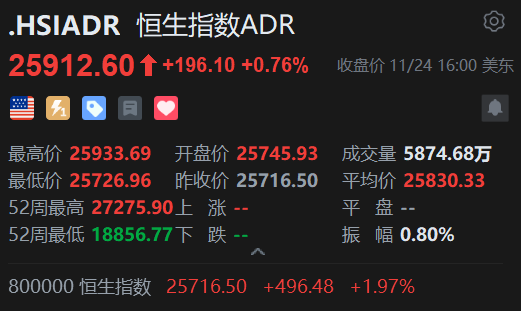
Core Viewpoint - The Hang Seng Index (HSI) closed at 25,912.60, up by 196.10 points or 0.76% on November 24, 2023, indicating a positive market sentiment with several large-cap stocks showing gains [1]. Group 1: Market Performance - The HSI reached a high of 25,933.69 and a low of 25,726.96 during the trading session, with a trading volume of 58.746 million shares [1]. - The index has a 52-week high of 27,275.90 and a low of 18,856.77, reflecting significant volatility over the past year [1]. Group 2: Major Stock Movements - HSBC Holdings closed at HKD 107.330, up by 0.03% compared to the previous close [2]. - Tencent Holdings closed at HKD 629.114, reflecting an increase of 0.74% from the last trading session [2]. - Alibaba Group saw a notable increase of 4.67%, closing at HKD 154.500 [3]. - Other significant gainers included NetEase, which rose by 5.87%, and Kuaishou, which increased by 7.11% [3].




上市六年即离场,金融壹账通退市落定,股价低迷与业绩承压是“导火索”
第一财经· 2025-11-24 15:41
Core Viewpoint - Financial One Account, a fintech company under Ping An, is officially delisting after receiving approval for its privatization plan from the Grand Court of the Cayman Islands, marking a swift exit from the public markets within just six years of its listing [3][4][6]. Group 1: Privatization Details - Financial One Account has withdrawn its listing status from the Hong Kong Stock Exchange and its American Depositary Shares (ADS) on the New York Stock Exchange have been permanently suspended, with the delisting process expected to complete by December 1 [3][4]. - The privatization offer was made by its controlling shareholder, Platinum Yu Limited, which is a subsidiary of Ping An, proposing to acquire all issued shares at HKD 2.068 per share, representing a premium of approximately 23.10% over the last trading price [4][5]. - The total cash required for the privatization is estimated at approximately HKD 1.689 billion, to be funded through internal cash resources and/or financing [5]. Group 2: Reasons for Delisting - The decision to privatize comes amid a broader trend of privatization in the Hong Kong market, where major shareholders believe that the market price does not reflect the company's value, allowing them to focus on long-term strategic development without the pressures of public market performance [8][9]. - Financial One Account's stock price has plummeted over 95% since its listing, attributed to low liquidity, reduced investor interest, and insufficient coverage from brokerage reports [10]. - The company has faced significant operational challenges, including a heavy reliance on Ping An for revenue, which has been criticized as a major weakness, and has struggled to increase third-party revenue despite efforts to do so [10][11]. Group 3: Financial Performance - Financial One Account's revenue from ongoing operations is projected to decrease by approximately 36.16% from FY2023 to FY2024, leading to increased operating losses [11]. - The company reported losses for both the previous fiscal year and the first half of the current year, failing to maintain profitability despite previous one-time gains from the sale of a virtual bank [11]. - The management aims to combine extensive industry knowledge with leading technology to enhance customer relationships and expand its ecosystem and overseas business, with plans to inject additional financial resources post-privatization [12].


上市六年即离场,金融壹账通退市落定,股价低迷与业绩承压是“导火索”
Di Yi Cai Jing· 2025-11-24 12:39
Core Viewpoint - Financial One Account, a fintech company under Ping An, is set to delist from both the NYSE and HKEX following its privatization plan, which has been approved by the Grand Court of the Cayman Islands [1][2][4]. Group 1: Delisting and Privatization - Financial One Account has withdrawn its listing status from HKEX as of November 21, with the final delisting process from NYSE to be completed by December 1 [1]. - The privatization offer was made by its controlling shareholder, Platinum Yu Limited, which is a subsidiary of Ping An Group, proposing to acquire all issued shares at HKD 2.068 per share, representing a premium of approximately 23.10% over the last closing price [2][3]. - Following the privatization, Ping An's ownership in Financial One Account will increase to 100% [2]. Group 2: Financial Performance and Market Conditions - Since its listing in December 2019, Financial One Account's stock price has dropped over 95%, attributed to low liquidity, reduced investor interest, and insufficient coverage by brokerage reports [6][7]. - The company's revenue from ongoing operations is projected to decrease by approximately 36.16% from FY2023 to FY2024, leading to increased operating losses [7]. - Financial One Account has faced challenges in diversifying its revenue sources, remaining heavily reliant on Ping An for income, which has been a significant concern for investors [6][7]. Group 3: Strategic Direction Post-Privatization - After privatization, the company plans to focus on long-term strategic goals, including enhancing customer relationships, optimizing products, and expanding its ecosystem and overseas business [7][8]. - The controlling shareholder, Platinum Yu, aims to inject additional financial resources and integrate the company further into the broader Ping An ecosystem once it becomes a wholly-owned subsidiary [8].
从产品组合到主账户管家 平安证券升级“平安30” 买方服务
2 1 Shi Ji Jing Ji Bao Dao· 2025-11-24 11:49
Group 1 - The core viewpoint of the articles highlights the acceleration of the buy-side advisory model in the brokerage industry, with Ping An Securities leading the way through its upgraded "Ping An 30" solution aimed at high-net-worth individuals [1][2] - Ping An Securities has achieved a significant milestone with the Ping An 30 solution surpassing 10 billion yuan in assets under management, reflecting strong client trust and commitment to asset appreciation [1] - The upgraded Ping An 30 solution addresses three major pain points faced by investors in traditional distribution models: fragmented holdings across multiple channels, lengthy decision-making processes, and inconsistent service quality [1][2] Group 2 - The upgraded Ping An 30 solution adopts a "main account" concept, providing a one-stop fund investment solution that allows for comprehensive analysis of portfolio holdings and real-time risk and return assessment [2] - The service aspect of Ping An 30 has been enhanced with a full-cycle professional support system, including weekly and monthly operation reports, quarterly reviews, and an annual client conference for direct interaction with investment teams [2] - The strategic upgrade of Ping An 30 positions it as a "client main account steward," focusing on intelligent wealth management centered around clients' financial asset accounts [2] Group 3 - International investment institutions are increasingly recognizing the potential of the Chinese market, shifting from a hesitant stance to proactive investment strategies, driven by China's strong macroeconomic fundamentals and innovative capabilities [3] - China has demonstrated a GDP growth rate surpassing that of Western countries, with a trade surplus expected to reach historical highs, further attracting foreign capital [3] - The unique and replicable industrial and innovation ecosystem in China is a key factor in drawing overseas capital to reassess and actively allocate resources to Chinese assets [3] Group 4 - The essence of stocks is shared risk and returns, with long-term investment focusing on the ability to generate cash flow, as emphasized by investment experts [4] - Shareholder returns in the A-share market have significantly increased from 41 billion yuan in 2001 to an estimated 2 trillion yuan in 2023-2024, indicating an improved market ecology [4] - In a low-growth environment, investment strategies should prioritize the fundamental aspect of cash flow generation, with a focus on thorough research and scientific risk pricing for sustainable compounding [4]
58家寿险公司上半年盈利1763亿元 国寿、平安、太保领跑
2 1 Shi Ji Jing Ji Bao Dao· 2025-11-24 10:37
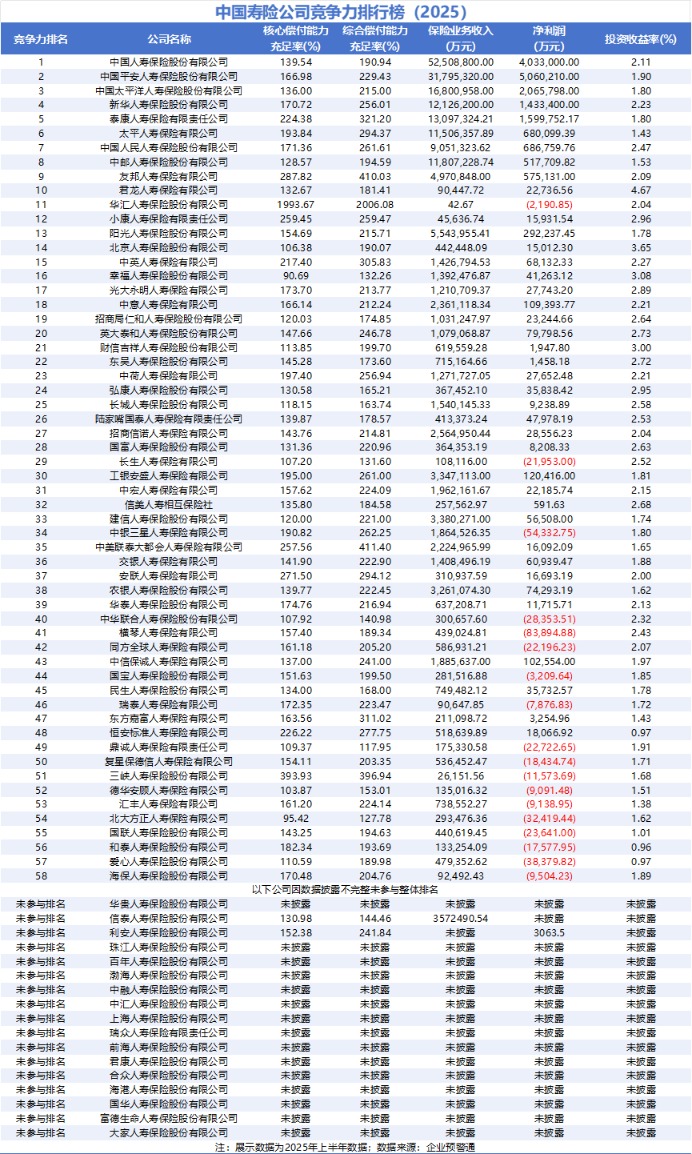
Core Insights - The report indicates a significant "stronger gets stronger" trend in China's life insurance industry, with the top ten companies accounting for 94.6% of the net profits in the first half of 2025 [1][5] - The top five life insurance companies achieved a combined premium income of 1.25 trillion yuan, showcasing their dominant market position [4][5] Group 1: Industry Overview - The report categorizes life insurance companies into four types: life insurance, property insurance, pension insurance, and health insurance, analyzing their competitiveness based on various dimensions [1] - In the first half of 2025, the life insurance sector's total profit reached 176.31 billion yuan, with 58 companies participating in the competitiveness ranking [1] Group 2: Top Companies Performance - The top five life insurance companies are China Life, Ping An Life, Taiping Life, New China Life, and TaiKang Life, all achieving net profits exceeding 10 billion yuan in the first half of 2025 [2][5] - China Life led with a premium income of 525.09 billion yuan and a net profit of 40.33 billion yuan, maintaining its market leadership [5] - Ping An Life reported a net profit of 50.60 billion yuan, the highest among life insurers [5] Group 3: Financial Metrics - The solvency ratios of the top companies remained robust, with TaiKang Life having a core solvency ratio of 224.38% and a comprehensive solvency ratio of 321.20% [5] - New China Life and Ping An Life also reported comprehensive solvency ratios exceeding 200% [5] Group 4: Investment Performance - New China Life achieved the highest investment return rate of 2.23% among the top five companies, followed by China Life at 2.11% [6] - Overall, the investment returns for the leading companies remained stable within a healthy range [6] Group 5: Market Dynamics - The report highlights a growing divide between large and small insurance companies, with 18 out of 58 companies reporting losses in the first half of 2025 [9] - Companies like Huahui Life, despite high solvency ratios, faced challenges due to low business income, indicating a need for operational revitalization [9] Group 6: Regulatory Impact - The insurance industry is transitioning from scale expansion to value creation, driven by regulatory changes such as the introduction of a dynamic adjustment mechanism for premium rates linked to market rates [10] - The report emphasizes that leading companies are focusing on cost control and risk management to adapt to the evolving market landscape [10]


“平安30”三年突破百亿,知名国际投资大咖发声:世界正重估中国!
中国基金报· 2025-11-24 10:33
Core Insights - The "Ping An 30" program has surpassed a management scale of 10 billion yuan, serving 5,482 clients and generating an absolute return of 860 million yuan over three years, marking a significant milestone in client trust [2][3][7] - The program's upgrade signifies a strategic shift from being a "product provider" to a "client main account manager," focusing on intelligent wealth management centered around clients' financial asset accounts [3][4] Group 1: Performance Metrics - "Ping An 30" has achieved a client retention rate of 81.15% and a repurchase rate of 53.73% [3] - The program's absolute return of 860 million yuan reflects its effective asset allocation capabilities and ongoing client support [2][3] Group 2: Market Perspectives - Global capital is increasingly viewing Chinese assets favorably, transitioning from hesitation to proactive investment, as highlighted by prominent investment figures [5] - China boasts a highly efficient labor force and a creative entrepreneurial ecosystem, contributing to GDP growth rates surpassing those of Western countries, alongside a trade surplus expected to exceed 1 trillion USD this year [5] - The A-share market's shareholder return has grown from 41 billion yuan in 2001 to an estimated 2 trillion yuan in 2023-2024, indicating an improved market ecology [6] Group 3: Investment Strategies - Discussions at the forum emphasized the importance of long-term investment strategies in a complex market environment, with insights shared by various investment leaders [8]

2025年金融消费趋势洞察研究报告
Sou Hu Cai Jing· 2025-11-24 09:16
Core Insights - The report reveals a shift in financial consumption trends from "instant gratification" to "future security," with a growing emphasis on insurance and healthcare products, particularly among the post-95 generation who prioritize retirement planning over entertainment spending [1][8][19] - Consumer pain points include a lack of tailored wealth management solutions, underwhelming product returns, complicated services, and a desire for more transparent information, with over 90% of consumers seeking a "hassle-free, time-saving, and cost-effective" financial service experience [1][8][30] Chapter 1: Consumption Trend Insights - Financial consumers are increasingly adopting a conservative asset allocation strategy, focusing on risk mitigation rather than high returns, with the structure of financial products shifting towards insurance over consumption and investment [15][19] - The demand for healthcare and insurance products is rising, with 62.8% of respondents concerned about healthcare and 36% about retirement, indicating a desire for financial products that provide real value during critical times [28][29] Chapter 2: User Pain Points Analysis - The primary consumer demographic consists of middle-aged women aged 31-50, who are often the decision-makers in family financial matters, leading to a demand for comprehensive financial solutions that address various family needs [32][34] - Key pain points include low product returns, complicated service processes, lack of personalization, and unclear product terms, with 86.7% of consumers dissatisfied with product features and performance [38][39][46] Chapter 3: Breaking the "Impossible Triangle" - The financial industry faces a dilemma known as the "impossible triangle," where achieving high returns, low risk, and high liquidity simultaneously is challenging, particularly in the healthcare and retirement sectors [29][30] - Financial institutions must not only provide asset management solutions but also help consumers establish long-term financial security, addressing the need for products that balance stable returns with long-term guarantees [29][30] Chapter 4: Practical Example - Ping An's "Three Savings Project" - Ping An's "Three Savings Project" serves as a model for integrating comprehensive financial services with healthcare and retirement planning, leveraging technology, product innovation, and professional services to enhance customer satisfaction [1][29] - The project has resulted in significant achievements, including a customer base exceeding 242 million and home care services covering 75 cities, demonstrating the effectiveness of a customer-centric approach in financial services [1][29] Chapter 5: Conclusion - Path to "Finance for the People" - The essence of "finance for the people" is centered around customer needs, emphasizing the importance of simplifying processes, enhancing transparency, and fostering collaboration to make financial services more accessible and user-friendly [1][12][29]

Ping An Unveils "Ancient Tree Guardian Action" at UN Climate Change Conference (COP30)
Prnewswire· 2025-11-24 08:55
Core Viewpoint - Ping An Insurance has launched the "Ancient Tree Guardian Action" project, integrating insurance, technology, and social welfare to protect over 55,000 ancient trees in China, showcasing innovative efforts in biodiversity conservation and climate change mitigation [1][3]. Group 1: Project Overview - The "Ancient Tree Guardian Action" was presented at COP 30, emphasizing the integration of insurance and technology for sustainable protection of ancient trees [1]. - The project aims to address the threats faced by approximately 5.08 million ancient trees in China due to climate change, pests, and funding shortages [2]. Group 2: Technological Integration - Ping An employs a unique "Insurance + Technology" model, utilizing big data, AI, and IoT for comprehensive assessments of ancient trees [3]. - The project has implemented a full-chain model for disaster management, providing over RMB 700 million (approximately USD 98 million) in risk protection as of October 2025 [3]. Group 3: Monitoring and Prevention - Technology plays a crucial role in the program, with IoT and environmental sensors monitoring soil moisture, air quality, and tree health in real-time [4]. - The proprietary "EagleX" system tracks extreme weather and issues alerts, shifting focus from post-disaster compensation to pre-disaster prevention [5]. Group 4: Community Engagement and Economic Growth - Ping An engages in public welfare activities, including educational programs and eco-tourism campaigns, to raise awareness and stimulate local economies [6]. - The "Travel with Ancient Trees" campaign reached 250 million users, promoting ecological knowledge and local green economic growth [6]. Group 5: Green Finance Strategy - The "Ancient Tree Guardian Action" is part of Ping An's broader green finance strategy, which includes insurance for carbon-sequestering ecosystems [7]. - By the end of 2024, Ping An's Carbon Sink Insurance had expanded to cover 18 provinces, providing financial support for ecological preservation [8]. Group 6: Financial Metrics - As of June 30, 2025, Ping An's green investments totaled RMB 144.482 billion (approximately USD 20 billion), with green loan balances at RMB 251.746 billion (around USD 35.3 billion) [9]. - Premium income from green insurance for the first three quarters of 2025 amounted to RMB 55.279 billion (about USD 7.7 billion) [9]. Group 7: Future Outlook - Ping An aims to continue innovating in green finance, developing a wider range of green insurance and investment products to support sustainable development [10].

石合群:保险业要为新能源汽车产业发展增添新动能
Zhong Guo Qi Che Bao Wang· 2025-11-24 07:10
当前,汽车产业正迎来全球化、智能化与绿色化趋势交融带来的深水区竞争,机遇与挑战并存。 "随着人工智能、大数据、物联网等技术与汽车产业的深度融合,汽车智能化也带来了责任认定难、系统风险高、数据安全隐患三大核心挑战。"石合 群表示,同时,在汽车电动化进程中,性能衰减的争议、热失控的威胁、残值的评估难也是现实难题。此外,在新能源汽车出海中,不同的市场在法规、 环境、文化等方面的差异也要求中国车企进行针对性适配,给车企提供本地化服务带来了巨大挑战。 (本文原标题为 中国平安财产保险股份有限公司党委副书记石合群:保险业要为新能源汽车产业发展增添新动能) 汽车产业的转型与变革,对产业链上下游及相关行业的同频共进、不断创新提出了更高的要求。"保险业可以赋能新能源汽车高质量发展,推动汽车 产业链的优化和整合,助推中国汽车产业在智能化、全球化进程中稳步前行,践行服务国家战略的使命,巩固中国新能源汽车的全球优势。"11月18日, 在中国汽车报社主办的第二十届中国经济论坛平行论坛——"展望'十五五' 巩固车优势"上,中国平安财产保险股份有限公司党委副书记石合群指出,保险 能够加持车企提升车辆安全水平,助力降低事故的发生率。"面向未 ...
