WuXi AppTec(02359)

Search documents
公募顶流四季报揭秘:科技冲锋与价值深蹲下的业绩分野
2 1 Shi Ji Jing Ji Bao Dao· 2026-01-28 12:31
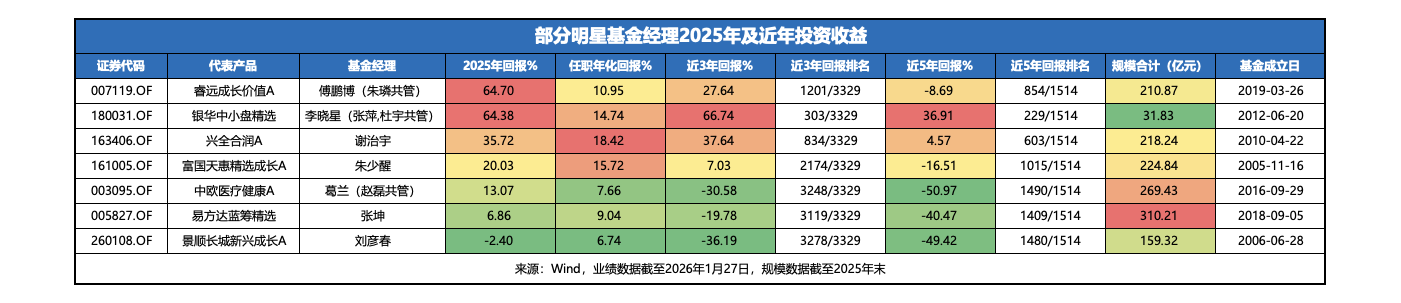
Core Viewpoint - The market experienced increased volatility in Q4 2025, with A-shares and Hong Kong stocks showing mixed performance, while sectors like AI computing and semiconductors thrived, contrasting with weaker performances in real estate and pharmaceuticals [1] Group 1: Market Performance - The Shanghai Composite Index rose by 2.22% in Q4 2025, while the Hang Seng Index fell by 4.56% [1] - The technology growth sector, particularly AI computing and semiconductors, showed significant gains, while industries such as real estate and pharmaceuticals faced challenges [1] Group 2: Fund Manager Performance - Star fund managers like Fu Pengbo and Li Xiaoxing achieved over 60% returns in 2025, focusing on AI computing and semiconductors [2] - Balanced allocation funds, such as Zhu Shaoxing's, demonstrated stability with a 20% annual return, benefiting from diversified investments across various sectors [3][14] Group 3: Investment Strategies - Fu Pengbo's fund increased its allocation to data center cooling and computing-related companies, with a top ten stock concentration of 70.38% [5] - Li Xiaoxing emphasized AI hardware innovation and semiconductor investments, with a focus on domestic advancements in the semiconductor industry [6] Group 4: Traditional Value Investments - Fund managers like Zhang Kun and Liu Yanhun maintained positions in traditional sectors like consumer goods and pharmaceuticals, despite facing net value pressures [8][12] - Liu Yanhun's fund experienced a 5.85% decline in Q4, reflecting the challenges faced by traditional value sectors [12] Group 5: Policy and Market Outlook - Fund managers noted the impact of "anti-involution" policies on corporate fundamentals, suggesting a shift towards supply-side optimization [17] - Despite market rebounds, equity assets are still viewed as attractive, with a focus on high-quality listed companies as scarce income-generating assets [18]






智通AH统计|1月28日
智通财经网· 2026-01-28 09:24
Core Viewpoint - The report highlights the AH premium rates of various stocks, indicating significant disparities between H-shares and A-shares, with some stocks showing extremely high premiums while others exhibit negative premiums [1][2]. Group 1: Top AH Premium Rates - Northeast Electric (00042) leads with an AH premium rate of 847.37%, followed by Zhejiang Shibao (01057) at 349.31% and Beijing Jingcheng Machinery Electric (00187) at 279.42% [1][2]. - The lowest AH premium rates are recorded for Contemporary Amperex Technology (03750) at -14.34%, China Merchants Bank (03968) at -4.99%, and Heng Rui Medicine (01276) at -1.15% [1][2]. Group 2: Top AH Deviation Values - Junshi Biosciences (01877) has the highest deviation value at 22.43%, followed closely by Beijing Jingcheng Machinery Electric (00187) at 22.18% and CanSino Biologics (06185) at 21.90% [1][3]. - The lowest deviation values are observed in Changfei Optical Fiber (06869) at -50.58%, Zhejiang Shibao (01057) at -45.38%, and Nanhua Futures (02691) at -27.12% [1][4]. Group 3: Detailed AH Premium and Deviation Rankings - The top ten AH stocks by premium rate include companies like Hongye Futures (03678) with a premium of 271.30% and Sinopec Oilfield Service (01033) at 248.51% [2]. - The bottom ten AH stocks by premium rate include WuXi AppTec (02359) with a slight premium of 0.42% and Midea Group (00300) at 6.75% [2]. - The top ten stocks by deviation also feature companies like Goldwind (02208) at 19.35% and Andeli Juice (02218) at 19.04% [3].

医药连续回调,药明康德一度翻红!医药ETF(159929)收跌超1%,资金逆势加仓近6000万元!机构:药明系业绩强劲,CXO板块后续发展动能充足!
Sou Hu Cai Jing· 2026-01-28 09:08
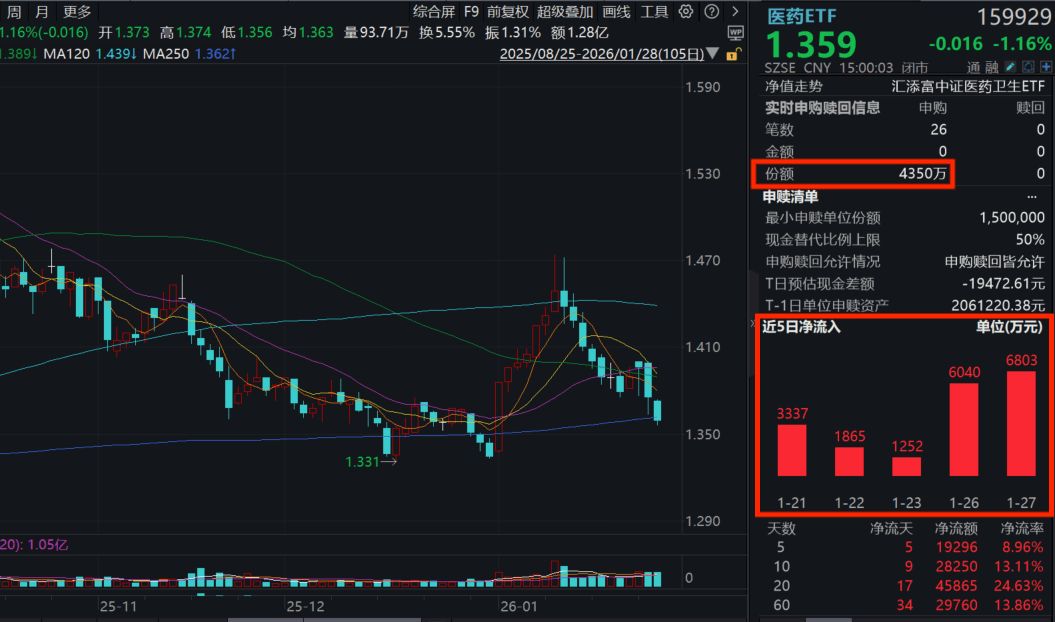
Core Viewpoint - The pharmaceutical sector is experiencing fluctuations, with the medical ETF (159929) showing a decline of 1.16% amidst a net inflow of nearly 60 million yuan, indicating ongoing investment interest despite market corrections [1][3]. Group 1: Market Performance - The Shanghai Composite Index has seen a rise, while the pharmaceutical sector is undergoing a pullback, with the medical ETF (159929) recording a trading volume exceeding 120 million yuan [1]. - Major stocks within the medical ETF have mostly declined, with notable drops including over 3% for United Imaging Healthcare and over 2% for Mindray Medical [3]. Group 2: Company Performance and Projections - CITIC Securities expresses optimism for leading pharmaceutical e-commerce platforms, highlighting their resource advantages and AI capabilities, which are expected to enhance revenue through AI medical applications [5]. - According to Everbright Securities, WuXi AppTec's companies have reported strong earnings forecasts, with WuXi AppTec expected to achieve revenue of 45.456 billion yuan in 2025, reflecting a year-on-year growth of 15.84% [5]. - WuXi Biologics anticipates adding 209 comprehensive projects in 2025, with two-thirds being dual-targeted antibodies and ADC drugs, indicating robust growth potential [5]. Group 3: Investment Trends and Strategies - Everbright Securities suggests that future investments in the pharmaceutical sector should focus on clinical value, emphasizing the importance of addressing clinical needs amid evolving domestic and international policies [6]. - CITIC Jinshi identifies four main investment themes for 2026: innovation, international expansion, marginal changes, and consolidation within the pharmaceutical industry [7]. - The innovation theme is particularly highlighted, with expectations for improved global liquidity and supportive national policies for innovative assets, including advanced technologies in pharmaceuticals and medical devices [8].
产业经济周报:BD出海加速,AI应用竞赛升级
Tebon Securities· 2026-01-28 07:25
Market Performance - The market showed mixed performance from January 19 to January 23, with the Shanghai Composite Index rising by 0.84% and the Shenzhen Component Index increasing by 1.11%[5] - The average daily trading volume was 2.80 trillion yuan, a decrease compared to the previous week[5] Healthcare Sector - At the JPM 2026 conference, over 20 Chinese innovative pharmaceutical companies showcased their products, with significant business development (BD) transactions announced[16] - In 2025, the value of China's innovative drug patent licensing transactions reached approximately $135.7 billion, a 143% increase year-on-year, with 157 total transactions[20] Consumer Sector - The Qianwen APP integrated with Alibaba's ecosystem, achieving over 100 million monthly active users within two months of launch, marking its entry into the "billion-level club"[25] - This integration allows for a seamless process from search to decision-making and payment, establishing a comprehensive AI application ecosystem[26] Hard Technology Sector - The supply of storage and logic chips remains tight, leading to widespread price increases across the industry[32] - The price of enterprise SSDs continues to rise, with a projected increase of 33-38% for NAND Flash products due to supply constraints[36] High-end Manufacturing - The State Grid announced a total fixed asset investment of 4 trillion yuan for the 14th Five-Year Plan period (2026-2030), a 40% increase from the previous period, averaging 800 billion yuan annually[42] - The goal is to achieve a 30% share of renewable energy in total power generation by 2030, indicating significant growth potential for the solar and wind energy sectors[46]



产业经济周报:BD出海加速,AI应用竞赛升级-20260128
Tebon Securities· 2026-01-28 06:49
Market Performance - The market showed mixed performance from January 19 to January 23, with the Shanghai Composite Index rising by 0.84% and the Shenzhen Component Index increasing by 1.11%[5] - The average daily trading volume was 2.80 trillion yuan, a decrease compared to the previous week[5] Healthcare Sector - At the JPM 2026 conference, over 20 Chinese innovative pharmaceutical companies showcased their advancements, with significant business development (BD) transactions reported[16] - In 2025, the value of China's innovative drug patent licensing transactions reached approximately $135.7 billion, a 143% year-on-year increase, with 157 total transactions[20] Consumer Sector - The Qianwen APP integrated with Alibaba's ecosystem, achieving over 100 million monthly active users within two months of launch, marking its entry into the "billion-level club"[25] - This integration allows for a seamless process from search to decision-making and payment, establishing a comprehensive AI application ecosystem[26] Hard Technology Sector - The supply of storage and logic chips remains tight, leading to widespread price increases across the industry[32] - The price of enterprise SSDs continues to rise due to increased demand from AI servers, with NAND Flash supply expected to decrease by 41.7% in 2026[35] High-end Manufacturing - The State Grid announced a total fixed asset investment of 4 trillion yuan for the 14th Five-Year Plan period (2026-2030), a 40% increase from the previous period, averaging 800 billion yuan annually[42] - By 2030, renewable energy generation is expected to account for approximately 30% of total power generation, indicating significant growth potential in the solar and wind sectors[46]

智通港股沽空统计|1月27日
智通财经网· 2026-01-27 00:24
Group 1 - The top short-selling ratios are recorded for China Resources Beer (100.00%), Anta Sports (100.00%), and Li Ning (100.00%) [1][2] - The highest short-selling amounts are for Pop Mart (1.209 billion), Xiaomi Group (1.075 billion), and Alibaba (0.974 billion) [1][2] - The highest deviation values are for CRRC (42.51%), Li Ning (38.82%), and Ping An Insurance (30.07%) [1][2] Group 2 - The top short-selling amounts list includes Pop Mart (1.209 billion), Xiaomi Group (1.075 billion), and Alibaba (0.974 billion) with respective short-selling ratios of 28.53%, 19.43%, and 8.66% [2] - The top short-selling ratio rankings show China Resources Beer, Anta Sports, and Li Ning all at 100.00% with short-selling amounts of 19.28 thousand, 9.50 thousand, and 10.09 thousand respectively [2] - The deviation values indicate that CRRC has a significant deviation of 42.51%, followed by Li Ning at 38.82% and Ping An at 30.07% [2][3]





智通港股沽空统计|1月26日
智通财经网· 2026-01-26 00:25
Group 1 - The top short-selling ratios are led by AIA Group (81299) and JD Health (86618) at 100.00%, followed by Baidu Group (89888) at 95.46% [1][2] - The highest short-selling amounts are recorded for Pop Mart (09992) at 1.3 billion, Alibaba (09988) at 1.26 billion, and Xiaomi Group (01810) at 1.064 billion [1][2] - The highest deviation values are for Baidu Group (89888) at 62.11%, Shenzhen Expressway (00548) at 37.02%, and SenseTime (80020) at 34.65% [1][2] Group 2 - The top ten short-selling ratios include AIA Group (81299) at 100.00%, JD Health (86618) at 100.00%, and Baidu Group (89888) at 95.46% [2] - The top ten short-selling amounts show Pop Mart (09992) leading with 1.3 billion, followed by Alibaba (09988) with 1.26 billion, and Xiaomi Group (01810) with 1.064 billion [2] - The top ten deviation values highlight Baidu Group (89888) at 62.11%, Shenzhen Expressway (00548) at 37.02%, and SenseTime (80020) at 34.65% [2]

没想到吧,除了稀土,我们还有一张“王牌”……
虎嗅APP· 2026-01-25 09:33
Core Viewpoint - The article emphasizes China's dominant position in the global pharmaceutical supply chain, particularly in the production of Active Pharmaceutical Ingredients (APIs) and Key Starting Materials (KSMs), which poses a significant asymmetric threat to U.S. national security [4][5]. Group 1: China's Dominance in Pharmaceutical Supply Chain - China holds a near-monopoly in the production of various pharmaceutical raw materials, with over 90% of global antibiotic intermediates supplied by China [18]. - Approximately 70%-80% of global vitamin production capacity is controlled by China, making it a critical player in the pharmaceutical industry [19]. - China's low-cost, high-output chemical manufacturing capabilities create significant barriers for competitors, allowing it to define prices and capacities in the market [21]. Group 2: Impact of Geopolitical Tensions - The U.S.-China trade tensions have led to concerns about the dependency of the U.S. on Chinese pharmaceutical supplies, which could lead to drug shortages in critical situations [9][10]. - The article illustrates a hypothetical scenario where geopolitical tensions could disrupt the supply of essential medications, highlighting the risks of "asymmetric interdependence" [7][9]. - The ongoing drug shortage issues in the U.S. are exacerbated by the complex global supply chain, where many active ingredients are sourced from China [10][11]. Group 3: Historical Context and Strategic Decisions - The article discusses the historical context of the pharmaceutical industry's shift, where Western companies outsourced low-margin API production to lower-cost countries, primarily China, while retaining high-margin R&D and marketing functions [23][24]. - This outsourcing has led to a significant loss of industrial capability in the West, as the foundational skills and infrastructure for API production have diminished [32]. Group 4: Challenges for India as an Alternative - India, often referred to as the "world's pharmacy," lacks the complete supply chain necessary for API production, relying heavily on Chinese intermediates [36][38]. - Despite efforts to establish a domestic API supply chain, India's progress is hindered by infrastructure challenges and the dominance of Chinese suppliers [37][39]. Group 5: Future Outlook and Strategic Recommendations - The article suggests that China is transitioning from merely being a low-cost producer to becoming a leader in technology and standards within the pharmaceutical industry [43]. - As geopolitical tensions rise, the need for China to innovate in green technologies and maintain its competitive edge in the pharmaceutical supply chain becomes critical [55][56]. - The future of the pharmaceutical industry will focus on balancing efficiency and safety, with the ability to provide cost-effective and safe drugs being a key determinant of success [58].

医药健康行业研究:Q4基金医药持仓情况出炉,关注板块调整后布局机遇
SINOLINK SECURITIES· 2026-01-25 07:50
Investment Rating - The report suggests a positive outlook for the innovative drug sector, indicating it will continue to be a core investment direction in 2026 due to the maturation of the industry chain and normalization of medical insurance negotiations [4]. Core Insights - The public fund's pharmaceutical holdings decreased to 8.11% in Q4 2025, down by 1.66 percentage points (pp) from the previous quarter. Excluding actively managed pharmaceutical funds, the holdings dropped to 3.90%, a decrease of 1.36pp [11][12]. - The innovative drug ETF reached a scale of 100.62 billion yuan in Q4, accounting for 13.11% of the pharmaceutical fund, which is a slight decrease of 1.35pp [13][15]. - The CXO sector saw a decline in holdings due to geopolitical disturbances, while the medical device sector benefited from innovations like brain-computer interfaces and surgical robots, leading to an increase in holdings [14][17]. - The report highlights the acquisition of PART by GSK for $2.2 billion to strengthen its position in the IgE antibody market, with the core product Ozureprubart showing significant market potential [2][31]. - The oral weight loss drug Wegovy has shown strong early commercial progress, with retail prescriptions reaching approximately 3,071 in the first four days post-launch, nearly three times that of its competitor Zepbound [2][31]. Summary by Sections Pharmaceutical Sector - The report indicates a significant decrease in public fund holdings in the pharmaceutical sector, with a noted resilience in the innovative drug segment [11][14]. - The report emphasizes the importance of focusing on leading companies with core pipeline competitiveness and global layout capabilities for investment [4]. Medical Devices - The introduction of new pricing guidelines for auxiliary medical services is expected to accelerate the adoption of innovative products in the medical device sector [3][17]. - The report suggests monitoring domestic leading companies in this sector for increasing product penetration [3]. Drugstores - The report discusses the potential for leading drugstore companies to increase market share, supported by recent government policies promoting high-quality development in the retail pharmaceutical industry [3][17]. - Specific companies like Yifeng Pharmacy and Dazhenglin are highlighted as having low valuations and significant cost reduction achievements [3]. CXO and Pharmaceutical Supply Chain - Several CXO companies have released optimistic earnings forecasts for 2025, indicating a clear upward trend in industry prosperity [2][31]. - The report recommends active investment in this sector due to the positive signals regarding industry growth [2][31].

创新药还能加仓?这场会定调2026
Jing Ji Guan Cha Wang· 2026-01-24 10:07
Core Insights - The 2026 JPM conference showcased a positive outlook for Chinese innovative pharmaceutical companies, with significant interest from multinational corporations in collaboration opportunities [2][3][4] - Chinese companies are shifting from merely licensing patents to deeper involvement in clinical development and commercialization in international markets [3][8] - The FDA's stance at JPM was relatively moderate, acknowledging the R&D efficiency of Chinese companies and suggesting improvements in approval processes using AI [3][6] Group 1: Conference Overview - The JPM conference, held in San Francisco, attracted numerous founders, executives, and investors from Chinese innovative pharmaceutical companies, indicating a vibrant atmosphere compared to previous years [2][5] - The event has evolved from a small gathering to a major industry benchmark, with participation from nearly all multinational pharmaceutical companies [5][10] - The number of attendees increased significantly in 2026, reflecting a more optimistic market sentiment compared to the previous year [5][10] Group 2: Market Trends - The Chinese innovative drug sector experienced a substantial stock price increase from March to August 2025, driven by business development (BD) transactions and foreign capital inflow, but faced a market correction afterward [4][11] - The interest in Chinese assets is growing, with many multinational companies expressing intentions for mergers and acquisitions (M&A) and BD transactions [11][12] - The trend of Chinese companies seeking deeper engagement in global markets is evident, moving beyond simple patent licensing to collaborative operational models [8][9] Group 3: Regulatory Environment - FDA officials at JPM highlighted the efficiency of Chinese clinical trials, with China completing Phase I trials in four weeks compared to much longer timelines in the U.S. [6][12] - The FDA's comments suggested a focus on optimizing clinical trial approval processes rather than emphasizing protectionist policies [5][6] Group 4: Future Outlook - The absence of major transactions at JPM 2026 was noted, but many multinational companies expressed a willingness to explore significant deals in the near future [11][12] - The upcoming expiration of patents for several blockbuster drugs is expected to drive increased M&A activity as companies seek to replenish their pipelines [12][13] - The trend of U.S. biotech firms considering establishing operations in China to leverage R&D efficiencies is emerging, indicating a shift in cross-border collaboration dynamics [10][11]