BANK COMM(03328)

Search documents
六大行将分红超2000亿元!
券商中国· 2025-08-30 10:41
Core Viewpoint - The banking industry has demonstrated stability and resilience in its mid-year performance for 2025, with a focus on supporting the real economy while transitioning towards digital transformation and diversified income sources [2][3]. Group 1: Financial Performance - A total of 42 A-share listed banks achieved operating income exceeding 2.9 trillion yuan, representing a year-on-year growth of over 1%, and a net profit attributable to shareholders of 1.1 trillion yuan, up by 0.8% [1]. - The six major state-owned banks reported a combined cash dividend exceeding 200 billion yuan for the mid-year period [2][10]. - The total asset scale of the six major banks reached approximately 214 trillion yuan, growing by about 7% compared to the end of the previous year [5][7]. Group 2: Revenue Structure - The revenue structure of listed banks is shifting from reliance on "single interest margin" to "diversified income," with non-interest income contributions increasing [3]. - In the first half of 2025, the six major banks collectively achieved a revenue of 1.8 trillion yuan, with a net profit of 682.52 billion yuan [3]. Group 3: Digital Transformation - The application of artificial intelligence (AI) has become a key driver for the transformation of banks, with various banks implementing AI strategies and establishing dedicated teams for AI development [13]. - Major banks have integrated numerous AI applications across various business lines, enhancing operational efficiency and customer service [13]. Group 4: Support for the Real Economy - As of the end of June, the loan balance of 42 A-share listed banks reached approximately 180 trillion yuan, reflecting a year-on-year growth of about 6%, with state-owned banks being the main contributors [14]. - The focus of credit allocation has been on supporting the real economy, particularly in areas such as small and micro enterprises, green finance, and technology finance [14].





国有大行“期中考”答卷: 扩规模、稳息差、向中间收入要效益
Jing Ji Guan Cha Wang· 2025-08-30 10:21
Core Insights - The six major state-owned banks in China reported their mid-year performance for 2025, indicating a growth in asset scale but a mixed performance in operating indicators, with three banks experiencing a decline in net profit [2][4] Asset Growth - Industrial and Commercial Bank of China (ICBC) total assets reached 52.32 trillion yuan, up 7.2% from the end of the previous year [3] - Agricultural Bank of China (ABC) total assets reached 46.86 trillion yuan, an increase of 8.37% [3] - China Construction Bank (CCB) total assets reached 44.43 trillion yuan, growing by 9.52% [3] - Bank of China (BOC) total assets reached 36.79 trillion yuan, up 4.93% [3] - Postal Savings Bank of China (PSBC) total assets reached 18.19 trillion yuan, increasing by 6.47% [3] - Bank of Communications (BoCom) total assets reached 15.44 trillion yuan, a rise of 3.59% [3] Operating Performance - ABC, BoCom, and PSBC reported positive growth in both operating income and net profit [5] - ABC achieved operating income of 369.94 billion yuan, a year-on-year increase of 0.85%, and net profit of 139.94 billion yuan, up 2.53% [6] - BoCom reported operating income of 133.37 billion yuan, a 0.77% increase, and net profit of 46.02 billion yuan, up 1.61% [6] - PSBC's operating income was 179.45 billion yuan, growing by 1.50%, with net profit at 49.42 billion yuan, an increase of 1.08% [7] - In contrast, ICBC, BOC, and CCB saw declines in net profit despite positive growth in operating income [7] Net Interest Margin Pressure - The net interest margin (NIM) for major state-owned banks remains under pressure, with declines noted across the board [9] - ICBC's NIM was 1.30%, down 13 basis points year-on-year; CCB's NIM was 1.40%, down 14 basis points; ABC's NIM was 1.32%, down 13 basis points; BOC's NIM was 1.26%, down 18 basis points; PSBC's NIM was 1.70%, down 21 basis points; BoCom's NIM was 1.21%, down 8 basis points [9] Non-Interest Income Growth - Non-interest income is becoming a more significant part of revenue for several banks as they adjust their income structure [12][13] - BOC's non-interest income accounted for over one-third of its total revenue, with a year-on-year growth exceeding 70% in its overseas operations [13][14] - ICBC's non-interest income was 113.52 billion yuan, up 6.5%, representing 26.58% of total revenue [15] - ABC's non-interest income totaled 87.46 billion yuan, a 15.1% increase, making up 23.64% of total revenue [16] - CCB's non-interest income was 107.56 billion yuan, up 19.64%, comprising 27.28% of total revenue [16] - PSBC's non-interest income reached 40.39 billion yuan, a 19.09% increase, accounting for 22.51% of total revenue [17]

2046亿元!六大行披露“发钱”方案,工行单家豪掷504亿元!
Jin Rong Shi Bao· 2025-08-30 10:06
Core Viewpoint - The six major state-owned banks in China announced their mid-year dividend plans for 2025, with a total cash dividend amounting to 204.657 billion yuan, reflecting a strong performance in revenue growth and shareholder returns [1][2]. Group 1: Dividend Plans - Industrial and Commercial Bank of China (ICBC) plans to distribute 1.414 yuan per 10 shares, totaling approximately 50.396 billion yuan, leading the dividend payouts among listed banks [1][4]. - Agricultural Bank of China (ABC) proposes a dividend of 1.195 yuan per 10 shares, amounting to 41.823 billion yuan, maintaining a payout ratio of 30% of its net profit [4]. - Bank of China (BOC) suggests a dividend of 1.094 yuan per 10 shares, with a total of 35.25 billion yuan, also keeping a 30% payout ratio [4]. - China Construction Bank (CCB) intends to distribute 1.858 yuan per 10 shares, totaling about 48.605 billion yuan, with a payout ratio of 30% [4]. - Bank of Communications (BoCom) plans to distribute 1.563 yuan per 10 shares, amounting to 13.811 billion yuan [4]. - Postal Savings Bank of China (PSBC) proposes a dividend of 1.230 yuan per 10 shares, totaling approximately 14.772 billion yuan, maintaining a stable payout ratio of 30% [5]. Group 2: Market Performance - As of August 29, 2023, the stock prices of listed banks have generally reached new highs this year, followed by some fluctuations [2][3]. - The Shanghai Composite Index rose by 0.37% to 3857.93 points on the last trading day of August, with a cumulative increase of 7.97% for the month [2]. - The stock performance of major banks includes ICBC up 11.18%, ABC up 37.37%, BOC up 4.65%, CCB up 7.20%, BoCom down 1.55%, and PSBC up 11.56% [2]. Group 3: Economic Context - The market sentiment has improved due to favorable factors such as policies aimed at reducing competition and expectations of economic recovery [3]. - The banking sector is experiencing reduced operational pressure due to a slowdown in interest margin decline, enhancing its attractiveness to medium- and long-term funds [3].

交行海南省分行以高效金融服务助力企业台风灾后复工
Zhong Guo Jin Rong Xin Xi Wang· 2025-08-30 10:01
Core Viewpoint - The article highlights the rapid response of the Bank of Communications Hainan Branch to the devastation caused by Typhoon "Jianyu" in Sanya, Hainan, emphasizing its efforts to provide timely financial support to affected businesses for recovery and resumption of operations [1][2]. Group 1: Financial Support Initiatives - The Bank of Communications Hainan Branch established a "green channel" for disaster-affected clients, simplifying credit approval processes and optimizing loan services to facilitate quick financial assistance [1]. - A mango plantation enterprise, significantly impacted by the typhoon, received a loan of 4 million yuan within days of the disaster, with the bank also reducing interest rates to alleviate financial burdens [1]. - A small business in the template sales sector was granted a 1.5 million yuan loan through a streamlined approval process, enabling it to resume operations promptly [1][2]. Group 2: Sector-Specific Assistance - The bank focused on severely affected sectors such as catering and renewable energy, expediting loan approvals, including an 8 million yuan loan for a restaurant and a 980,000 yuan credit loan for a new energy vehicle sales store [2]. - The total amount of disaster-related loan projects reviewed by the bank exceeded 10 million yuan, covering various industries including construction, services, and agriculture [2]. Group 3: Ongoing Support and Management - The bank implemented a "one customer, one policy" service ledger to assess the needs of affected businesses, ensuring that financial services remain uninterrupted and loans are extended where necessary [2]. - The bank emphasized dynamic monitoring of fund usage to prevent misuse, ensuring that financial resources are effectively directed towards the most critical recovery efforts [2].

超2000亿元红包!国有大行上半年盈利超6800亿,中期分红30%
Di Yi Cai Jing· 2025-08-30 09:55
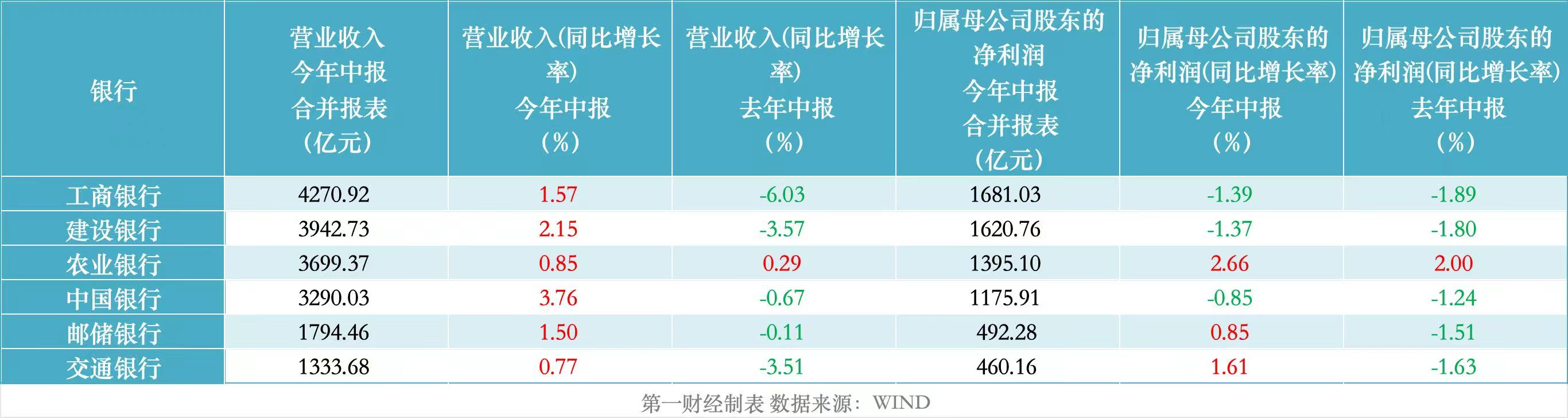
Core Viewpoint - The financial performance pressure on major state-owned banks has eased, with significant improvements in revenue and net profit compared to the previous year [1] Group 1: Financial Performance - In the first half of 2025, the six major state-owned banks achieved a total operating income of 1.83 trillion yuan, slightly up from approximately 1.8 trillion yuan in the same period last year [1] - The net profit attributable to shareholders reached 682.52 billion yuan, compared to about 683.39 billion yuan in the previous year [1] - All six major banks reported positive year-on-year growth in operating income, with China Bank (3.76%), Construction Bank (2.15%), and Industrial and Commercial Bank (1.57%) leading the growth rates [3] Group 2: Year-on-Year Comparison - In contrast to last year, when five of the six banks experienced negative revenue growth, this year all banks showed improvement, with Industrial and Commercial Bank previously experiencing a decline of over 6% [3] - Three banks reported positive year-on-year growth in net profit, with Agricultural Bank leading at 2.66%, followed by Traffic Bank and Postal Savings Bank at 1.61% and 0.85%, respectively [3] Group 3: Dividend Distribution - All six banks announced a mid-term dividend plan, distributing 30% of their net profit for the first half of the year, totaling 204.66 billion yuan [3] - The total dividend amount last year was approximately 204.82 billion yuan, with a stable payout ratio of 30% [3] Group 4: Dividend Details - Industrial and Commercial Bank plans to distribute approximately 50.40 billion yuan, with a dividend of 1.414 yuan per 10 shares [4] - Agricultural Bank intends to distribute 4.18 billion yuan, with a dividend of 1.195 yuan per 10 shares [4] - Construction Bank plans to distribute 48.61 billion yuan, with a dividend of 1.858 yuan per 10 shares [4] Group 5: Stock Performance - As of August 29, the median dividend yield for the six major banks is over 3%, with Industrial and Commercial Bank having the highest yield at around 4.15% and Construction Bank the lowest at 2.03% [5] - Agricultural Bank leads in stock performance with a 37.37% increase, while Traffic Bank has seen a decline of 1.55% [5]
狂赚6900亿元!国有六大行中期业绩亮眼,投资者笑称“躺着赚钱”
Hua Xia Shi Bao· 2025-08-30 09:40
Core Viewpoint - The performance report of China's six major state-owned banks for the first half of 2025 demonstrates their strong profitability and stability, reinforcing their appeal to conservative investors who value safety and consistent returns [1][2]. Group 1: Financial Performance - The six major banks collectively earned over 690 billion yuan in net profit in the first half of 2025, showcasing robust profitability [1]. - Industrial and Commercial Bank of China (ICBC) led with a revenue of 427.09 billion yuan, although its net profit decreased by 1.46% year-on-year to 168.80 billion yuan [3]. - Agricultural Bank of China reported a revenue of 369.90 billion yuan and a net profit increase of 2.5% to 139.94 billion yuan [4]. Group 2: Asset Quality - All six banks reported a year-on-year decline in non-performing loan (NPL) ratios, indicating improved asset quality [5]. - Postal Savings Bank of China had the lowest NPL ratio at 0.92%, while ICBC and China Construction Bank both reported NPL ratios of 1.33% [6]. - The banks maintained high provision coverage ratios, with ICBC at 217.71% and Agricultural Bank at 295% [5][6]. Group 3: Net Interest Margin - The net interest margin (NIM) for the six banks collectively declined, with the range of decrease between 0.08% and 0.21% [7]. - Postal Savings Bank had the highest NIM at 1.7%, while ICBC and Agricultural Bank reported NIMs of 1.3% and 1.32%, respectively [7][9]. - Future expectations indicate that while NIM may continue to decline, the rate of decrease is expected to slow down [10][11]. Group 4: Dividend Distribution - The six banks plan to distribute over 200 billion yuan in dividends, reflecting their status as "cash cows" in the capital market [12]. - The dividend payout ratio for most banks is around 30%, with ICBC proposing a dividend of 1.414 yuan per 10 shares, totaling approximately 50.40 billion yuan [12][13]. - The consistent high dividend payouts enhance the attractiveness of these banks to long-term investors [14][15].
管窥六大行上半年动向:推出中期分红计划,持续发力科技金融
Sou Hu Cai Jing· 2025-08-30 08:58
Core Viewpoint - The six major banks in China reported their mid-year performance, showing stable growth in revenue and net profit, while also announcing mid-term dividend plans amidst challenges such as declining net interest margins. Financial Performance - Industrial and Commercial Bank of China (ICBC) achieved operating income of 427.09 billion RMB, a growth of 1.6%, and net profit of 168.80 billion RMB, with ROA at 0.67% and ROE at 8.82% [1] - Agricultural Bank of China reported operating income of 369.9 billion RMB and net profit of 139.9 billion RMB, with year-on-year growth of 0.8% and 2.5% respectively [1] - Bank of China recorded operating income of 329.00 billion RMB, a year-on-year increase of 3.76%, and net profit of 126.14 billion RMB, with ROA at 0.70% and ROE at 9.11% [1] - China Construction Bank reported operating income of 394.27 billion RMB, a growth of 2.15%, and net profit of 162.64 billion RMB [1] - Bank of Communications achieved operating income of 133.37 billion RMB, a year-on-year increase of 0.77%, and net profit of 46.02 billion RMB, with a growth of 1.61% [2] - Postal Savings Bank reported operating income of 179.45 billion RMB, a growth of 1.50%, and net profit of 49.42 billion RMB, with a year-on-year increase of 1.08% [2] Dividend Plans - ICBC proposed a mid-term cash dividend of 1.414 RMB per 10 shares, totaling approximately 50.40 billion RMB [2] - Agricultural Bank suggested a cash dividend of 1.195 RMB per 10 shares, amounting to 41.82 billion RMB [2] - Bank of China plans to distribute a cash dividend of 1.094 RMB per 10 shares, totaling 35.25 billion RMB [2] - China Construction Bank proposed a cash dividend of 1.858 RMB per 10 shares, amounting to approximately 48.61 billion RMB [2] - Bank of Communications plans to distribute a cash dividend of 1.563 RMB per 10 shares, totaling 13.81 billion RMB [3] - Postal Savings Bank suggested a cash dividend of 1.230 RMB per 10 shares, totaling approximately 14.77 billion RMB [3] Strategies to Address Net Interest Margin Pressure - Bank of China is focusing on increasing asset allocation, optimizing liability structure, and managing foreign currency funds to counteract interest rate pressures [4] - China Construction Bank is adjusting its asset-liability structure and enhancing pricing management to maintain a reasonable net interest margin [4] Focus on Technology Finance - ICBC is enhancing its technology finance service system and has established 28 AIC equity investment funds, with technology loan balances exceeding 6 trillion RMB [6] - Bank of Communications is building a comprehensive financial service system for technology innovation, providing loans to 68,000 enterprises with a balance exceeding 1.5 trillion RMB [6] - China Construction Bank reported a technology loan balance of 5.15 trillion RMB, with a year-on-year increase of 16.81% [7]
交通银行殷久勇:聚焦重点领域 做足项目储备、深挖信贷需求
2 1 Shi Ji Jing Ji Bao Dao· 2025-08-30 07:24
Core Viewpoint - The report highlights that despite a slight decline in credit demand in the real economy, the bank is focusing on enhancing its credit project reserves and supporting key national strategies and sectors [1][3]. Group 1: Financial Performance - In the first half of 2025, the bank achieved a net profit attributable to shareholders of 46.016 billion yuan, a year-on-year increase of 1.61% [1]. - The total assets of the group reached 15.44 trillion yuan, growing by 3.59% compared to the end of the previous year [1]. - The non-performing loan (NPL) ratio stood at 1.28%, a decrease of 0.03 percentage points from the end of the previous year [1][2]. Group 2: Credit Growth and Focus Areas - The total customer loan balance reached 9 trillion yuan, an increase of 443.4 billion yuan, with a growth rate of 5.18% year-on-year [2][3]. - The bank is increasing support for major national strategies and key sectors, with loans in the Yangtze River Delta, Guangdong-Hong Kong-Macau, and Beijing-Tianjin-Hebei regions growing by 5.57% [2]. - Personal consumption loans increased by 18.06%, indicating a strong focus on consumer finance [2]. Group 3: Risk Management and Asset Quality - The bank's NPL ratio improved, but early warning indicators such as the attention loan ratio and overdue loan ratio have slightly increased [5][6]. - The bank disposed of 37.83 billion yuan in NPLs, a year-on-year increase of 27.9%, with significant recoveries from large projects [6]. - The bank is enhancing risk management by optimizing monitoring and collection processes, particularly for overdue loans [7]. Group 4: Interest Margin and Deposit Management - The net interest margin for the bank was 1.21%, showing a decline due to falling asset yields [8][9]. - The bank's deposits grew by 371 billion yuan, with a year-on-year increase of 271 billion yuan, primarily in time deposits [10]. - To manage deposit costs, the bank plans to enhance customer engagement through various services and reduce high-cost deposits [10].
国有六大行,拟中期分红超2000亿元
Zhong Guo Zheng Quan Bao· 2025-08-30 06:14
Core Insights - The six major state-owned banks in China reported a combined net profit of over 680 billion yuan for the first half of 2025, with all banks announcing mid-term dividend plans [1][3] Financial Performance - In the first half of 2025, the six banks achieved total operating income exceeding 1.8 trillion yuan and a combined net profit of 682.5 billion yuan [1] - Individual bank performances include: Industrial and Commercial Bank of China (ICBC) 168.1 billion yuan, Agricultural Bank of China (ABC) 139.5 billion yuan, Bank of China (BOC) 117.6 billion yuan, China Construction Bank (CCB) 162.1 billion yuan, Bank of Communications (BCOM) 46.0 billion yuan, and Postal Savings Bank of China (PSBC) 49.2 billion yuan [1] Dividend Plans - The total proposed mid-term dividends from the six banks exceed 200 billion yuan, with specific proposals including: - ICBC: 1.414 yuan per 10 shares, totaling approximately 50.4 billion yuan [3] - ABC: 1.195 yuan per 10 shares, totaling approximately 41.8 billion yuan [3] - BOC: 1.094 yuan per 10 shares, totaling approximately 35.3 billion yuan [3] - CCB: approximately 48.6 billion yuan [3] - PSBC: 1.230 yuan per 10 shares, totaling approximately 14.8 billion yuan [3] - BCOM: 1.563 yuan per 10 shares, totaling approximately 13.8 billion yuan [4] Strategic Focus - The banks are shifting away from a pure scale-driven approach, focusing on balanced and high-quality development [2] - In a low-interest-rate environment, banks are addressing the challenge of narrowing net interest margins by adapting to interest rate changes and diversifying non-interest income sources [2] - The banks are actively supporting new productive forces through technology finance, green finance, inclusive finance, pension finance, and digital finance [5] - Specific initiatives include: - CCB's comprehensive financial services for technology sectors, with a technology loan balance of 5.15 trillion yuan [5] - ICBC's establishment of an 80 billion yuan technology innovation fund [5] - PSBC's plan to invest 10 billion yuan in establishing an Asset Investment Company (AIC) [5]
狂赚6900亿元撒2000亿元分红,国有六大行中期业绩亮眼,投资者笑称“躺着赚钱”
Hua Xia Shi Bao· 2025-08-30 05:42
Core Viewpoint - The performance of China's six major state-owned banks in the first half of 2025 demonstrates their strong profitability and investment value, with a total net profit exceeding 690 billion yuan and a total dividend payout expected to exceed 200 billion yuan, reinforcing their status as "cash cows" in the capital market [2][15]. Group 1: Financial Performance - The six major banks achieved a total net profit of over 690 billion yuan in the first half of 2025, with all banks announcing mid-term dividend plans totaling over 200 billion yuan [2][15]. - Industrial and Commercial Bank of China (ICBC) reported the highest operating income of 427.09 billion yuan, but its net profit decreased by 1.46% year-on-year to 168.80 billion yuan [5][6]. - Agricultural Bank of China (ABC) ranked third in operating income with 369.90 billion yuan and a net profit increase of 2.5% to 139.94 billion yuan [7]. Group 2: Asset Quality - All six banks reported a year-on-year decline in non-performing loan (NPL) ratios, indicating improved asset quality [8][9]. - Postal Savings Bank of China had the lowest NPL ratio at 0.92%, while ICBC and Construction Bank both reported NPL ratios of 1.33% [8][9]. - The provision coverage ratios remained high, with ICBC at 217.71% and ABC at 295%, indicating strong risk mitigation capabilities [8][9]. Group 3: Net Interest Margin - The net interest margin (NIM) for all six banks showed a collective decline, with the range of decrease between 0.08% to 0.21% [10][11]. - Postal Savings Bank led with a NIM of 1.7%, followed by Construction Bank at 1.4% and ABC at 1.32% [10][13]. - The banks' management expressed expectations for a continued decline in NIM, but with a narrowing rate of decrease in the second half of the year [14]. Group 4: Dividend Distribution - The total expected dividend payout from the six banks is over 200 billion yuan, with dividend rates generally around 30% [15][18]. - ICBC plans to distribute approximately 50.40 billion yuan, while ABC intends to distribute about 41.82 billion yuan, both maintaining a 30% payout ratio [15][16]. - The consistent high dividend payout ratios reflect the banks' confidence in their operational stability and aim to attract long-term investors [17][18].