
BANK COMM(03328)

Search documents
分红公告“每10股”写成“每股”,交通银行公告更正并致歉
Zhong Guo Ji Jin Bao· 2026-03-30 12:50
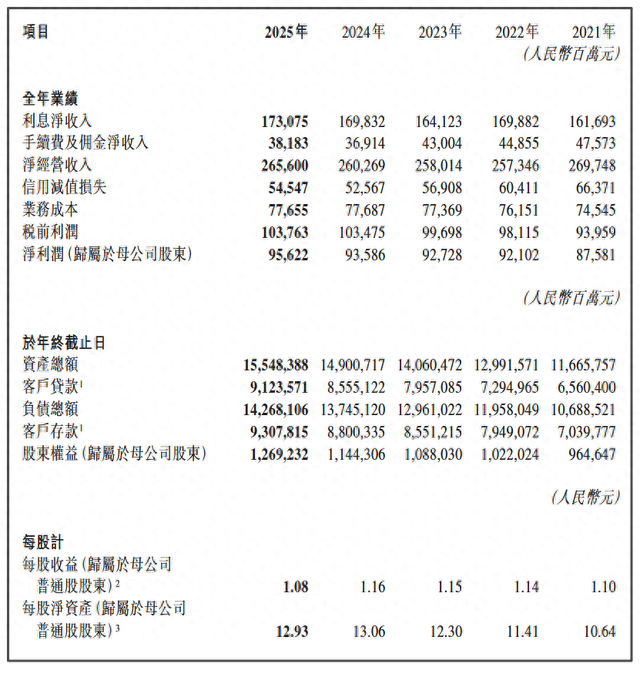
Group 1 - The core point of the article is that Bank of Communications issued a correction regarding its 2025 profit distribution announcement, changing the cash dividend from "per share" to "per 10 shares" [2][3][4] - The corrected cash dividend for 2025 is 3.247 yuan (including tax) per 10 shares, instead of per share as previously stated [3][4] - The bank attributed the error to "inadequate proofreading" and expressed apologies for any inconvenience caused to investors, stating that other content remains unchanged [4] Group 2 - For the year 2025, Bank of Communications reported total operating revenue of 265.071 billion yuan, a year-on-year increase of 2.02% [4] - The net profit attributable to shareholders was 95.622 billion yuan, reflecting a year-on-year growth of 2.18% [4] - The bank plans to distribute a total cash dividend of 28.692 billion yuan for 2025, with a cash dividend payout ratio of 32.3% [4]


机构行为图谱系列之二:藩篱与抉择:商业银行配债受哪些指标影响
ZHESHANG SECURITIES· 2026-03-30 12:24
Report Industry Investment Rating - The report does not mention the industry investment rating [1] Core Viewpoints - Multiple regulatory indicators form the "fence" for banks' allocation behavior, and banks' "choices" within these fences determine their asset allocation structure [1][3][24] Summary by Relevant Catalog 1. Fence Within: How Regulatory Constraints Determine Banks' Bond Market Choices - **"Ballast Stone" Status of Bank Allocation in the Bond Market**: As the main bond allocators in the bond market, commercial banks' "ballast stone" status is rooted in three logics: scale dominance, counter - cyclical characteristics, and stability under regulatory constraints. As of the end of February 2026, commercial banks' bond allocation in the inter - bank market was 82.16 trillion yuan, ranking first among various institutions, mainly investing in interest - rate bonds. Their counter - cyclical allocation provides a buffer for the market, and regulatory constraints make them natural buyers of interest - rate bonds [2][17][18] - **Commercial Bank Regulation: Macro - Prudential + Micro - Constraints**: Understanding banks' bond allocation behavior requires understanding their regulatory constraints, including the Macro - Prudential Assessment System (MPA), interest - rate risk indicators (ΔEVE/NII), liquidity risk indicators (LCR/NSFR), and capital adequacy ratio. These indicators form the "fence" for banks' allocation behavior [3][24] 2. Central Bank MPA: From Broad Credit to Bond Allocation - **Overview of MPA Indicator System**: MPA reshapes banks' bond - allocation behavior in three dimensions: total amount, structure, and timing. In terms of total amount, the broad - credit growth constraint makes bond investment a "regulatory item" after loan issuance. Structurally, capital - adequacy pressure forces banks' self - operated funds to concentrate on interest - rate bonds with zero risk - weight. Temporally, liquidity assessment indicators create a rigid "quarter - end effect". Under these constraints, banks' self - operated bond - allocation behavior shows characteristics of "quota restricted by credit, concentration on interest - rate bonds, and rhythm restricted by quarter - ends" [4][29] - **Three Transmission Paths of MPA on Banks' Bond Allocation**: - **Broad - Credit Growth Constraint → Limited Bond Allocation Quota**: The upper limit of broad - credit growth locks the growth rate of bond investment, squeezing out bond allocation when loan growth is fast, especially at quarter - ends [32][33] - **Capital - Adequacy Constraint → Decreased Risk Appetite + Increased Supply of Capital Instruments**: To meet capital - adequacy requirements, banks issue secondary - capital bonds and perpetual bonds and increase the allocation of low - capital - occupancy interest - rate bonds while reducing high - capital - occupancy credit bonds. In a period of strict capital regulation, the spread between interest - rate bonds and credit bonds tends to widen [34] - **Liquidity Indicator Constraint → Quarter - End Fund Pulse + Solidified Maturity Preference**: LCR assessment tightens the quarter - end capital market and releases concentrated demand for interest - rate bonds. NSFR constraint restricts banks from lending to non - bank institutions at quarter - ends, inhibits excessive maturity mismatch, and solidifies banks' preference for short - term bonds or long - term interest - rate bonds [35] 3. Triple Constraints of the Banking Risk Supervision System under the Financial Regulatory System - **Capital - Adequacy Constraint: Risk Weights Guide Allocation**: Capital - adequacy ratio is the core regulatory indicator. Risk weights determine the capital occupancy of bonds, and banks prefer bonds with lower risk weights. The investment priority of bond types is: treasury bonds, policy - financial bonds > local - government bonds > general - credit bonds, commercial - financial bonds > secondary - capital bonds > perpetual bonds. When capital adequacy is under pressure, banks compress high - weight assets, and the regulatory rating affects business qualifications and asset structure. Capital - supplement pressure increases the supply of capital instruments [37][44][45] - **Liquidity Risk Indicators: LCR and NSFR's "Rigid Demand" for High - Liquidity Assets**: The core goal of liquidity - risk supervision is to guide banks to match the maturity structure of assets and liabilities. LCR and NSFR are the two pillars. Different bonds have different conversion rates in HQLA and RSF coefficients, which affect banks' bond - type preferences. The comprehensive impact includes a significant quarter - end effect, solidified maturity preference, and structural differentiation [47][51][57] - **Interest - Rate Risk Supervision Indicators: How ΔEVE and ΔNII Constrain Allocation Maturity**: ΔEVE measures the maximum loss of the net present value of banks' assets and liabilities under different interest - rate shocks, and ΔNII measures the impact of interest - rate changes on net interest income. These two indicators jointly restrict large domestic banks' long - bond allocation. Banks tend to "buy short and sell long" to control bond maturity [58][59][60]



交通银行(03328) - 海外监管公告
2026-03-30 10:45
香港交易及結算所有限公司及香港聯合交易所有限公司對本公告之內容概不負責,對其準確性 或完整性亦不發表任何聲明,並明確表示,概不就因本公告全部或任何部分內容而產生或因倚 賴該等內容而引致之任何損失承擔任何責任。 (於中華人民共和國註冊成立的股份有限公司) 於本公告發佈之日,本行董事為任德奇先生、張寶江先生、殷久勇先生、 周萬阜先生、常保升先生*、廖宜建先生*、陳紹宗先生*、穆國新先生*、 艾棟先生*、張向東先生 # 、李曉慧女士 # 、馬駿先生 # 、王天澤先生 # 、肖偉先生 # 及 劉瑞霞女士 # 。 * 非執行董事 # 獨立非執行董事 股票代码:601328 股票简称:交通银行 编号:临 2026-013 (股份代號:03328) 海外監管公告 本公告乃根據香港聯合交易所有限公司證券上市規則第13.10B條而作出。 茲載列交通銀行股份有限公司於上海證券交易所網站刊登的《交通銀行股份有限 公司更正公告》,謹供參閱。 承董事會命 交通銀行股份有限公司 何兆斌 公司秘書 中國上海 2026年3月30日 更正后:(三)以截至 2025 年 12 月 31 日的普通股总股本 883.64 亿股为基 数,向本行登记在 ...
交通银行就利润分配方案公告存在文字错误致歉
Xin Lang Cai Jing· 2026-03-30 10:20
交通银行股份有限公司(以下简称"交通银行"或"本行")董事会及全体董事保证本 公告内容不存在任何虚假记载、误导性陈述或者重大遗漏,并对其内容的真实性、准确性和 完整性承担法律责任。 本行于 2026年3月27日披露《交通银行股份有限公司 2025年度利润分配 方案公告》(公告编号:临 2026-006),因校对不严,原公告存在文字错误。现 更正如下: 更正前:(三)以截至2025年12月31日的普通股总股本 883.64 亿股为基 数,向本行登记在册的A股股东和H股股东,每10股分配现金股利人民币1.684 元(含税),共分配现金股利人民币148.80亿元。在此基础上,加上本行已派发 的 2025年半年度股息(每10股分配现金股利人民币1.563元(含税)),本行 2025年度全年每股分配现金股利3.247元(含税),共分配现金股利人民币286.92 亿元,现金分红比例为32.3%(即分配的现金股利总额占归属于母公司普通股股 东净利润的比例)。 3月30日,交通银行发布更正公告:本行于2026年3月27日披露《交通银行股份有限公司2025年度利润分 配方案公告》,因校对不严,原公告存在文字错误。"每股分配现金 ...
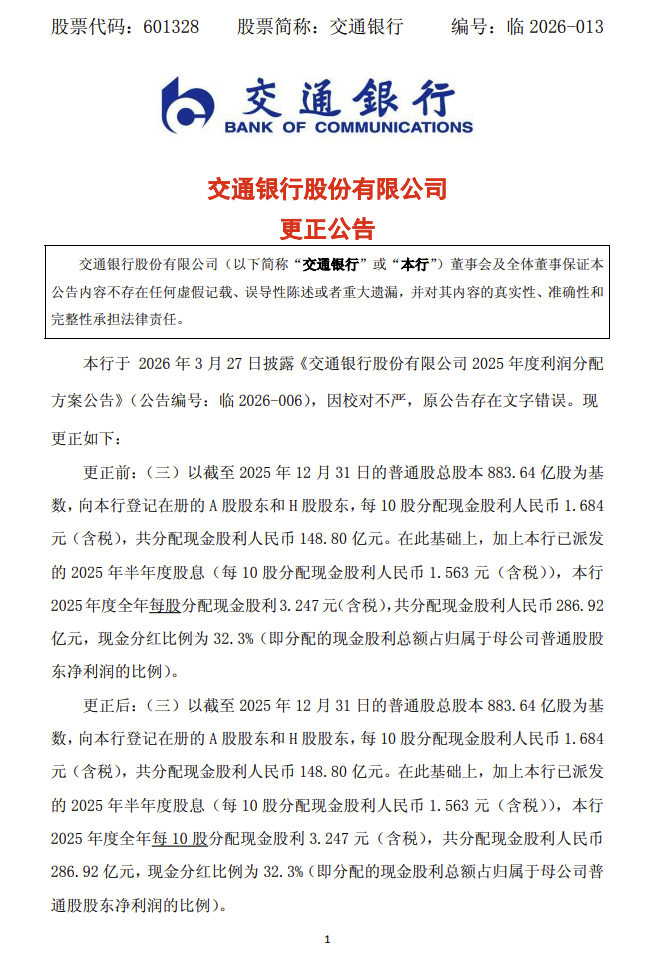
交通银行(601328) - 交通银行更正公告
2026-03-30 09:17
股票代码:601328 股票简称:交通银行 编号:临 2026-013 交通银行股份有限公司 更正公告 1 除上述更正外,其他内容无修改。本行对上述错误给投资者带来的不便深表 歉意。本行将进一步加强信息披露编制与复核,确保信息披露质量。 特此公告 交通银行股份有限公司董事会 交通银行股份有限公司(以下简称"交通银行"或"本行")董事会及全体董事保证本 公告内容不存在任何虚假记载、误导性陈述或者重大遗漏,并对其内容的真实性、准确性和 完整性承担法律责任。 本行于 2026 年 3 月 27 日披露《交通银行股份有限公司 2025 年度利润分配 方案公告》(公告编号:临 2026-006),因校对不严,原公告存在文字错误。现 更正如下: 更正前:(三)以截至 2025 年 12 月 31 日的普通股总股本 883.64 亿股为基 数,向本行登记在册的 A 股股东和 H 股股东,每 10 股分配现金股利人民币 1.684 元(含税),共分配现金股利人民币 148.80 亿元。在此基础上,加上本行已派发 的 2025 年半年度股息(每 10 股分配现金股利人民币 1.563 元(含税)),本行 2025年度全年每股分 ...
美银证券:降交通银行(03328)目标价至6.75港元 维持“中性”评级
智通财经网· 2026-03-30 07:08
智通财经APP获悉,美银证券发布研报称,交通银行(03328)去年纯利同比增长2.2%至956亿元人民币(下 同),较该行预期低0.6%。拨备前利润同比增1.6%,较预期高0.4%。股本回报率同比跌0.7个百分点至 8.4%。派息比率同比降至32.3%,全年每股派息0.325元,同比跌14.3%,受注资摊薄影响,但股息率仍 稳健,交行H股及交行(601328.SH)A股分别为5.3%及4.7%。该行下调交行2026年盈利预测1%,维持H 股"中性"评级,目标价由7.09港元下调至6.75港元,交行A股评级"买入",目标价由8.2元人民币下调至 7.54元人民币。 ...
交通银行:2025年盈利956亿元,同比增长2.18%
Guan Cha Zhe Wang· 2026-03-30 06:14
Core Viewpoint - The financial performance of Bank of Communications for the year 2025 shows steady growth in assets, net profit, and revenue, alongside improvements in asset quality and a focus on supporting key economic regions and sectors [1][2]. Financial Performance - Total assets reached 15.55 trillion RMB, an increase of 4.35% from the previous year [1][2]. - Net profit attributable to shareholders was 95.622 billion RMB, a year-on-year growth of 2.18% [1][2]. - Operating income was 265.071 billion RMB, reflecting a 2.02% increase compared to the previous year [1][2]. - The non-performing loan ratio stood at 1.28%, down by 0.03 percentage points from the end of the previous year, with a provision coverage ratio of 208.38% [1][8]. Loan and Deposit Growth - The balance of domestic RMB loans reached 8.87 trillion RMB, growing by 7.88% year-on-year [1]. - The bank's focus on effective investment support led to significant growth in loans to the manufacturing sector and private enterprises, both exceeding the average loan growth rate [1]. - Customer deposits amounted to 9.31 trillion RMB, with a notable increase in various loan categories, including a 20.76% rise in inclusive small and micro loans [5]. Dividend Policy - The bank announced a cash dividend of 0.1684 RMB per share for the second half of the year, totaling 14.88 billion RMB, maintaining a dividend payout ratio of over 30% for 14 consecutive years [3][4]. Strategic Initiatives - The bank launched the "Sci-Tech Easy Loan" product line, focusing on emerging technology sectors, with a loan balance of 1.58 trillion RMB, up 10.73% [5]. - Green finance initiatives included the issuance of 30 billion RMB in green bonds, with a loan balance of 950.825 billion RMB, reflecting a 14.16% increase [5]. - Digital finance efforts led to a retail AUM of nearly 6 trillion RMB, growing by 8.91%, and the deployment of over 2,500 AI assistants [6]. International and Cross-Border Operations - The bank's cross-border financial services platform, "Bank of Communications Trade Finance," saw a 7.61% increase in cross-border business income [7]. - The financing balance for cross-border trade grew by 85.58%, with international settlement volume increasing by 14.55% [7]. Capital Strength - The bank completed a targeted issuance of 120 billion RMB to enhance its capital strength and risk resilience [4]. - It ranked 9th among the "Top 1000 Global Banks" in terms of Tier 1 capital since 2023, maintaining its status as a globally systemically important bank for three consecutive years [9].
美银:下调交通银行AH股目标价,下调2026年盈利预测1%
Xin Lang Cai Jing· 2026-03-30 05:40
美银证券发表研究报告指,交通银行去年纯利按年增长2.2%至956亿元,较该行预期低0.6%;拨备前利 润按年增1.6%,较预期高0.4%;股本回报率按年跌0.7个百分点至8.4%。派息比率按年降至32.3%,全 年每股派息0.325元,按年跌14.3%,受注资摊薄影响,但股息率仍稳健,交行H股及A股分别为5.3%及 4.7%。该行下调交行2026年盈利预测1%,维持H股"中性"评级,目标价由7.09港元下调至6.75港元;交 行A股评级"买入",目标价由8.2元下调至7.54元。 ...
大行评级丨美银:下调交通银行AH股目标价,下调2026年盈利预测1%
Ge Long Hui· 2026-03-30 05:37
美银证券发表研究报告指,交通银行去年纯利按年增长2.2%至956亿元,较该行预期低0.6%;拨备前利 润按年增1.6%,较预期高0.4%;股本回报率按年跌0.7个百分点至8.4%。派息比率按年降至32.3%,全 年每股派息0.325元,按年跌14.3%,受注资摊薄影响,但股息率仍稳健,交行H股及A股分别为5.3%及 4.7%。该行下调交行2026年盈利预测1%,维持H股"中性"评级,目标价由7.09港元下调至6.75港元;交 行A股评级"买入",目标价由8.2元下调至7.54元。 ...
交通银行:归母净利润同比增长2.18% 不良贷款率实现四连降
Xin Lang Cai Jing· 2026-03-30 05:34
Core Insights - The core viewpoint of the news is that Bank of Communications (交通银行) has demonstrated solid financial performance in 2025, with a focus on both growth and structural optimization [1][3]. Financial Performance - In 2025, the bank achieved a net profit attributable to shareholders of 95.622 billion yuan, representing a year-on-year increase of 2.18% [1][3]. - The net operating income reached 265.6 billion yuan, with a year-on-year growth of 2.05%, and all major income items showed positive growth [1][3]. - By the end of 2025, total assets exceeded 15.5 trillion yuan, marking a 4.35% increase from the previous year [1][3]. - Over the past five years, the total dividend payout amounted to 123.869 billion yuan, with a dividend ratio maintained above 30% for 14 consecutive years [1][3]. Revenue Structure - The net income from fees and commissions grew by 3.44% year-on-year, increasing its share of net operating income to 14.38%, indicating that non-interest income is becoming a new engine for profit growth [1][3]. - Business and management expenses slightly decreased by 0.04%, leading to a cost-to-income ratio of 29.30%, showcasing significant cost reduction and efficiency improvement [1][3]. Asset Quality and Capital Strength - The non-performing loan (NPL) ratio stood at 1.28%, down by 0.03 percentage points from the previous year, continuing a four-year downward trend [1][3]. - The provision coverage ratio increased to 208.38%, up by 6.44 percentage points from the previous year, indicating enhanced risk mitigation capacity [1][3]. - The bank disposed of 73.837 billion yuan in non-performing loans, a year-on-year increase of 10.75%, reflecting a strengthened effort in risk clearance [1][3]. Capital Adequacy - The core Tier 1 capital adequacy ratio improved to 11.43%, up by 1.19 percentage points from the previous year, providing ample space for future credit allocation and strategic transformation amid tightening capital regulations [2][4]. Strategic Direction - The bank's performance in 2025 not only reflects solid results but also outlines a clear path for transformation, moving from stability to progress and from quantity to quality [2][4].