CMS(06099)

Search documents
从大数据到云原生:招商证券引领南科大学子探索金融技术前沿
Quan Jing Wang· 2025-11-17 08:14
Core Insights - The collaboration between China Merchants Securities and Southern University of Science and Technology aims to integrate investor education into the national education system, focusing on cultivating financial technology talents [1][2] - The courses on big data and cloud-native technologies are designed to bridge theoretical knowledge and practical applications in the financial industry, highlighting the importance of these technologies in areas such as customer profiling and risk management [1] Group 1 - The courses were conducted on November 7 and 11, 2025, featuring lectures on the application of big data and cloud-native technologies in the financial sector [1] - The lectures were led by Wang Chao, a data expert from the Information Technology Department of China Merchants Securities, who provided insights into the evolution of technology and its practical applications in the securities industry [1] - The big data course covered key technologies such as Hadoop, Spark, and Flink, illustrating their applications in precise customer profiling, intelligent risk control, and targeted marketing [1] Group 2 - The cloud-native course outlined the development of technology from its inception to maturity, emphasizing its role in building efficient architectures for handling large transaction volumes [1] - The collaboration between China Merchants Securities, Shenzhen Securities Regulatory Bureau, Shanghai Stock Exchange, and Southern University of Science and Technology has been ongoing since 2021, focusing on a comprehensive educational model that includes knowledge transfer, case analysis, and career development [2] - Future cooperation will aim to enhance talent cultivation, academic research, and employment guidance, fostering high-level financial technology talents with international perspectives and innovative capabilities [2]

大行评级丨招商证券国际:哔哩哔哩盈利前景持续改善 评级“增持”
Ge Long Hui· 2025-11-17 04:05
Core Viewpoint - Bilibili's Q3 revenue grew by 5% year-on-year, meeting expectations, while non-GAAP operating profit and net profit exceeded expectations by 6% and 22% respectively, driven by better-than-expected cost control and efficiency improvements from AI [1] Group 1: Financial Performance - Bilibili's Q3 revenue growth of 5% aligns with market expectations [1] - Non-GAAP operating profit and net profit surpassed expectations by 6% and 22%, respectively [1] - The company is expected to see a 22% and 19% year-on-year increase in advertising revenue for Q4 this year and next year [1] Group 2: Business Segments - The gaming segment is anticipated to recover quarter-on-quarter due to new popular products [1] - Strong performance in advertising is supported by Bilibili's rich content, traffic, and share of young users [1] Group 3: Future Outlook - The company maintains a positive outlook on its ability to adapt to the preferences of young users and sustain classic product operations [1] - Non-GAAP net profit forecasts have been raised by 4% to 7%, with expected revenues increasing by 13% and 9% year-on-year over the next two years [1] - The target price for Bilibili's US stock is set at $30, with a target price of HKD 234 for its H-shares [1]
研报掘金丨招商证券:腾讯音乐风险回报具吸引力 目标价下调至25.6美元
Ge Long Hui A P P· 2025-11-17 02:40
Core Viewpoint - Tencent Music's Q3 performance exceeded expectations, driven by strong growth in non-subscription business and stable subscription growth [1] Financial Performance - Revenue increased by 21% year-on-year, with non-subscription business growing by 51% year-on-year and subscription business growing by 17% year-on-year [1] - Non-GAAP net profit exceeded expectations by 4% [1] Investment Outlook - The company is viewed positively due to its strong content and services, establishing a solid competitive moat [1] - The target price for US stocks has been revised down from $29.2 to $25.6, maintaining a "Buy" rating [1]

十大券商看后市|A股中长期向好趋势不改,短期或以震荡为主
Sou Hu Cai Jing· 2025-11-17 00:17
Core Viewpoint - The A-share market is expected to maintain a long-term upward trend despite short-term fluctuations, with a focus on sector rotation and investment opportunities in technology and cyclical industries [1][3][10]. Market Performance - The A-share market has been oscillating around the 4000-point mark, with a slowdown in the upward slope of the index, but this does not indicate the end of the current market cycle [1][10]. - The market is currently in a "systematic slow bull" phase, with a positive long-term outlook [1][12]. Sector Rotation - There is a notable rotation among sectors, with funds shifting from previously high-performing technology stocks to sectors like lithium batteries and consumer goods, benefiting from policy support [3][10][11]. - Investment themes to watch include anti-involution and dividend opportunities, as well as specific technology segments that may see a rebound [2][4]. Institutional Behavior - As the year-end approaches, institutional allocations are expected to stabilize, leading to a focus on balanced investment strategies [3][8]. - The upcoming Central Economic Work Conference is anticipated to set the tone for macroeconomic policies and investment priorities for the following year [8][11]. Economic Indicators - Recent economic indicators show a decline in M1 growth, suggesting a weakening macro liquidity environment, which may impact market dynamics [10]. - The market is currently experiencing a "high position oscillation," with expectations of a gradual recovery in economic conditions [5][16]. Investment Strategies - Investors are advised to focus on sectors with potential for performance improvement, such as AI, engineering machinery, and renewable energy, while also considering the implications of global market trends [7][17]. - The emphasis on "small and mid-cap + thematic investment" is seen as a favorable strategy in the current market environment [15].


机构研究周报:牛市或步入第二阶段,配置力量有望推动利率下行
Wind万得· 2025-11-16 22:35
Focus Review - The People's Bank of China (PBOC) will conduct a 6-month reverse repurchase operation of 800 billion yuan to maintain liquidity in the banking system, resulting in a net injection of 500 billion yuan after accounting for maturing operations [3] - The PBOC has established a pattern of monthly liquidity injections, indicating a continued focus on maintaining a loose monetary environment amid increased growth demands [3] Equity Market - CITIC Securities suggests that China's capital market is transitioning from an emerging market to a mature market, with an increasing global business exposure for listed companies, which is foundational for a low-volatility bull market [5] - Huatai Securities predicts that the A-share profit cycle will likely recover in the first half of 2026, driven by positive signals from capacity inventory cycles and overseas expansion [6] - Galaxy Securities warns of a potential decline in market risk appetite as the year-end approaches, suggesting a focus on cyclical sectors and dividend stocks that may benefit from improved Sino-U.S. trade relations [7] Industry Research - HSBC Jintrust Fund highlights the storage industry as a sector with multiple opportunities, driven by policy shifts and increased demand, particularly from AI data centers, suggesting a strategic opportunity for high growth [12] -招商证券 identifies investment potential in sectors experiencing supply clearing, particularly in resources, consumer goods, and traditional machinery, recommending focus on quality leaders and low-inventory industries [13] - 嘉实基金 sees significant long-term growth potential in China's innovative pharmaceutical sector, suggesting that recent corrections are a market adjustment rather than an end to the growth trend [14] Asset Allocation - Guosen Securities indicates that the bull market may be entering its second phase, with economic conditions improving and a broadening market trend, particularly in technology and undervalued sectors like liquor and real estate [22]






从“内卷”到“反内卷”,新能源赛道迎来新周期?|2025招商证券“招财杯”ETF实盘大赛
Sou Hu Cai Jing· 2025-11-14 12:26
Core Viewpoint - The renewable energy sector has entered a new growth cycle driven by policy support, rising demand, and technological advancements, particularly in solar, lithium battery, and energy storage segments [1][3][18]. Policy Support - The "anti-involution" policy is being reinforced, which is expected to improve the supply-demand structure in the solar industry and curb excessive competition [6][10]. - The "14th Five-Year Plan" has shifted focus from rapid growth to high-quality development, emphasizing the importance of renewable energy in meeting future electricity demands [11][12]. Demand Dynamics - The demand for renewable energy is primarily driven by two sectors: the electric vehicle market and energy storage. The electric vehicle market is seeing strong sales due to new model releases and upgraded subsidy policies [4][7]. - Energy storage is transitioning from policy-driven demand to economic-driven demand, with significant cost reductions in storage systems and increasing profitability due to market price fluctuations [4][7]. Technological Advancements - Solid-state batteries are expected to achieve small-scale production by 2027 and enter the mid-to-high-end power battery market by 2030, driven by technological breakthroughs [1][17]. - Perovskite solar cells are anticipated to be commercialized around 2030, potentially enhancing efficiency and reducing costs in the solar sector [16][17]. Market Performance - The renewable energy sector has rebounded significantly after a prolonged adjustment period, with various sub-sectors experiencing substantial price increases [3][19]. - The sector's valuation remains relatively low compared to historical levels, presenting an attractive investment opportunity for those seeking growth with a margin of safety [19][20]. Investment Opportunities - Investors interested in lithium battery demand and solid-state battery breakthroughs can consider the CSI New Energy Vehicle Index, which covers the entire lithium battery supply chain [2][25]. - For those focused on the "anti-involution" concept, the CSI Photovoltaic Industry Index is recommended, while the ChiNext New Energy Index offers comprehensive coverage of lithium, storage, solar, and wind energy sectors [2][25].
中资券商股尾盘加速下跌 高基数下10月新开户有所回落 机构称居民存款搬家仍在
Zhi Tong Cai Jing· 2025-11-14 07:11
Core Viewpoint - Chinese brokerage stocks experienced a significant decline in late trading, with notable drops in major firms such as GF Securities, CITIC Securities, and others, reflecting a broader market sentiment shift [1] Group 1: Market Performance - As of the report, GF Securities (000776) fell by 3.88% to HKD 19.09, CITIC Securities (601066) decreased by 2.34% to HKD 12.94, and other major brokerages also saw declines [1] - The Shanghai Stock Exchange reported that new account openings in October totaled 2.4672 million, a month-on-month decrease of 21.4% and a year-on-year decline of 66.3% [1] Group 2: Market Sentiment and Analysis - Donghai Securities noted that the slowdown in new account openings is attributed to a previous surge in market sentiment that led to concentrated demand, as well as a high base effect from last year's "924" market rally [1] - Despite the decline in new accounts, market sentiment remains high, with ongoing fluctuations around the 4000-point level leading to divergent trading sentiments among brokerages [1] Group 3: Financial Data Insights - China Galaxy Securities highlighted that financial data from October indicates a further shift of residents' deposits, driven by the stock market's profitability, which is a positive signal for the market [1] - The firm also pointed out that the apparent pause in the movement of deposits from residents to non-bank entities is likely influenced by last year's rapid shifts, suggesting that monitoring of subsequent data is essential [1]


港股异动 | 中资券商股尾盘加速下跌 高基数下10月新开户有所回落 机构称居民存款搬家仍在
智通财经网· 2025-11-14 07:09
Group 1 - Chinese brokerage stocks accelerated their decline towards the end of trading, with notable drops including GF Securities down 3.88% to HKD 19.09, CITIC Securities down 2.34% to HKD 12.94, and China Merchants Securities down 1.88% to HKD 15.62 [1][1][1] - The Shanghai Stock Exchange reported that new account openings in October totaled 2.4672 million, a month-on-month decrease of 21.4% and a year-on-year decrease of 66.3% [1][1][1] - Donghai Securities noted that the slowdown in account openings is attributed to a previous surge in market sentiment and the high base effect from last year's "924" market rally, while still indicating that market sentiment remains strong [1][1][1] Group 2 - China Galaxy Securities highlighted that financial data from October indicates a further shift of household deposits into the stock market, which is a positive signal for the market [1][1][1] - The firm previously emphasized that the apparent pause in the movement of household deposits to non-bank entities in September was influenced by last year's rapid shifts, suggesting that the trend of moving deposits is ongoing and should be monitored [1][1][1]

A股重要信号,至少6家券商上调两融规模
2 1 Shi Ji Jing Ji Bao Dao· 2025-11-14 05:25
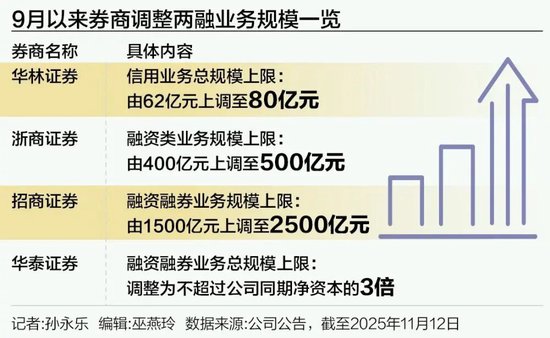
记者丨孙永乐 21世纪经济报道记者观察到,面对A股市场信用交易需求的持续旺盛,券商正积极把握业务机遇,纷纷 扩容两融业务规模。 10月底,两家头部券商几乎同步官宣上调两融业务额度,招商证券将两融业务规模上限从1500亿元大幅 提升至2500亿元,华泰证券最新两融总规模上限则定格在约2865亿元。 据记者不完全统计,截至目前,年内已有至少6家证券公司宣布上调两融及相关融资类业务规模上限, 包括华林证券、山西证券、兴业证券、浙商证券。 业内人士认为,10月两融新开户数据环比回落,主要是因为国庆长假压缩开户窗口,叠加节后市场波动 引发观望情绪。但需看到这是短期扰动,非趋势逆转。投资者信心修复与政策暖意仍在,两融需求长期 向好。当前市场杠杆水平更趋稳健,券商在业务扩张中仍坚守风控底线。 编辑丨巫燕玲 近日,A股10月融资融券新开户数据出炉。中证数据有限责任公司(简称"中证数据")最新数据显示, 10月份市场新开融资融券账户13.02万户,环比9月的20.54万户出现明显回落。 截至10月末,市场融资融券账户总数已达1539.88万户,同时,融资融券余额继续攀升,已经从年初的 不足1.9万亿元增长至2.49万亿元。 同 ...
A股重要信号,至少6家券商上调两融规模
21世纪经济报道· 2025-11-14 05:21
Core Viewpoint - The A-share market experienced a significant decline in new financing and securities lending accounts in October, with 130,200 new accounts opened, a decrease of 36.61% compared to September's 205,400 accounts. Despite this, the total number of financing and securities lending accounts reached 15.39 million, and the balance of financing and securities lending increased to 2.49 trillion yuan, indicating a robust long-term demand for credit trading in the market [1][4][8]. Summary by Sections New Account Openings - In October, the number of new financing and securities lending accounts fell to 130,200, down from 205,400 in September, marking a 36.61% decrease. This decline is attributed to the National Day holiday and market volatility, which compressed the time available for investors to open accounts [3][4][6]. - The total number of financing and securities lending accounts reached 15.39 million by the end of October, with 96 securities companies and 11,600 business outlets engaged in these activities [4]. Market Dynamics - The financing and securities lending balance has risen from less than 1.9 trillion yuan at the beginning of the year to 2.49 trillion yuan, reflecting a strong demand for credit trading [1][8]. - The market sentiment has shown volatility, impacting both ordinary trading and credit trading accounts, with a noticeable decrease in new account openings for both categories in October [4][6]. Brokerages' Response - Major brokerages are actively expanding their financing and securities lending business. For instance, China Merchants Securities raised its business limit from 150 billion yuan to 250 billion yuan, while Huatai Securities set its limit at approximately 286.5 billion yuan [2][8][9]. - At least six securities companies have announced increases in their financing and securities lending business limits this year, including Huatai Securities, China Merchants Securities, and others [7][9]. Future Outlook - Industry experts predict that the demand for financing and securities lending will remain strong in the long term, despite short-term fluctuations. The current market leverage level is stabilizing, and brokerages are maintaining risk control while expanding their business [1][10].