
DRCB(09889)

Search documents
东莞农商银行:支付新升级,消费新动力
Nan Fang Du Shi Bao· 2025-06-26 23:12
Core Viewpoint - Dongguan Rural Commercial Bank is actively responding to policies aimed at expanding domestic demand and promoting consumption by implementing innovative financial measures to support local economic development [2][5]. Group 1: Financial Services and Innovations - The bank focuses on simplifying processes, lowering thresholds, and accurately reaching target customers to enhance market vitality [2]. - It promotes the use of QR code payments in high-frequency consumer scenarios such as farmers' markets and convenience stores, significantly improving payment efficiency and consumer experience [2][3]. Group 2: Consumer Incentives and Promotions - Dongguan Rural Commercial Bank has launched various promotional activities to stimulate consumption, including discounts for customers using the bank's payment services at participating merchants [3]. - The "Spend and Save" campaign offers discounts such as "20 yuan off for spending 100 yuan" and "5 yuan off for spending 20 yuan," covering over 900 merchants across 30 towns [3]. Group 3: Collaboration and Community Engagement - The bank collaborates with local government and businesses to organize diverse promotional activities in key sectors like tourism, dining, and retail, effectively engaging different consumer groups [4]. - It has introduced a "trade-in" subsidy program for durable goods, encouraging consumers to upgrade their appliances [4]. Group 4: Digital Payment Expansion - Dongguan Rural Commercial Bank is promoting the use of digital RMB in retail, with over 30,000 digital wallets and services provided to more than 200 merchants [4]. - The bank aims to enhance the breadth and depth of digital payment services in core areas such as wholesale markets and dining [4]. Group 5: Future Outlook - The bank is committed to continuing its support for the real economy and optimizing financial service models to contribute to the prosperity of Dongguan's economy and the vitality of its consumption market [5].


或受2024年罚单影响,东莞农商银行债券承销能力被定为D类
Hua Xia Shi Bao· 2025-06-11 11:16
Core Viewpoint - The China Interbank Market Dealers Association has rated Dongguan Rural Commercial Bank as a D-class general underwriter, which may lead to the loss of its underwriting qualifications if it remains in this category for two consecutive years [1][5][8]. Group 1: Market Evaluation Results - The evaluation results are the first disclosure following the revision of market evaluation rules in June 2024, which categorized underwriters into general and specialized types [4]. - Among 26 national and 28 local banks, most were rated B-class, with 12 rated A-class, while Dongguan Rural Commercial Bank and two others received a D-class rating [2][5]. Group 2: Underwriting Business Performance - Dongguan Rural Commercial Bank's net commission income has decreased by 35.9% year-on-year to 457 million yuan in 2024, influenced by adjustments in insurance and wealth management product fees [1][9]. - The bank's overall commission income has declined from 1.585 billion yuan in 2016 to 457 million yuan in 2024, a reduction of 71.2% [9]. Group 3: Regulatory and Compliance Issues - The D-class rating may be linked to a fine of 800,000 yuan imposed on the bank in December 2024 for inadequate bond underwriting management and inappropriate insurance product sales to elderly clients [8]. - The evaluation criteria include business scale and quality, with the bank reportedly falling below the bottom 10% in terms of underwriting amounts and issuer numbers [2][6]. Group 4: Financial Performance Impact - The bank's net profit has been declining, with a 12.11% drop in 2023 and a 9.08% drop in 2024, indicating pressure on overall financial performance [10]. - The decline in underwriting qualifications could further impact the bank's intermediary income and overall performance growth [10].

债券承销综合评价结果首次公布!江西银行、吉林银行、东莞农商行被评为D档
Xin Lang Cai Jing· 2025-06-06 11:33
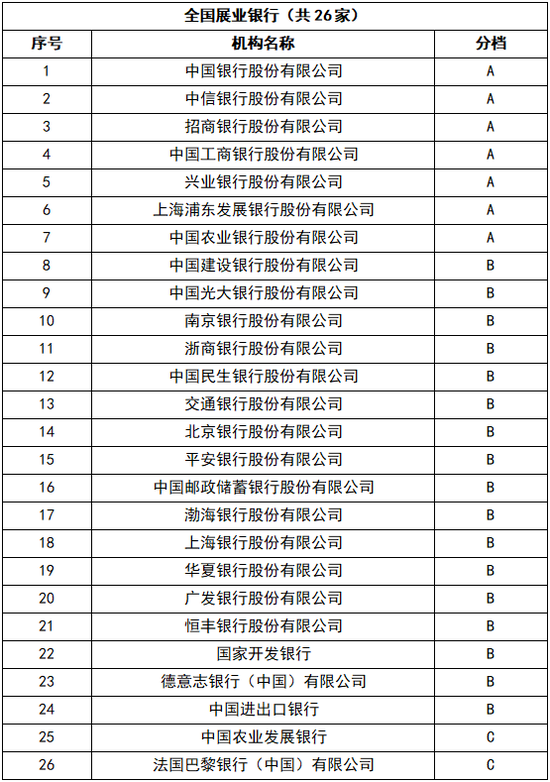
Core Insights - The China Interbank Market Dealers Association has released the annual evaluation results for main underwriters of non-financial corporate debt financing instruments for 2024, marking the first comprehensive evaluation of its kind [1][2][6] - A total of 72 institutions were evaluated, with 17 receiving an A rating, including major banks like Bank of China and CITIC Bank, as well as several securities firms [1][2][3] - The evaluation aims to shift the market focus from "scale-driven" to "capability-driven" by assessing underwriters on pricing, sales, and market-making abilities [2][6] Evaluation Results - Among the 26 national banks evaluated, 7 were rated A, while 17 received a B rating, and 2 were rated C [3][4] - In the local banks category, 5 institutions received an A rating, while 18 were rated B, and 3 were rated D, which indicates compliance issues [4][7] - In the securities firms category, 5 firms received an A rating, with 10 rated B and 3 rated C [5][6] Special Categories - The association identified four types of specialty underwriters: value discovery, inclusive finance, pioneering, and open service, with China Merchants Bank being the only institution to receive all four distinctions [1][6][8] - Notable institutions recognized for their capabilities include CITIC Securities and Industrial and Commercial Bank of China in various specialty categories [5][6] Compliance and Risks - Three banks were rated D due to compliance issues, which could lead to the cancellation of their business qualifications if they remain in this category for two consecutive years [7][9] - Specific compliance failures included improper bond underwriting management and violations related to bond trading practices [9][10] Market Expansion - The number of institutions involved in non-financial corporate debt financing has expanded, with 99 main underwriters reported as of April 2025, including 67 banks and 25 securities firms [10][12] - The total issuance of debt financing instruments reached 34,396 billion yuan, indicating a robust market activity [10][12] Future Directions - The association plans to enhance the evaluation mechanism to further improve the underwriting capabilities and quality of service in the bond market, aligning with national policies for economic support [12][14]



破2!多款银行理财产品下调
Jin Rong Shi Bao· 2025-05-14 12:38
Core Viewpoint - The recent adjustment of performance benchmarks for bank wealth management products reflects a response to market interest rate changes, indicating a new wave of adjustments in the banking wealth management market following the release of news about interest rate cuts [1][2]. Group 1: Adjustments in Performance Benchmarks - Multiple banks and wealth management subsidiaries have announced reductions in the performance benchmarks of their products, with some adjustments exceeding 100 basis points and benchmarks falling below 2% [1]. - For instance, Xinyin Wealth Management adjusted the performance benchmark of its "Tiantian Wanlibao" product from an annualized range of 2.10%-4.05% to 1.50%-2.50% [1]. - Approximately 150 bank wealth management products have adjusted their performance benchmarks since May 7, 2025, indicating a widespread trend in the industry [3]. Group 2: Market Scale and Trends - The total scale of the bank wealth management market has decreased by 0.81 trillion yuan compared to the end of last year, with a current scale of approximately 29.14 trillion yuan [3]. - The industry is facing a dilemma of expanding scale while experiencing shrinking income, as continuous reductions in deposit rates have led many low-volatility wealth management products to be positioned as substitutes for deposits [3]. Group 3: Investor Response and Fee Adjustments - Investors are advised to adapt to the changing market environment by adjusting their investment return expectations and considering their investment capabilities and experiences [4]. - Following the benchmark adjustments, many wealth management institutions have initiated a wave of fee reductions to enhance product attractiveness and signal shared interests with clients [5]. - For example, Jiaoyin Wealth Management announced a reduction in the sales fee rate for one of its products from 0.20% to 0.10% per year for a three-month period [5].
东莞农商银行盘中最低价触及3.160港元,创近一年新低
Jin Rong Jie· 2025-05-06 08:56
本文源自:金融界 作者:港股君 东莞农村商业银行股份有限公司(以下简称"东莞农商银行")是一家具有独立法人资格的总行级地方性股 份制商业银行,历史可追溯至1952年,前身是东莞市农村信用合作联社,2005年完成统一法人体制改革,2009 年完成股份制改制,2021年9月29日成功在香港联交所挂牌上市(股份代号:9889.HK),成为全国第13家上市 农商银行、H股第4家上市农商银行,也是东莞市首家上市地方法人金融机构。截至2023年12月末,东莞农 商银行集团资产总额达7088.54亿元,同比增幅7.78%;集团各项存款余额4870.95亿元,同比增幅6.08%;集团 各项贷款余额3550.73亿元,同比增幅6.95%。集团不良贷款率为1.23%,拨备覆盖率308.30%,资本充足率 15.85%,一级资本充足率13.65%,实现净利润53.46亿元,ROA(资产利润率)、ROE(资本利润率)分别为 0.78%和9.61%。据英国《银行家》最新统计,按截至2022年末的一级资本计算,东莞农商银行排名全球银 行业第214位,位居全球银行业300强;在中国银行业协会发布的"2023年中国银行业100强榜单"中,按 ...
东莞农商银行(09889) - 2024 - 年度财报
2025-04-29 10:32
Financial Performance - Operating revenue for 2024 was RMB 12,311,928 thousand, a decrease of 7.15% compared to 2023[34]. - Pre-tax profit for 2024 was RMB 4,103,910 thousand, down 20.62% from the previous year[34]. - Net profit for 2024 was RMB 4,860,559 thousand, reflecting a decline of 9.08% year-over-year[34]. - Total assets increased to RMB 745,904,488 thousand, representing a growth of 5.23% compared to 2023[35]. - Basic earnings per share for 2024 decreased to RMB 0.67, down 10.67% from 2023[35]. - The cost-to-income ratio increased to 37.44%, up 2.14 percentage points compared to the previous year[37]. - Net interest income decreased to RMB 9.17 billion, a decline of RMB 1.40 billion or 13.22% year-on-year[50]. - Non-interest income increased to RMB 3.14 billion, up RMB 449.79 million or 16.73% year-on-year[50]. Asset and Loan Management - The total assets of the group reached RMB 746.904 billion, with total deposits amounting to RMB 520.248 billion and total loans of RMB 381.045 billion[19]. - Customer loans and advances reached RMB 381,044,893 thousand, a growth of 7.31% from 2023[35]. - The non-performing loan ratio stands at 1.84%, with a provision coverage ratio of 207.72%[26]. - The total amount of customer loans and advances reached RMB 381.04 billion, an increase of RMB 25.97 billion or 7.31% compared to the previous year[100]. - The non-performing loan (NPL) ratio improved to 1.84% in 2024 from 1.23% in 2023, with total non-performing loans amounting to RMB 6.98 billion compared to RMB 4.30 billion in the previous year[134][135]. Risk Management - The company has not identified any significant risks that could adversely affect its future development strategy and operational goals during the reporting period[7]. - The report indicates that the company has maintained a focus on risk management, detailing the main risks faced and the measures taken to address them[7]. - The risk management framework includes a board of directors, supervisory board, senior management, and specialized committees, ensuring comprehensive risk oversight[199]. - The company maintains a prudent risk appetite, balancing risk, capital, and returns in its overall risk management principles[199]. Strategic Initiatives - The new five-year development strategy has been established, focusing on enhancing strategic execution and promoting digital transformation[21]. - The group aims to improve financial service quality and efficiency, emphasizing the importance of serving the real economy and enhancing financial product innovation[22]. - The group is committed to deepening institutional reforms and enhancing core competitiveness through improved organizational structure and resource allocation[22]. - The group plans to align with national and local strategic decisions, focusing on high-quality development and market changes[20]. Shareholder and Dividend Information - The company plans to allocate 10% of the audited net profit for 2024, amounting to RMB 443 million, to statutory surplus reserves and another RMB 443 million to general reserves[7]. - A cash dividend of RMB 0.25 per share (before tax) is proposed based on the total share capital, pending approval at the 2024 annual general meeting[7]. - The group aims to create greater value for shareholders, customers, society, and employees while achieving symbiosis with the economy, society, and environment[22]. Digital Transformation and Technology - The bank is focusing on digital transformation and light capital development as part of its strategic initiatives[30]. - The company is actively advancing financial technology innovations, focusing on smart marketing, risk control, and operational efficiency[195]. - The company has invested a total of RMB 615.55 million in financial technology during the reporting period[192]. - The comprehensive counter replacement rate for electronic channels reached 98.49%, indicating a strong digital operation capability[198]. Market Presence and Expansion - The company aims to deepen its market presence in the Guangdong-Hong Kong-Macao Greater Bay Area, focusing on regional coordinated development[139]. - The company has established 485 branches, with 475 located in Dongguan, making it the leader in the number of bank branches in that area[196]. - The company has partnered with third parties to set up two rural commercial banks in Zhanjiang and Shantou, totaling 165 branches[196]. Compliance and Governance - The company assures that the content of the annual report is true, accurate, and complete, with no false records or misleading statements[6]. - The bank's governance structure includes a diverse shareholder base, promoting a balanced and coordinated decision-making process[30]. - The company has maintained compliance with regulatory requirements, with the single largest customer loan to net capital ratio at 4.23%, below the 10% threshold[143].
9家上市行“反向追薪”超1.13亿!渤海银行人均退薪3.93万,招商银行未再披露
Xin Lang Cai Jing· 2025-04-03 00:23
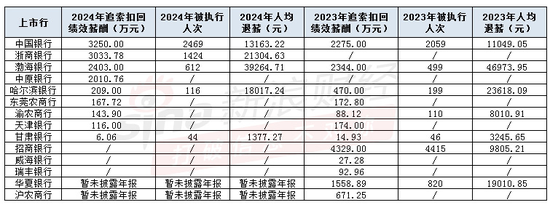
Core Viewpoint - The 2024 annual reports of listed banks reveal significant performance salary clawbacks, with a total amount exceeding 113 million yuan across nine banks, indicating a growing trend in enforcing accountability in executive compensation [1][4]. Summary by Category Performance Salary Clawbacks - Nine listed banks have disclosed their performance salary clawback situations in their 2024 annual reports, including major banks like Bank of China, Zhejiang Commercial Bank, and Bohai Bank [1][4]. - The total amount of clawbacks reported by these banks exceeds 113 million yuan, with Bank of China leading at 32.5 million yuan [1][4]. - The average clawback amount per person was highest at Bohai Bank, reaching 39,264.71 yuan, while Bank of China and Harbin Bank also reported significant average clawbacks exceeding 10,000 yuan [2][4]. Year-on-Year Comparison - Compared to 2023, several banks, including China Merchants Bank and Weihai Bank, did not disclose specific clawback amounts for 2024, despite having reported significant figures in the previous year [6]. - In 2023, China Merchants Bank had the highest clawback amount at 43.29 million yuan, affecting 4,415 employees with an average clawback of approximately 9,805 yuan [6]. Disclosure Trends - Zhejiang Commercial Bank and Zhongyuan Bank disclosed specific clawback amounts for the first time in 2024, indicating an improvement in transparency [7]. - Bohai Bank and Dongguan Rural Commercial Bank have consistently disclosed their clawback amounts for three consecutive years, showing a commitment to accountability [5][6]. Regulatory Context - The regulatory framework for performance salary clawbacks has been strengthened over the years, with guidelines established by the former China Banking Regulatory Commission and the China Banking and Insurance Regulatory Commission [10][11]. - As of 2023, over 95% of banking institutions have implemented performance salary clawback mechanisms, reflecting a significant shift towards more robust governance in the banking sector [11].
“扎根地方经济+数字化转型”的东莞农商银行,2024年报数据双降
Jin Rong Jie· 2025-04-01 08:06
Financial Performance - Dongguan Rural Commercial Bank reported a revenue of 12.312 billion yuan in 2024, a year-on-year decrease of 7.15% [1] - Net profit fell to 4.861 billion yuan, down 9.08% year-on-year, with attributable net profit decreasing by 10.40% to 4.625 billion yuan [1] - Pre-tax profit saw a significant decline of 20.62% to 4.104 billion yuan, primarily due to falling market interest rates and policies aimed at benefiting the real economy, leading to a 13.22% reduction in net interest income [1] Business Growth - The bank's total assets reached 745.904 billion yuan, reflecting a year-on-year growth of 5.23% [1] - Deposits increased by 6.81% to 520.248 billion yuan, while loans grew by 7.31% to 381.045 billion yuan, indicating strong regional market penetration and support for the real economy [1] Profitability Challenges - The average yield on interest-earning assets decreased from 3.64% to 3.23%, primarily due to lower loan yields influenced by the decline in LPR and reduced bond investment returns [2] - Despite a slight decrease in the cost of interest-bearing liabilities to 1.93%, net interest margin pressure remains significant [2] - Non-interest income saw a structural adjustment, with non-interest net income increasing by 16.73% to 3.138 billion yuan, largely driven by a 70.87% surge in trading net income [2] Asset Quality - The non-performing loan (NPL) ratio rose from 1.23% in 2023 to 1.84%, indicating increasing risk exposure [3] - The provision coverage ratio significantly dropped from 308.30% to 207.72%, reflecting a weakened risk mitigation capacity [3] Liquidity and Capital Adequacy - The loan-to-deposit ratio slightly increased to 73.27%, showing improved liquidity management [3] - Capital adequacy ratio stood at 16.54%, with a Tier 1 capital adequacy ratio of 14.37%, both exceeding regulatory requirements [3] Future Outlook - The bank's performance highlights the typical challenges faced by regional banks during macroeconomic pressures, balancing scale expansion with profitability [3] - Future focus will be on achieving "high-quality growth" through digital transformation, optimizing asset structure, and strengthening risk control capabilities [3]
不良四连涨,东莞农商银行上市后首次营收净利“双降”
2 1 Shi Ji Jing Ji Bao Dao· 2025-03-30 13:14
Core Viewpoint - Dongguan Rural Commercial Bank reported its first annual decline in both revenue and net profit since its listing in Hong Kong in 2021, with revenue of 12.312 billion yuan and net profit of 4.861 billion yuan for 2024, marking a decrease of 7.15% and 9.08% respectively compared to the previous year [1][2][3] Financial Performance - The bank's total assets reached 745.904 billion yuan at the end of 2024, an increase of 37.051 billion yuan or 5.23% from the beginning of the year [1][4] - The total loan balance was 381.045 billion yuan, up 25.972 billion yuan or 7.31% year-on-year [1][4] - The non-performing loan ratio stood at 1.84%, with a provision coverage ratio of 207.72% [1][5] - The capital adequacy ratio and tier 1 capital adequacy ratio were 16.54% and 14.37% respectively [1][5] Revenue Breakdown - Interest income decreased to 9.174 billion yuan, down 1.398 billion yuan or 13.22% year-on-year, while non-interest income increased to 3.138 billion yuan, up 450 million yuan or 16.73% [3] - Non-interest income growth was primarily driven by bond and fund investments, with trading net income reaching 1.848 billion yuan, an increase of 766 million yuan or 70.87% [3] - Fee and commission income, however, declined to 457 million yuan, down 256 million yuan or 35.88% due to changes in market conditions [3] Business Segment Performance - The contribution of corporate banking to revenue decreased, with corporate banking revenue at 5.494 billion yuan, accounting for 44.62% of total revenue, down from 55.19% the previous year [5] - Retail banking revenue increased to 5.561 billion yuan, making it the largest revenue segment, while funding business revenue was 1.501 billion yuan [5] Strategic Focus - The bank aims to enhance its retail banking strategy, with personal deposits growing to 3.146 billion yuan, an increase of 8.09%, and personal loans reaching 1.282 billion yuan, up 3.91% [6] - The bank plans to implement a new five-year development strategy in 2025, focusing on improving management efficiency and enhancing services for small and micro enterprises [6]
东莞农商银行(09889) - 2024 - 年度业绩
2025-03-28 14:18
Financial Performance - Dongguan Rural Commercial Bank reported a net profit of RMB 4.43 billion for the fiscal year ending December 31, 2024, with a proposed cash dividend of RMB 0.25 per share[10]. - Operating revenue for 2024 was RMB 12,311,928 thousand, a decrease of 7.15% compared to RMB 13,260,162 thousand in 2023[37]. - Pre-tax profit for 2024 was RMB 4,103,910 thousand, down 20.62% from RMB 5,169,736 thousand in 2023[37]. - Net profit for 2024 was RMB 4,860,559 thousand, reflecting a decline of 9.08% from RMB 5,345,816 thousand in 2023[37]. - The non-performing loan ratio stands at 1.84%, with a provision coverage ratio of 207.72%[29]. - The capital adequacy ratio and the tier 1 capital adequacy ratio are 16.54% and 14.37%, respectively[29]. - Basic earnings per share for 2024 was RMB 0.67, down 10.67% from RMB 0.75 in 2023[38]. - The cost-to-income ratio increased to 37.44% in 2024, compared to 35.30% in 2023, reflecting higher operational costs relative to income[40]. Asset and Loan Growth - The total assets of the group reached RMB 746.904 billion, with total deposits amounting to RMB 520.248 billion and total loans at RMB 381.045 billion[22]. - Customer loans and advances reached RMB 381,044,893 thousand, an increase of 7.31% from RMB 355,073,342 thousand in 2023[38]. - Total loans increased to RMB 381.05 billion, reflecting a growth of RMB 25.97 billion or 7.31% from the start of the year[50]. - The balance of personal loans (excluding business loans) was RMB 726.59 billion, an increase of RMB 27.08 billion, or 3.87% year-on-year[185]. - The total loan amount as of December 31, 2024, was RMB 381,044,893 thousand, with normal loans accounting for 96.11% of the total, a slight decrease from 96.55% in 2023[131][132]. Risk Management - The report includes a detailed description of the main risks faced by the bank and the measures taken to address them[10]. - The non-performing loan ratio rose to 1.84% in 2024, up from 1.23% in 2023, indicating a deterioration in asset quality[45]. - The coverage ratio for provisions decreased to 207.72% in 2024 from 308.30% in 2023, suggesting a reduction in the buffer against potential loan losses[45]. - The company continues to assess asset quality and manage risk classification in accordance with regulatory requirements[129]. Strategic Initiatives - The new five-year development strategy has been established, focusing on enhancing strategic execution and promoting digital transformation[24]. - The group aims to improve financial service quality and efficiency, emphasizing the importance of serving the real economy[25]. - The group plans to deepen institutional reforms and enhance innovation capabilities to boost operational management quality[25]. - The group is committed to aligning with national strategies, particularly in rural revitalization and regional coordinated development[22]. - The group will implement a "1+N" strategic planning system to ensure effective execution of its strategic initiatives[24]. Digital Transformation and Technology - The bank emphasizes digital transformation and has implemented a new generation core system to enhance operational efficiency[33]. - The company is actively advancing financial technology innovations, focusing on smart marketing, risk control, and operational efficiency[198]. - The company is enhancing its IT infrastructure, including the construction of a new data center and disaster recovery data center expansion[198]. - The company aims to strengthen technology systems to promote the integration of online and offline business operations[198]. Governance and Compliance - The bank's financial report was audited by KPMG, which issued a standard unqualified audit opinion[9]. - The bank's board meeting was attended by 14 out of 17 directors, ensuring compliance with relevant regulations[9]. - The bank's governance structure is designed to balance diverse shareholder interests, promoting a culture of cooperation and mutual growth[33]. Shareholder Value and Community Impact - The bank plans to allocate 10% of its net profit, amounting to RMB 4.43 billion, to statutory surplus reserves and general reserves[10]. - The group aims to create greater value for shareholders, customers, society, and employees while achieving symbiosis with the economy, society, and environment[25]. - The group is set to continue its efforts in promoting green finance, digital finance, and inclusive finance as part of its strategic initiatives[22].