
FSSS(600399)

Search documents
特钢板块1月29日跌0.39%,常宝股份领跌,主力资金净流出8216.83万元
Zheng Xing Xing Ye Ri Bao· 2026-01-29 09:03
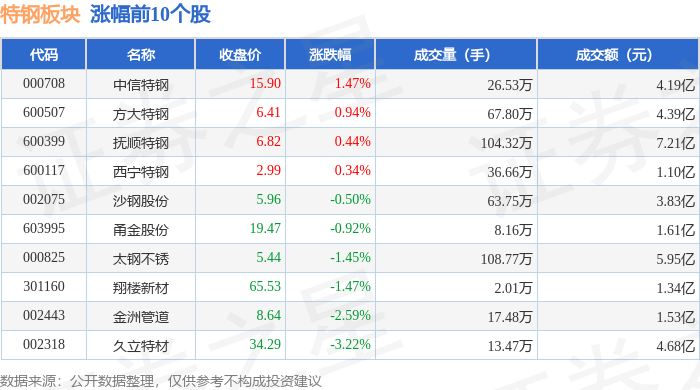
Market Overview - The special steel sector experienced a decline of 0.39% on January 29, with Changbao Co. leading the drop [1] - The Shanghai Composite Index closed at 4157.98, up 0.16%, while the Shenzhen Component Index closed at 14300.08, down 0.3% [1] Stock Performance - Notable stock performances in the special steel sector include: - CITIC Special Steel (000708) closed at 15.90, up 1.47% with a trading volume of 265,300 shares and a turnover of 419 million yuan [1] - Fangda Special Steel (600507) closed at 6.41, up 0.94% with a trading volume of 678,000 shares and a turnover of 439 million yuan [1] - Fushun Special Steel (600399) closed at 6.82, up 0.44% with a trading volume of 1,043,200 shares and a turnover of 721 million yuan [1] - Changbao Co. (002478) closed at 9.82, down 4.01% with a trading volume of 541,800 shares and a turnover of 546 million yuan [2] Capital Flow Analysis - The special steel sector saw a net outflow of 82.17 million yuan from institutional investors, while retail investors had a net inflow of 84.75 million yuan [2] - Detailed capital flow for selected stocks includes: - CITIC Special Steel had a net inflow of 47.09 million yuan from institutional investors [3] - Changbao Co. experienced a net outflow of 21.95 million yuan from institutional investors [3] - Retail investors contributed a net inflow of 50 million yuan to Changbao Co. [3]


特钢板块1月28日涨1.53%,久立特材领涨,主力资金净流出2397.71万元
Zheng Xing Xing Ye Ri Bao· 2026-01-28 08:56
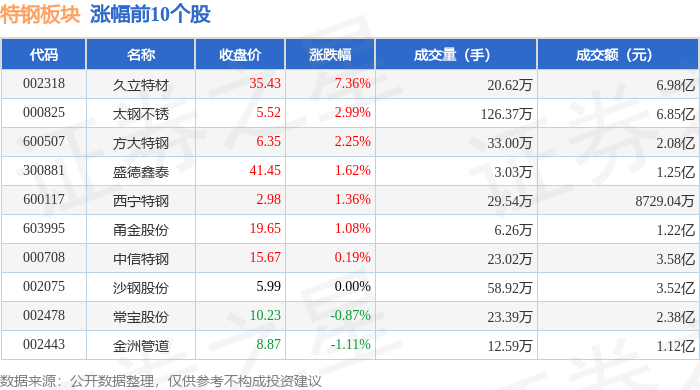
Market Performance - The special steel sector increased by 1.53% on January 28, with Jiuli Special Materials leading the gains [1] - The Shanghai Composite Index closed at 4151.24, up 0.27%, while the Shenzhen Component Index closed at 14342.9, up 0.09% [1] Stock Performance - Jiuli Special Materials (002318) closed at 35.43, up 7.36% with a trading volume of 206,200 shares and a transaction value of 698 million [1] - Other notable performers include: - Taiyuan Iron & Steel (000825) at 5.52, up 2.99% [1] - Fangda Special Steel (600507) at 6.35, up 2.25% [1] - Xining Special Steel (600117) at 2.98, up 1.36% [1] - Conversely, Changbao Co. (002478) and Jinzou Pipeline (002443) saw declines of 0.87% and 1.11%, respectively [1] Capital Flow - The special steel sector experienced a net outflow of 23.98 million from institutional investors and 18.07 million from retail investors, while retail investors saw a net inflow of 42.05 million [2] - The detailed capital flow for individual stocks indicates that Jiuli Special Materials had a net inflow of 21.80 million from institutional investors [3] - Other stocks with significant net inflows include: - Taiyuan Iron & Steel with 14.52 million [3] - Fangda Special Steel with 12.80 million [3] - Notably, Xining Special Steel had a net inflow of 6.99 million from institutional investors [3]


特钢板块1月27日跌0.74%,方大特钢领跌,主力资金净流出2.07亿元
Zheng Xing Xing Ye Ri Bao· 2026-01-27 08:49
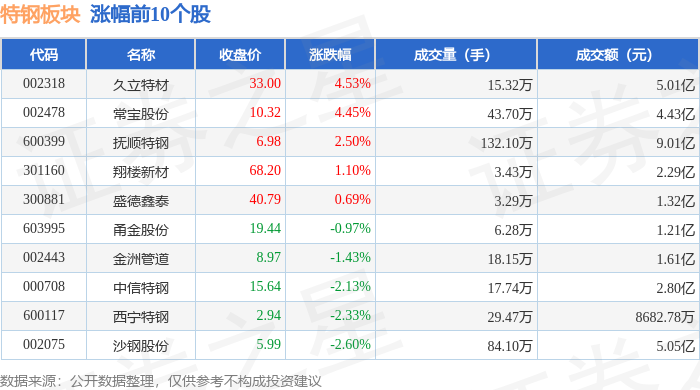
Market Overview - The special steel sector experienced a decline of 0.74% on January 27, with Fangda Special Steel leading the drop [1] - The Shanghai Composite Index closed at 4139.9, up 0.18%, while the Shenzhen Component Index closed at 14329.91, up 0.09% [1] Stock Performance - Notable gainers in the special steel sector included: - Jiuli Special Materials (002318) with a closing price of 33.00, up 4.53% [1] - Changbao Co. (002478) with a closing price of 10.32, up 4.45% [1] - Fushun Special Steel (600399) with a closing price of 6.98, up 2.50% [1] - Conversely, Fangda Special Steel (600507) closed at 6.21, down 2.97%, and Taiyuan Iron & Steel (000825) closed at 5.36, down 2.72% [2] Trading Volume and Capital Flow - The total net outflow of main funds in the special steel sector was 207 million yuan, while retail funds saw a net inflow of 80.86 million yuan [2] - The trading volume for Jiuli Special Materials was 153,200 hands, with a transaction amount of 501 million yuan [1] Individual Stock Capital Flow - Capital flow analysis showed: - Zhongxin Special Steel (000708) had a main fund net inflow of 2.51 million yuan, but a net outflow from retail funds of 13.10 million yuan [3] - Fushun Special Steel (600399) had a main fund net outflow of 3.87 million yuan, with a retail net inflow of 3.74 million yuan [3] - Fangda Special Steel (600507) experienced a main fund net outflow of 19.29 million yuan, while retail funds saw a net inflow of 13.44 million yuan [3]
特钢板块1月23日涨1.41%,抚顺特钢领涨,主力资金净流出3106.95万元
Zheng Xing Xing Ye Ri Bao· 2026-01-23 09:04
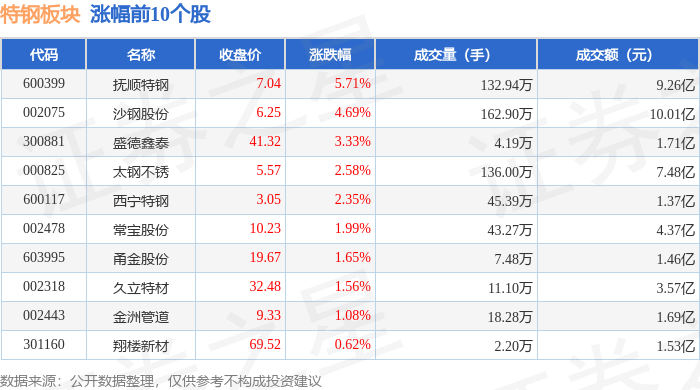
Market Performance - The special steel sector increased by 1.41% on January 23, with Fushun Special Steel leading the gains [1] - The Shanghai Composite Index closed at 4136.16, up 0.33%, while the Shenzhen Component Index closed at 14439.66, up 0.79% [1] Individual Stock Performance - Fushun Special Steel (code: 666009) closed at 7.04, up 5.71% with a trading volume of 1.3294 million shares and a transaction value of 926 million yuan [1] - Shagang Group (code: 002075) closed at 6.25, up 4.69% with a trading volume of 1.6290 million shares and a transaction value of 1 billion yuan [1] - Other notable performers include: - Shengde Zhengtai (code: 300881) at 41.32, up 3.33% [1] - Taiyuan Iron & Steel (code: 000825) at 5.57, up 2.58% [1] - Xining Special Steel (code: 600117) at 3.05, up 2.35% [1] Capital Flow Analysis - The special steel sector experienced a net outflow of 31.0695 million yuan from institutional investors and 78.62 million yuan from speculative funds, while retail investors saw a net inflow of 110 million yuan [2] - Fushun Special Steel had a net inflow of 20.1508 million yuan from institutional investors, while it faced a net outflow of 39.2418 million yuan from speculative funds [3] - Xining Special Steel had a net inflow of 9.4850 million yuan from institutional investors, but also faced outflows from both speculative and retail investors [3]
钢铁板块发力走高 酒钢宏兴、武进不锈等涨停
Zheng Quan Shi Bao Wang· 2026-01-23 07:11
Core Viewpoint - The steel industry is entering a new phase of "reduction and quality improvement," with increasing differentiation and structural changes expected [1] Group 1: Steel Industry Overview - The steel sector experienced a rise on the 23rd, with companies like Jiugang Hongxing, Wujin Stainless Steel, and Dazhong Mining hitting the daily limit, while Fushun Special Steel and Sangang Min Guang increased by over 5% [1] - According to CICC, the new capacity replacement policy for 2025 is expected to tighten, and the new industry standards will likely promote graded management within the sector [1] Group 2: Environmental and Regulatory Factors - The implementation of ultra-low emission modifications and green indicators is anticipated to become a new tool for differentiated production control [1] - By 2026, the steel industry is expected to see a reduction in internal competition, with supply clearing expected to accelerate, benefiting ESG-compliant companies first [1] Group 3: Special Steel Sector Insights - As the "14th Five-Year Plan" begins, the domestic manufacturing sector is projected to maintain high prosperity through 2026, supported by national encouragement for technological innovation and increased investment in advanced manufacturing [1] - The acceleration of domestic substitution for key materials due to trade frictions is expected to benefit the industry by concentrating resources in high value-added areas, enhancing the overall competitiveness of special steel companies [1] - Profitability in the special steel sector is anticipated to improve, with the valuation center expected to rise [1]


全面暴走!黑色系期货全线飘红,钢铁板块掀拉升狂潮,细分赛道集体跟涨爆发
Jin Rong Jie· 2026-01-23 06:58
Core Viewpoint - The A-share steel sector experienced a strong short-term rally, with significant upward movement in stock prices and a notable release of profit potential, driven by key stocks like JiuGang Hongxing and Wujin Stainless Steel reaching their daily limits [1] Group 1: Market Performance - The steel sector saw widespread gains, with multiple core stocks such as Dazhong Mining, Fushun Special Steel, and Shagang Co. participating in the upward trend, indicating a collective rise in the sector [1] - The rally was supported by a favorable funding environment, as the black commodity futures market showed overall gains, enhancing investor sentiment towards the steel sector [1] Group 2: Policy and Regulatory Support - The Ministry of Finance introduced policies to address low-price competition in government procurement, effective from February 1, 2026, which is expected to stabilize steel prices and support profitability for steel companies [2] - New capacity control policies are being proposed to phase out inefficient production, favoring companies with low emissions and high-end products, which will enhance industry concentration and strengthen leading enterprises [2] Group 3: Cost and Profitability Factors - The supply of iron ore is steadily increasing, and domestic resource development is intensifying, leading to a stabilization in iron ore prices, which will help steel companies reduce production costs and restore profit margins [3] - The stable supply and low prices in the coking coal sector also contribute to a favorable cost environment for steel producers [3] Group 4: Demand Drivers - The demand for steel in the electric vehicle sector is expected to grow significantly, with a projected increase of over 4% in automotive steel demand by the second half of 2025, benefiting the steel industry [4] - The shipbuilding industry is witnessing a recovery, with an anticipated growth rate of over 6% in steel demand for shipbuilding by the second half of 2025, driven by high-value steel requirements for advanced vessels [4] - Infrastructure investment is projected to maintain a growth rate of over 5% year-on-year, with increasing demand for high-strength and corrosion-resistant steel materials, solidifying the steel sector's role as a core support for demand [4]

钢铁股拉升,酒钢宏兴、武进不锈涨停
Ge Long Hui· 2026-01-23 06:05
Core Viewpoint - The A-share market saw significant gains in the steel sector on January 23, with several stocks reaching their daily limit up, indicating strong investor interest and potential bullish sentiment in the industry [1]. Group 1: Stock Performance - Jiugang Hongxing (600307) experienced a rise of 10.11%, with a total market value of 13 billion and a year-to-date increase of 25.45% [1]. - Wujin Stainless Steel (603878) increased by 10.05%, with a market capitalization of 5.04 billion, but has seen a year-to-date decline of 3.02% [1]. - Dazhong Mining (001203) rose by 7.80%, with a market value of 49.8 billion and a year-to-date increase of 6.00% [1]. - Fushun Special Steel (600399) saw a gain of 6.16%, with a market capitalization of 13.9 billion and a year-to-date increase of 21.06% [1]. - Yongxing Materials (002756) increased by 6.11%, with a market value of 30 billion and a year-to-date rise of 2.69% [1]. - Sansteel Minguang (002110) rose by 4.73%, with a market capitalization of 11.3 billion and a year-to-date increase of 5.92% [1]. - Shagang Co. (002075) increased by 4.19%, with a market value of 13.6 billion and a year-to-date rise of 8.17% [1]. - Shengde Xintai (300881) saw a gain of 4.18%, with a market capitalization of 4.583 billion and a year-to-date increase of 23.04% [1]. Group 2: Additional Stock Movements - Yizhou Guoshi (601969) increased by 3.70%, with a market value of 23.5 billion but a year-to-date decline of 1.01% [1]. - Linggang Co. (600231) rose by 3.52%, with a market capitalization of 6.697 billion and a year-to-date increase of 9.81% [1]. - Nanjing Steel (600282) increased by 3.37%, with a market value of 35.9 billion and a year-to-date rise of 10.65% [1]. - Hebei Steel Resources (000923) saw a gain of 3.36%, with a market capitalization of 16 billion and a year-to-date increase of 16.11% [1]. - Hengxing Technology (002132) rose by 3.57%, with a market value of 5.69 billion and a year-to-date increase of 14.37% [1]. - Baogang Co. (600010) increased by 3.21%, with a market capitalization of 116.4 billion and a year-to-date rise of 7.98% [1].


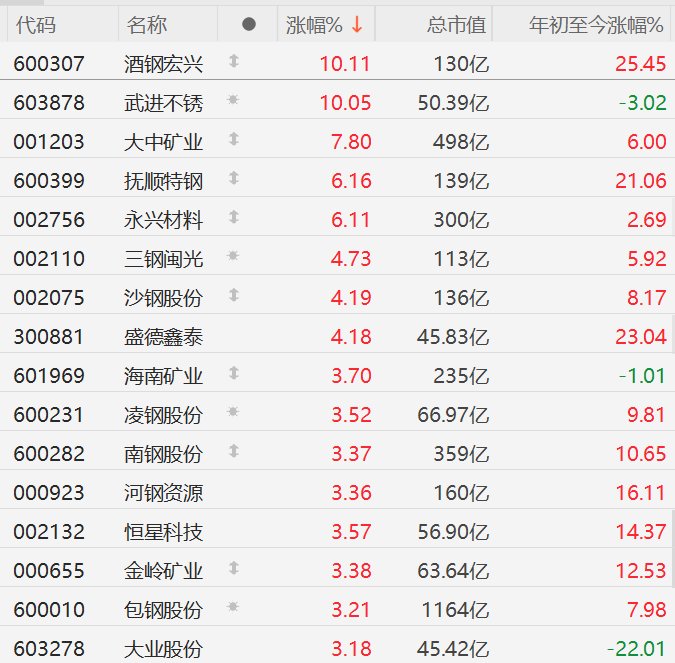
A股钢铁股拉升,酒钢宏兴、武进不锈涨停
Ge Long Hui· 2026-01-23 06:04
Group 1 - The A-share market saw significant gains in steel stocks during the afternoon session, with notable increases in several companies [1] - JiuGang Hongxing and Wujin Stainless Steel reached the daily limit of a 10% increase, while Da Zhong Mining rose over 7% [1] - Fushun Special Steel and Yongxing Materials both increased by more than 6%, and SanGang Mingguang, ShaGang Co., and Shengde Xintai saw gains exceeding 4% [1]

商业航天:箭体不锈钢+发动机高温合金正成为火箭新材料体系(附报告)
材料汇· 2026-01-22 15:32
Core Viewpoint - The article emphasizes that "rocket body stainless steel + engine high-temperature alloy" is evolving into a new generation of rocket material systems, driven by the commercialization and reusability of space launches [1][7]. Group 1: Investment Opportunities in New Materials - The rapid development of commercial space is driving the demand for aerospace stainless steel and high-temperature alloy materials [2]. - Stainless steel is becoming the primary choice for rocket bodies in reusable rockets due to its low cost, high-temperature resistance, and ease of processing [4][12]. - High-temperature alloys are essential for the hot-end components of liquid rocket engines, with an average usage of 28% in liquid rocket engines [5][19]. Group 2: Historical Context and Current Trends - Historically, aluminum alloys dominated rocket materials, with limited applications for stainless steel and high-temperature alloys [3]. - Currently, the rocket material system is transitioning from aluminum-dominated to a combination of stainless steel and high-temperature alloys, particularly in reusable rocket designs [4][11]. Group 3: Future Outlook - In the future, aerospace stainless steel and high-temperature alloys are expected to be key materials for rocket technology evolution, providing advantages in extreme temperature environments and manufacturing speed [6][8]. - The demand for large low-orbit satellite constellations is anticipated to drive the scale of rocket launches, enhancing the growth prospects for stainless steel and high-temperature alloys [47]. Group 4: Supply Chain and Market Dynamics - The supply of aerospace stainless steel is highly segmented and customized, with early movers and validated companies likely to experience structural growth opportunities [8]. - High-temperature alloy suppliers face high barriers to entry, resulting in a favorable competitive landscape [8][21].






商业航天拉动不锈钢及高温合金需求
HTSC· 2026-01-22 13:20
Investment Rating - The report maintains an "Overweight" rating for the aerospace and military industry, as well as for the steel sector [5]. Core Insights - The rapid development of commercial aerospace is driving demand for aerospace stainless steel and high-temperature alloys, which are becoming the new material system for rockets [1][4]. - Stainless steel is increasingly being adopted for rocket structures due to its cost-effectiveness, high-temperature resistance, and ease of processing, while high-temperature alloys are essential for engine components [1][3][4]. - The transition from aluminum alloys to a combination of stainless steel and high-temperature alloys is a significant trend in rocket material evolution, driven by the need for cost reduction and performance enhancement [9][10]. Summary by Sections Historical Context - Historically, aluminum alloys dominated rocket materials, with limited use of stainless steel and high-temperature alloys [1][2]. Current Status - The current rocket material landscape is transitioning from aluminum dominance to the integration of stainless steel and high-temperature alloys, particularly in reusable rocket designs [2][3]. Future Outlook - The future of rocket technology is expected to favor stainless steel and high-temperature alloys due to their superior properties, which are essential for the evolving demands of rocket design and operation [3][4]. Investment Conclusion - The report suggests focusing on companies involved in the supply of stainless steel for rocket tanks and components, as well as leading enterprises in high-temperature alloy production [4][19]. - Key companies identified include Fushun Special Steel, Aerospace Materials, and others that have established a strong foothold in the aerospace materials supply chain [4][19]. Demand Analysis - The demand for rockets is anticipated to surge due to the rapid growth of low Earth orbit satellite constellations, which will drive the need for increased launch frequency and scale [4][45]. Supply Analysis - The supply side of aerospace stainless steel is characterized by high customization and segmentation, with early movers likely to benefit from structural growth opportunities [4][19]. - High-temperature alloy suppliers face significant barriers to entry, indicating a favorable competitive landscape for established players [4][19].