航天材料

Search documents
别再盯着热门股了!社保、外资正悄悄建仓这10只低调黑马,业绩扎实估值低,看懂的人已经行动
Sou Hu Cai Jing· 2026-02-28 00:15
Core Viewpoint - The A-share market in 2026 is experiencing a slow upward trend in indices, while individual stocks show a stark contrast in performance, with retail investors often facing losses due to chasing popular stocks. Meanwhile, institutional investors are quietly accumulating shares in low-profile companies with strong fundamentals, characterized by consistent earnings growth, low valuations, and significant technological barriers [1]. Group 1: Company Highlights - Shenghong Technology is a global leader in AI server PCB production, supplying major clients like NVIDIA and Google. The company achieved a net profit of 3.245 billion yuan in 2025, a year-on-year increase of over 324%, and expects a profit range of 4.16 billion to 4.56 billion yuan for 2025, reflecting a growth of 260% to 295% [3]. - Xibu Materials is the sole domestic supplier of high-temperature niobium alloy materials for commercial aerospace, with a significant order from SpaceX. The company anticipates revenue from aerospace materials to exceed 1.5 billion yuan in 2025, with a gross margin of 45% [4]. - XianDao Intelligent is a leading provider of solid-state battery equipment, with new orders totaling 12.4 billion yuan in the first half of 2025. The company reported a net profit of 1.186 billion yuan in the first three quarters of 2025, a nearly 95% increase year-on-year [5]. - Jiangsu Bank, a city commercial bank, reported a revenue of 67.183 billion yuan and a net profit of 30.583 billion yuan in the first three quarters of 2025, with a non-performing loan ratio of only 0.84% [7]. - Chaojie Co., Ltd. transitioned from automotive fasteners to aerospace components, securing 285 million yuan in commercial aerospace orders by the end of 2025, with a 161% year-on-year growth in aerospace revenue [8]. - Xiamen Tungsten is a resource giant with a focus on tungsten, rare earths, and lithium battery materials, achieving a revenue of 46.469 billion yuan in 2025, a 31.37% increase year-on-year [9]. - Tianfu Communication is a key supplier of optical devices in the optical communication sector, expecting a net profit of 1.881 billion to 2.150 billion yuan in 2025, a growth of 40% to 60% [11]. - Weichai Power is transitioning from traditional heavy-duty engines to becoming a key player in AI data center energy supply, with a significant increase in sales of its M-series engines for data centers [12]. - Fuzheng Technology leads in nonlinear optical crystals, holding over 80% market share in high-end manufacturing applications, driven by the demand for 6G technology and laser radar [13]. - China Jushi is a dominant player in the fiberglass industry with over 40% market share, focusing on high-end products and global expansion to mitigate cyclical risks [14].





火箭隔热材料
2026-02-02 02:22
Summary of Key Points from the Conference Call on Rocket Thermal Insulation Materials Industry Overview - The thermal insulation materials for rockets are primarily categorized into resin-based composites, aerogel composites, functional coatings, ceramic matrix composites, multilayer insulation materials, and ceramic tiles. These materials are crucial for protecting spacecraft and rocket engines from extreme temperatures and radiation [2][3][5]. Core Insights and Arguments 1. **Resin-Based Composites**: These materials utilize high polymer resins that decompose and carbonize at high temperatures, forming a porous carbon layer that blocks heat transfer. Common types include glass fiber with phenolic resin and carbon fiber with phenolic resin. They are mainly used in the heat shield of spacecraft and solid rocket engines [3][4]. 2. **Aerogel Composites**: Aerogels, such as silica and alumina aerogels, are characterized by low thermal conductivity and ultra-light density. They are used as inner lining insulation materials in rocket segments to protect electronic components from radiation [5]. 3. **Functional Coatings**: These coatings are applied via spraying and can form a porous carbon layer that dissipates heat. They are cost-effective but require improvements in protective performance [2][5]. 4. **Ceramic Matrix Composites**: These materials, including carbon-silicon carbide, are used in next-generation aircraft but have longer manufacturing cycles and higher costs. They are essential for high-temperature applications [2][5]. 5. **Multilayer Insulation Materials**: Composed of high-reflectivity aluminum foil and low thermal conductivity layers, these materials are effective in blocking radiation and are commonly used on spacecraft surfaces and cryogenic storage [5]. 6. **Ceramic Tiles**: The ceramic tiles used in SpaceX's Starship are made from quartz fibers and feature a high-reflectivity coating. They are designed for reusability and have superior thermal resistance compared to NASA's earlier ablative systems [2][6]. Competitive Landscape - Numerous research institutions in China, such as Northwestern Polytechnical University and Central South University, are engaged in the development of thermal insulation materials. Key competitors for Hubei Hangju Technology Co., Ltd. include the 703 and 306 Institutes of the China Aerospace Science and Technology Corporation, which have significant advantages in carbon-carbon composites and thermal coatings [4][13]. Market Trends and Future Outlook 1. **Commercial Spaceflight Demand**: The development of reusable rocket technology is expected to significantly increase the demand for thermal insulation materials. Hubei Hangju has established partnerships with several domestic commercial space companies and is preparing for potential market needs [14][15]. 2. **Cost Control Innovations**: The introduction of flexible ablative coatings, which are cheaper and have shorter production cycles compared to traditional thermal tiles, is anticipated to reshape the market dynamics. These coatings can form in-situ ceramics at high temperatures, enhancing their protective capabilities [9][10]. 3. **Material Recovery and Maintenance**: Hubei Hangju is focusing on developing technologies for the recovery and maintenance of thermal materials post-launch. They are exploring rapid repair techniques to ensure materials can be reused effectively [17][18]. 4. **Industry Positioning**: Hubei Hangju positions itself as a full-chain solution provider, managing everything from raw material synthesis to post-launch maintenance. This comprehensive approach enhances their competitiveness in the market [19]. 5. **Industrial Capabilities**: The leading companies in the domestic market, such as the 703 Institute and Hubei Hangju, have the capacity for large-scale production and direct engagement with major manufacturers, giving them a competitive edge [20]. Additional Important Insights - The cost of ceramic-based thermal insulation materials is primarily driven by energy consumption during the high-temperature sintering process, with initial estimates indicating that these materials account for about 10% of the total product cost [8]. - The application of thermal protection materials varies significantly between solid and liquid propulsion systems, with solid rockets predominantly using resin-based materials and coatings for specific areas [12]. This comprehensive analysis highlights the evolving landscape of rocket thermal insulation materials, emphasizing the technological advancements, competitive dynamics, and market opportunities within the industry.
成分股多股涨停,科创综指增强ETF涨1.04%
Xin Lang Cai Jing· 2026-01-23 06:33
Group 1 - The aerospace new materials, forklift electrification for overseas markets, and flexible protective layers for robots are viewed positively by institutions, indicating growth certainty or long-term potential [1] - As of January 23, the Shanghai Composite Index rose by 0.29%, the Shenzhen Component Index increased by 0.55%, and the ChiNext Index went up by 0.27% [1] - The ETF market saw the Kweichow Moutai (588670) increase by 1.04%, with several component stocks such as Laplace (688726.SH) and Zhenray Technology (688270.SH) hitting the daily limit [1] Group 2 - Huatai Securities indicates that large low-orbit constellations will drive the scaling of rockets, with cost reductions and engine performance improvements expected to boost two new materials for rockets [2] - The supply side of aerospace stainless steel is highly segmented and customized, with companies having first-mover advantages likely to gain structural growth opportunities; high-temperature alloy suppliers have a competitive landscape that is favorable [2] - CITIC Securities reports that with rising raw material prices and increased demand for AI and storage, a new round of packaging price increases is anticipated, with a focus on advanced packaging and storage packaging segments [2]



商业航天:箭体不锈钢+发动机高温合金正成为火箭新材料体系(附报告)
材料汇· 2026-01-22 15:32
Core Viewpoint - The article emphasizes that "rocket body stainless steel + engine high-temperature alloy" is evolving into a new generation of rocket material systems, driven by the commercialization and reusability of space launches [1][7]. Group 1: Investment Opportunities in New Materials - The rapid development of commercial space is driving the demand for aerospace stainless steel and high-temperature alloy materials [2]. - Stainless steel is becoming the primary choice for rocket bodies in reusable rockets due to its low cost, high-temperature resistance, and ease of processing [4][12]. - High-temperature alloys are essential for the hot-end components of liquid rocket engines, with an average usage of 28% in liquid rocket engines [5][19]. Group 2: Historical Context and Current Trends - Historically, aluminum alloys dominated rocket materials, with limited applications for stainless steel and high-temperature alloys [3]. - Currently, the rocket material system is transitioning from aluminum-dominated to a combination of stainless steel and high-temperature alloys, particularly in reusable rocket designs [4][11]. Group 3: Future Outlook - In the future, aerospace stainless steel and high-temperature alloys are expected to be key materials for rocket technology evolution, providing advantages in extreme temperature environments and manufacturing speed [6][8]. - The demand for large low-orbit satellite constellations is anticipated to drive the scale of rocket launches, enhancing the growth prospects for stainless steel and high-temperature alloys [47]. Group 4: Supply Chain and Market Dynamics - The supply of aerospace stainless steel is highly segmented and customized, with early movers and validated companies likely to experience structural growth opportunities [8]. - High-temperature alloy suppliers face high barriers to entry, resulting in a favorable competitive landscape [8][21].






华菱线缆终止收购星鑫航天控制权,标的曾为神舟飞船配套
Cai Jing Wang· 2026-01-20 05:26
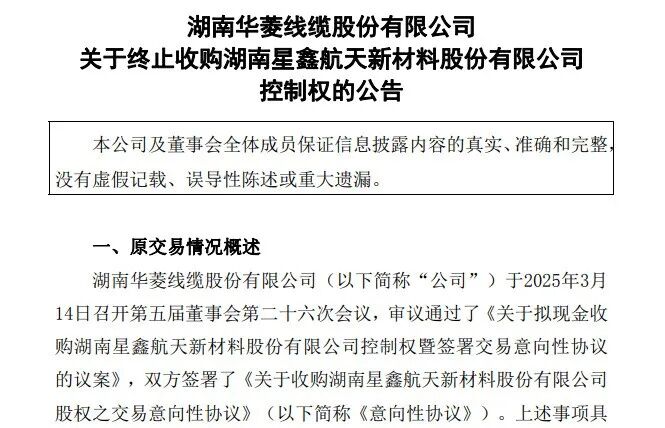
Core Viewpoint - Hualing Cable has decided to terminate the acquisition of control over Hunan Xingxin Aerospace New Materials Co., Ltd. due to a lack of agreement on specific terms of the agreement with the counterparty, and this decision was made mutually without requiring board approval [1] Group 1 - The termination of the acquisition will not adversely affect the company's production operations or financial status, nor will it harm the interests of the company and its shareholders [1] - Hualing Cable's stock price has seen a maximum increase of 187.13% since November 27, 2025 [1] - The initial announcement for the cash acquisition of control over Xingxin Aerospace was made on March 14, 2025 [1] Group 2 - Xingxin Aerospace specializes in high-temperature resistant materials, silicon nitride ceramic products, and phenolic resin materials, providing supporting products for the Shenzhou series spacecraft, Chang'e series detectors, Tiangong space station, and various launch vehicles [1] - The company participated in the first manned spaceflight project [1]
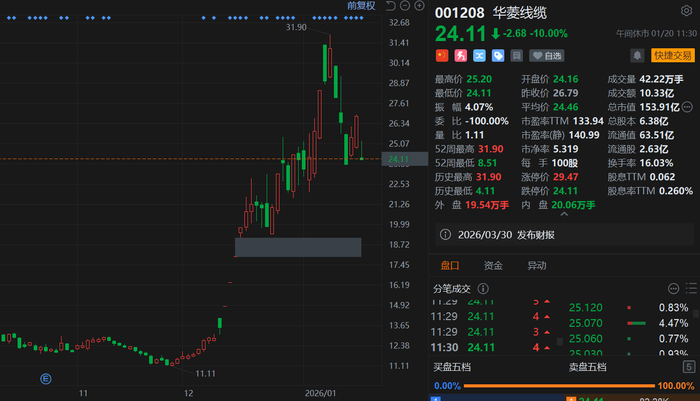
A股异动丨终止收购星鑫航天,华菱线缆跌停,昨日涨停
Ge Long Hui A P P· 2026-01-20 03:47
Core Viewpoint - Hualing Cable (001208.SZ) experienced a significant drop, closing at 24.11 yuan with a total market value of 15.39 billion yuan, following the announcement of the termination of its acquisition of Hunan Xingxin Aerospace New Materials Co., Ltd. [1] Group 1: Acquisition Details - The acquisition process began in March 2025 and lasted nearly 10 months, ultimately failing due to disagreements on key terms of the core agreement [1] - Xingxin Aerospace was the core target of the acquisition, possessing significant rarity in business qualifications and industry status, which was a key motivation for Hualing Cable to initiate the acquisition [1]
商业航天“大牛股”,终止收购!
Zhong Guo Zheng Quan Bao· 2026-01-19 14:28
Core Viewpoint - Hualing Cable announced the termination of the acquisition agreement with Xingxin Aerospace due to a lack of consensus on specific terms, which will not adversely affect the company's operations or financial status [1][3]. Group 1: Acquisition Details - Hualing Cable and Xingxin Aerospace mutually agreed to terminate the "Intent Agreement for the Acquisition of Hunan Xingxin Aerospace New Materials Co., Ltd." [1]. - The acquisition was not finalized with a formal agreement as of the announcement date [3]. - The termination does not require board approval and is a result of mutual agreement between the parties [3]. Group 2: Company Background - Xingxin Aerospace, established in 2003, is a national high-tech enterprise specializing in high-temperature resistant materials and products for various space missions, including Shenzhou and Chang'e series [4]. - Xingxin Aerospace reported revenues of 56.42 million yuan, 51.37 million yuan, and 68.15 million yuan for the years 2022, 2023, and 2024, respectively, with net profits of 23.63 million yuan, 22.46 million yuan, and 26.49 million yuan [4]. Group 3: Market Performance - Hualing Cable is recognized as a "bull stock" in the commercial aerospace sector, with a stock price increase of 178% from November 27, 2025, to January 12, 2026 [4]. - As of January 19, 2026, Hualing Cable's stock price was 26.79 yuan per share, with a market capitalization of 17.101 billion yuan [4].
深度|商业航天新材料全景图:新材料企业的机遇与投资逻辑(附20+报告)
材料汇· 2026-01-14 14:18
Core Insights - The global commercial aerospace market is projected to reach a size of $75-125 billion in 2024, with an expected growth to $140 billion by 2025. In China, the market is anticipated to reach 2.3 trillion RMB in 2024, growing by 22.9% year-on-year, and is expected to exceed 2.8 trillion RMB in 2025. Material technology is becoming a core factor determining the competitiveness of commercial aerospace companies [1] - The demand for materials in commercial aerospace differs significantly from traditional aerospace, with a focus on lightweight materials, high-temperature resistance, and reliability to reduce costs. The cost savings of approximately 20,000-30,000 RMB per kilogram of payload make lightweight materials a priority [1] Overview of Key New Materials in Commercial Aerospace - A total of 128 new materials have been identified as critical for commercial aerospace applications, categorized into various types including aluminum-lithium alloys, titanium alloys, stainless steel, high-temperature alloys, copper alloys, and composite materials [3][4] - Aluminum-lithium alloys (e.g., 2195, 2099) are used in rocket storage tanks and main structures, offering a weight reduction of 10-15% compared to traditional aluminum alloys, with a strength increase of 20% [4] - Titanium alloys (e.g., Ti-6Al-4V) are utilized in engine components and satellite structures, with a density of 4.5 g/cm³ and high-temperature resistance up to 600°C [4] - Carbon fiber composites (e.g., T300, T700) are essential for rocket fairings and satellite shells, providing a strength-to-weight ratio significantly higher than steel [4][5] Application of Carbon Fiber Composites - Carbon fiber composites (CFRP) are crucial in commercial aerospace, accounting for 15-20% of the manufacturing cost of medium-sized reusable rockets, with values exceeding 20 million RMB per unit [10] - In satellite manufacturing, carbon fiber costs represent 12-15% of total costs for low Earth orbit satellites, with values ranging from 8-12 million RMB, and over 25% for high Earth orbit satellites, exceeding 15 million RMB [10][11] - The T700 grade carbon fiber has a tensile strength of ≥4.9 GPa and is used in less critical components, while T800 and T1100 grades are used in more demanding applications, with T1100 achieving a tensile strength of 7.0 GPa [11] High-Temperature Materials and Refractory Metals - Ultra-high temperature materials are critical for rocket engine technology, with combustion chamber temperatures exceeding 3000°C and nozzle throat temperatures above 1650°C [15] - Ceramic matrix composites (C/C) and high-temperature alloys (e.g., nickel-based alloys) are essential for engine components, with domestic production rates for high-temperature alloys exceeding 95% [19][20] - Refractory metals (e.g., tungsten, molybdenum) are key materials for extreme temperature environments, with applications in rocket engine nozzles and fuel storage systems [23][24] Emerging and Sustainable Materials - Emerging materials such as self-healing composites and biodegradable polymers are being explored for their potential in reducing environmental impact and enhancing the longevity of aerospace components [8] - The use of recycled carbon fiber composites is being piloted, offering a cost reduction of 50% while maintaining 90% of the original strength [8]
UTG玻璃-商业航天的黄金配角
2026-01-12 01:41
Summary of UDG Glass in Commercial Aerospace Industry Overview - UDG Glass is increasingly being applied in the aerospace sector, particularly in flexible solar wings, replacing traditional heavy glass. Companies such as Changxin, Dongxu Group, Sade Semiconductor, and Lens Technology are actively involved in research and development [1][2][3]. Key Points and Arguments - **Market Value and Cost**: The packaging value of UDG Glass accounts for approximately 5% of the overall price, translating to over 10,000 yuan per square meter. If perovskite or HJT technology is adopted, costs could drop to around 30,000 yuan, with the packaging portion potentially costing only a few thousand yuan [1][6]. - **Challenges of Perovskite and HJT Technologies**: Perovskite batteries face stability and lifespan challenges in space, being sensitive to water, oxygen, heat, and UV radiation. HJT technology also has lifespan issues, requiring additional radiation hardening and thermal control design costs [1][7]. - **Emerging Technologies**: CIGS (Copper Indium Gallium Selenide) technology is gaining traction in Europe and Japan, with potential to improve efficiency and reduce costs when layered with perovskite. This could significantly impact commercial aerospace in the next three to five years [1][8]. - **Domestic Competitors**: Key domestic players in the UDG Glass market include Changxin, Dongxu Group, Sade Semiconductor, and Lens Technology. Traditional methods have low yield rates (around 40%) and face efficiency improvement challenges [3]. - **SpaceX's Current Practices**: SpaceX currently uses gallium arsenide for packaging but is exploring alternatives due to lifespan limitations. Companies like Changxin and Lens Technology are adapting to SpaceX's supply chain to offer better solutions [4][15]. - **Testing and Validation**: Domestic companies are actively conducting downstream customer validation, with satellite tests expected this year or next. The testing cycle typically lasts about a year [11]. - **Future Projections**: UDG Glass applications are expected to accelerate from 2027, driven by increased low-orbit satellite launches and the growing consensus on flexible solar wings. Changxin is noted for its significant production capacity [24]. Additional Important Insights - **Importance of Packaging Process**: The packaging process is crucial for the radiation resistance and lifespan of solar wings. The quality of the packaging directly affects the solar wing's ability to withstand space radiation [9][22]. - **Comparison with Other Materials**: UDG Glass is compared with CPI (Colored Polyimide), where UDG shows advantages in bending resistance and stability against radiation, while CPI excels in fatigue performance [28]. - **Production Challenges**: The production of large-sized UDG products remains complex, with most companies currently unable to produce particularly large items [35]. - **Collaboration with Tesla**: Changxin has established a partnership with Tesla to meet the demand for large-scale production at lower costs [32]. This summary encapsulates the key developments and insights regarding UDG Glass in the commercial aerospace industry, highlighting its potential, challenges, and competitive landscape.
顶固集创:航聚科技研发的WS系列柔性可复用防热材料已运用于蓝箭航天朱雀三号箭体
Zheng Quan Shi Bao Wang· 2025-12-17 09:19
Core Viewpoint - The company Dinggu Jichuang (300749) has invested in Hangju Technology, which specializes in the research and development of thermal protection materials for aerospace vehicles, indicating a positive outlook on the commercial aerospace sector and Hangju Technology's growth potential [1] Group 1: Company Overview - Hangju Technology focuses on special functional materials for thermal protection in aerospace applications, including spacecraft, launch vehicles, and deep-sea submersibles [1] - The company is recognized as a leading enterprise in China with capabilities in thermal protection design, simulation, material R&D, wind tunnel testing, and comprehensive solutions [1] Group 2: Product Applications - The WS series of flexible reusable thermal protection materials developed by Hangju Technology has been applied to the Blue Arrow Aerospace Zhuque-3 launch vehicle [1] Group 3: Investment Insight - Dinggu Jichuang holds a 5.8018% stake in Hangju Technology, driven by optimism regarding the prospects of the commercial aerospace industry and the development potential of Hangju Technology [1]