
Hongdou Industrial(600400)

Search documents
红豆周海江谈全国统一大市场:打破壁垒、内外兼修 拥抱发展新机遇
Zhong Guo Jing Ji Wang· 2025-12-01 09:30
在国家"建设全国统一大市场"战略部署持续推进的背景下,广大民营企业正积极把握政策机遇,主动融 入新发展格局。作为中国纺织服装行业的代表性企业,红豆集团结合自身实践,分享了企业在跨区域经 营、内外贸一体化及未来发展布局等方面的思考与探索。 跨区域经营更便利,企业积极适应统一标准 在谈及"全国统一大市场"政策带来的积极变化时,红豆集团党委书记、董事局主席周海江表示,服装行 业在跨区域经营中确实感受到了更多便利,尤其在资质互认、标准统一和市场监管等方面。 周海江介绍,红豆正主动调整经营策略,积极参与行业和地方组织的标准宣贯活动,主动采用区域内通 用的检测认证标准。这一做法不仅减少了企业在不同市场面临的重复检测成本,也成为提升产品信誉、 打造品牌的有力手段。 应对内外贸一体化挑战,"两跨"战略构筑发展韧性 周海江坦言,红豆集团在转向内外贸协同发展的过程中遇到了一些挑战。为此,企业坚定推进"两跨"战 略布局,即跨境电商与跨境办厂双轮驱动,建立强大的全球资源整合能力,构筑韧性体系。通过亚马 逊、Shopify独立站等平台推动自主品牌出海,并构建"境内外联动"的全球化生产网络,以柬埔寨工厂 为生产主阵地,辐射越南、孟加拉等 ...

红豆股份(600400) - 红豆股份关于以集中竞价交易方式回购股份的进展公告
2025-12-01 09:16
重要内容提示: | 回购方案首次披露日 | 2025/4/30 | | | | | | | --- | --- | --- | --- | --- | --- | --- | | 回购方案实施期限 | 年 月 2025 4 4 | 28 | 日~2026 | 年 | 月 | 日 27 | | 预计回购金额 | 1,000万元~2,000万元 | | | | | | | 回购用途 | □减少注册资本 √用于员工持股计划或股权激励 | | | | | | | | □用于转换公司可转债 | | | | | | | | □为维护公司价值及股东权益 | | | | | | | 累计已回购股数 | 109.05万股 | | | | | | | 累计已回购股数占总股本比例 | 0.05% | | | | | | | 累计已回购金额 | 242.32万元 | | | | | | | 实际回购价格区间 | 2.17元/股~2.56元/股 | | | | | | 一、 回购股份的基本情况 江苏红豆实业股份有限公司(以下简称"公司")于 2025 年 4 月 28 日召开 第九届董事会第二十一次会议,审议通过了《关于以集中竞价交易 ...
红豆股份(600400.SH):已累计回购109.05万股股份
Ge Long Hui A P P· 2025-12-01 09:08
格隆汇12月1日丨红豆股份(600400.SH)公布,截至2025年11月底,公司已累计回购股份109.05万股,占 公司总股本的比例为0.05%,购买的最高价为2.56元/股、最低价为2.17元/股,已支付的总金额为 2,423,205.00元(不含佣金、过户费等交易费用)。 ...
纺织服装板块走高 七匹狼、梦洁股份等涨停
Zheng Quan Shi Bao Wang· 2025-11-26 03:21
Core Viewpoint - The textile and apparel sector showed significant upward movement on the 26th, with several companies reaching their daily price limits, indicating strong market interest and potential recovery in the sector [1] Group 1: Textile Manufacturing - By 2025, the textile manufacturing and branding sectors faced external pressures, including tariff impacts and macroeconomic challenges, yet leading companies demonstrated strong operational resilience [1] - The gradual easing of tariff disruptions is expected to support long-term growth trends in the manufacturing sector, with positive order outlooks for leading OEMs in 2026, suggesting a potential recovery in profitability [1] - Some leading companies still possess considerable valuation recovery potential, indicating investment opportunities in the manufacturing segment [1] Group 2: Brand Apparel - The brand apparel sector can learn from the experiences of overseas leading brands that successfully navigated the 2008 financial crisis, suggesting that local brands may capitalize on operational improvements during the retail recovery phase [1] - The focus on enhancing internal capabilities during downturns may position local brands favorably to benefit from the anticipated retail recovery [1] Group 3: Outdoor Sports Segment - The outdoor footwear and apparel segment is identified as one of the most promising areas within the industry, showing a trend of accelerated growth [1] - In addition to outdoor footwear and apparel, certain outdoor equipment segments are also experiencing high growth cycles, indicating a robust market environment [1]



红豆股份:公司正多措并举推动经营质量提升
Zheng Quan Ri Bao Wang· 2025-11-21 15:13
Core Viewpoint - The company is actively enhancing its operational quality through various strategies, focusing on brand development, retail upgrades, e-commerce expansion, and professional attire market growth [1] Group 1: Brand Development - The company is deepening the concept of "Comfort Technology" to establish a new benchmark in comfortable clothing [1] Group 2: Retail Upgrades - The company aims to break through business limitations and improve channel management quality [1] Group 3: E-commerce Expansion - The company is constructing a "self-operated + joint operation" dual-engine model to increase its share in the comfortable clothing e-commerce sector [1] Group 4: Professional Attire Market - The company is focusing on key business markets in professional attire to expand its business scale [1]
红豆股份:截至2025年9月30日,公司股东总数为96321户
Zheng Quan Ri Bao Wang· 2025-11-21 15:09
证券日报网讯红豆股份(600400)11月21日在互动平台回答投资者提问时表示,截至2025年9月30日, 公司股东总数为96,321户。 ...
红豆股份高溢价收购关联资产引监管问询,业绩预测与历史下滑趋势明显背离
2 1 Shi Ji Jing Ji Bao Dao· 2025-11-19 02:28
Core Viewpoint - Red Bean Co., Ltd. (600400.SH) is under scrutiny from the Shanghai Stock Exchange regarding its proposed acquisition of online business assets from its controlling shareholder, due to a significant discrepancy between the historical performance decline of the target assets and optimistic future profit forecasts [1] Group 1: Financial Performance - The target assets reported a net profit of 63.78 million yuan in 2022, which is projected to decline to 34.95 million yuan by 2024, indicating a drop of over 45% from 2022 to 2024 [1] - The profit forecast in the acquisition proposal predicts a gradual increase in net profit from 38.85 million yuan in 2026 to 42.46 million yuan in 2028, which contrasts sharply with the historical downward trend [1] Group 2: Company Response - Red Bean Co., Ltd. attributes the historical performance decline to temporary factors such as insufficient working capital, inadequate product supply, and increased investment in the Douyin platform [2] - The company believes that post-transaction, the liquidity of the target assets will improve under unified capital management [2] - The divergence in profit forecasts is explained by three factors: expected stable gross margin, stable expense ratio, and a projected tax rate of 25%, as opposed to the higher effective tax rate experienced recently due to excessive advertising and promotional expenses [2] Group 3: Competitive Dynamics - After the transaction, the target assets will focus on online sales, potentially creating competition with the offline business retained within the Red Bean system [2] - The controlling shareholder has committed to resolving this competitive issue within 60 months post-transaction [2]
红豆股份(600400) - 红豆股份关于上海证券交易所对公司购买红豆居家线上业务资产组暨关联交易相关事项的监管工作函的回复公告
2025-11-18 10:46
股票代码:600400 股票简称:红豆股份 编号:临2025-057 江苏红豆实业股份有限公司 关于上海证券交易所对公司购买红豆居家线上业务资产组 暨关联交易相关事项的监管工作函的回复公告 本公司董事会及全体董事保证本公告内容不存在任何虚假记载、误导性陈述或 者重大遗漏,并对其内容的真实性、准确性和完整性承担法律责任。 风险提示: 1、无锡红豆居家服饰有限公司(以下简称红豆居家)对红豆居家线上业务资 产组(以下简称标的资产组或标的资产)的业绩承诺和补偿措施,以及控股股东红 豆集团有限公司(以下简称红豆集团)及其第一大股东周海江对上述补偿义务承担 连带保证责任的承诺是根据标的资产组及红豆居家当前经营状况、未来发展规划及 行业前景趋势等因素制定。若未来宏观经济、产业政策、市场需求、经营管理等不 及预期,则业绩完成及补偿履行存在不确定风险。 2、根据公司与红豆集团及其第一大股东周海江拟签署的《商标使用许可协 议》,红豆集团无限期无偿许可公司使用的 33 项商标是非独占性的。如后续出现 注册商标被撤销、宣告无效、所有权发生变动等任何影响该等注册商标状态的情形, 或者注册商标被质押、冻结、拍卖、变卖等任何导致公司无法依 ...
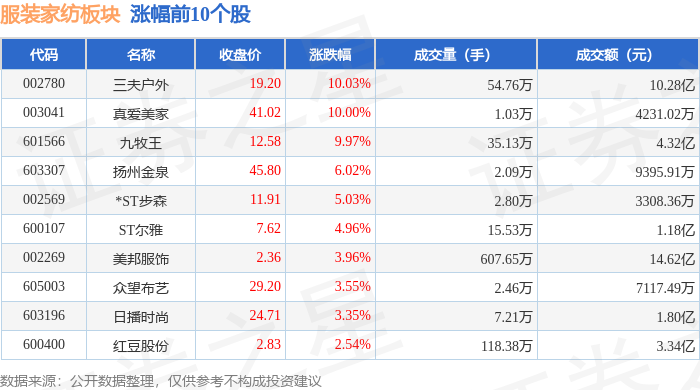
服装家纺板块11月14日涨0.03%,三夫户外领涨,主力资金净流出2.7亿元
Zheng Xing Xing Ye Ri Bao· 2025-11-14 08:51
Core Insights - The apparel and home textile sector experienced a slight increase of 0.03% on November 14, with Sanfu Outdoor leading the gains [1] - The Shanghai Composite Index closed at 3990.49, down 0.97%, while the Shenzhen Component Index closed at 13216.03, down 1.93% [1] Stock Performance - Sanfu Outdoor (002780) saw a closing price of 19.20, with a significant increase of 10.03% and a trading volume of 547,600 shares, amounting to a transaction value of 1.028 billion [1] - Other notable performers included Zhenyaomeijia (003041) with a 10.00% increase, closing at 41.02, and Jiuwang (601566) with a 9.97% increase, closing at 12.58 [1] - The overall performance of the apparel and home textile sector showed mixed results, with several stocks experiencing gains while others faced declines [2] Capital Flow - The apparel and home textile sector experienced a net outflow of 270 million from institutional investors, while retail investors saw a net inflow of 364 million [2][3] - The capital flow data indicates that while institutional investors withdrew funds, retail investors were actively buying into the sector [2][3] Individual Stock Capital Flow - Meibang Apparel (002269) had a net inflow of 97.50 million from institutional investors, but faced a net outflow of 71.73 million from speculative funds [3] - Jiuwang (601566) also saw a significant net inflow of 84.38 million from institutional investors, with a net outflow of 37.59 million from speculative funds [3] - The data reflects a trend where institutional investors are more engaged in certain stocks, while speculative funds are withdrawing [3]


次级债不赎回历史案例复盘
Huachuang Securities· 2025-11-11 13:15
1. Report Industry Investment Rating No relevant content provided. 2. Core View of the Report The report focuses on the historical cases of subordinated debt non - redemption, analyzes the characteristics, subsequent progress, and credit risk outlook of non - redemption, aiming to help investors better understand the credit risk characteristics of subordinated debt. Since the non - redemption announcement of "22 Hongdou MTN003" by Hongdou Group in October 2025, the risk of subordinated debt non - redemption has attracted attention. The report suggests paying more attention to subordinated debt of insurance companies and industrial entities with operational pressure and weak shareholder support in the future [2][11][54]. 3. Summary According to Relevant Catalogs 3.1 Subordinated Debt Concept and Classification - Subordinated bonds are debt instruments with repayment priority after general liabilities but before common stock equity, featuring high risk and high return. As of November 10, 2025, the scale of outstanding subordinated debt was about 10.7 trillion yuan, with the financial industry accounting for about 8.5 trillion yuan [3][12]. - Most subordinated debts have a call option, and issuers usually have a strong incentive to call. The call motivation is mainly based on the interest rate jump - up mechanism and the "decreasing" nature of capital. Non - financial enterprise subordinated debts are mostly used to repay interest - bearing debts and supplement working capital, while financial institution subordinated debts are mostly used for capital replenishment [19]. - For non - perpetual subordinated debts (mainly 5 + 5), there is a "decreasing" nature of capital, and insurance companies have a stronger call motivation due to the interest rate jump - up mechanism. For perpetual subordinated debts (mainly 5 + N), most securities companies and non - financial enterprises set an interest rate jump - up mechanism [20][21]. - For non - financial enterprises, perpetual bonds are not necessarily subordinated debts. For financial enterprises, perpetual bonds are all subordinated debts. If an issuer announces non - redemption, it may indicate fundamental pressure and difficulties in rolling over subordinated debt, posing risks such as duration mismatch and investment losses for investors [25]. 3.2 Historical Case Review of Subordinated Debt Non - Redemption - As of November 10, 2025, 70 entities with 88 subordinated debts had non - redemption events, involving a bond scale of about 76.5 billion yuan. Non - redemption mainly occurred in commercial bank secondary capital bonds, concentrated in weak - qualified banks in Liaoning Province, and was common in low - rated subordinated debts [4][27][37]. - In terms of industry type, non - redemption mainly occurred in banks and insurance companies, with 74 and 7 non - redeemed bonds respectively, accounting for 84% and 8% of the total number of non - redeemed subordinated debts, and involving scales of 45.5 billion yuan and 17.6 billion yuan, accounting for 59% and 23% respectively [27]. - In terms of enterprise nature, non - redemption mainly occurred in public enterprises, but the number of non - redemption events among private enterprises has increased since 2024 [5][37]. 3.3 Subsequent Progress of Subordinated Debt Non - Redemption - After 88 subordinated debts were not redeemed, 1 bond defaulted, 1 was extended, 65 continued to exist normally, and 21 were fully redeemed at or before maturity. Only a few entities could successfully issue subordinated debt again after non - redemption, and the issuance had non - market - oriented characteristics. Some weak - qualified entities may continue to not redeem subordinated debt [6][45][49]. 3.4 Credit Risk Outlook of Subordinated Debt Non - Redemption - In the past, the risk of subordinated debt non - redemption was mainly concentrated in banks, but recently, risks of insurance companies and industrial entities have gradually emerged. In the future, when analyzing the risk of subordinated debt non - redemption, it is recommended to pay more attention to insurance companies and industrial entity subordinated debts with operational pressure and weak shareholder support [7][54].