
CATEC(600879)

Search documents
商业航天延续强势领涨
Tebon Securities· 2025-12-25 12:11
Market Analysis - The A-share market is experiencing a strong upward trend, with the Shanghai Composite Index rising for seven consecutive days, closing at 3959.62 points, up 0.47% [6] - The overall market sentiment is positive, with a total trading volume of 1.94 trillion yuan, reflecting a 2.5% increase from the previous trading day [6] - The market is expected to continue its upward trajectory, driven by improved risk appetite and external factors stabilizing [7] Sector Performance - The commercial aerospace sector is leading the market with a significant increase of 4.95%, driven by high trading volumes in companies like China Satellite and Aerospace Electronics [5] - The paper products index also saw a rise of 3.63%, supported by a favorable exchange rate for imports [5] - Conversely, the non-ferrous metals sector declined by 0.92%, attributed to fluctuations in international gold prices [5] Bond Market - The government bond futures market is experiencing slight adjustments, with the 30-year main contract closing down 0.24% [10] - The central bank's liquidity injection of nearly 200 billion yuan indicates a continued loose monetary policy [10] - The market is expected to maintain a long-term easing bias, with potential for further adjustments in the first quarter of the following year [14] Commodity Market - The commodity index has slightly decreased by 0.16%, with significant volatility observed in platinum and palladium prices [10] - The price of polysilicon has surged, reflecting tight supply expectations, while the market remains optimistic about industry recovery [10] - Recent regulatory changes in trading for platinum and palladium have led to increased volatility, suggesting a cautious approach to these commodities [10] Investment Opportunities - Key investment themes include commercial aerospace, artificial intelligence, and large consumer sectors, driven by government support and market dynamics [12] - The report highlights the attractiveness of dividend stocks and the potential for further capital inflows into the A-share market due to the appreciation of the yuan [14] - The focus on technological innovation and the development of a modern industrial system is expected to catalyze growth in targeted sectors [7]


主力动向:12月25日特大单净流出32.65亿元
Zheng Quan Shi Bao Wang· 2025-12-25 10:12
Market Overview - The two markets experienced a net outflow of 3.265 billion yuan, with 2,019 stocks seeing net inflows and 2,690 stocks experiencing net outflows [1] - The Shanghai Composite Index closed up by 0.47% [1] Industry Analysis - Among the 12 industries with net inflows, the automotive sector led with a net inflow of 2.84 billion yuan and an index increase of 1.46% [1] - The machinery equipment sector followed with a net inflow of 2.398 billion yuan and an increase of 1.51% [1] - Other notable sectors with net inflows included defense and military, and electrical equipment [1] - Conversely, 19 industries saw net outflows, with the electronics sector experiencing the highest outflow of 3.785 billion yuan, followed by non-ferrous metals with 2.630 billion yuan [1] Stock Performance - A total of 47 stocks had net inflows exceeding 200 million yuan, with Aerospace Electronics leading at 2.228 billion yuan [2] - Other top stocks included Goldwind Technology with 1.016 billion yuan and Feilong Co., Ltd. with 0.982 billion yuan [2] - Stocks with significant net outflows included Aerospace Development at 1.808 billion yuan, followed by Shenghong Technology and Tianfu Communication with outflows of 1.540 billion yuan and 0.944 billion yuan respectively [2] - Stocks with net inflows over 200 million yuan saw an average increase of 8.23%, outperforming the Shanghai Composite Index [2] Top Stocks by Net Inflow | Code | Name | Closing Price (Yuan) | Change (%) | Net Inflow (Billion Yuan) | Industry | |--------|-----------------|----------------------|------------|---------------------------|-------------------| | 600879 | Aerospace Electronics | 18.61 | 9.99 | 2.228 | Defense & Military | | 002202 | Goldwind Technology | 19.17 | 9.98 | 1.016 | Electrical Equipment | | 002536 | Feilong Co., Ltd. | 33.55 | 7.84 | 0.982 | Automotive | | 002050 | Sanhua Intelligent Control | 47.56 | 5.50 | 0.732 | Home Appliances | | 300274 | Sunshine Power | 167.88 | 1.21 | 0.704 | Electrical Equipment | | 002792 | Tongyu Communication | 38.18 | 10.00 | 0.696 | Communication | | 000559 | Wanxiang Qianchao | 13.44 | 9.98 | 0.659 | Automotive | | 601138 | Industrial Fulian | 66.72 | 2.43 | 0.635 | Electronics | | 002565 | Shunhao Co., Ltd. | 15.56 | 5.99 | 0.608 | Light Industry | | 688270 | Zhenlei Technology | 133.50 | 16.90 | 0.600 | Electronics | [2][3] Top Stocks by Net Outflow | Code | Name | Closing Price (Yuan) | Change (%) | Net Outflow (Billion Yuan) | Industry | |--------|-----------------|----------------------|------------|-----------------------------|-------------------| | 000547 | Aerospace Development | 25.60 | 2.69 | -1.808 | Defense & Military | | 300476 | Shenghong Technology | 299.51 | -3.16 | -1.540 | Electronics | | 300394 | Tianfu Communication | 214.80 | -3.71 | -0.944 | Communication | | 300502 | Xinyi Sheng | 447.99 | -1.22 | -0.919 | Communication | | 002163 | Hainan Development | 20.68 | 6.87 | -0.769 | Construction | | 600343 | Aerospace Power | 43.27 | 3.52 | -0.588 | Machinery Equipment | | 600693 | Dongbai Group | 20.91 | -2.52 | -0.500 | Retail | | 300456 | Saiwei Electronics | 59.09 | -3.13 | -0.495 | Electronics | | 688795 | Moer Thread-U | 628.86 | -0.81 | -0.410 | Electronics | | 002600 | Lingyi Intelligent Manufacturing | 15.84 | -1.00 | -0.398 | Electronics | [4]



12月25日主力资金流向日报
Zheng Quan Shi Bao Wang· 2025-12-25 09:34
Market Overview - On December 25, the Shanghai Composite Index rose by 0.47%, the Shenzhen Component Index increased by 0.33%, the ChiNext Index went up by 0.30%, and the CSI 300 Index saw a gain of 0.18% [1] - Among the tradable A-shares, 3,772 stocks rose, accounting for 69.17%, while 1,473 stocks declined [1] Capital Flow - The main capital saw a net outflow of 18.129 billion yuan throughout the day [1] - The ChiNext experienced a net outflow of 4.408 billion yuan, while the STAR Market had a net outflow of 1.689 billion yuan, and the CSI 300 constituents faced a net outflow of 8.559 billion yuan [1] Industry Performance - Out of the 25 primary industries classified by Shenwan, the top gainers were Defense and Military with a rise of 2.91% and Light Industry Manufacturing with an increase of 1.59% [1] - The industries with the largest declines were Comprehensive and Nonferrous Metals, which fell by 1.12% and 0.77%, respectively [1] Sector Capital Inflows - Eight industries saw net inflows, with the Automotive sector leading at a net inflow of 2.747 billion yuan and a daily increase of 1.46% [1] - The Machinery Equipment sector followed with a daily rise of 1.51% and a net inflow of 1.862 billion yuan [1] Sector Capital Outflows - Twenty-three industries experienced net outflows, with the Electronics sector leading at a net outflow of 6.123 billion yuan despite a daily increase of 0.29% [1] - The Nonferrous Metals sector had a net outflow of 4.135 billion yuan and a decline of 0.77% [1] Individual Stock Performance - A total of 2,056 stocks saw net inflows, with 705 stocks having inflows exceeding 10 million yuan, and 118 stocks with inflows over 100 million yuan [2] - The stock with the highest net inflow was Aerospace Electronics, which rose by 9.99% with a net inflow of 1.869 billion yuan [2] - The stocks with the largest net outflows included Aerospace Development, Shenghong Technology, and Hainan Development, with outflows of 1.680 billion yuan, 1.596 billion yuan, and 959 million yuan, respectively [2]



太空算力成为市场热点,上海港湾、中国卫星、通宇通讯、航天电子、复旦微电领涨,太空算力题材相关企业整理
Jin Rong Jie· 2025-12-25 09:26
Core Viewpoint - "Space computing power" is not merely a concept hype but is rooted in profound industrial evolution logic, addressing the limitations of traditional satellites in data processing and transmission efficiency. Group 1: Key Companies and Their Highlights - Shanghai Port (605598.SH) focuses on lightweight, high-temperature resistant perovskite batteries to meet the energy needs of computing satellites, with a latest stock price of 61.90 yuan and a daily increase of +10.01% [1] - China Satellite (600118.SH) is the leading domestic satellite manufacturer with an annual production capacity of 200 small satellites, playing a key role in the national "Trinity Computing Constellation" project, with a latest stock price of 72.73 yuan and a daily increase of +10.00% [2] - Tongyu Communication (002792.SZ) provides the core satellite communication phased array antennas essential for signal transmission between satellites and ground stations, with a latest stock price of 38.18 yuan and a daily increase of +10.00% [3] - Aerospace Electronics (600879.SH) holds over 90% market share in onboard computers, with its AI processing modules enhancing satellite computing power from T-level to P-level, crucial for the "Trinity Computing Constellation" project, with a latest stock price of 18.61 yuan and a daily increase of +9.99% [4] - Fudan Microelectronics (688385.SH) is the only domestic company capable of mass-producing radiation-resistant FPGAs, providing hardware reliability for satellite computing modules, with a latest stock price of 75.20 yuan and a daily increase of +16.21% [5] Group 2: Additional Companies and Their Contributions - Aerospace Smart Equipment (300455.SZ) has over 70% market share in onboard computer systems for commercial satellites, with a latest stock price of 18.26 yuan and a daily increase of +10.44% [7] - Zhongke Star Map (688568.SH) has developed an integrated data processing platform that combines FPGA chips and AI algorithms for efficient space-based computing, with a latest stock price of 51.96 yuan and a daily increase of +7.11% [8] - Shanghai Huguang (603131.SH) is involved in commercial space launches with capabilities for multi-satellite launches, aligning with the needs of computing constellations, with a latest stock price of 29.88 yuan and a daily increase of +6.71% [9] - Shunhao Co., Ltd. (002565.SZ) has invested in Beijing Orbit Chen Guang, focusing on the construction of giant computing satellite constellations, with a latest stock price of 15.56 yuan and a daily increase of +5.99% [10] - Qianzhao Optoelectronics (300102.SZ) has achieved a solar cell conversion efficiency of 28%, providing stable energy support for space computing devices, with a latest stock price of 24.62 yuan and a daily increase of +5.62% [11]


16.24亿元主力资金今日抢筹国防军工板块
Zheng Quan Shi Bao Wang· 2025-12-25 09:10
Market Overview - The Shanghai Composite Index rose by 0.47% on December 25, with 25 out of the 28 sectors experiencing gains, led by the defense and military industry, which increased by 2.91% [1] - The total net outflow of capital from the two markets was 18.129 billion yuan, with 8 sectors seeing net inflows, primarily in the automotive sector, which had a net inflow of 2.747 billion yuan and a rise of 1.46% [1] Defense and Military Industry - The defense and military industry saw a significant increase of 2.91%, with a total net inflow of 1.624 billion yuan, and 122 out of 138 stocks in this sector rose, including 10 stocks hitting the daily limit [2] - The top stocks in terms of net capital inflow included Aerospace Electronics with 1.869 billion yuan, followed by Shanghai Hanyun and Guanglian Aviation with 328 million yuan and 279 million yuan respectively [2] - The sector also had 7 stocks with net capital outflows exceeding 100 million yuan, with Aerospace Development leading at 1.680 billion yuan, followed by Hezhong Shizhuang and Feilihua with 288 million yuan and 237 million yuan respectively [2] Capital Flow in Defense and Military Industry - The top inflow stocks in the defense and military sector included: - Aerospace Electronics: +9.99%, turnover rate 19.47%, net inflow 1.869 billion yuan - Shanghai Hanyun: +8.06%, turnover rate 21.08%, net inflow 328 million yuan - Guanglian Aviation: +19.99%, turnover rate 24.02%, net inflow 279 million yuan [2] - The top outflow stocks included: - Aerospace Development: +2.69%, turnover rate 33.26%, net outflow 1.681 billion yuan - Hezhong Shizhuang: +3.25%, turnover rate 24.00%, net outflow 287 million yuan - Feilihua: -3.71%, turnover rate 6.27%, net outflow 237 million yuan [4]




超3700只个股上涨
第一财经· 2025-12-25 07:30
Core Viewpoint - The A-share market showed a positive trend with all three major indices closing higher, indicating a potential upward momentum as the year-end approaches [3][11]. Market Performance - The Shanghai Composite Index rose by 0.47% to close at 3959.62, the Shenzhen Component Index increased by 0.33% to 13531.41, and the ChiNext Index gained 0.30% to 3239.34 [4]. - The trading volume in the Shanghai and Shenzhen markets reached 1.92 trillion, an increase of 443 billion compared to the previous trading day, with over 3700 stocks rising [8]. Sector Highlights - The commercial aerospace sector continued its strong performance, with stocks like Shenjian Co. achieving six consecutive trading limits, and nearly 30 stocks in this sector hitting the daily limit [5]. - The robotics sector also saw significant gains, with stocks such as Chaojie Co. and Haoshi Electromechanical reaching their daily limits [6]. Capital Flow - Main capital inflows were observed in the aerospace, automotive, and insurance sectors, with notable net inflows into stocks like Aerospace Electronics (17.34 billion), Goldwind Technology (8.22 billion), and Sunshine Power (7.78 billion) [10]. - Conversely, there were net outflows from the electronics, communications, and non-ferrous metals sectors, with stocks like Shenghong Technology and Aerospace Development facing significant sell-offs [10]. Institutional Perspectives - CITIC Construction expressed that the Shanghai Composite Index is challenging the 4000-point mark, suggesting a focus on performance as the year ends [11]. - Guodu Securities indicated that the cross-year market trend has begun, with an expectation for the upward trend to continue, particularly favoring technology growth stocks [12]. - Everbright Securities noted the sustained market vitality with a seven-day upward trend in the Shanghai Composite Index, anticipating continued capital inflow and a bullish outlook for technology growth sectors [12].



沪深两市今日成交额合计1.92万亿元,中际旭创成交额居首
Xin Lang Cai Jing· 2025-12-25 07:17
Core Viewpoint - The total trading volume of the Shanghai and Shenzhen stock markets reached 1.92 trillion yuan on December 25, reflecting an increase of approximately 442.55 billion yuan compared to the previous trading day [1] Trading Volume Summary - The trading volume in the Shanghai market was 785.02 billion yuan, while the Shenzhen market recorded 1.14 trillion yuan [1] - The top traded stock was Zhongji Xuchuang, with a trading volume of 16.55 billion yuan [1] - Other notable stocks included Industrial Fulian, Aerospace Development, Xinyi Sheng, and Aerospace Electronics, with trading volumes of 13.55 billion yuan, 13.34 billion yuan, 12.73 billion yuan, and 11.59 billion yuan respectively [1]


主力资金监控:航天电子净买入超14亿
Xin Lang Cai Jing· 2025-12-25 06:32
Core Viewpoint - The main focus of the article is on the significant net inflow of capital into the aerospace electronics sector, while other sectors such as electronics and non-ferrous metals experienced notable outflows [1] Group 1: Capital Flow Analysis - Major capital inflow was observed in the machinery, general equipment, and transportation equipment sectors [1] - Aerospace Electronics saw a net capital inflow of 1.428 billion yuan, leading the market [1] - Industrial Fulian, Goldwind Technology, and Sanhua Intelligent Control also experienced significant net inflows [1] Group 2: Sector Performance - The electronics sector faced a net outflow exceeding 4.6 billion yuan [1] - Shenghong Technology was the most affected, with a net sell-off exceeding 1 billion yuan [1] - Hainan Development, Tianfu Communication, and Xinyismeng also recorded substantial net outflows [1]
持续爆发!卫星ETF(159206)涨超6%,全市场ETF涨幅第二!
Sou Hu Cai Jing· 2025-12-25 06:16
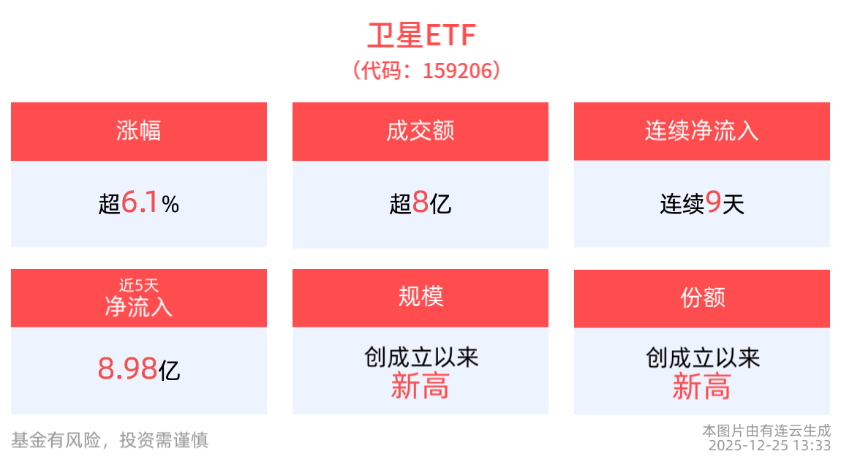
Core Viewpoint - The A-share commercial aerospace sector experienced a significant surge, with the Satellite ETF (159206) rising over 6%, leading the market [3] Group 1: Market Performance - The Satellite ETF reached a new high in scale at 4.159 billion yuan [4] - Notable stocks included Chaojie Co. (301005) with a 20% increase, and several others like Shanghai Port (605598) and Shenglu Communication (002446) achieving 10% increases [4] - The Satellite ETF has seen continuous net inflows over the past nine days, totaling 1.418 billion yuan, with a peak single-day inflow of 353 million yuan [5] Group 2: Industry Developments - As of December 23, 2025, China conducted nearly 90 space launches, setting a historical record, with 23 of these by private commercial rocket companies [7] - The China Manned Space Engineering Office announced plans for four missions in 2026, including the first launch of the Long March 10A reusable rocket [7] - According to a report by China International Capital Corporation, the satellite industry is at a critical turning point, with expectations for significant growth in satellite tenders and launch volumes [7] Group 3: Investment Opportunities - The Satellite ETF focuses on commercial aerospace and satellite communication, positioned to benefit from China's ambitions as a "space power" [8] - The ETF is the first of its kind in the market, established on March 6, 2025, and is expected to see accelerated growth due to supportive policies and decreasing launch costs [8]


卫星ETF易方达上涨3.88%,航天科技集团强调突破重复使用火箭,推动航天与AI融合
Ge Long Hui A P P· 2025-12-25 04:33
Core Viewpoint - The satellite industry is experiencing significant growth, driven by a recent meeting of the China Aerospace Science and Technology Corporation, which outlined strategic initiatives for the "14th Five-Year Plan" focusing on technological breakthroughs and cross-industry integration [1][2] Group 1: Industry Developments - The meeting emphasized the importance of aerospace technology in national security and military responsibilities, marking a shift from a "task-oriented" approach to an "industry-oriented" model [1] - The focus on integrating aerospace with AI, advanced manufacturing, and renewable energy is expected to create new productive forces and accelerate the commercialization of space [1] Group 2: Market Impact - Companies such as Zhenray Technology, Aerospace Electronics, and China Satellite have seen stock price increases of over 16%, 8%, and 6% respectively, contributing to a 3.88% rise in the E Fund Satellite ETF [1] - The E Fund Satellite ETF tracks the CSI Satellite Industry Index, which covers a wide range of sectors including satellite manufacturing, launching, communication, navigation, and remote sensing, indicating a concentrated focus on leading companies in the industry [2]

