
CATEC(600879)

Search documents
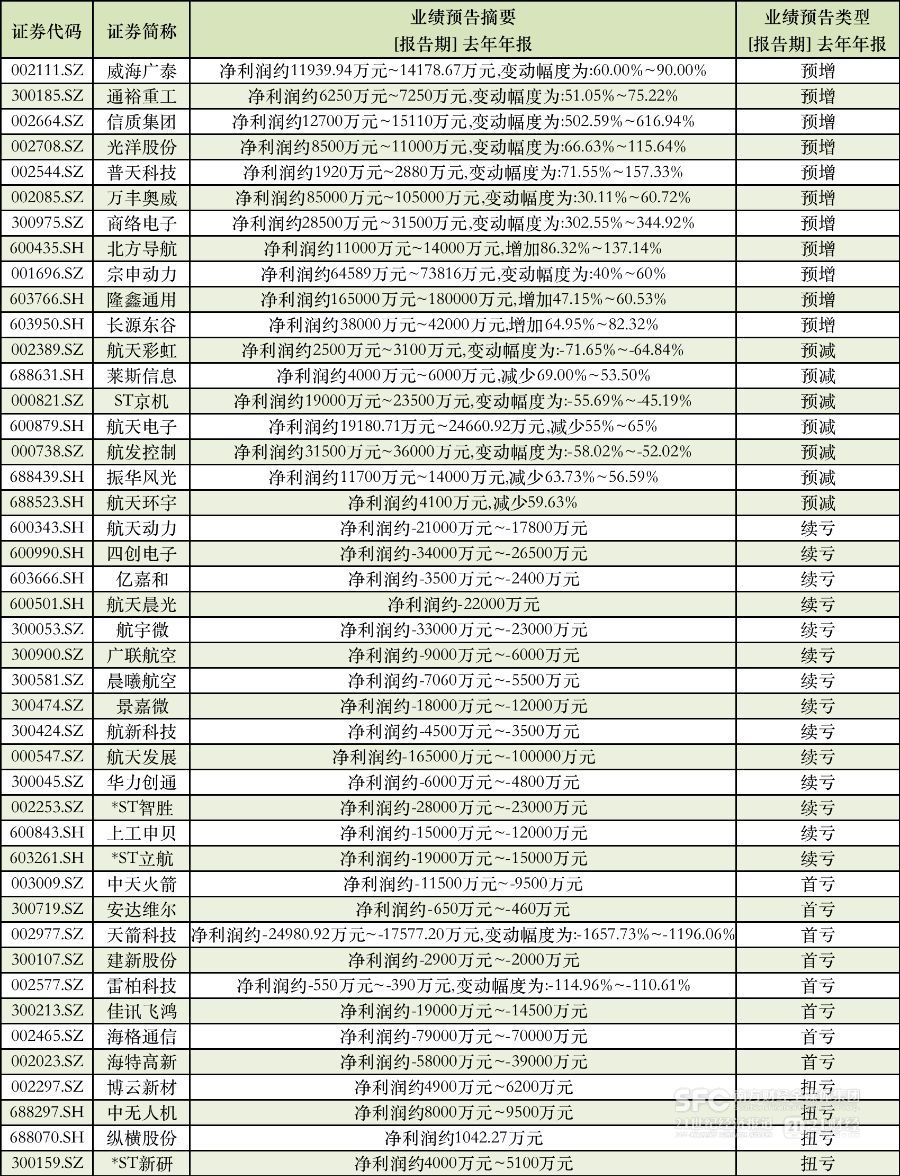
44家低空企业披露业绩预告:万丰奥威等预增,上工申贝等续亏
2 1 Shi Ji Jing Ji Bao Dao· 2026-02-02 07:20
Core Viewpoint - The low-altitude economy sector is showing mixed results for 2025, with 22 companies expected to be profitable while another 22 are projected to incur losses, indicating a significant divergence in performance within the industry [3]. Performance Forecast Summary Profit Growth - 11 companies are expected to report profit increases, with notable projections including: - Xinzhi Group (002664.SZ) and Shangluo Electronics (300975.SZ) anticipating several-fold increases in net profit [4]. - Weihai Guangtai (002111.SZ), Tongyu Heavy Industry (300185.SZ), and Guangyang Co. (002708.SZ) expecting over 50% growth in net profit [4]. - Wan Feng Aowei (002085.SZ) and Zongshen Power (001696.SZ) also forecasted net profit growth [4]. Losses - 22 companies are projected to incur losses, with several notable cases: - Zhongtian Rocket (003009.SZ) and Andavil (300719.SZ) have shifted from profit to loss [7]. - Haige Communication (002465.SZ) is investing heavily in R&D, leading to increased costs and a projected loss [7]. - Companies like Aerospace Power (600343.SH) and Sihua Electronics (600990.SH) are also expected to continue reporting losses [8]. Industry Insights - The low-altitude economy's contribution to overall profits remains limited, with most revenue still coming from aircraft manufacturing and infrastructure construction [3]. - Companies like Wan Feng Aowei are leveraging their low-altitude business to drive profit growth, supported by strong orders in general aviation aircraft manufacturing and strategic acquisitions [5]. - The industry is witnessing a shift towards commercial applications of low-altitude technologies, with companies preparing for a significant commercialization phase in 2026 [9][10]. Strategic Developments - Companies are increasingly focusing on integrating low-altitude infrastructure and management platforms, as seen with Suzhou Keda's strategic investments in civil aviation infrastructure [11]. - The emphasis on R&D and market expansion in emerging fields like low-altitude economy is evident, with companies aiming to enhance their competitive edge through innovative solutions [7][11].


中证500ETF天弘(159820)跌2.59%,半日成交额640.37万元
Xin Lang Cai Jing· 2026-02-02 03:38
Group 1 - The core point of the article highlights the performance of the Zhongzheng 500 ETF Tianhong (159820), which experienced a decline of 2.59% to 1.391 yuan at midday, with a trading volume of 6.4037 million yuan [1] - The major holdings of the Zhongzheng 500 ETF Tianhong include stocks such as Yingweike, which fell by 2.51%, and Xinyi Communication, which rose by 1.49%. Other notable movements include Giant Network down 1.43%, and Chifeng Gold down 10.00% [1] - The performance benchmark for the Zhongzheng 500 ETF Tianhong is the Zhongzheng 500 Index return, managed by Tianhong Fund Management Co., Ltd. Since its establishment on August 7, 2020, it has achieved a return of 42.49%, with a monthly return of 12.28% [1]





机构投资对战互联网“吸睛大法”
Zhong Guo Zheng Quan Bao· 2026-02-01 20:53
Core Viewpoint - The rise of "Internet trading strategies" has led to significant speculation in the stock market, particularly among retail investors, driven by social media influencers and algorithmic recommendations [1][2][3] Group 1: Internet Trading Strategies - The "Internet trading strategy" is characterized by leveraging personal accounts or matrix accounts to attract attention and create momentum for specific stocks [2] - Influencers like "Chen Xiaoqun" have gained notoriety for their dramatic wealth stories, amplifying their influence through social media platforms [1][3] - The commercial aerospace sector has exemplified this strategy, with significant trading activity observed in stocks like "航天发展" [2] Group 2: Regulatory Actions - Recent regulatory actions have targeted influencers and their trading practices, revealing the operational logic behind "Internet trading strategies" [4] - The Zhejiang Securities Regulatory Bureau has penalized individuals for promoting stocks while simultaneously selling them, highlighting the risks associated with influencer-driven trading [4] Group 3: Institutional Investor Response - Institutional investors, particularly quantitative funds, are incorporating social media data into their investment strategies, often using it as a contrarian indicator rather than a signal to follow [5][6] - Quantitative teams are exploring more stable social data, such as sales figures and social media sentiment, to gauge market conditions [6] Group 4: Market Dynamics and Risks - The phenomenon of "social trading" has intensified, with retail investors increasingly relying on influencers for investment decisions, leading to potential market volatility [7] - Algorithms on social media platforms can create echo chambers, limiting the diversity of information available to retail investors [8] Group 5: Professional Investor Strategies - Professional institutions are encouraged to shift from one-way communication to more interactive services, providing educational content that aligns with investor habits [9] - Building trust through transparency and genuine engagement is essential for professional institutions to compete with social media influencers [9]


航天电子:公司航天电子信息产品严格按照相关总体单位技术标准和质量要求研制生产
Zheng Quan Ri Bao Wang· 2026-01-30 15:10
Core Viewpoint - Aerospace Electronics (航天电子) emphasizes that its information products are developed and produced in strict accordance with relevant technical standards and quality requirements set by the overall unit [1] Group 1 - The company engages with investors through an interactive platform to address inquiries [1] - The commitment to quality and adherence to technical standards is highlighted as a key aspect of the company's production process [1]
航天电子:航天电子信息产品主要应用于火箭、卫星、飞船等航天专用领域
Zheng Quan Ri Bao Wang· 2026-01-30 12:14
Core Viewpoint - Aerospace Electronics (航天电子) focuses on providing information products primarily for specialized aerospace applications, including rockets, satellites, and spacecraft [1]. Group 1 - The company’s products are mainly utilized in the aerospace sector [1].
航天装备板块1月30日跌0.84%,航天环宇领跌,主力资金净流出6.61亿元
Zheng Xing Xing Ye Ri Bao· 2026-01-30 09:00
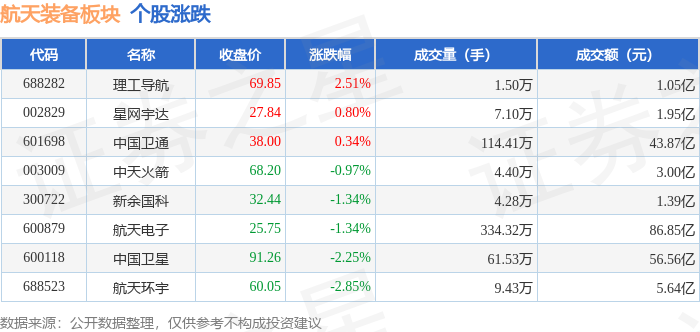
Market Overview - The aerospace equipment sector experienced a decline of 0.84% on January 30, with Aerospace HuanYu leading the drop [1] - The Shanghai Composite Index closed at 4117.95, down 0.96%, while the Shenzhen Component Index closed at 14205.89, down 0.66% [1] Stock Performance - Key stocks in the aerospace equipment sector showed varied performance: - Ligong Navigation (688282) closed at 69.85, up 2.51% with a trading volume of 15,000 shares and a turnover of 105 million yuan [1] - Xingwang Yuda (002829) closed at 27.84, up 0.80% with a trading volume of 71,000 shares and a turnover of 195 million yuan [1] - China Satellite (600118) closed at 91.26, down 2.25% with a trading volume of 615,300 shares and a turnover of 5.656 billion yuan [1] - Aerospace Electronics (600879) closed at 25.75, down 1.34% with a trading volume of 3,343,200 shares and a turnover of 8.685 billion yuan [1] Capital Flow - The aerospace equipment sector saw a net outflow of 661 million yuan from institutional investors, while retail investors contributed a net inflow of 453 million yuan [1] - Detailed capital flow for key stocks includes: - China Satellite (600118) had a net outflow of 290 million yuan from institutional investors and a net inflow of 205 million yuan from retail investors [2] - Aerospace HuanYu (688523) experienced a significant net outflow of 68.81 million yuan from institutional investors, with a net inflow of 60.56 million yuan from retail investors [2] - Ligong Navigation (688282) had a net inflow of 11.93 million yuan from institutional investors, but a net outflow from retail investors [2]





航天电子20260129
2026-01-30 03:12
Summary of Aerospace Electronics Conference Call Company Overview - Aerospace Electronics is the only publicly listed platform under the Aerospace Science and Technology Corporation that encompasses all main businesses. The military products segment has shown stable growth, while the civilian products segment has faced competition, leading to losses in 2018 and 2023, resulting in a decline in net profit attributable to shareholders [2][3]. Core Business Segments - The company's business structure is divided into two main areas: aerospace electronics support and unmanned systems. The aerospace electronics support includes five sub-segments: telemetry and control communication, electromechanical components, inertial navigation, electrical assembly, and integrated circuits. Telemetry and control communication is the largest and most critical segment, while inertial navigation is applied in high-precision scenarios [2][3][4]. Unmanned Systems - The unmanned systems business, managed by the subsidiary Times Feihong, is a core segment and the only unit within the Aerospace Science and Technology Corporation focused on precision-guided weapons. Products are widely used in regions such as Africa and the Middle East, with short-term reliance on domestic satellite support [2][6]. Commercial Aerospace Initiatives - The company is actively involved in the commercial aerospace sector, participating in major domestic low-orbit internet satellite constellations, particularly with partners like the China Academy of Space Technology. The company is expected to benefit significantly from the peak period of domestic satellite internet construction [2][7]. Contribution to Rockets and Satellites - Aerospace Electronics contributes significantly to rocket and satellite systems, with over 66% of electronic components in Long March rockets sourced from the company, accounting for 15%-30% of the rocket's total value. For satellites, 30%-40% of the platform's value comes from the company's products [2][8]. Future Growth Prospects - The company is expected to continue benefiting from the growth of the commercial aerospace sector due to its strong positioning and close ties with the Aerospace Science and Technology Corporation. It is anticipated that the company will achieve significant revenue growth in the coming years [2][9]. Technical Capabilities - Aerospace Electronics possesses leading technical capabilities in four key areas: spacecraft telemetry, electromechanical components, inertial navigation, and integrated circuits. The company has a strong presence in the domestic market, particularly in telemetry and control communication, and has a substantial revenue stream from inertial navigation technologies [2][10][11]. Unmanned Equipment Development - The unmanned equipment business focuses on small to medium-sized drones, which are in high demand among military forces. The company has developed a range of products, including small reconnaissance drones and larger loyal wingman systems, with a strong emphasis on advanced control capabilities [2][12]. International Trade Performance - The company has been successful in the international military trade market, exporting products like the Feihong 92 and Feihong 95 drones to friendly nations. The international market offers a favorable environment for sales, with higher profit margins compared to domestic sales [2][13][14]. Investment and Strategic Planning - As the only publicly listed platform under the Aerospace Science and Technology Corporation, the company is positioned for significant performance realization in commercial aerospace and deep space exploration. It plans to invest in expanding production capacity and enhancing competitiveness through a 300 million yuan investment in an underwater vehicle industrialization base [2][15]. Impact of Equity Incentives - The company has implemented equity incentive measures for key subsidiaries to enhance employee motivation and align long-term interests. These incentives are expected to support sustained growth in the unmanned systems segment, contributing positively to overall company performance [2][16].
千亿商业航天产业蓄势待发,航空航天ETF(159227)近1周份额增长1.7亿份
Xin Lang Cai Jing· 2026-01-30 03:06
Group 1 - The China Aerospace Science and Technology Corporation plans to enhance commercial launch capabilities and develop competitive commercial rockets for regular transportation, aiming for reusable rockets to achieve scalable and mature commercial applications [2] - Shanghai is focused on becoming a national hub for the commercial aerospace industry, targeting an industry scale of approximately 100 billion yuan by 2027, with a planned area of about 9.3 square kilometers for the "Rocket Star City" [2] - The East Wu Securities report highlights that SpaceX is set to enter a quiet period ahead of its IPO, aiming to raise over $30 billion, with part of the funds allocated for developing space-based data centers [2] Group 2 - The Aerospace ETF (159227) closely tracks the China Aerospace Index, covering key industry chain segments such as aerospace equipment, satellite navigation, and new materials, with a high weight of 70% in commercial aerospace concepts [3] - The top ten holdings in the Aerospace ETF include industry leaders such as Aerospace Development, China Satellite, and Aerospace Electronics [3] Group 3 - As of January 30, 2026, the China Aerospace Industry Index (CN5082) showed mixed performance among its constituent stocks, with Beimo High-Tech leading at an increase of 8.87% [1] - The Aerospace ETF recorded a turnover rate of 7.49% and a trading volume of 244 million yuan, with an average daily trading volume of 732 million yuan over the past month [1] - The Aerospace ETF experienced a significant increase in shares, growing by 170 million shares in the past week, with a net inflow of 131 million yuan recently [1]


1月30日重要公告一览



Xi Niu Cai Jing· 2026-01-30 03:02
Group 1: Profit Forecasts - Dongcai Technology expects a net profit of approximately 300 million yuan for 2025, representing a year-on-year increase of about 65.73% [1] - Aerospace Electronics anticipates a net profit of 192 million to 247 million yuan for 2025, a decrease of 55% to 65% year-on-year [2] - Oulai New Materials forecasts a loss of 33 million to 48 million yuan for 2025, compared to a profit of 28.17 million yuan in the previous year [3] - Jiu Ding New Materials projects a net profit of 85 million to 98 million yuan for 2025, reflecting a year-on-year increase of 187.68% to 231.68% [5] - Chuan Yi Technology expects a net profit of 78 million to 103 million yuan for 2025, reversing a loss of 73.47 million yuan from the previous year [6] - Ju Yi Technology anticipates a net profit of 70 million to 105 million yuan for 2025, representing a year-on-year increase of 228.36% to 392.54% [7] - ST Xifa forecasts a net profit of 110 million to 160 million yuan for 2025, a year-on-year increase of 319.91% to 510.77% [19] - Light Media expects a net profit of approximately 1.5 billion to 1.9 billion yuan for 2025, reflecting a year-on-year increase of 413.67% to 550.65% [34] - Tianqi Lithium anticipates a profit of 369 million to 553 million yuan for 2025, compared to a loss of 7.905 billion yuan in the previous year [31] Group 2: Loss Forecasts - Star Ring Technology expects a loss of 220 million to 250 million yuan for 2025, with a projected revenue of 420 million to 450 million yuan, a year-on-year increase of 13.06% to 21.13% [9] - Filinger anticipates a loss of 65 million to 85 million yuan for 2025, compared to a loss of 37.31 million yuan in the previous year [10] - Jiahe Meikang forecasts a loss of 240 million to 280 million yuan for 2025, compared to a loss of 256 million yuan in the previous year [11] - Light Textile City expects a loss of 15 million to 22.5 million yuan for 2025 [23] - Ailon Technology anticipates a profit of 14.96 million to 22.44 million yuan for 2025, reversing a loss of 21.70 million yuan from the previous year [24] - ST Yun Chuang forecasts a loss of 139 million to 149 million yuan for 2025, with projected revenue of 53.5 million to 57.5 million yuan, a year-on-year increase of 6.15% to 14.09% [42] - Meike Home expects a loss of 1.2 billion to 1.8 billion yuan for 2025, compared to a loss of 864 million yuan in the previous year [36] Group 3: Shareholder Actions - Huafeng Chemical announced that shareholders plan to reduce their holdings by no more than 0.73% of the company's shares [8] - Naxinwei disclosed that shareholders plan to reduce their holdings by no more than 1.75% of the company's shares [12] - Shikong Technology announced that a shareholder plans to reduce their holdings by no more than 3% of the company's shares [13] - Yandong Micro disclosed that a shareholder plans to reduce their holdings by no more than 1% of the company's shares [37] - Daily Interaction announced that shareholders plan to reduce their holdings by no more than 0.135% of the company's shares [41]
航天电子:预计2025年度净利润约为1.92亿元~2.47亿元,同比减少55%~65%
Mei Ri Jing Ji Xin Wen· 2026-01-29 10:20
每经头条(nbdtoutiao)——水贝黄金平台"杰我睿"兑付危机调查:40倍杠杆对赌,金价越涨平台越 亏!老板自称"还在深圳",投资者:兑付方案本金打两折,无法接受 (记者 王瀚黎) 每经AI快讯,航天电子1月29日晚间发布业绩预告,航天时代电子技术股份有限公司预计2025年度实现 归属于上市公司股东的净利润约为1.92亿元~2.47亿元,与上年同期相比,预计减少约3.01亿元~3.56亿 元,同比减少55%~65%。2024年度净利润包含了处置航天电工股权的收益2.08亿元,是导致2025年度归 属于上市公司股东的净利润较2024年度减少的主要原因,也是导致2025年度归属于上市公司股东的扣除 非经常性损益的净利润同比变化的主要原因;2025年度公司产品毛利率较2024年度有所下降,导致2025 年度归属于上市公司股东的净利润较2024年度有所减少。 ...