
TKGF(601233)

Search documents
石油化工2025年三季报业绩总结:25Q3油价环比上涨,上游景气修复,中游仍显低迷,聚酯淡季承压
Shenwan Hongyuan Securities· 2025-11-06 10:13
Investment Rating - The report maintains a "Positive" outlook on the petrochemical industry for Q3 2025 [3] Core Insights - Q3 2025 saw a slight recovery in oil prices, with Brent crude averaging $68.2 per barrel, a 2.1% increase quarter-on-quarter but a 19.8% decrease year-on-year [6][22] - The upstream oil and gas sector experienced improved performance due to rising oil prices, while the downstream refining sector faced challenges from weak terminal demand [34][21] - The report highlights potential investment opportunities in high-quality companies within the polyester sector and large refining enterprises [6][34] Summary by Sections Upstream Oil and Gas Sector - In Q3 2025, the oil and gas extraction and service industry achieved total revenue of CNY 15,797.5 billion, a 4.0% decrease year-on-year but a 3.5% increase quarter-on-quarter [21] - The net profit for the sector was CNY 930.5 billion, down 6.1% year-on-year but up 6.2% quarter-on-quarter, with a gross margin of 20.9% [21][23] - The report notes that the recovery in oil prices contributed to improved performance in upstream extraction and sales [21] Downstream Refining and Chemical Sector - The refining and chemical industry reported total revenue of CNY 16,702.0 billion in Q3 2025, a 5.3% decrease year-on-year but a 3.8% increase quarter-on-quarter [34] - The net profit for this sector was CNY 596.9 billion, reflecting a 5.4% increase year-on-year and a 14.8% increase quarter-on-quarter, with a gross margin of 17.8% [34][36] - The report indicates that while oil prices rose, the downstream refining product margins decreased, particularly in the polyester sector due to seasonal demand fluctuations [35][34] Price Trends and Margins - The report details various price trends, including the average price of Brent crude at $68.2 per barrel and the average price differences for key petrochemical products [16][18] - Specific price differences such as the ethylene-ethylene price difference at $605 per ton and the propylene-propane price difference at CNY 1,464 per ton were noted, with some margins expanding while others contracted [15][18] - The report emphasizes the concentration of profits in the polyester industry, with the PTA segment under pressure [15][34] Investment Recommendations - The report recommends focusing on high-quality companies in the polyester sector, such as Tongkun Co. and Wan Kai New Materials, as well as large refining companies like Hengli Petrochemical and Rongsheng Petrochemical [6][34] - It also suggests that the oil price is expected to maintain a mid-to-high level with limited downside potential, recommending companies with high dividend yields like China National Petroleum and China National Offshore Oil [6][34]


硫磺、硫酸等涨幅居前,建议关注进口替代、纯内需、高股息等方向
Huaxin Securities· 2025-11-06 09:35
Investment Rating - The report maintains a "Buy" rating for several companies in the chemical industry, including Xinyangfeng, Senqilin, Ruifeng New Materials, Sinopec, Juhua, Yangnong Chemical, CNOOC, Tongkun, and Daotong Technology [10]. Core Viewpoints - The report highlights significant price increases in sulfur, sulfuric acid, and lithium battery electrolyte, suggesting a focus on import substitution, domestic demand, and high dividend opportunities [6][19]. - The chemical industry is currently experiencing a weak overall performance, with mixed results across different sub-sectors due to past capacity expansions and weak demand [22]. - The report emphasizes the potential for the glyphosate industry to enter a recovery phase, recommending companies like Jiangshan Co., Xingfa Group, and Yangnong Chemical [8][22]. - It suggests focusing on companies with strong competitive positions and growth potential, particularly in the lubricant additive sector and coal-to-olefins industry [22]. - The report also notes the impact of international oil price fluctuations on the chemical sector, with a recommendation to pay attention to companies benefiting from lower raw material costs due to declining oil prices [20][22]. Summary by Sections Chemical Industry Investment Suggestions - The report suggests monitoring the glyphosate industry for potential recovery, with a focus on companies like Jiangshan Co., Xingfa Group, and Yangnong Chemical [8][22]. - It highlights the importance of selecting stocks with good competitive dynamics and profitability, particularly in the lubricant additive and coal-to-olefins sectors [22]. Price Trends of Chemical Products - Significant price increases were noted for sulfur (10.77%), lithium battery electrolyte (10.53%), and sulfuric acid (9.09%) [19]. - Conversely, products like R22 saw a drastic price drop of 60.49%, indicating volatility in the market [19]. Market Dynamics - The report discusses the influence of geopolitical events, such as US sanctions on Russia, on international oil prices, which are expected to remain around $65 per barrel [20][24]. - It also mentions the mixed performance of the chemical industry due to varying demand across different sectors, with some areas like lubricants performing better than others [22].



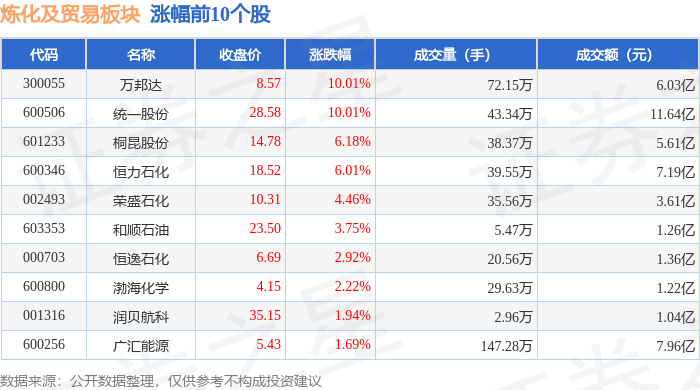
炼化及贸易板块11月6日涨1.02%,万邦达领涨,主力资金净流入3.37亿元
Zheng Xing Xing Ye Ri Bao· 2025-11-06 08:50
Market Overview - The refining and trading sector increased by 1.02% on November 6, with Wanbangda leading the gains [1] - The Shanghai Composite Index closed at 4007.76, up 0.97%, while the Shenzhen Component Index closed at 13452.42, up 1.73% [1] Stock Performance - Wanbangda (300055) closed at 8.57, rising by 10.01% with a trading volume of 721,500 shares and a transaction value of 603 million yuan [1] - Unified Shares (600506) also rose by 10.01% to 28.58, with a trading volume of 433,400 shares and a transaction value of 1.164 billion yuan [1] - Other notable performers included Tongkun Co. (601233) up 6.18% to 14.78, Hengli Petrochemical (600346) up 6.01% to 18.52, and Rongsheng Petrochemical (002493) up 4.46% to 10.31 [1] Capital Flow - The refining and trading sector saw a net inflow of 337 million yuan from main funds, while retail investors experienced a net outflow of 249 million yuan [2] - The main funds showed significant inflows in stocks like Guanghui Energy (600256) and Unified Shares (600506), while retail investors withdrew from several stocks including Rongsheng Petrochemical (002493) and Hengli Petrochemical (600346) [3]


化学纤维板块午后走高,新凤鸣触及涨停
2 1 Shi Ji Jing Ji Bao Dao· 2025-11-06 05:18
Group 1 - The chemical fiber sector experienced a rise in the afternoon, with Xin Fengming hitting the daily limit up [1] - Tongkun Co., Ltd. increased by over 6%, indicating strong market performance [1] - Other companies such as Zhongfu Shenying, Nanjing Chemical Fiber, and Huafeng Chemical also saw gains [1]


桐昆股份涨2.01%,成交额3191.99万元,主力资金净流入51.03万元
Xin Lang Cai Jing· 2025-11-06 02:04
Core Viewpoint - Tongkun Co., Ltd. has shown a mixed performance in stock price and financial results, with a notable increase in net profit despite a decline in revenue [1][2]. Financial Performance - As of September 30, 2025, Tongkun Co., Ltd. reported a revenue of 67.397 billion yuan, a year-on-year decrease of 11.38% [2]. - The net profit attributable to shareholders reached 1.549 billion yuan, reflecting a significant year-on-year increase of 53.83% [2]. - The company has distributed a total of 3.203 billion yuan in dividends since its A-share listing, with 341 million yuan distributed over the past three years [3]. Stock Market Activity - On November 6, 2023, the stock price of Tongkun Co., Ltd. increased by 2.01%, reaching 14.20 yuan per share, with a total market capitalization of 34.148 billion yuan [1]. - The stock has experienced a year-to-date increase of 21.36%, but has seen a decline of 1.53% over the last five trading days and 3.14% over the last twenty days [1]. - The company had a net inflow of main funds amounting to 510,300 yuan, with large orders accounting for 11.73% of total purchases [1]. Shareholder Structure - As of September 30, 2025, the number of shareholders decreased by 28.96% to 50,100, while the average number of tradable shares per shareholder increased by 40.76% to 47,780 shares [2]. - Among the top ten circulating shareholders, Hong Kong Central Clearing Limited holds 35.9221 million shares, an increase of 9.4667 million shares from the previous period [3]. - New entrant Penghua CSI Subdivision Chemical Industry Theme ETF holds 25.2748 million shares, while Southern CSI 500 ETF reduced its holdings by 482,300 shares [3].
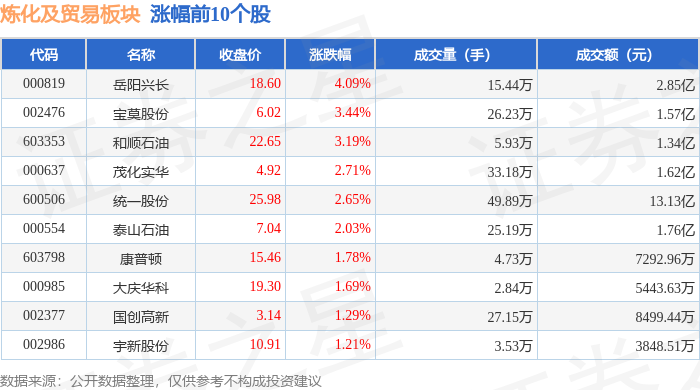
炼化及贸易板块11月5日跌0.41%,桐昆股份领跌,主力资金净流出2.34亿元
Zheng Xing Xing Ye Ri Bao· 2025-11-05 08:55
Core Insights - The refining and trading sector experienced a decline of 0.41% on November 5, with Tongkun Co., Ltd. leading the losses [1] - The Shanghai Composite Index closed at 3969.25, up 0.23%, while the Shenzhen Component Index closed at 13223.56, up 0.37% [1] Sector Performance - Notable gainers in the refining and trading sector included: - Maoyang Xichang: Closed at 18.60, up 4.09% with a trading volume of 154,400 shares and a turnover of 285 million yuan - Baomo Co., Ltd.: Closed at 6.02, up 3.44% with a trading volume of 262,300 shares and a turnover of 157 million yuan - Heshun Petroleum: Closed at 22.65, up 3.19% with a trading volume of 59,300 shares and a turnover of 134 million yuan [1] - Major decliners included: - Tongjing Co., Ltd.: Closed at 13.92, down 1.42% with a trading volume of 160,800 shares and a turnover of 226 million yuan - Rongsheng Petrochemical: Closed at 9.87, down 1.40% with a trading volume of 232,900 shares and a turnover of 231 million yuan - Hengyi Petrochemical: Closed at 6.50, down 1.07% with a trading volume of 155,200 shares and a turnover of 101 million yuan [2] Capital Flow - The refining and trading sector saw a net outflow of 234 million yuan from major funds, while retail investors contributed a net inflow of 220 million yuan [2] - Specific stock capital flows indicated: - Maoyang Xichang: Major funds net outflow of 31.4 million yuan, retail net outflow of 17.5 million yuan - Heshun Petroleum: Major funds net inflow of 11.1 million yuan, retail net outflow of 9.1 million yuan [3]
基础化工增收增利,石油石化减收减利,行业资本性开支延续下降,氟化工、农化、炼油化工等盈利可观
KAIYUAN SECURITIES· 2025-11-05 01:14
Investment Rating - The investment rating for the chemical industry is "Positive (Maintain)" [1] Core Viewpoints - The chemical industry is expected to benefit from the "anti-involution" policy, leading to a favorable supply-demand balance and potential dual improvement in performance and valuation [6] - The basic chemical sector has shown revenue and profit growth in the first three quarters of 2025, with significant profitability in sub-sectors like fluorochemicals and agricultural chemicals [4][6] Summary by Sections Industry Overview - In the first three quarters of 2025, the basic chemical industry index outperformed the CSI 300 index by 7.46%, while the petroleum and petrochemical industry index underperformed by 21.06% [14] - The basic chemical industry achieved a revenue of CNY 17,645.8 billion, a year-on-year increase of 3.0%, and a net profit of CNY 1,097.5 billion, up 6.3% [4][35] Basic Chemicals - The basic chemical sector's net profit growth rate exceeded revenue growth, with capital expenditures continuing to decline year-on-year [4][36] - In Q3 2025, the sector's revenue was CNY 6,051.5 billion, a year-on-year increase of 2.1%, while net profit reached CNY 366.4 billion, up 16.8% [4][35] Sub-sector Analysis - In the first three quarters of 2025, sub-sectors such as pesticides, adhesives, fluorochemicals, and potassium fertilizers saw significant year-on-year net profit growth [4][37] - The top ten sub-sectors by net profit growth included pesticides (174%) and fluorochemicals, with substantial increases in profitability observed [38]


桐昆股份(601233)季报点评:供给增速放缓 PTA“反内卷”有望催化景气
Xin Lang Cai Jing· 2025-11-04 14:32
Group 1 - The company reported a total revenue of 67.4 billion yuan for Q3 2025, a year-on-year decrease of 11%, while the net profit attributable to shareholders reached 1.6 billion yuan, a year-on-year increase of 54% [1] - In Q3 alone, the company achieved a revenue of 23.2 billion yuan, down 17% year-on-year and 6% quarter-on-quarter, with a net profit of 500 million yuan, showing significant year-on-year growth but a 7% decline from the previous quarter [1] - The decline in revenue is primarily attributed to the price drop of key products such as polyester filament and PTA, with average prices for PTA and POY down approximately 13% and 10% year-on-year, respectively [1] Group 2 - The profitability of PTA improved significantly, with the PTA price spread increasing by 103 yuan/ton year-on-year, while the filament price spread remained stable [1] - The overall profitability of the filament industry is currently not ideal, with weak cost support for PTA and sluggish downstream demand, indicating that the fundamentals have not shown clear signs of recovery [1] - Industry inventory levels are relatively low, and downstream inventory has gradually been digested during the past few years of market downturn, suggesting potential for future recovery in industry conditions [1] Group 3 - The growth rate of filament capacity is slowing, with an expected increase of approximately 2.6 million tons in 2026, representing a growth rate of 6%, while actual production this year may be less than 1.2 million tons, with a growth rate of less than 3% [2] - The PTA industry has been in a prolonged downturn, and a recent meeting was held to prevent excessive competition within the PTA and bottle-grade polyester chip industries, aiming for stable industry operations [2] - The overall capital expenditure in the PTA industry is nearing its end, with limited capacity increases expected in 2026-2027, which may lead to better cost support and a potential recovery in the industry chain [2] Group 4 - The company’s profit forecast for 2025-2027 is adjusted to 2 billion, 3 billion, and 4.2 billion yuan, respectively, considering the fourth quarter is typically a low season for the filament industry and the current weakening of the PTA price spread [2]
桐昆股份(601233):25Q3点评:Q3长丝需求偏弱,反内卷下看好盈利修复
ZHESHANG SECURITIES· 2025-11-04 08:56
Investment Rating - The investment rating for the company is "Buy" [4] Core Views - The demand for polyester filament is weak in Q3, but there is optimism for profit recovery due to the "anti-involution" policy [2][3] - The company reported a revenue of 67.397 billion yuan for the first three quarters of 2025, a year-on-year decrease of 11.38%, while the net profit attributable to shareholders increased by 53.83% to 1.549 billion yuan [1][2] - The company expects a significant improvement in the supply-demand dynamics for polyester filament and PTA as older production capacities exit the market [3] Summary by Sections Financial Performance - In Q3 2025, the company achieved a revenue of 23.239 billion yuan, a year-on-year decrease of 16.51% and a quarter-on-quarter decrease of 6.06%. The net profit attributable to shareholders was 0.452 billion yuan, a year-on-year increase of 872.09% but a quarter-on-quarter decrease of 6.88% [1][2] - The gross margin for Q3 was 4.01%, a year-on-year increase of 0.69 percentage points, while the net margin was 1.97%, a year-on-year increase of 1.99 percentage points [2] Market Dynamics - The retail sales of clothing and textiles in China increased by 3.1% year-on-year, while textile and apparel exports decreased by 0.33% [2] - The sales volume of polyester filament and PTA for the first three quarters decreased by 3.3% and increased by 22.9% year-on-year, respectively [2] Profit Forecast and Valuation - The forecasted net profit attributable to shareholders for 2025-2027 is 2.09394 billion yuan, 2.98886 billion yuan, and 3.94824 billion yuan, respectively, with corresponding EPS of 0.87, 1.24, and 1.64 yuan [4] - The current price corresponds to a PE ratio of 16.50 for 2025, 11.56 for 2026, and 8.75 for 2027 [4]
桐昆股份跌2.02%,成交额2.28亿元,主力资金净流出1152.67万元
Xin Lang Cai Jing· 2025-11-04 06:39
Core Viewpoint - Tongkun Co., Ltd. has experienced a stock price decline of 2.02% on November 4, with a current price of 14.08 CNY per share and a total market capitalization of 33.859 billion CNY. The company has seen a year-to-date stock price increase of 20.33% but has faced recent declines over various trading periods [1]. Financial Performance - For the period from January to September 2025, Tongkun Co., Ltd. reported a revenue of 67.397 billion CNY, reflecting a year-on-year decrease of 11.38%. However, the net profit attributable to shareholders increased by 53.83% to 1.549 billion CNY [2]. Shareholder Information - As of September 30, 2025, the number of shareholders for Tongkun Co., Ltd. was 50,100, a decrease of 28.96% from the previous period. The average number of circulating shares per shareholder increased by 40.76% to 47,780 shares [2]. Dividend Distribution - Since its A-share listing, Tongkun Co., Ltd. has distributed a total of 3.203 billion CNY in dividends over the past three years [3]. Institutional Holdings - As of September 30, 2025, Hong Kong Central Clearing Limited was the fifth-largest circulating shareholder, holding 35.9221 million shares, an increase of 9.4667 million shares from the previous period. New institutional shareholder, Penghua Zhongzheng Subdivision Chemical Industry Theme ETF, holds 25.2748 million shares [3].