PICC(601319)

Search documents
上市险企缘何不再披露月度保费?
Jin Rong Shi Bao· 2025-08-20 01:59
Core Viewpoint - The practice of monthly premium disclosure by listed insurance companies in China has been broken, with major companies like China Life, China Ping An, and China Pacific Insurance no longer releasing this data [1][2]. Group 1: Reasons for Stopping Monthly Premium Disclosure - Regulatory bodies do not mandate insurance companies to disclose monthly premium income, allowing companies to have discretion over such disclosures [1][2]. - The implementation of new accounting standards (IFRS 17) has changed the way premium income is recognized, making previous data incomparable [1][2]. - Monthly premium income can fluctuate significantly due to various factors such as seasonality, marketing activities, and new product launches, which may not accurately reflect the long-term operational performance of insurance companies [2][3]. Group 2: Alternative Metrics for Evaluating Insurance Companies - Consumers should focus on the solvency adequacy of insurance companies, which indicates their ability to meet payout obligations under extreme risk scenarios [3][4]. - Investors should pay attention to indicators such as new business value, channel efficiency, comprehensive cost ratio, and investment return rate, which can be found in annual and semi-annual reports [3][4]. - Monitoring regulatory penalties against insurance companies can provide insights into their business quality and compliance levels [3][4].



车险“中国方案”赋能汽车产业“生态出海”
Zheng Quan Ri Bao· 2025-08-19 16:37
Core Viewpoint - The article highlights the challenges faced by Chinese electric vehicle (EV) manufacturers in securing affordable insurance when expanding into international markets, emphasizing the need for a comprehensive service ecosystem to support this transition [1][2][3]. Group 1: Market Trends - The export of Chinese electric vehicles is experiencing significant growth, with projected exports of 1.203 million, 1.284 million, and 1.06 million units for 2023, 2024, and the first half of 2025, respectively, representing year-on-year growth of 77.6%, 6.7%, and 75.2% [2]. - The increasing focus on localizing service systems by Chinese EV companies is raising the demand for overseas insurance services [2]. Group 2: Challenges in Insurance - Chinese EV owners abroad are facing high insurance premiums and difficulties in obtaining coverage, with examples of insurance companies refusing to insure vehicles due to concerns over parts supply and repair capabilities [3]. - Key issues identified include insufficient insurance supply, weak repair capabilities for EVs overseas, and high claims costs due to a lack of pricing experience among local insurers [2][3]. Group 3: Domestic Insurance Companies' Initiatives - Domestic insurance companies are actively seeking to support the international expansion of Chinese EVs, with strategic partnerships being formed to facilitate insurance coverage in markets like Thailand [4]. - Notable collaborations include China Pacific Insurance partnering with Mitsui Sumitomo Insurance and Zhongyi Insurance Brokerage to implement insurance solutions for Chinese EV manufacturers in Thailand [4]. Group 4: Future Directions - The article suggests that domestic insurers should focus on key markets where Chinese manufacturers are investing in factories, leveraging core technological advantages for competitive positioning [8]. - Recommendations include enhancing collaboration with automakers, sharing driving data, and developing localized insurance products to better meet market needs [8].

新疆金融监管局同意中国人保财险将光明路支公司变更营业场所
Jin Tou Wang· 2025-08-19 11:58
2025年8月11日,新疆金融监管局发布批复称,《关于变更中国人民财产保险股份有限公司乌鲁木齐市 光明路支公司办公场址的请示》(乌人保财险发〔2025〕121号)收悉。经审核,现批复如下: 二、中国人民财产保险股份有限公司应按照有关规定及时办理变更及许可证换领事宜。 一、同意中国人民财产保险股份有限公司将光明路支公司营业场所变更为:新疆乌鲁木齐市天山区光明 路326号人保大厦24楼2402室、2403室、2409室。 ...
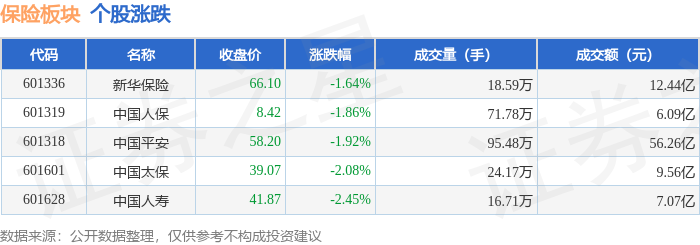
保险板块8月19日跌2.12%,中国人寿领跌,主力资金净流出10.5亿元
Zheng Xing Xing Ye Ri Bao· 2025-08-19 08:33
| 代码 | 名称 | 收盘价 | 涨跌幅 | 成交量(手) | 成交额(元) | | | --- | --- | --- | --- | --- | --- | --- | | 601336 | 新华保险 | 66.10 | -1.64% | 18.59万 | | 12.44亿 | | 601319 | 中国人保 | 8.42 | -1.86% | 71.78万 | | 6.09亿 | | 601318 | 中国平安 | 58.20 | -1.92% | 95.48万 | | 56.26亿 | | 601601 | 中国太保 | 39.07 | -2.08% | 24.17万 | | 9.56亿 | | 601628 | 中国人寿 | 41.87 | -2.45% | 16.71万 | | 7.071Z | 证券之星消息,8月19日保险板块较上一交易日下跌2.12%,中国人寿领跌。当日上证指数报收于 3727.29,下跌0.02%。深证成指报收于11821.63,下跌0.12%。保险板块个股涨跌见下表: 从资金流向上来看,当日保险板块主力资金净流出10.5亿元,游资资金净流入2.28亿元,散户资金净流入 8 ...


机器人产业崛起催生保险需求新蓝海 如何破题数据孤岛
Bei Jing Shang Bao· 2025-08-19 02:12
Group 1 - The core viewpoint of the articles highlights the rapid integration of robots into various sectors, creating new demands for risk management and insurance solutions [1][2][3] - The first World Humanoid Robot Games showcased the performance and risks associated with robots, emphasizing the need for insurance to mitigate potential liabilities [2][3] - Insurance companies are innovating to develop comprehensive risk coverage for robots, including product liability, property damage, cybersecurity, and research and development insurance [3][4] Group 2 - The insurance sector is actively testing new products in various scenarios, such as providing coverage for events like marathons and consumer-grade robotic products [4][5] - Local governments are implementing policies to encourage insurance innovation in the robotics field, including subsidies for companies purchasing insurance [5][6] - Despite the promising outlook for robot insurance, challenges remain, particularly in risk assessment due to the lack of historical data and the complexity of robot operations [6][7] Group 3 - The industry recognizes the need for improved data sharing between insurance companies and robot manufacturers to enhance risk assessment and product pricing [8] - Establishing a collaborative platform for data sharing is essential for developing targeted insurance products that meet the diverse needs of different applications [8] - The growing penetration of robots in various sectors presents significant market opportunities for the insurance industry to create tailored products that support the development of a manufacturing powerhouse [8]

上市险企缘何不再披露月度保费?
Jin Rong Shi Bao· 2025-08-19 01:03
Core Viewpoint - The practice of monthly premium disclosure by listed insurance companies in China has been broken, with major companies like China Life, China Ping An, and China Pacific Insurance no longer publishing this data [1][2]. Group 1: Reasons for Stopping Monthly Premium Disclosure - Regulatory bodies do not mandate insurance companies to disclose monthly premium income, allowing companies to have discretion over such disclosures [1][2]. - The implementation of new accounting standards (IFRS 17) has changed the way premium income is recognized, making previous data incomparable [1][2]. - Monthly premium income can fluctuate significantly due to various factors, such as seasonal trends and marketing activities, which may not accurately reflect the long-term operational stability of insurance companies [2][3]. Group 2: Alternative Metrics for Evaluating Insurance Companies - Consumers should focus on the solvency adequacy of insurance companies, which indicates their ability to meet obligations under extreme risk scenarios [3][4]. - Investors should pay attention to indicators such as new business value, channel efficiency, comprehensive cost ratio, and investment return rate, which are available in annual and semi-annual reports [3][4]. - Monitoring regulatory penalties against insurance companies can provide insights into their business quality and compliance levels [3][4].
中证香港中盘精选指数上涨0.67%,前十大权重包含中国人民保险集团等
Jin Rong Jie· 2025-08-18 14:50
从中证香港中盘精选指数持仓的市场板块来看,香港证券交易所占比100.00%。 从中证香港中盘精选指数持仓样本的行业来看,可选消费占比18.21%、金融占比13.34%、医药卫生占 比13.08%、工业占比12.15%、信息技术占比11.46%、通信服务占比8.94%、原材料占比5.70%、公用事 业占比5.66%、主要消费占比4.98%、房地产占比3.90%、能源占比2.58%。 据了解,中证香港中盘精选指数从香港市场选取中等规模的100只证券作为指数样本,以反映香港交易 所上市中等规模证券的整体表现该指数以2004年12月31日为基日,以1000.0点为基点。 从指数持仓来看,中证香港中盘精选指数十大权重分别为:康方生物(4.54%)、中国太保 (3.81%)、中信证券(2.19%)、金蝶国际(2.12%)、哔哩哔哩-W(2.1%)、中国铁塔(2.0%)、 商汤-W(1.98%)、美的集团(1.94%)、中国人民保险集团(1.88%)、药明康德(1.81%)。 资料显示,指数样本每半年调整一次,样本调整实施时间分别为每年6月和12月的第二个星期五的下一 交易日。定期调整设置缓冲区,排名在81名至220名之间 ...
机器人带火新需求,机器人保险是新蓝海吗
Bei Jing Shang Bao· 2025-08-18 13:06
Core Insights - The rapid integration of robots into various sectors is creating new demands for risk management and insurance solutions [1][3] - The insurance market is witnessing innovation to address the unique risks associated with robot applications, moving beyond traditional property insurance to comprehensive risk coverage [1][4] Group 1: New Market and Demand - The first World Humanoid Robot Games highlighted the performance and risks associated with robots, emphasizing the need for insurance to manage potential liabilities [3][4] - Incidents during competitions, such as a robot losing control and injuring a technician, underscore the importance of risk management in robotic applications [3][4] Group 2: Insurance Innovations - Experts suggest that future robot insurance should cover four key areas: product liability, property loss, cybersecurity, and research and development risks [4][5] - Insurance companies are actively developing diverse insurance products tailored to various robotic applications, including consumer-grade robots and logistics robots [5][6] Group 3: Policy Support and Challenges - Regulatory bodies are promoting insurance product innovation in the robotics sector through policies and subsidies to support technological advancements [6][7] - Despite the promising outlook for robot insurance, challenges remain, particularly in risk assessment due to a lack of historical data and the complexity of robotic operations [6][7] Group 4: Data Sharing and Collaboration - Industry experts advocate for enhanced communication and data sharing between insurance companies and robot manufacturers to improve risk assessment and product development [8] - Establishing a shared platform for accident data collection is crucial for developing accurate risk models and insurance products tailored to specific applications [8][9] Group 5: Market Potential - The increasing penetration of robots across industries presents significant growth opportunities for the robot insurance market, necessitating comprehensive insurance solutions throughout the robot lifecycle [8][9]

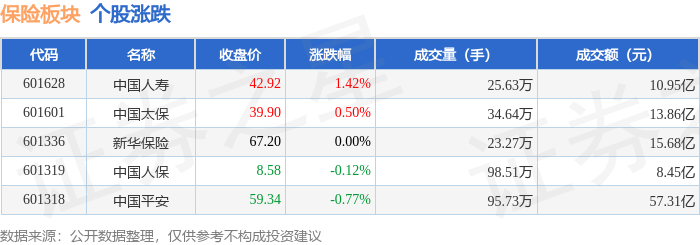
保险板块8月18日涨0.38%,中国人寿领涨,主力资金净流入9101.06万元
Zheng Xing Xing Ye Ri Bao· 2025-08-18 08:39
从资金流向上来看,当日保险板块主力资金净流入9101.06万元,游资资金净流出9862.17万元,散户资金 净流入761.11万元。保险板块个股资金流向见下表: 证券之星消息,8月18日保险板块较上一交易日上涨0.38%,中国人寿领涨。当日上证指数报收于 3728.03,上涨0.85%。深证成指报收于11835.57,上涨1.73%。保险板块个股涨跌见下表: | 代码 | 名称 | 收盘价 | 涨跌幅 | 成交量(手) | 成交额(元) | | | --- | --- | --- | --- | --- | --- | --- | | 601628 | 中国人寿 | 42.92 | 1.42% | 25.63万 | | 10.95 Z | | 601601 | 中国太保 | 39.90 | 0.50% | 34.64万 | | 13.86 Z | | 601336 | 新华保险 | 67.20 | 0.00% | 23.27万 | | 15.68亿 | | 61319 | 中国人保 | 8.58 | -0.12% | 98.51万 | | 8.45 Z | | 601318 | 中国平安 | 59.34 | ...
2Q25保险资金运用分析:股票余额环比增长8.9%,基金配置比例持续下降
ZHONGTAI SECURITIES· 2025-08-18 06:10
Investment Rating - The report maintains an "Overweight" rating for the insurance sector, indicating a positive outlook for the industry over the next 6 to 12 months [2]. Core Insights - The insurance sector's total investment balance reached 36.23 trillion yuan by the end of Q2 2025, with a year-on-year growth rate of 17.4%, marking the fifth consecutive quarter of improvement [5]. - The asset allocation shows a continued increase in bond investments, with a slight slowdown in growth, while stock allocations have improved for five consecutive quarters [5][6]. - The report highlights that the insurance industry is not as negatively impacted as the market perceives, with valuations reflecting the pressures on both assets and liabilities [5]. Summary by Sections Industry Overview - The total market capitalization of the insurance industry is approximately 32,643.28 billion yuan, with a circulating market value of 32,637.15 billion yuan [2]. Investment Allocation - By the end of Q2 2025, the allocation of insurance funds was as follows: bank deposits (8.6%), bonds (51.1%), stocks (8.8%), securities investment funds (4.8%), long-term equity investments (7.9%), and other non-standard assets (18.2%) [5][6]. - The bond allocation has increased, but the growth rate has shown signs of slowing down, while stock allocation has seen a consistent rise [5]. Performance Metrics - The year-on-year growth rates for original premiums, net assets, and total assets as of June 2025 were 5.3%, 23.4%, and 16.1%, respectively, indicating improved operational performance [5]. - The solvency ratios for property and life insurance companies were reported at 240.6% and 196.6%, respectively, showing a recovery trend [5][18]. Investment Recommendations - The report suggests focusing on companies such as New China Life Insurance, Ping An Insurance, China Life Insurance, AIA, China Pacific Insurance, and China People’s Insurance, as they are expected to benefit from the current market conditions [5].